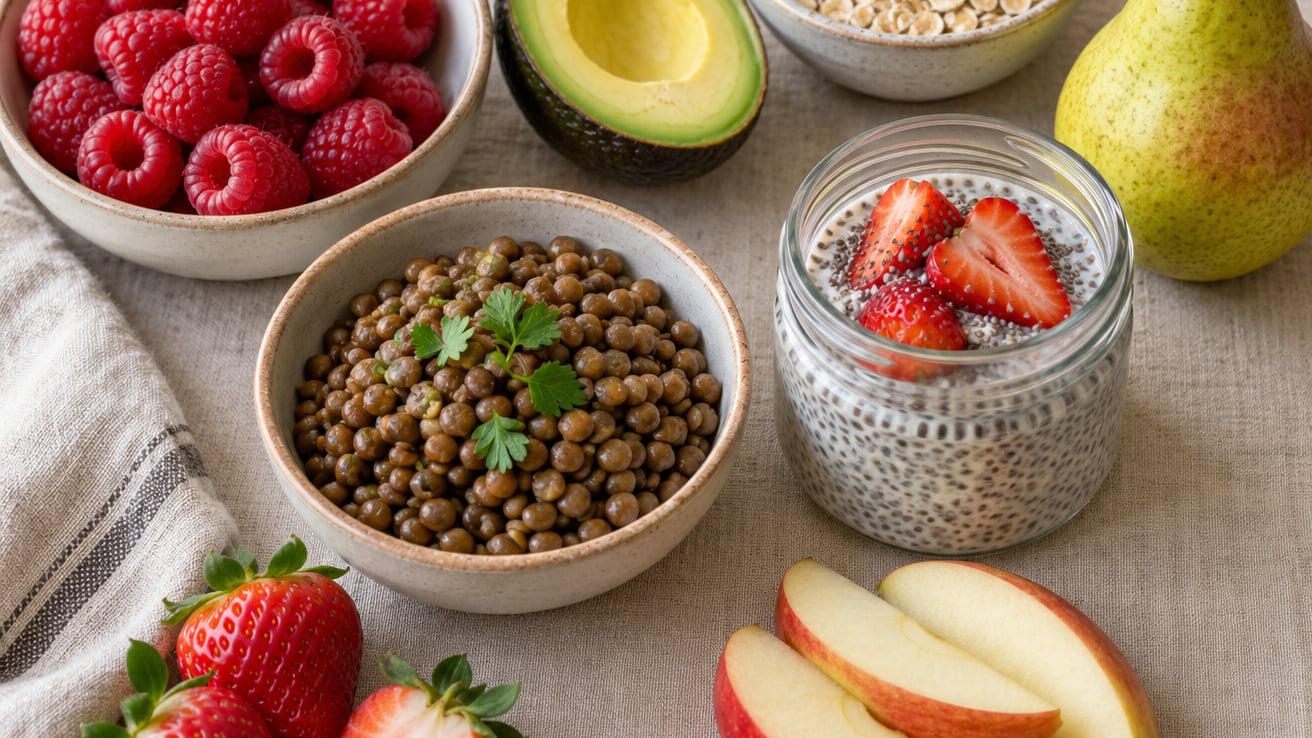
Most kids are short on fiber, and the foods that fix it are not always the foods they will eat. The practical fiber rich foods for kids are beans, oats, pears, raspberries, avocado, sweet potatoes, lentils, chickpeas, chia, flaxseed, whole-wheat pasta, barley, broccoli, apples and strawberries. Below I break each one down by the fiber a realistic child-sized serving actually delivers, plus the preparation formats that get around seeds, skins, lumps and strong smells.
Every food on this list also has a texture workaround. That matters more than it sounds. A kid who refuses a raspberry because of the seeds does not need a different fruit, they need the same fruit blended. Our own family went through years of refusing anything visibly speckled, and switching formats was the single change that moved the needle more than any conversation about trying new foods.
Two things before the list. First, water. Fiber absorbs water, and a child who adds fiber without increasing fluids will feel worse, not better. Second, go slowly. Most pediatric guidance is to add a few grams at a time over two to three weeks rather than doubling fiber overnight. If your child has a diagnosed condition, is on medication, or is under a year old, talk to your pediatrician or a registered dietitian before making big changes.
Table of Contents
- Fiber Rich Foods for Kids at a Glance
- 1. Raspberries
- Freezing and buying
- 2. Avocado
- 3. Chia Seeds
- Chia puddings that work for sensory-sensitive kids
- 4. Oats
- Why oatmeal suits a gluten-free or dairy-free kitchen
- Batch cooking oats for the week
- 5. Pears
- Pears as a portable snack that survives the school day
- 6. Black Beans
- Bean and fiber lunches that hold up by midday
- One warning before you add beans
- 7. Broccoli
- Using broccoli as an ingredient instead of a side dish
- 8. Sweet Potatoes
- Roasting is the method that solves most problems
- 9. Whole-Wheat Pasta
- Cooking whole-wheat pasta so nobody notices the swap
- 10. Flaxseed
- Grinding and storing flaxseed
- 11. Apples
- Cooking apples, and what it does to the fiber
- 12. Barley
- Cooking barley in a way that keeps it chewy, not tough
- 13. Lentils
- A week of lentils in one pot
- 14. Strawberries
- Strawberry formats that hold up
- 15. Chickpeas
- Roasting chickpeas instead of frying them
- A note on hummus and food texture
- Frequently Asked Questions
- How much fiber does a child need each day?
- How can I add fiber to my child’s diet without upsetting their stomach?
- What are 5 high fiber foods that picky eaters usually accept?
- What foods help kids with constipation?
- Is one banana a day enough fiber for a kid?
- Is a fiber supplement a good idea for children?
- Conclusion
Fiber Rich Foods for Kids at a Glance
The table below lists fiber per practical serving rather than per 100 grams, because nobody measures out 100 grams of broccoli for a six-year-old. Amounts are approximate and vary by variety, preparation and portion size, so treat them as a guide.
| Food | Fiber per practical serving | Notable nutrients | Kid-friendly formats | Allergy and sensory notes |
|---|---|---|---|---|
| Raspberries | About 8 g per 1 cup | Vitamin C, manganese | Smooth sauce, yogurt swirl, oatmeal mix-in, blended into smoothies | Seed texture is the usual problem; straining or blending removes it |
| Avocado | About 5 g per half a medium fruit | Folate, potassium, monounsaturated fat | Mashed on toast, sliced in wraps, blended into smoothies, stirred into eggs | Mild and neutral; easy to leave visible chunks, so mash for texture avoiders |
| Chia seeds | About 10 g per 1 oz (28 g) | Omega-3 fats, calcium | Chia pudding, overnight oats, chilled chia water, smoothie thickener | Gel texture when soaked; use ground or use sparingly if texture is an issue |
| Oats | About 4 g per half cup dry rolled oats | Manganese, iron, slow-release carbohydrate | Oatmeal, overnight oats, baked oat bars, blended into smoothies, oat flour muffins | Certified gluten-free oats exist for celiac households; check the label |
| Pears | About 5 g per medium fruit with skin | Vitamin C, vitamin K | Ripe slices, blended sauce, baked wedges, oatmeal topping, dried | Smooth texture is very high tolerance for most texture-sensitive kids |
| Black beans | About 7 g per half cup cooked | Protein, iron, folate, magnesium | Mashed, blended into sauce, hummus-style dip, quesadillas, soup | Whole beans are a common trigger; mashed and hidden versions fare much better |
| Broccoli | About 5 g per 1 cup cooked | Vitamin C, vitamin K, folate | Finely chopped, roasted, blended, pureed into sauces, hidden in muffins | Floret texture and green colour drive most refusals; smooth versions slip through |
| Sweet potato | About 4 g per medium baked potato with skin | Beta-carotene (vitamin A), potassium | Soft cubes, fries, mash, pancakes, puree, oatmeal mix-in | Sweetness is an advantage; a skin left on after baking is not |
| Whole-wheat pasta | About 6 g per 1 cup cooked | B vitamins, magnesium, iron | Short shapes cooked very soft, mac and cheese, soup, with sauce | Lentil and chickpea pasta give similar fiber with no gluten |
| Flaxseed | About 2 g per tablespoon ground | Omega-3 fats, lignans | Oatmeal, smoothies, muffins, pancakes, stirred into pasta sauce | Whole seeds pass through undigested; always grind for absorption |
| Apple | About 4 g per medium fruit with skin | Vitamin C, pectin | Whole with skin, smooth sauce, baked, apple sauce, oat topping | Skin is where most of the fiber sits; peel only if texture is the blocker |
| Barley | About 3 g per half cup cooked | Selenium, magnesium, B vitamins | Soup, rice substitute, oatmeal, baked dishes, pilaf | Contains gluten; swap for quinoa, brown rice or buckwheat for celiac households |
| Lentils | About 8 g per half cup cooked | Protein, iron, folate | Soup, red-lentil pasta, mashed taco filling, blended dal, dips | Red lentils cook soft and lend themselves to smooth sauces |
| Strawberries | About 3 g per 1 cup halved | Vitamin C, antioxidants | Halved fresh, sliced, blended sauce, yogurt topping, freeze-dried pieces | Red dye and seeds can bother some kids; freeze-dried pieces are a texture-free option |
| Chickpeas | About 6 g per half cup cooked | Protein, folate, manganese | Hummus, mashed sandwiches, roasted, blended soups, chickpea pasta | Hummus is a gentler first step than whole chickpeas |
1. Raspberries
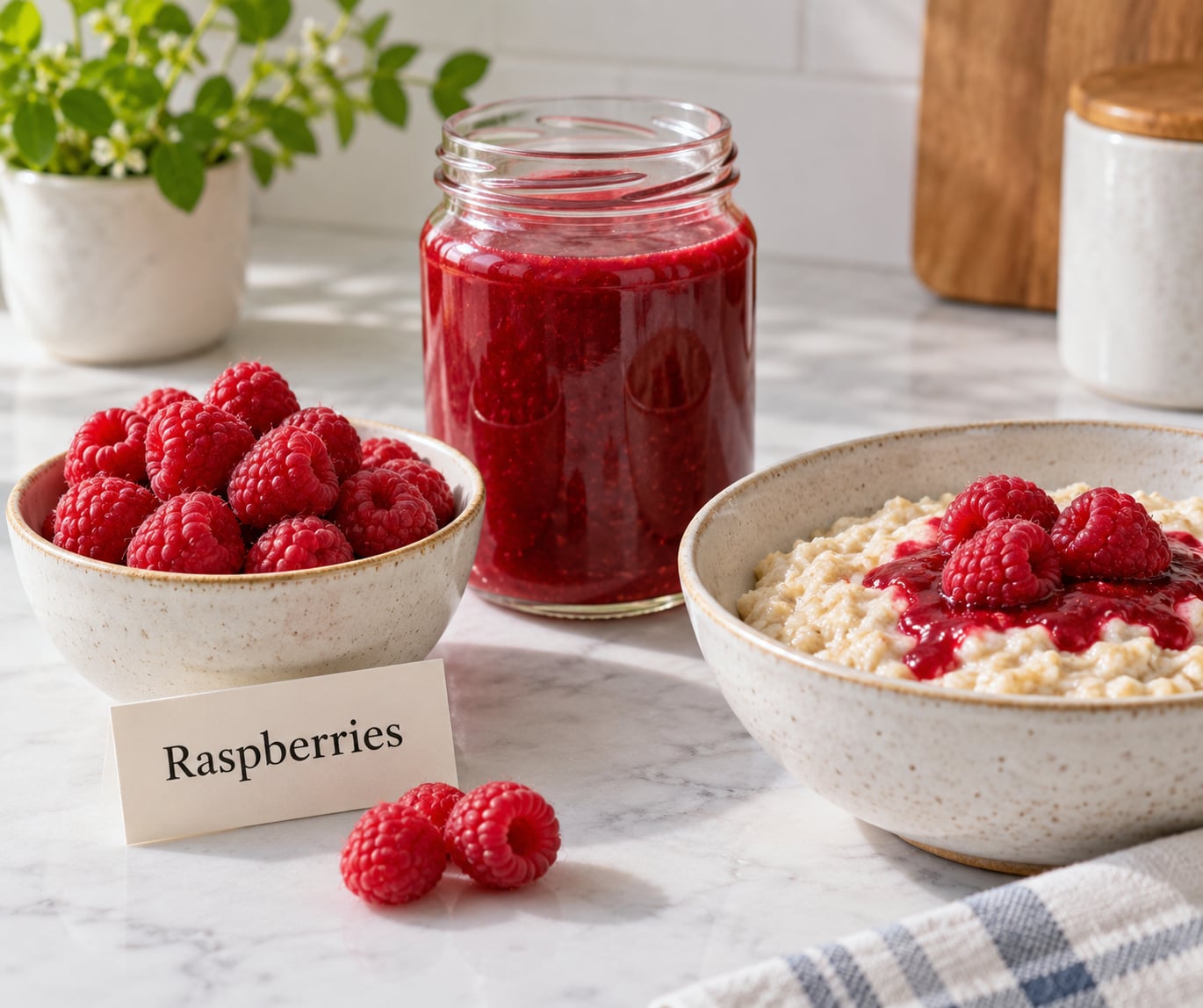
Raspberries are the highest-fiber fruit per calorie most families can buy, at roughly 8 grams in a single cup. That same cup brings a good amount of vitamin C and manganese, which is why they turn up so often in lists of high fiber foods for children.
The catch is texture. A raspberry is a cluster of tiny drupes around a hollow center, and many kids read that as seeds or as something that squirts. Strained raspberry sauce keeps the fiber and the color while removing every bit of grit, and it disappears into plain yogurt without looking like a vegetable.
Two other formats work well. Blended raspberries stirred into oatmeal turn the bowl pink and mild. A spoonful of seedless raspberry sauce over frozen yogurt reads as a dessert rather than a nutrition intervention, which is useful on days when nothing green is getting eaten.
Freezing and buying
Frozen raspberries hold their fiber well and are usually less expensive than fresh out of season. Blending them while still partly frozen gives a thick sauce that needs little or no added sugar, and thawed berries that were frozen in a single layer do not clump the way a solid block does.
For a nut-free or seed-free household, raspberry is one of the safer high-fiber fruits, since it carries none of the major allergens. That makes it a useful early fruit for a baby-led weaning approach once the texture is appropriate for the child’s stage, puréed for younger babies and lightly mashed for toddlers.
Buy them with an eye on how long they will sit before you wash them. Raspberries are fragile and mold quickly, and a moldy box gets thrown out entirely, which is a wasteful way to lose one of the highest-fiber fruits in the house.
2. Avocado
Half a medium avocado gives about 5 grams of fiber along with folate, potassium and monounsaturated fat. The fat matters: it slows digestion, so the fiber and the fat together tend to keep a child satisfied longer than either alone.
Avocado is unusual in that it fits into almost any meal without announcing itself. Mashed on toast, sliced into a breakfast wrap, folded into scrambled eggs, or spooned straight from the skin with a spoon works, and most kids tolerate the pale green color because there is nothing to hide.
For a child who rejects visible lumps, blending avocado into a fruit smoothie with banana is usually the reliable route. The fruit is neutral enough that it disappears behind berries or mango, and you still get the fiber and the fat in the same glass.
Two practical notes on buying and storing. Hass avocados are the higher-fiber variety, and an overripe one that has darkened and softened is at its best mashed, where the texture changes from a possible objection into an asset. Store the whole fruit on the counter and cut it only when you are ready to use it; the cut flesh darkens quickly in air, and that color is worth avoiding with a child already suspicious about green and brown foods.
On a nut-free schedule, mashed avocado also does the job a nut butter would do on toast or apple slices, without the allergen risk at a school. Most allergy programs treat avocado as a low-risk item that is usually permitted at school, which makes it one of the easier sandwich spreads to pack.
3. Chia Seeds
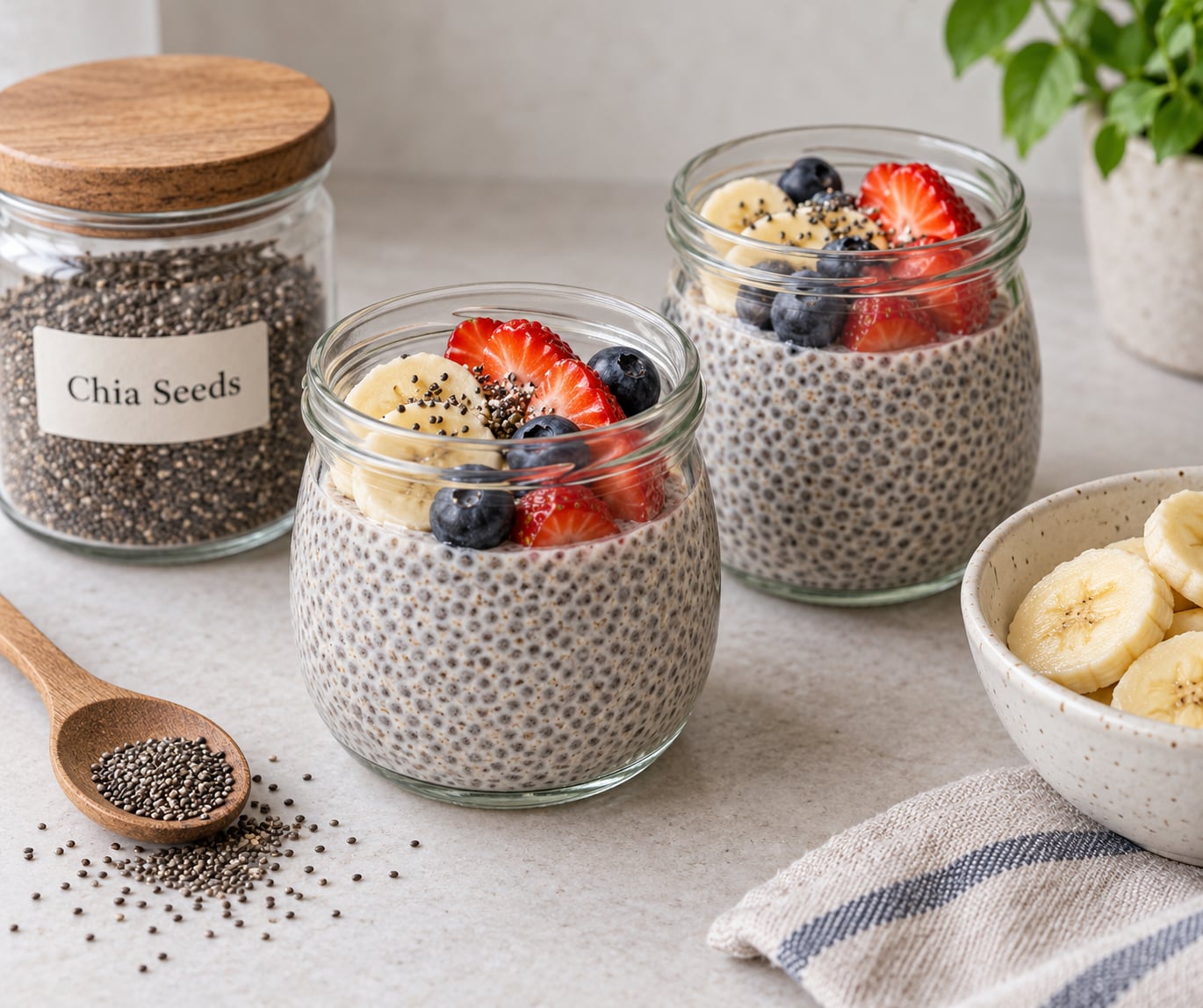
One ounce of chia seeds delivers about 10 grams of fiber, more than most cereals, and it comes with plant-based omega-3 fats and calcium. There is no strong flavor at all, which is exactly why it works as a background addition rather than a food a child has to accept on its own terms.
Preparation is the safety issue here. Dry chia seeds absorb liquid and swell, so they are mixed into liquid and left to set rather than eaten dry. The classic version is chia pudding: two tablespoons of seeds stirred into a cup of milk or a milk alternative, refrigerated overnight, topped with fruit in the morning.
Chia puddings that work for sensory-sensitive kids
Chia forms a gel, and gel textures are not universal. If your child reacts to pudding, chia gel, or anything that feels slippery, use ground chia instead. Ground chia dissolves into smoothies and oatmeal without forming any gel at all, and you get a similar fiber contribution at about a tablespoon a serving. Chilled chia water, with seeds strained out afterward, is another way to add fiber and keep the texture completely thin.
4. Oats
A half cup of dry rolled oats gives about 4 grams of fiber, plus manganese and iron, and the soluble fiber in oats is the type that slows digestion and feeds beneficial gut bacteria. It is one of the few foods where the health argument and the kid argument point the same way, since oatmeal is soft, warm and faintly sweet.
For gluten-free households, certified gluten-free oats are widely available and are labeled as such, because standard oats are frequently cross-contacted with wheat, barley or rye. If celiac disease is the diagnosis, check that certification on the box rather than assuming a plain oatmeal container is safe.
Format does more work than ingredient here. Rolled oats simmered in milk become porridge. The same dry oats mixed with yogurt and fruit overnight become a no-cook breakfast. Ground oats disappear into smoothies and muffins, and baked oat bars travel well to school. My kids eat plain oatmeal about as often as they eat it as a chocolate-adjacent baked bar, so both stay in rotation.
Why oatmeal suits a gluten-free or dairy-free kitchen
Oats are the easiest grain to build a whole breakfast around when wheat is off the table. A bowl of oats cooked in coconut milk or oat milk gives a thick, creamy porridge that carries the fiber, and it accepts fruit, cinnamon and nut or seed butter without changing the base. If dairy is also out, the porridge still works as long as it gets its creaminess from oat milk or from blended banana rather than from butter.
Steel-cut and quick oats differ mainly in texture and cooking time, not fiber. Quick oats are a good compromise for a family that likes the shorter cooking time but finds steel-cut too chewy for younger children.
Batch cooking oats for the week
Most busy mornings fail on time, not on planning. Cook a large pot of oats on a weekend, portion it into a muffin tin, freeze the individual cups, and pull two out the night before so they thaw in the refrigerator. A weekday morning then takes about two minutes of stirring and a spoon of whatever topping the week allows. The same batch can go into a blender with milk for a smoothie, which covers the kids who will not eat it from a bowl.
That second texture is genuinely useful. Some children accept oats as a drink and refuse them as porridge, and a blended cup gets the same fiber in.
5. Pears
A medium pear with the skin on gives about 5 grams of fiber, and the fiber is largely soluble, the kind that helps with regularity. Pears are also naturally sweet enough that they rarely get negotiated with, which is a genuine advantage over green vegetables in most homes.
Texture is where pears split families. A ripe pear sliced thinly is fine for most kids. A raw pear cut into chunks is firm and can feel squeaky, and some children find that off-putting. Baking fixes it, since heat softens the flesh considerably, and blending turns pears into a sauce that is remarkably close to unsweetened applesauce.
One practical note: check ripeness at the store. A pear that yields slightly to gentle pressure can be served raw, and a firmer one is better for baking. Skipping that check is the most common reason a family gives up on pears.
Pears as a portable snack that survives the school day
A whole pear needs no packaging and no refrigeration for the morning it travels, which makes it one of the easiest lunches to pack. Sliced pear browns by lunchtime, so pack it in a rigid container with a lemon wedge tossed through the slices, or send the whole fruit and let the slicing happen at school.
Dried pear slices are the shelf-stable option, and they concentrate the fiber into a smaller serving. They are also chewy, so they suit older children rather than toddlers, and they count as a dried fruit with added sugar in some school nutrition programs even when nothing has been added.
Pairing a pear with a protein item, like a hard-boiled egg or a small portion of nut or seed butter, slows digestion further and helps the fiber work better. Fruit alone can leave a hungry child hungry again in twenty minutes.
6. Black Beans
Half a cup of cooked black beans provides about 7 grams of fiber along with protein, iron, folate and magnesium. Beans are the most efficient fiber source in most kitchens, largely because canned versions cost little and keep for months, which matters when you are feeding a family that eats beans several times a week.
Whole beans are also the hardest fiber food to get accepted, and texture is again the reason. Skin, shape and the way they roll around the mouth are all reasons a child says no. Mashing changes that completely: mashed black beans mixed into a small amount of the sauce they usually eat will add fiber with almost no visual difference from the original dish.
Build up in stages rather than switching dinner over. Start with hummus, which is a chickpea preparation and much more familiar in texture, then move to a bean dip with a smooth base. From there, try bean and cheese quesadillas with the beans pressed thin, and add bean soup where the flavor comes from elsewhere. Most families need several attempts before beans move from a tolerated food to an asked-for food.
Two useful preparation details. Rinse canned beans well and mash them, which reduces both the sodium and the amount of intact skin going in. And mash rather than blend if you want the fiber to feel like food; a blended bean puree behaves more like a thick sauce and slips past a child who would reject the pieces.
Bean and fiber lunches that hold up by midday
A whole-grain wrap with mashed black bean spread is the simplest lunchbox fiber upgrade available, since it adds several grams without looking like a change of plan. A small container of bean dip with seed crackers does the same work for a younger child, and it travels without needing a microwave. If a school allows nuts, a thin layer of nut butter on a whole-grain cracker sits well next to fruit.
The rule at school is usually different from the rule at home. Many programs that allow homemade food still screen for whole nuts and nut butters, and a nut-free spread such as sunflower seed butter carries a comparable fiber and fat profile while keeping the lunch eligible.
One warning before you add beans
Beans and lentils produce more gas than most other fiber sources, which is the reason behind nearly every unpleasant first experience with legumes. Introduce them in small portions, once a week to start, rather than as the centerpiece of a meal. Cooking beans from dried and discarding the soaking water reduces some of that effect compared with canned.
7. Broccoli
One cup of cooked broccoli gives about 5 grams of fiber, along with vitamin C, vitamin K and folate. Raw broccoli is higher per cup on some measures but far harder to get into a child, so cooking counts as the practical serving.
The color is usually the bigger obstacle than the flavor. Florets sitting visibly on a plate read as a vegetable no matter how well they are seasoned, while the same broccoli blended into a sauce is experienced as one food rather than two.
Formats that work: finely chopped broccoli folded into rice or scrambled eggs, roasted until the edges caramelize, blended into tomato sauce and pasta sauce, pureed and mixed into a muffin batter, or served as a raw slaw with a creamy dressing where the texture is soft. A broccoli smoothie with fruit is a real option for a family where nothing green survives the plate.
Using broccoli as an ingredient instead of a side dish
The single most effective change with broccoli is stopping serving it as a separate object on the plate. Once it is mixed into something a child already calls dinner, it stops being a vegetable decision and becomes part of the meal. Finely chopping raw broccoli and stirring it into rice does this with almost no flavor transfer, since it cooks inside the dish rather than next to it.
A blended sauce is the other reliable option. Simmer broccoli with a small amount of potato or white beans until very soft, blend until completely smooth, and stir it into tomato or cream sauce. The potato thickens the sauce and softens the taste, and the result freezes well if you make a double batch.
For texture-sensitive children, the sneaky-adjacent version is worth trying honestly rather than hiding it: grated broccoli in muffins or a quick bread, named as broccoli from the start. The concern is usually a visible green piece rather than a deception, so honesty rarely costs you the vegetable.
8. Sweet Potatoes
A medium baked sweet potato with the skin on provides about 4 grams of fiber and a large share of the daily vitamin A target for kids. The sweetness is doing most of the recruitment work here, since it is one of the few vegetables most kids approach without being persuaded.
Preparation decides the outcome. Cubes roasted until soft go on a plate happily. Wedges cut thin and baked with a little oil read as fries and travel well. Mash with a little butter or coconut milk becomes a side dish in the shape kids already accept.
Sweet potato also works as a flour, which is where the fiber hides most effectively. A tablespoon of finely grated or mashed cooked sweet potato in pancakes, muffins or quick bread adds fiber that nobody can identify. Grate it raw into batter for baking so it stays in the mix without needing pre-cooking.
Roasting is the method that solves most problems
Cut the sweet potato into sticks a finger wide, toss with a small amount of oil, and bake at high heat until the edges brown. Slow steaming leaves them soft and wet, and wet fries rarely get eaten. Roasting develops a crisp exterior and a caramel sweetness that reads as a different food from the mashed version.
A sheet pan in the oven while dinner cooks solves the convenience problem as well as the texture one. It is a side dish that appears without a second pot on the stove, and leftovers reheat well in a hot oven for a few minutes.
Serve it alongside something the child already likes rather than instead of it. Sweet potato fries next to a familiar main dish get eaten in a way that sweet potato alone on a plate does not.
9. Whole-Wheat Pasta
One cup of cooked whole-wheat pasta gives about 6 grams of fiber, roughly double what the same volume of refined pasta offers, with B vitamins, magnesium and iron in the mix. It is one of the easiest swaps in the category because it changes nothing about the meal except the fiber.
Children usually notice the difference, and the fix is texture and shape. Whole-wheat pasta cooked a minute or two longer than the box says, in short shapes like rotini or shells, is softer and easier to eat. Finely grinding it, or buying a pasta that blends whole wheat with refined flour, softens the flavor considerably for younger kids.
For a gluten-free kitchen, lentil pasta and chickpea pasta deliver a similar fiber profile with no gluten, and red-lentil pasta dissolves into sauces faster than most. Our guide to starting a gluten-free casein-free diet for kids covers the pantry basics worth having on hand before you commit to the swap.
Cooking whole-wheat pasta so nobody notices the swap
Undercooking is the usual reason whole-wheat pasta gets rejected. Bring the water to a full boil, salt it properly, and cook at least a minute past the package time until the strands are genuinely soft with no resistance. Mushy pasta that a child tolerates beats firm and honest pasta that goes back on the plate.
Shape matters more than most people expect. Rotini and shells hold sauce in the grooves and are easier to manage than long strands, and smaller shapes cut down the fiddly work of twirling. Keep a box of the shape the family prefers on hand so the upgrade is only the wheat, not the shape as well.
Flavor is the other half. Whole wheat pairs with strongly seasoned tomato sauce, pesto and slow-cooked ragu far better than with a plain butter sauce, and adding a spoonful of tomato paste to a butter sauce makes it more interesting without changing what the dish is.
10. Flaxseed
One tablespoon of ground flaxseed contributes about 2 grams of fiber plus plant-based omega-3 fats and lignans. The flavor is almost nothing, which means it can be added to foods a child already eats without turning the dish into a new food to evaluate.
There is one rule worth being firm about: grind it. Whole seeds pass through the digestive tract intact, so a child can swallow a spoonful and gain very little. Ground flaxseed keeps for a few months in the freezer and works in oats, smoothies, muffins, pancakes, and stirred into a pasta sauce or meatball mix where the texture disappears completely.
Start with half a tablespoon. Doubling it later is fine, but starting high is the fastest route to a kid deciding that breakfast has betrayed them.
Grinding and storing flaxseed
A coffee grinder or a spice grinder handles a small batch in about a minute, and enough for several weeks of use. Store the ground flaxseed airtight in the freezer and pull out a spoonful at a time; it keeps the omega-3 fats reasonably well for a few months and does not need to be kept in the refrigerator for that length of time.
There is one more line worth drawing. Whole flaxseed is not dangerous in a child who is eating normally, since it simply passes through. The concern is wasting the offering, and worse, a child learning that spoonfuls of food are things that do nothing. Grinding it means the fiber and the fats are actually absorbed.
A nut-free household can still use it this way. Ground flax in oatmeal or a smoothie replaces the role a ground nut would have played in the recipe, without carrying the allergen label that a school would flag.
11. Apples
A medium apple with the skin on offers about 4 grams of fiber and a useful amount of pectin, a soluble fiber that is easy on the stomach. Apples are also the cheapest high-fiber item in most kitchens, which is a real advantage when a family is eating them daily.
Whole with the skin is the highest-fiber form, but it is also the one most often refused, because raw apple is firm and the skin is a distinct texture. Baking softens both. Blending into sauce is the smoothest version, and jarred applesauce with no added sugar is an honest everyday option.
The creative middle ground that works surprisingly often is baked apple with oats and cinnamon on top. The top becomes a crumbly texture many kids read as a dessert crust, and the skin softens enough to eat along with the fruit.
Cooking apples, and what it does to the fiber
Cooking apple does not destroy its fiber. The pectin in particular breaks down into a form that is easier for the gut to use, and softened fruit is usually easier for a child to eat in quantity. Long, slow cooking concentrates the flavor, so a baked apple tastes sweeter than a raw one even with nothing added.
Peeling is the trade-off worth thinking about. Removing the skin removes a meaningful share of the fiber and a good part of the pectin, which is why sauce made from peeled apples is a gentler introduction than a whole fruit with skin. For a child new to apples, start smooth; add the skin later once the fruit itself is not in dispute.
For applesauce without added sugar, cook the fruit with a splash of water and a cinnamon stick, then blend. A Granny Smith or similar firm variety holds up well and stays tart enough that it does not need sweetening.
12. Barley
Half a cup of cooked pearl barley provides about 3 grams of fiber, plus selenium, magnesium and B vitamins. Barley is a chewy whole grain that stretches a soup or stew, and the soluble fiber in it is one of the types most associated with supporting gut bacteria.
It works as a rice substitute, as the base of a pilaf, simmered into oatmeal for a chewier breakfast, and baked into dishes where it soaks up broth. Because it holds its shape, it is also useful in bean and lentil soups where children might otherwise refuse the legumes.
Barley contains gluten, so celiac households will need a substitute. Quinoa, brown rice, millet and buckwheat all bring some fiber and keep the grain component of a meal intact. Anything higher-fiber on the substitution list, such as a lentil blend, brings more fiber than barley did along with it.
Cooking barley in a way that keeps it chewy, not tough
Barley needs long, slow simmering, not a hard boil. Bring it to a boil, then lower the heat and let it cook covered at a steady simmer for around half an hour, longer if using pearl rather than quick barley. Rushing it is what turns a chewy grain into a hard one that nobody wants to eat twice.
Add it to soup rather than cooking it separately when time is short. A handful of pearl barley dropped into a pot of soup or stew in the morning softens by dinnertime and thickens the broth, so it costs almost no extra effort.
For a breakfast use, combine cooked barley with oats and simmer in milk, which produces a porridge chewier than plain oatmeal. Some kids find that chewy version easier to accept than instant oats, since it reads as a distinct food rather than a texture change in a familiar one.
13. Lentils
Half a cup of cooked lentils gives about 8 grams of fiber with protein, iron and folate, which makes lentils one of the highest-fiber everyday foods available. They are cheap, they cook in half an hour, and they thicken a soup on their own.
Red lentils are the easiest starting point, since they break down into a soft texture that blends smooth and takes on whatever flavors are in the pot. Green and brown lentils hold their shape and work better in salads, side dishes and stuffed foods where a distinct texture is welcome.
Red-lentil pasta is worth adding to the pantry, since it cooks quickly, has no gluten, and can carry a sauce without falling apart. Mashed lentils make a taco or tostada filling that does not look like legumes. Blended dal is the smoothest entry point of all, and it reheats well enough for batch cooking.
A week of lentils in one pot
Cook a large batch of red lentils with onion, garlic, cumin and a stock cube, then blend or leave as is depending on the eater. Freeze it in individual portions, since a lentil soup that reheats in two minutes on a weeknight is the difference between using it and not.
Lentil patties are the other form that quietly works. Mash cooked lentils with a little egg or chickpea flour and bake or pan-fry them, and they become a new food rather than a bowl of the same lentils. With yogurt or cucumber on the side, they resemble falafel, which is a familiar shape to most children.
Dry red lentils do not need soaking, unlike larger pulses. That saves a step, and the cook time is short enough that a lentil dish is realistic on a weeknight even when nothing else is prepared ahead.
14. Strawberries
One cup of halved strawberries provides about 3 grams of fiber and a strong dose of vitamin C. The number is lower than raspberries, and there is a reason: strawberries are mostly water, which is fine for hydration but does less for fiber per cup.
What strawberries do have going for them is versatility. Halved pieces are easier to manage than whole, sliced berries work on cereal and yogurt, and blended strawberry sauce covers pancakes, oatmeal and toast with a sweet that reads as dessert.
Freeze-dried strawberry pieces are the form worth knowing about for a sensory-sensitive child. They carry the flavor, they do not bleed red juice into everything they touch, and they have a dry, crumbly texture that some children who avoid fresh berries handle without complaint.
Strawberry formats that hold up
Fresh strawberries spoil within a few days, so buy them for eating rather than for storing, and slice them at the table rather than in advance. A sliced berry bleeds juice into everything else in the bowl, which is often what turns a child off, so keep them on their own plate or on top of something white.
For a breakfast that lasts past the first ten minutes, blended strawberry sauce over oatmeal or pancakes works better than whole berries on cereal. Add the sauce after cooking so the color stays bright, and strain it if seed texture is an issue.
Frozen strawberries blend well from frozen with no added liquid, which makes them a cheap out-of-season option for smoothies and sauce. Note that frozen fruit is blended shorter than fresh, so the texture comes out closer to a puree than a puree you did deliberately.
15. Chickpeas
Half a cup of cooked chickpeas gives about 6 grams of fiber with protein, folate and manganese. Like beans and lentils, they are a dual win: they add fiber and they add protein, which matters in a household trying to raise fiber without raising total calories too much.
Hummus is the entry point most families already know. It is a smooth, familiar, dip-able format that carries chickpea fiber without a child ever identifying it as a legume, and it works with pretzels, pita, cucumber or crackers for dipping.
Beyond hummus: mash chickpeas with mayonnaise or avocado for a sandwich spread, roast them until they are crunchy for a snack, blend them into soups where they add body without texture, and use chickpea pasta as a gluten-free alternative. We were surprised how often the roasted version succeeded with kids who refused everything else in the legume family.
Roasting chickpeas instead of frying them
Drain and dry the chickpeas properly, toss with a little oil and salt, and roast at high heat until they rattle. Drying them on a towel before they go in the oven is the step that decides whether they crisp or steam, and it is the step most recipes skip.
Watch them toward the end, since they go from done to bitter quickly at that temperature. A large batch keeps several days airtight and travels well, though they soften slightly on the second day as the moisture inside redistributes.
Canned chickpeas are the shortcut. Rinse them, dry them well, and roast straight from the can. There is no soaking or long cooking involved, which makes this one of the fastest high-fiber snacks in the kitchen.
A note on hummus and food texture
Hummus suits a lot of texture-sensitive children because it is smooth and spreadable, but a small number react to the grainy chickpea bits in a coarse blend. For those, blending longer with a little olive oil or ice water produces a very smooth hummus that behaves more like a cream.
Cucumber rounds or bell pepper strips are the usual dippers when seeds are an issue. For a nut-free and seed-free household, those carry the same crunch without an allergen label to negotiate at school.
Frequently Asked Questions
How much fiber does a child need each day?
Most guidance works from an age plus 5 formula as a floor: a 4-year-old needs about 19 grams, a 7-year-old about 22. Federal guidelines give ranges of roughly 14 to 19 grams for ages 1 to 3, 17 to 25 grams for ages 4 to 8, and 22 to 31 grams for ages 9 to 13. A pediatrician can tell you where your child sits within that range.
How can I add fiber to my child’s diet without upsetting their stomach?
Add a small amount at a time and hold it there for about a week before adding more. Most of the discomfort people call fiber shock comes from a sudden jump, not from fiber itself. Raise fluids alongside every increase, keep the new food in a format your child already accepts, and back off if gas or pain shows up rather than pushing through it.
What are 5 high fiber foods that picky eaters usually accept?
Avocado, oats, berries blended into a sauce, sweet potato and whole-wheat pasta are the five I would start with, because each one can be introduced in a format that hides the fiber. Add lentils or black beans later. The acceptance rate improves far more by changing the texture than by changing the food, so try the sauce or the mash before dropping the ingredient entirely.
What foods help kids with constipation?
Pears, prunes, plums, kiwi, oats, beans, lentils and chia seeds are all commonly recommended for constipation, and they work largely through soluble fiber that draws water into the stool. Fluid is the part families miss. If constipation is persistent, painful, or comes with weight loss or blood in the stool, contact your pediatrician rather than adjusting food alone.
Is one banana a day enough fiber for a kid?
One medium banana gives about 3 grams of fiber, so on its own it falls well short of what most children need. Bananas are also more useful when slightly underripe for constipation, since they contain more resistant starch than a fully yellow fruit. Think of a banana as one useful item in a day that also needs oats, beans, fruit and vegetables, not as a solution on its own.
Is a fiber supplement a good idea for children?
For most children, food is the better first route, and a supplement rarely fixes a diet that is short on fiber as a category. Supplements do come up with picky eaters, feeding struggles, or specific medical needs, and the age-appropriate product matters. Talk with your pediatrician or a registered dietitian about the dose and the type rather than choosing one from a label or a search result.
Conclusion
Start with one food your child already eats and change only the format. Oats become baked oat bars, raspberries become smooth sauce, beans get mashed into a dish they already like, and sweet potato goes into a pancake. Hold the change for a week or two before adding a second one.
Whatever you add, raise fluids at the same time, because fiber without water is the most common reason a fiber attempt fails. If a sensory difference or a restricted diet is part of your family’s picture, our guides on why food texture matters more than taste for some kids and managing constipation in autistic kids go into the texture and routine side in more detail.