
Talking to a teacher about food allergies goes well when you arrive with a short list of specific requests instead of a worry. Start with the school nurse, bring the signed emergency plan your child’s doctor already completed, name the exact foods and what happens after exposure, and ask for a small set of classroom accommodations in writing. The whole conversation takes about fifteen minutes.
Food runs through a school day in ways most adults forget: birthday treats, reading rewards, holiday snacks, art-class dough, the pizza at lunch. A teacher who has not been told exactly what to avoid is guessing. Your job is to replace the guess with an instruction, and then put the instruction somewhere the teacher can find it again in October.
Table of Contents
- What You Need
- Step-by-Step: How to Talk to a Teacher About Food Allergies
- Common Mistakes
- Frequently Asked Questions
- Do food allergies qualify for a 504 plan?
- Is a food allergy considered a disability under the ADA?
- What are the four R’s of food allergy emergency response?
- What should a school food allergy action plan include?
- When should I tell the school about my child’s food allergy?
- What if the teacher will not take the allergy seriously?
- How to Make the Allergy Conversation Easier
What You Need
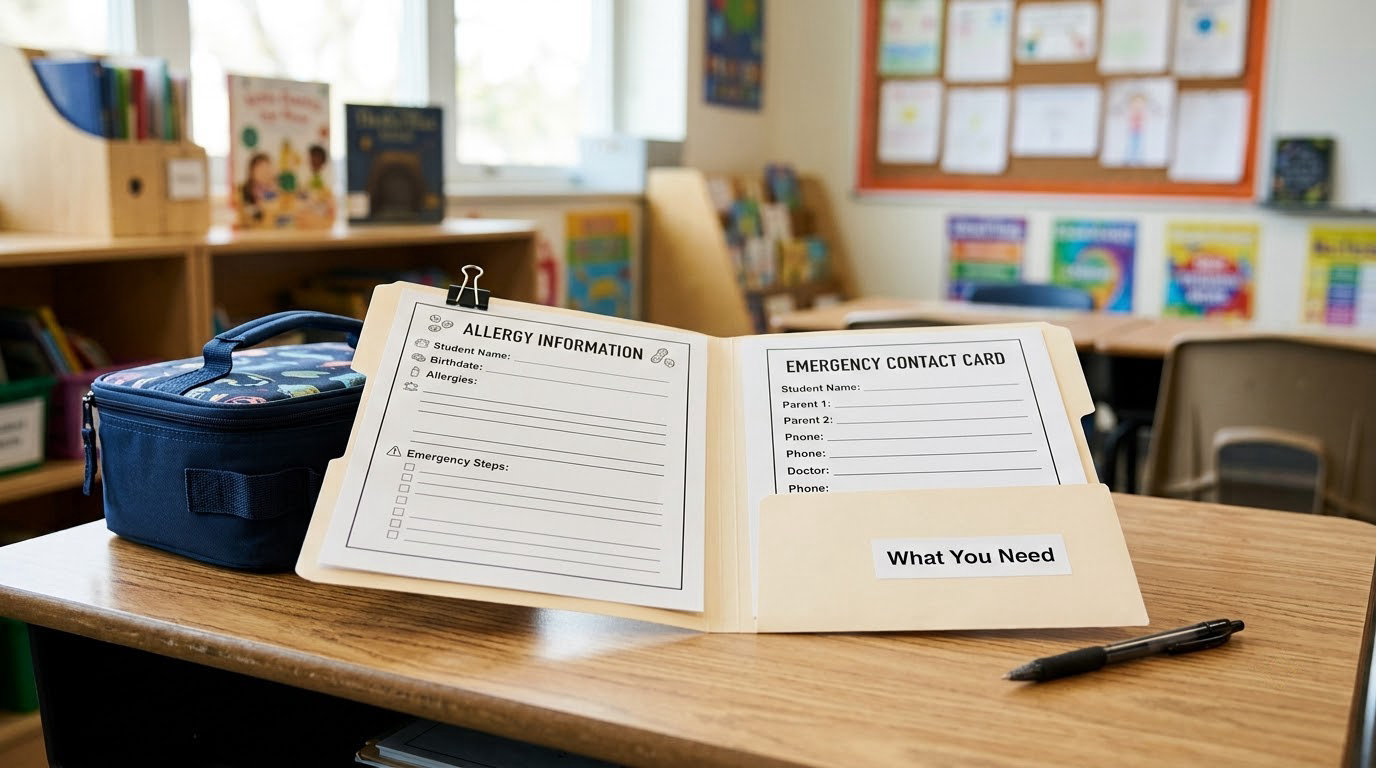
Before you meet anyone, gather five things. Without them, the conversation turns into a debate about whether the allergy is serious.
- The signed emergency plan. Ask your child’s allergist or pediatrician for the Allergy and Anaphylaxis Emergency Plan form. Your doctor fills it in and signs it; you bring the copy. This is the single document that carries the most weight with school staff.
- A plain list of allergens. Name the specific foods, not the category. “Tree nuts, sesame, and egg” beats “no nuts.” Note whether the child reacts to smell, touch, or cross-contact, because that changes what a teacher can safely allow.
- Two auto-injectors, in date. Check the expiration on both. Many families find an expired device in a school drawer and lose a week while a replacement is arranged. Confirm the dose your child needs, since it changes by weight.
- Your list of specific asks. Write down what you want in behavioral terms: food stays out of the classroom, handwashing before lunch, no shared utensils, a safe treat box for parties. Vague concerns get vague answers.
- One sentence about your child beyond the allergy. Who they are, how they communicate, what helps them. It changes the tone and it matters more than parents expect.
Skip the research phase that eats an afternoon. Your child’s doctor, the school nurse, and FARE or Food Allergy Research and Education can fill in the medical details.
Step-by-Step: How to Talk to a Teacher About Food Allergies
Start with the school nurse, not the teacher
The nurse is the person who owns the health file, and the nurse is usually the one who decides where the auto-injector lives and who has been trained to use it. Talk to them first, then ask them to set up the conversation with the teacher. Several parents in allergy parent groups say this sequencing is the thing they wish they had done first, because the plan then moves through the office before it ever reaches the classroom.
Ask for the meeting in writing
Email beats a phone call because it produces a record. Keep it short and give a clear ask.
Subject: Food allergy plan for [Child’s Name], Grade [X]
Hi [Teacher’s Name], [Child] has a diagnosed allergy to [foods]. I have the signed emergency plan from our doctor and would like to meet with you, the school nurse, and me for about fifteen minutes before [date or event]. The plan covers the classroom, lunch, and any food that comes into the room. Please let me know what time works.
One short paragraph does the job. You do not need to justify the allergy in the email; that is what the meeting is for.
Open with the fact, then the ask
When you sit down, lead with the specific outcome you want from the school. A calm opener sounds like this: “I want to make sure [Child] is safe here, and I need your help with three specific things.” Then give the number of asks up front. Teachers do well with short, concrete lists and poorly with open-ended worry.
Skip the throat-clearing about how much you have worried. Your child’s doctor has already written the medical part down, and the teacher is not the person who needs the medical history.
Explain the allergy in specific terms
This is where how to talk to a teacher about food allergies turns into something practical. Name the foods, then name the reaction, then name the scenario.
“[Child] reacts to sesame and tree nuts. Exposure means hives and swelling within minutes, and in one past episode it led to anaphylaxis requiring an auto-injector. The risk is not usually eating the food directly. It is a classmate’s snack shared at the table, or a baking project where the same scoop touches both.”
Say what a reaction looks like so the teacher can spot it. Then say plainly that the response is the auto-injector first, followed by a call to 911, and that nobody should wait to see if it settles.
One caution from allergists worth repeating here: a peanut-free classroom does not equal a safe classroom for a child allergic to something else. Rules about one allergen create a false sense of security. Explain what your child actually avoids.
Request a safe classroom plan with eight concrete asks
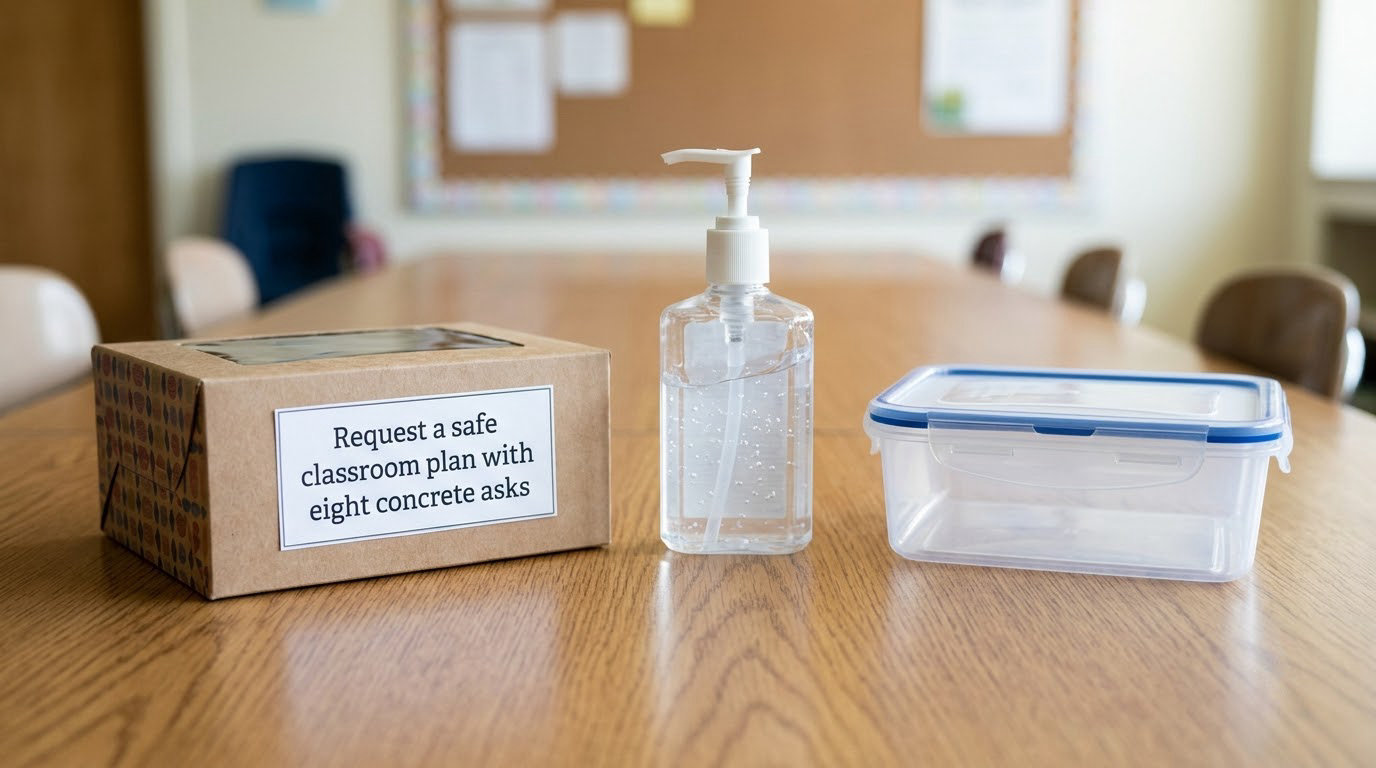
These are the requests to put in front of the teacher, in writing, before you leave.
- No food in the classroom without advance notice to you.
- Your child’s desk and hands washed before lunch and before food events.
- No shared cups, utensils, or spoons at celebrations.
- A labeled safe treat box that only holds items you have approved.
- Non-food rewards, such as stickers, points, or extra recess, so your child is not left out.
- Ingredient labels checked on any packaged snack that arrives.
- Auto-injector stored where the teacher or nurse can reach it in seconds, with a second one nearby.
- Every adult who works with your child, including specials teachers and substitutes, gets the plan.
Ask about the cafeteria separately. The classroom teacher does not control lunch, and the food service staff usually need their own written request for a meal substitution or a modified tray.
Send a written summary the same day
Within a few hours, email the list you agreed on. Something like: “Thank you for the meeting today. Here is what we discussed and what I am sending to the nurse and cafeteria. Please correct anything I got wrong.” Attach the signed plan.
This single email prevents the most common failure, which is the teacher remembering one version, the nurse having another, and your child being the tie-breaker. Written confirmation is the difference between a plan and a memory.
Confirm who is responsible, then check back
Ask each person to repeat their part back to you. Who administers the auto-injector? Who calls 911? Where is it stored? Who trains a substitute in week three when the regular teacher is out? If a name comes back as “someone in the office,” keep asking until you get a person.
Then set the follow-up. Check in after the first full week, again after any schedule change or classroom swap, and again each May or June for the following year. If your child changes classrooms or advances a grade, the plan does not automatically travel with them. Start over with the new teacher.
Common Mistakes
Waiting for an incident. By the time a reaction happens, the school has already decided how careful it needs to be. Tell them before.
Vague warnings. “He can’t have nuts” leaves room for interpretation. Write the specific foods and the specific response.
Only telling the homeroom teacher. The art teacher, the specials teacher, the bus driver, the cafeteria monitor, and every substitute need to know. One nurse or office handoff is not enough.
Assuming the plan exists. Parents on parent forums describe the gap between a signed plan on paper and what happens on an ordinary Tuesday. Ask where the plan physically lives and who has a copy.
Skipping the nurse. The nurse manages the health record, the medication, and the training. The teacher manages the room. Both conversations are needed.
Not asking for the plan in writing. If the only record is a hallway conversation, it evaporates the first time staffing changes.
Confusing plan types. A doctor’s emergency action plan, an individualized health care plan, and a 504 plan are three different documents with different jobs. Section 504 of the Rehabilitation Act of 1973 and the Americans with Disabilities Act cover a student whose condition substantially limits a major life activity, which many students with severe food allergies do. Ask the school’s 504 coordinator whether a formal plan is appropriate.
Blowing up the relationship. Teachers tune out alarm. Calm, specific, and short gets more cooperation than urgency, even when the urgency is completely justified.
Two more things parents bring up constantly. Food as a classroom reward is invisible to you, so ask directly what the class uses for rewards. And if your child is autistic, tell the teacher about sensory and routine issues alongside the allergy: a substitute’s unexpected change on a bad day can trigger a meltdown that gets mistaken for a behavior problem, and an established routine for handwashing and lunch makes the allergy steps easier to follow. Written, literal, pre-read requests land better with school staff than long emotional explanations.
Frequently Asked Questions
Do food allergies qualify for a 504 plan?
Sometimes, yes. Section 504 covers students whose condition substantially limits a major life activity such as eating, and severe food allergies that require an auto-injector have been recognized on that basis. It is not automatic. You ask the school’s 504 coordinator to evaluate your child, bring the doctor’s documentation, and ask what accommodations the school will put in writing.
Is a food allergy considered a disability under the ADA?
A food allergy can qualify. The Americans with Disabilities Act applies when a physical impairment substantially limits a major life activity, and needing emergency medication to eat is treated as limiting. Whether yours qualifies depends on severity and on documentation, so request an evaluation rather than deciding on your own.
What are the four R’s of food allergy emergency response?
Recognize the reaction, Respond with the auto-injector, Report by calling 911, and Review afterward with the family and the school. The order matters: epinephrine first, then the emergency call. Do not wait to see whether symptoms settle, because epinephrine works best early.
What should a school food allergy action plan include?
The child’s name and photo, the specific allergens, the symptoms that mean a reaction is happening, exactly where the auto-injector is stored, who administers it, when to call 911, and the parent and emergency contacts. The doctor signs and dates it, the family carries two in-date devices, and a copy lives with the school nurse.
When should I tell the school about my child’s food allergy?
Before the first day, or the week you learn about the diagnosis. Send it in writing, meet with the nurse, then the teacher, and repeat the whole process every May or June for the following year. Repeat it again whenever your child changes classroom, switches schools, or a new specialist teacher joins the schedule.
What if the teacher will not take the allergy seriously?
Move up the ladder. Re-send the signed plan by email and ask for a written reply, then take it to the nurse, then the principal, then the 504 coordinator or district office. Document each conversation with a follow-up email. If the school still refuses to accommodate a documented medical need, you can file a complaint with your state education agency or the US Department of Education Office for Civil Rights.
How to Make the Allergy Conversation Easier
Do one thing tomorrow: write down the exact allergens and the symptoms, then email the teacher and the nurse asking for fifteen minutes with all three of you in the room. Bring the signed emergency plan, make your eight requests, and send the summary before you leave your car in the parking lot. The rest of the year takes care of itself once the instructions are written down and everyone with a job has read them.