
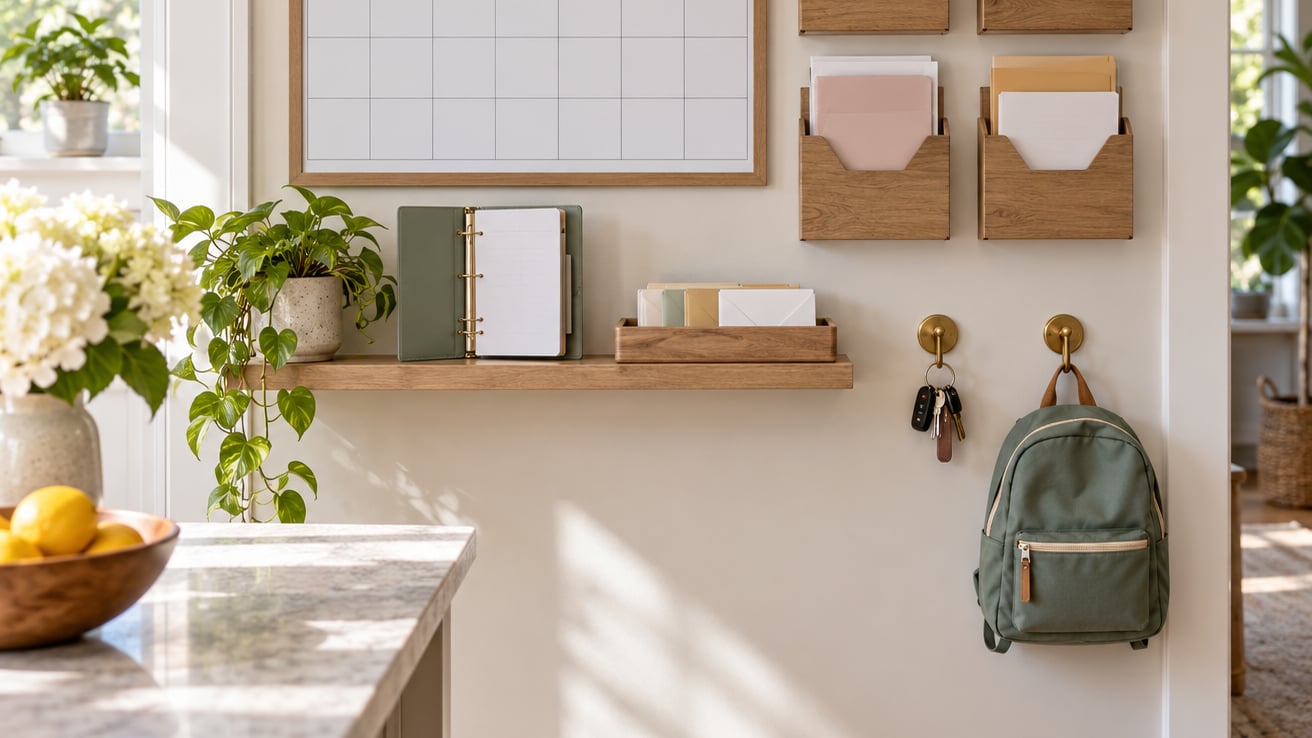
A family command center is a designated central space in your home where you organize schedules, mail, paperwork, to-do lists, keys, and daily essentials, so everyone can see at a glance where others are and what needs doing. Building one takes an afternoon and a handful of items you probably already own.
The reason it works is that it moves information out of your head and onto a wall. Right now your family probably runs on a mental calendar held by one person, which is why that person is exhausted. A command center gives the schedule a home outside your memory.
Here is the short version. Choose a spot everyone passes daily. Pick the calendar format your family will actually update. Sort the paper into zones. Add visual supports for routines and transitions. Then protect five minutes on Sunday for a reset. That is the whole method.
If your household includes a child with ADHD, autism, sensory needs, or an executive-function difference, read step four twice. The visual layer is doing more work in that house than in a typical one, and a system that depends on a parent remembering to update it will fail there faster than anywhere else.
Table of Contents
- What You Need
- Step-by-Step: How to Create a Family Command Center
- Choose a central, easy-to-reach location
- Map the information your family actually uses
- Create clear zones for schedules and documents
- Add visual supports for routines and transitions
- Set up a simple weekly reset
- Common Mistakes
- Frequently Asked Questions
- Where should I put a family command center?
- How do you create a family command center that works with a child with sensory or attention needs?
- What should I put in a family command center?
- How do I keep a family command center from turning into a cluttered dumping ground?
- How do I get my family to actually use the command center?
- Conclusion
What You Need
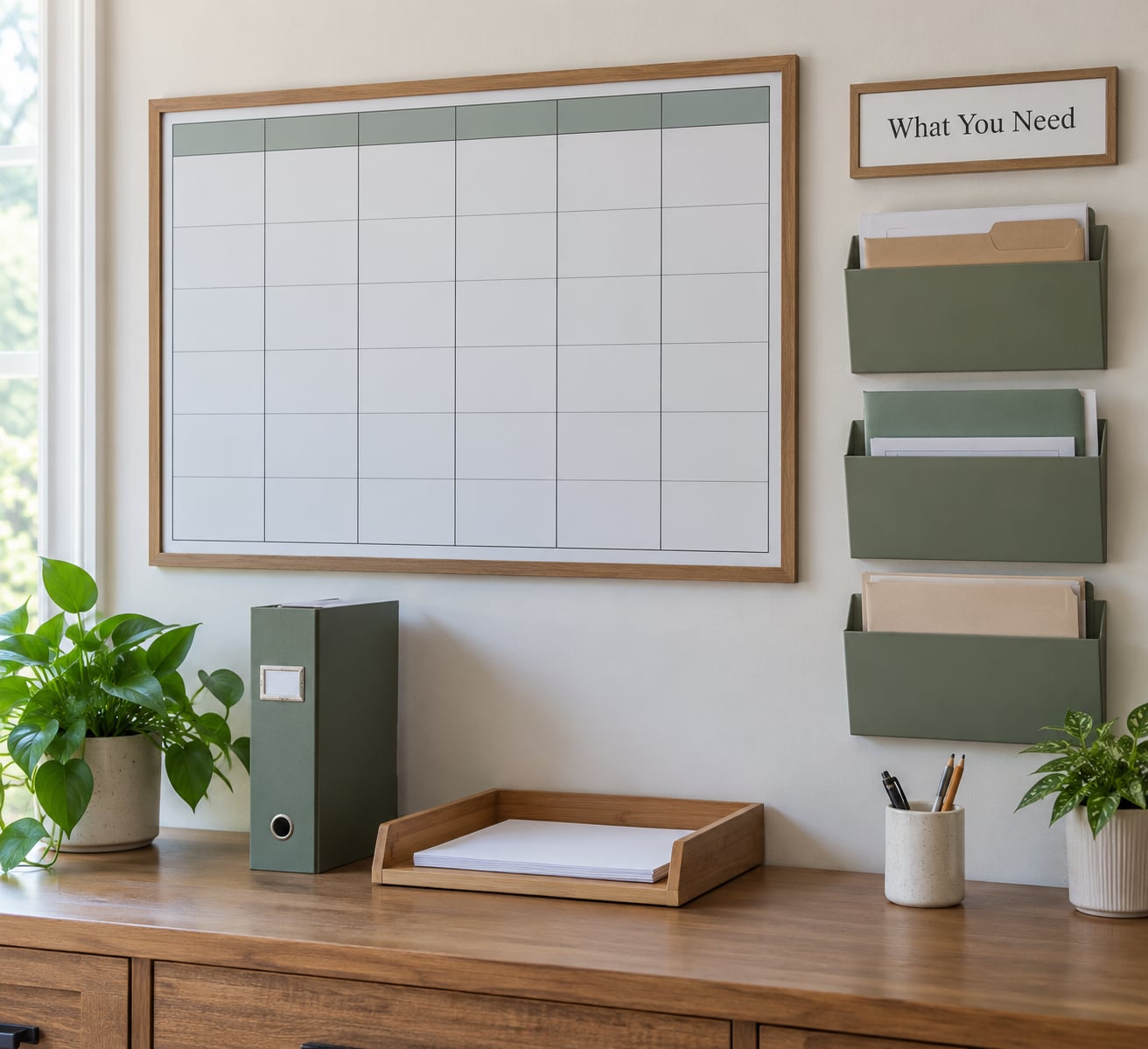
Start with what is already in a closet drawer. A command center does not need new hardware, and buying a matching set of wall organizers before you know what your family uses is the most common way people end up with an expensive, empty wall.
Here is the full list of what a working one usually contains.
- A central location. A stretch of wall, the side of a fridge, the back of a door, or a shelf. It has to be somewhere people already walk past.
- A calendar or planner. Wall calendar, dry-erase monthly grid, scrolling meal chart, or a shared app on a screen. Pick the one your family will update without being asked.
- A document organizer. Wall pockets, a hanging file holder, a three-ring binder, or a small inbox tray. This is where school papers live.
- Visual supports. Picture checklists, a first-then board, a daily schedule strip, or a chore chart. Keep them age-appropriate.
- A small tray or box for pocket contents. Receipts, coupons, permission slips about to be signed, the stray permission slip you were looking for on Tuesday.
- A way to capture notes. A pen on a tether, a magnetic holder, or a dry-erase surface. Unattached pens vanish; this is not a theory.
- Two or three hooks. Keys, backpacks, jackets. Hooks turn a wall into a drop zone instead of a floor pile.
You also need a trash can and a paper shredder within about six feet of the center, and no further away than that. When the shredder is in the garage, junk mail accumulates for a week before anyone deals with it.
Step-by-Step: How to Create a Family Command Center
Choose a central, easy-to-reach location
The location decides whether anyone uses it. A command center in an office nobody enters is decorative, and that is the single most common reason these systems get abandoned in month two.
Kitchen wall or fridge side is the most popular choice because it is where people already stand and talk. Mudroom or entryway wins if you also want the drop zone for shoes, bags, and jackets. The coffee bar area works well in homes where that surface is already the family’s message board.
Two tests before you commit. First, can a five-year-old read the calendar without asking for help? Second, can the adult who holds the logistics reach it without moving furniture? If either answer is no, the spot is wrong, and no amount of styling fixes it.
Tape paper templates of each component to the wall at planned sizes and step back for a day before you drill anything. Layout mistakes are expensive to fix after installation, and this costs a roll of painter’s tape.
Map the information your family actually uses
Write down the recurring papers and details that currently cause friction. Not everything that could go on the wall goes on the wall.
Most families land on the same short list: the family calendar, upcoming appointments and therapy times, school forms and permission slips, a meal plan, and a place for action items that need a signature or a decision this week.
Then stop. Anything that gets added without a purpose becomes clutter within a month, and clutter is what turns a command center into a dumping zone.
Meals are one area worth doing deliberately, especially if anyone in the house has a restricted diet. Learning how to read a nutrition label quickly takes about two minutes and removes a whole category of label-checking arguments from the week.
Create clear zones for schedules and documents
Divide the wall or the surface into labeled sections so every item has an obvious home and a visible boundary.
- Schedules zone. Calendar, appointment dates, therapy times, school start and pickup times.
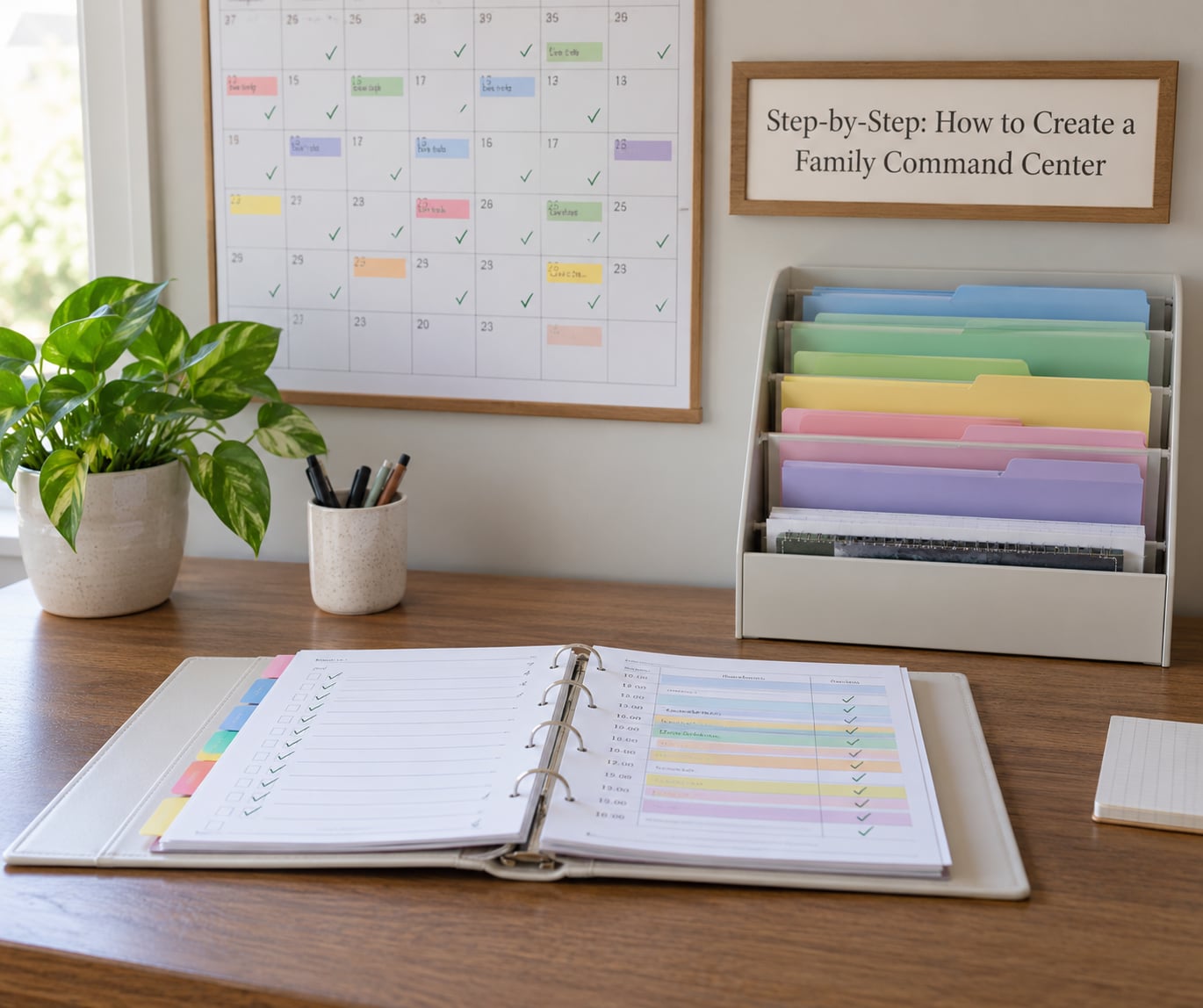
- School and health zone. A binder or wall pockets divided into three: this week, this month, and reference. IEP paperwork, therapy notes, and medical forms belong in the reference pocket, not in the weekly pile.
- Menu zone. The meal plan and a grocery list that can be written on and wiped clean.
- Action zone. A short list of things that need a reply, a signature, or a decision. Keep it to five items. Anything longer stops being read.
Labeling matters more than it looks like it should. Unlabeled baskets get ignored within two weeks, and the parent maintaining them quietly takes everything back into the kitchen drawer.
For the meal side of things, how to meal plan for a gluten-free family is a solid starting structure, and freezer cooking for a special-needs family turns that plan into meals that are already half done on the days the schedule falls apart.
Add visual supports for routines and transitions
Visual supports are what turn a wall of information into something a child can act on independently. This is also where a neurodivergent household gets the most value.
A picture checklist for the morning routine works better than written steps for most younger kids. A first-then board handles the hardest transition of the day, the one where getting shoes on and getting out the door pull in opposite directions. A simple daily schedule strip showing what happens in order takes the question out of every five minutes.
Two rules keep this from becoming overstimulating. Keep the visual field small and consistent rather than adding a new board every time something is hard. And change it on a schedule you already have, not when you notice a rough week.
If writing the boards by hand has become a chore you dread, that is a signal, not a discipline problem. A tablet or monitor showing date, weather, and the day’s schedule updates itself, which takes the daily handwriting off the list entirely.
Set up a simple weekly reset
The reset is the part that decides whether the system survives past month two. Five minutes, same time, same person.
- Check the coming week on the calendar and move anything with a deadline into the action zone.
- Pull one week’s worth of school papers out of the pockets and file them. Toss the rest.
- Refill the pen, wipe the dry-erase surfaces, and check the grocery list is clean.
- Look two months ahead for anything with a lead time: registration forms, camp applications, therapy re-scheduling windows.
- Clear the drop zone. Keys and backpacks back to their hooks, floor clear.
Sunday evening after dinner works better than Monday morning, because Monday morning you are already behind.
Common Mistakes
Over-organizing on day one. A full wall of matching organizers on night one is the most common way to build something the family resents. Fix: start with one calendar, one document organizer, and the reset. Add zones as you notice what actually piles up, usually within a month.
Using more than one system. A paper calendar plus a shared app plus a group text plus a whiteboard on the fridge is four systems, and four systems means four places to forget. Fix: paper for the shared visual, digital for reminders that need to chase a person. Each has one job.
Mounting things at adult height. A calendar your child cannot read is a calendar only you read. Fix: test reach before installing, and put the daily schedule at the lowest comfortable height rather than at eye level for the adults.
Adding items without a purpose. The decorative basket with no function becomes the junk drawer of the wall. Fix: if you cannot name what lives in it in five words, leave it off.
Skipping the reset. This is the one that kills command centers. A center that quietly degrades gets ignored, and ignored systems get taken down. Fix: put the five minutes on a calendar that already exists in your life, not a new one.
Quick-use tip: attach a dry-erase surface for the action list rather than rewriting paper. Rewriting is the friction point that stops the habit forming.
Frequently Asked Questions
Where should I put a family command center?
Put it where people already walk past several times a day. The kitchen wall or fridge side works best for most families because that is where conversations happen and the surface is already in use. A mudroom or entryway makes more sense if you also want a drop zone for keys, backpacks, and shoes. Avoid anywhere that requires a closed door to reach.
How do you create a family command center that works with a child with sensory or attention needs?
Keep the visual field small, consistent, and predictable rather than adding new items when a hard week happens. Use picture checklists for routines, a first-then board for the toughest transition, and a simple daily schedule strip in order. Choose surfaces that update on their own, like a tablet showing date, weather, and the day’s plan, so nothing depends on you rewriting boards daily.
What should I put in a family command center?
The core is a family calendar, a document organizer for school papers and health or therapy records, a meal plan with a writable grocery list, a short action list capped at five items, and two or three hooks for keys and bags. Keep a tray for receipts and slips that need a signature. Add visual supports for routines after the basics are working, not before.
How do I keep a family command center from turning into a cluttered dumping ground?
Give everything a labeled home and remove anything you cannot name the purpose of. Cap the action list at five items so it stays readable, and sort paper into three groups: this week, this month, and reference. Put a shredder and trash can within a few feet of the center, and do the five-minute weekly reset without skipping it.
How do I get my family to actually use the command center?
Build it with them instead of presenting a finished wall. Let each person pick one zone and one task they own, such as adding their own activities or checking the meal plan before dinner. Involving children in the planning step is the most reliable way to get adoption. Expect slow uptake for a few weeks and keep the reset short.
Conclusion
Start with three things this weekend: pick the wall, hang one calendar, and put the five-minute reset on Sunday evening. Add zones only when something real piles up.
The measure of a good command center is not how it looks. It is whether the person carrying the logistics stopped holding every appointment in their head, and whether your child can answer “what happens next” without asking you.
If it is not working, change one thing at a time. A system that asks less of the family will always beat a prettier one that asks more.