

If you are searching for how to stop bedwetting in older kids, the honest answer is that there is no single trick. It takes a consistent bedtime routine, sensible evening fluids, a clear path to the toilet, simple tracking, and plenty of patience, usually spread across weeks or months rather than days. Most families see the first change within three to four weeks and meaningful progress over two to three months.
This guide walks through that plan one step at a time, including how to spot the signs that mean a doctor visit matters more than another week of tracking. It also covers adapting the plan for children with mobility, sensory, communication, or toileting-support needs.
This is general information, not medical advice. Any medication, supplement, or treatment decision belongs with your child’s pediatrician.
Table of Contents
- What You Need to Stop Bedwetting in Older Kids
- Step-by-Step
- Step 1: Build a Baseline for How to Stop Bedwetting in Older Kids
- Step 2: Check for Daytime Signs and Address Simple Barriers
- Step 3: Make Nighttime Toilet Access Routine and Calm
- Step 4: Wake the Child at the Right Time, If Needed
- Step 5: Set a Calm Bedtime Fluid Routine
- Step 6: Use Rewards, Charts, and Encouragement Without Shame
- Step 7: Review Progress and Know When to Seek More Help
- Common Mistakes
- Frequently Asked Questions
- When should I take my older child to the doctor for bedwetting?
- Are bedwetting alarms effective for older kids?
- What should I do after my child has a bedwetting accident?
- How can I help an autistic or disabled child stay dry at night?
- How long should it take an older child to stop bedwetting?
- Take the First Step Without Turning It Into a Battle
What You Need to Stop Bedwetting in Older Kids
Before you change anything, gather the basics. Bedwetting past the usual age is usually not a discipline problem, so the tools you need are boring ones that make the plan possible to run consistently.
- A consistent bedtime routine. Same order, roughly the same times, most nights. Predictability is doing more work here than any clever trick.
- A waterproof mattress protector that fits properly and washes easily, plus a spare set of sheets. Laundry fatigue is a real reason families quit, so make cleanup a five-minute job.
- A tracking tool. A wall calendar, a notebook, or a notes app on your phone. Something you can glance at in ten seconds at bedtime.
- A clear path to the toilet, a nightlight, and a bedroom door that stays open or unlocked.
- Supplies that do not restrict movement, such as loose sleepwear and, if useful, a washable nighttime layer instead of disposable pull-ups.
- Your child’s input. Older kids are part of this, not the subject of it. Ask what the nights feel like and what worries them.
One thing this plan deliberately leaves out: any specific medication, supplement, or branded device recommendation. For a child who is six or older, a prescriber may discuss options, but that conversation belongs in the clinic, not in a general web guide.
Step-by-Step
Seven steps, in this order. Most families do not work through all seven at once; start with steps one, three, and five, and add the rest once the routine is stable.
Step 1: Build a Baseline for How to Stop Bedwetting in Older Kids

You cannot change what you have not measured. For at least one to two weeks, write down a small set of facts each morning. Bedtime, the time of the last pee of the day, any overnight accident and roughly when it happened, whether the morning was dry, how much the child drank in the evening, any bowel movement, and anything that disrupted sleep.
That is it. Keep it to a line or two per night, because the version of this plan that lasts is the one that takes thirty seconds.
A calendar entry might read: “Asleep 8:40. Accident around 1:30am, sheet damp. Dry-ish by 6:00. Two cups of water after dinner. No bowel movement.” Over two weeks, patterns start to show themselves: accidents clustering in the first half of the night, or arriving on nights when dinner fluids were heaviest.
Keep this baseline neutral. It is a weather report, not a report card.
Step 2: Check for Daytime Signs and Address Simple Barriers
Nighttime wetting is easier to address once you know whether anything is happening during the day. Pay attention to frequent or urgent urination, pain with urination, unusual odor, fever, constipation, daytime accidents, or a child who cannot wake enough to reach the toilet in time.
Constipation deserves special attention. A full rectum sits right behind the bladder and can reduce how much urine a child can hold, and fixing constipation is often one of the cheapest wins available. If that is a familiar struggle in your house, our guide on how to manage constipation in autistic kids covers fiber, fluid, and toilet-habit routines you can adapt.
If your child is wetting during the day, in clothing, or complaining of pain, this is no longer a behavior-only plan. Contact the pediatrician. How to stop bedwetting in older kids safely starts with ruling out the handful of medical causes that are worth checking, such as a urinary tract infection or diabetes, and that assessment belongs with a clinician who can order a urinalysis if they see fit.
Step 3: Make Nighttime Toilet Access Routine and Calm
Make the toilet trip part of going to bed rather than something to remember. Bathroom first, then brushing teeth and changing into sleep clothes, in that order, so the last thing before sleep is teeth rather than a full bladder.
Clear the path. Keep the nightlight on, keep doors open, and put a small step stool where the child needs one. If waking up means negotiating with a duvet in the dark, that is a comfort problem, not a motivation problem.
For a child with mobility, sensory, communication, or toileting-support needs, adjust the goal rather than the child. A visual schedule, a written cue, an AAC symbol for “toilet,” or an adapted seat can all matter more than any reward chart. You may find proprioceptive activities for kids at home useful for building body awareness that supports daytime toileting.
Whatever the setup, make cleanup uneventful. Fresh sheet, no sighing, no commentary.
Step 4: Wake the Child at the Right Time, If Needed
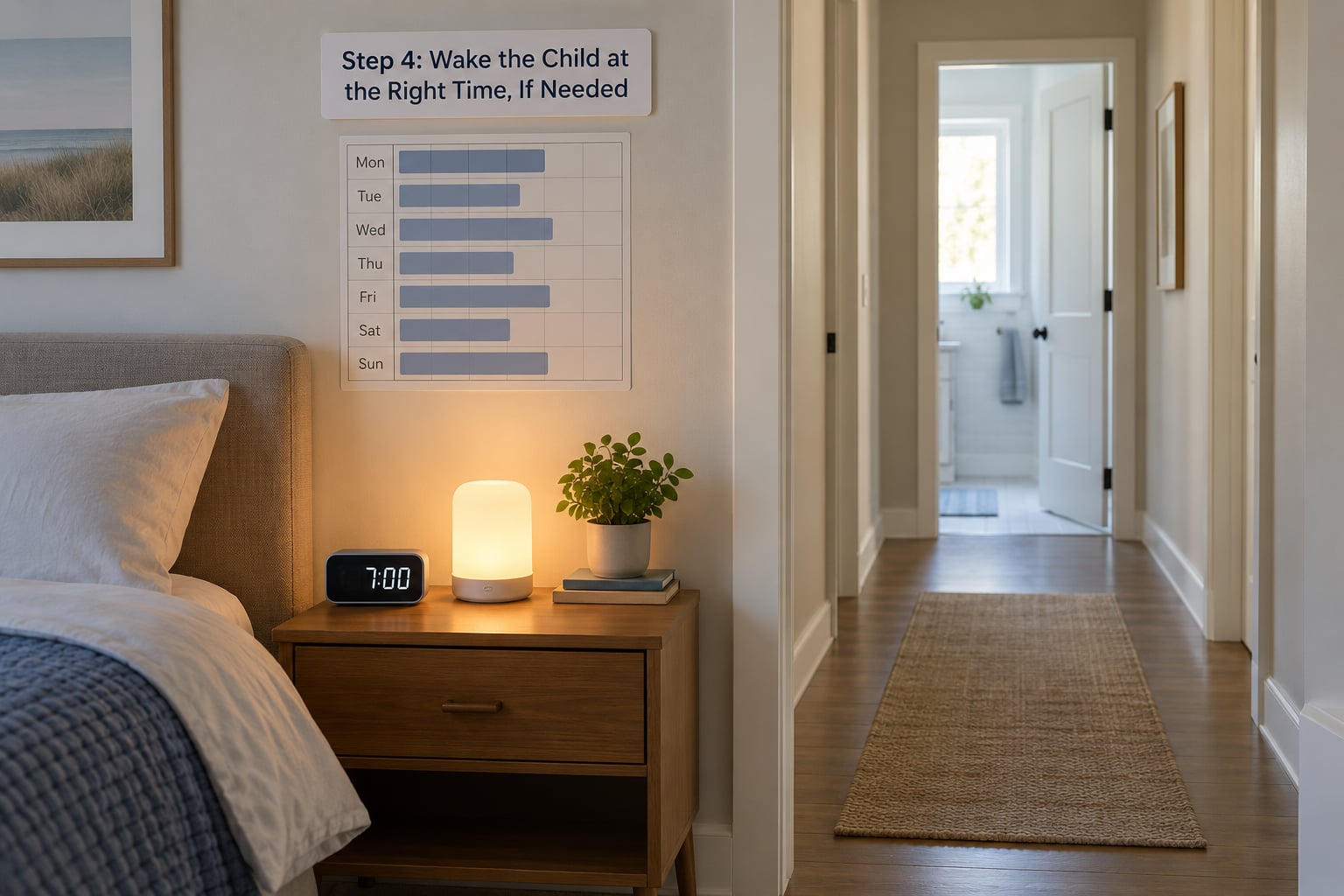
Here is where the advice conflicts, so here is how to think it through. Some pediatric guidance suggests waking a child once or twice before the typical time their bladder produces urine. Other sources advise leaving sleep alone entirely. You can reconcile those by letting your baseline data decide.
If accidents cluster at a predictable hour, say around 2am, a gentle wakeup just before that point is reasonable. Keep it low-key: a hand on the shoulder, lights low, toilet, water, back to bed. One wakeup is plenty; a nightly sequence of wakeups over months is a different thing and is not something most families should sustain.
Reduce the number of wakeups gradually as dry stretches get longer, and step back entirely once accidents stop clustering. Some children cannot wake reliably on their own, cannot communicate that they need the toilet, or cannot get there. For those children, age-appropriate assistance from an adult is the plan, not an alarm and not shame.
Step 5: Set a Calm Bedtime Fluid Routine
Fluids matter, but the goal is not a thirsty child. Offer most of the day’s water in the morning, afternoon, and early evening, and keep a normal drink available at bedtime if the child wants one. Cutting water off entirely tends to produce thirst, headache, constipation, and more concentrated urine, which is not a plan.
What usually helps is moving the volume earlier rather than removing it. Skip the huge glass of water an hour before lights out, and offer something smaller instead. Check your baseline afterward: did accidents drop without thirst complaints, dry mouth, or a constipated few days? If not, back off and keep it where it was.
Some families also find it helps to look at what is in the drink rather than only how much. Caffeine-containing drinks, including chocolate milk, cola, tea, and energy drinks, are the ones pediatric sources most often flag as bladder irritants for children. Citrus, artificial dyes, artificial sweeteners, and fizzy drinks get the same mention. You do not have to ban all of it; a small change is easier to keep.
Step 6: Use Rewards, Charts, and Encouragement Without Shame
Notice the behaviors you actually want more of, not just the dry mornings. A star for using the toilet before brushing teeth. A star for drinking at the right time. A star for putting the washable layer on without a reminder. Those are things in your child’s control, which is the whole point.
Keep it specific and low-pressure. A simple chart on the kitchen door, stars for effort rather than perfection, and a short spoken acknowledgment at bedtime usually hold up better than an elaborate system with prizes attached.
When an accident happens, handle it neutrally: sheets off, fresh sheets on, back to bed. Punishment and public correction do not address why the bladder emptied, and they reliably add anxiety that makes the next night harder.
If your child has recently started wetting again after a long dry stretch, treat that as data worth bringing to a doctor, not as a character flaw. If the child is in the middle of a potty-training slide for other reasons, our post on how to handle regression in potty training for kids may be useful context.
Step 7: Review Progress and Know When to Seek More Help
Every two to four weeks, look at the record and change one thing. That single-change rule matters, because when five things shift at once you cannot tell which one helped or which one backfired.
Expect wobble. Illness, travel, a new sibling, a school change, a birthday party sleepover, or a heatwave can all bring accidents back for a while. That is a normal response to a disrupted system, not proof the plan failed. Restart the baseline and carry on.
Contact your child’s pediatrician if you notice wetting that is new after a long dry period, wetting with pain, fever, or odor, substantial daytime symptoms, persistent snoring or restless sleep, or wetting that continues despite a consistent routine for several months. A referral to a pediatric urologist or nephrologist is a normal next step for persistent primary enuresis, not a failure of parenting.
Be cautious with commercial programs. Pediatric guidance is consistent that no over-the-counter product or supplement reliably cures bedwetting, and some programs with impressive claims cost a great deal of money for little return. Talk to the doctor before buying any of them.
Common Mistakes
Mistake one: punishing or shaming. Bedwetting is involuntary. Punishment raises anxiety and can make wetting more likely, not less. Fix: neutral cleanup, specific praise for the habits you want.
Mistake two: abruptly restricting all fluids. A thirsty child with concentrated urine is a harder problem than the one you started with. Fix: shift the volume earlier instead of removing it.
Mistake three: sending a child to bed in wet clothing or soiled pajamas. This adds discomfort and smell to the night. Fix: a washable nighttime layer, changed in the morning like any other clothes.
Mistake four: relying on an alarm alone. A moisture alarm can teach a child to wake with a full bladder, but it does nothing about evening fluids, constipation, or a clear path to the toilet. If you use one, run it alongside the routine rather than instead of it.
Mistake five: blaming the child. Older kids know exactly how embarrassing it is. Fix: say out loud that it is not their fault and not something they can control, every time.
Mistake six: comparing progress with siblings or friends. Development really does vary. Fix: compare this month with last month.
A few practical tips that help more than they should: pick a mattress protector that actually fits and washes in a normal cycle, keep the bedtime routine identical even on weekends when you can, and protect your child’s dignity by handling laundry and sheets privately and matter-of-factly.
Frequently Asked Questions
When should I take my older child to the doctor for bedwetting?
Call the pediatrician for new wetting after a long dry period, wetting with pain, fever, or odor, daytime accidents, or persistent snoring. A referral to a pediatric urologist is routine for persistent primary enuresis. If you are unsure how to stop bedwetting in older kids safely, a baseline record of several weeks gives the doctor useful detail at the visit.
Are bedwetting alarms effective for older kids?
Moisture alarms are one of the better-studied approaches, and pediatric sources often cite improvement in roughly half to three-quarters of children who use one consistently. They work by teaching the child to wake when the bladder is full. Most families see the first change in two to six weeks and full benefit over several months, and deep sleepers usually need longer.
What should I do after my child has a bedwetting accident?
Change the sheets, keep your voice neutral, and avoid commentary. Do not wake the child fully, and do not add extra chores as a consequence. If accidents are happening after a long dry stretch, note it on your tracking calendar and mention it to the pediatrician rather than treating it as a behavior problem at home.
How can I help an autistic or disabled child stay dry at night?
Build the plan around regulation and access rather than motivation. Use a visual schedule, written or AAC cues, an adapted toilet seat, a clear lit path, and a washable layer so a sensory-driven accident is not a crisis. Let a calm adult assist at night when waking or reaching the toilet is not realistic. Sensory-friendly bedding matters too.
How long should it take an older child to stop bedwetting?
Expect weeks to months, not days. A fair benchmark is first improvement within three to four weeks and a meaningful reduction over two to three months, with relapses around illness or travel. Going to stop bedwetting in older kids is a gradual retraining process, and anyone promising a guaranteed timeline in a week is overselling it.
Take the First Step Without Turning It Into a Battle
Start with a two-week record and nothing else: bedtime, last toilet visit, overnight accidents and when they happened, morning dryness, evening fluids, and bowel movements. Then sit down with your child, look at the patterns together, and pick one change to try.
If anything on the warning-sign list showed up, bring the record to your child’s pediatrician rather than starting a behavior plan first. No one can promise a specific timeline for how to stop bedwetting in older kids, but consistency, a calm household, and regular review of the data give you the best odds and the least damage to your child’s confidence along the way.