

You cannot stop a nightmare once it has started, but you can lower how often they happen and how hard they hit. To stop nightmares in children over time, keep bedtime predictable and screen-free, make the room feel safe, respond calmly and validate the fear the moment they wake, and rewrite the scary ending during the day. Expect a two-week picture before you judge the plan.
Here is the short version for the night it happens:
- Go to your child quickly and quietly
- Keep your voice low and your body calm
- Name the feeling before you correct the dream
- Offer the comfort object they chose earlier
- Slow their breathing down with yours
- Guide them to a safe, boring image
- Return to bed early and skip the debrief
The rest of this guide explains where those steps come from, how to find the trigger that keeps repeating, and what to do when nothing you do seems to help.
Table of Contents
- What You Need
- Step-by-Step: How to Stop Nightmares in Children
- 1. Record the Nightmare Pattern
- 2. Create a Safe and Predictable Bedtime Routine
- 3. Look for Everyday Triggers
- 4. Reassure Without Forcing the Story
- 5. Use Grounding and Imagery Techniques
- 6. Review Media, Stress, and Daytime Experiences
- 7. Monitor Progress and Ask for Help
- Common Mistakes
- Frequently Asked Questions
- At what age do nightmares in children usually happen?
- How long do children’s nightmares typically last?
- What should I say when my child has a nightmare?
- Can a nightmare come from something my child ate?
- How can you stop nightmares in children without medicine?
- When should I talk with a doctor about my child’s nightmares?
- What to Do First
What You Need
Almost everything this plan asks for is free and already in your house. You need a notebook or a notes app, a bedtime that does not move much from night to night, a bedroom that feels comfortable rather than overstimulating, and the willingness to have one honest conversation about how scary it was.
That last item matters more than it sounds. Parents on r/Parenting repeatedly describe the same thing: the dream is easier to talk about later in a quiet moment than at three in the morning while the child is still shaking.
Two things to have in place before you start:
- A consistent wake time, which anchors bedtime more reliably than a fixed lights-out time
- A comfort object your child picks out while calm, not one handed over in the middle of a scare
Contact your child’s pediatrician before starting if nightmares began after a frightening or traumatic event, come with loud snoring or breathing pauses, come with sleepwalking, disrupt most nights for weeks, or come with daytime anxiety that is getting worse. Those are not the cases this plan is built for.
Step-by-Step: How to Stop Nightmares in Children
Nightmares and night terrors get confused constantly, and they need opposite responses. A nightmare is a scary dream the child wakes fully from and can usually describe. A night terror is an episode of panic that happens in the first part of the night, often one to two hours after falling asleep, where the child is partly awake, often screaming, and typically remembers nothing in the morning.
The single most useful thing you can tell the difference by is the morning. If your child tells you about it later, it was a nightmare. If they act like nothing happened, it was probably a night terror. The seven steps below focus on nightmares.
1. Record the Nightmare Pattern
Start a two-week log before you change anything, because the pattern is usually more informative than any single bad night. Note the day of the week, what happened in the few hours before bed, the time your child woke, whether they were crying, screaming or talking, how long it took to settle, and how the morning started.
Keep it simple. Five columns on a page by the bed is enough. Parents who track for two weeks usually start seeing the obvious things: the nights after a late screen, the nights after a sibling fight, the nights that follow a full day of sensory overload.
What you are building is a picture of triggers, not a diagnosis. A log tells you where to aim the routine. It cannot tell you what is going on inside your child’s brain, and it is not a substitute for a conversation with their doctor.
2. Create a Safe and Predictable Bedtime Routine
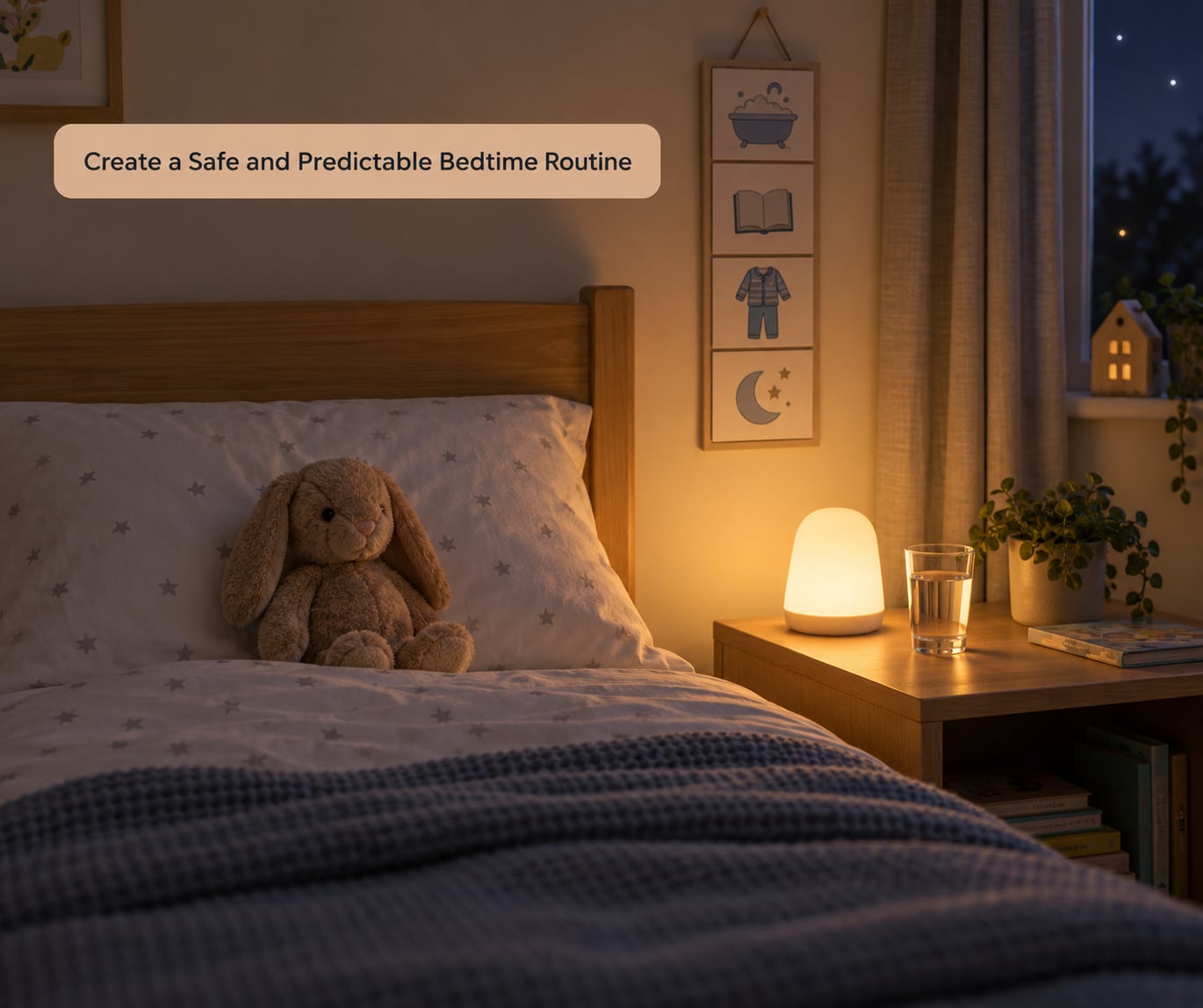
Consistency does more work here than any single trick. The same sequence, in the same order, most nights, tells your child’s body the day is ending.
A 30-minute version for toddlers and preschoolers: dim the lights, run a warm bath or pyjama routine, read two familiar books, one minute of slow breathing together, lights out with the door cracked and a nightlight on. Older kids usually need more runway, so stretch the same sequence to 45 or 60 minutes with a quiet activity instead of more screens.
For autistic children, write the routine down where they can see it. A visual schedule with picture cards removes the guessing, and it works on the nights when your verbal instructions are not landing because everyone is tired. If your child wanders or tries to leave the room in the dark, our guide to preventing wandering in autistic children covers the safety side of that setup.
A routine supports better sleep. It is not a guarantee that a nightmare will never happen again, and holding it to that standard is how parents end up exhausted.
3. Look for Everyday Triggers
Run through this list with your log open rather than from memory. Common contributors include an irregular or shifting sleep schedule, a child who stayed up too late, frightening stories or films, an argument before bed, a change in routine such as a new school or a new bedroom, sensory discomfort like a scratchy blanket or a room that is too warm, an illness or fever, a new medication, a full bladder right before bed, and any night that was already broken up by an earlier waking.
Overtiredness deserves its own line. A child who has missed sleep by ninety minutes is far more likely to have a bad night, which means an early bedtime often fixes a problem you were reading as a nightmare problem.
Triggers vary by child, and some children have none you can find. If your log comes back clean after two weeks, that is information too. It shifts your attention to the routine and the daytime experience.
4. Reassure Without Forcing the Story
Most parents find this the hardest step. Your instinct is to ask what happened, and the answer is usually to wait.
Validate the feeling first, then the fact. Try: “You were really scared. That was a scary dream, and dreams are not real, but the scared feeling was real.” Do not say “it was not real, nothing happened” as your opening line. That message tells your child you think the fear was silly.
Listen without quizzing. A good follow-up is “Tell me if you want to” or “Do you want help making it go away, or just sit here with me for a minute?” Do not ask what the monster looked like or demand the child repeat disturbing details. Many children say one word and stop.
Have the full conversation later. Sit down in daylight, ask what he or she remembers, draw it if drawing helps, and then move straight into rewriting it in the next step. If your child cannot yet describe the dream in words, use play or pictures: hand over a dinosaur and say “did the big one show up?” Let the play carry the conversation.
For children with limited verbal communication, keep the script short and physical rather than elaborate. Staying close, a hand on the back, low light, and the comfort object do most of the work when words are not available.
5. Use Grounding and Imagery Techniques

Grounding brings the child back into the actual room. Name three things they can see in the dark, like the shape of the curtain or the poster on the wall, and two things they can feel, like the pillow or the blanket edge. Pair that with slow breathing, four counts in and six counts out, with your hand on their back so they can feel the rhythm.
Some children resist breathing instructions. Substitute instead of insisting: blow out a pretend candle, exhale like a sigh, or push a soft toy down the bed and let it go. Sensory input like a cool cloth on the back of the neck or a weighted blanket works for other children and does nothing for others. Keep all of this optional and drop whatever does not land.
Imagery rehearsal therapy is the more structured option, and it is the technique most parents have never heard of. It was developed for nightmare disorder and it works on the dream, not on the child. You do it in daylight, never at three in the morning.
- Write the nightmare down. Use your child’s own words from the calm daytime conversation, even a fragment.
- Rescript the ending. Keep the beginning, but change what happens next into something safe and boring. Not a scary version, not a heroic one.
- Rehearse the new version daily for one to two weeks. Ten seconds a day. Some families do it in the car.
A worked example. Your child said: “There was a big dog and it got in the room.” The rescripted version: “There was a big dog and it got in the room, and Dad turned on the light, and the dog went back outside and closed the door. Then I got my rabbit and we read a book.” Rehearse that exact wording until it feels boring, which is the point.
Some children love this. It gives them control over a thing that felt completely out of control. Others are not ready for it and nothing is lost by trying again later. If your child’s nightmares follow a specific traumatic event, ask a clinician to guide the rescripting rather than doing it alone.
6. Review Media, Stress, and Daytime Experiences
Bedtime problems are often daytime problems arriving late. Audit what your child watches in the two hours before bed, including on a shared screen, and count the frightening content you may be dismissing because it is meant for older siblings. Horror films and graphic games are obvious; a fast-paced animated chase scene is often the real culprit in a six-year-old.
Then look at the day itself. Bullying, a hard friendship, a packed schedule, a new sibling, a therapy appointment, a noisy or crowded home. For a sensory-sensitive child, an ordinary busy day can register as exhausting, and the dreams show up at bedtime.
Action plan: set a screen curfew you can actually hold, cut frightening inputs rather than arguing case by case, add one predictable daily activity your child enjoys, and check in for a few minutes each day without an agenda. If school is involved, a short note to the teacher about what you are seeing at home is often more useful than a formal meeting.
Parents on r/Mommit report removing the trigger objects entirely once they spotted the link, including a dinosaur toy and a sibling’s bedding with a character on it. That is not a crazy move. If your child stops dreaming about the dinosaur after the dinosaur leaves the room, you have your answer. Related daytime stress habits are worth a look too, such as how to stop a child from chewing on clothes.
7. Monitor Progress and Ask for Help
Judge this plan over two to four weeks, not over two nights. Look for a drop in frequency, shorter wake-ups, faster returns to sleep, calmer mornings, and a child who talks about the dream more easily. A night here and there is normal and not a sign the plan failed.
If nothing has changed after a month, change one variable at a time. Earlier bedtime first, because overtiredness is common. Then the screen curfew. Then the sensory conditions in the room.
| Feature | Nightmare | Night terror |
|---|---|---|
| When it happens | Second half of the night, often close to waking | First one to two hours after falling asleep |
| Waking state | Fully awake and alert | Partly awake, eyes open, hard to reach |
| Recall in the morning | Usually remembers the dream | Usually remembers nothing |
| Sound and movement | Crying, talking, may stay in bed | Screaming, thrashing, may leave the bed |
| Typical age range | Common from about age three upward | Most common between ages four and ten |
| What helps most | Comfort, validation, staying with them | Stay calm, guide them back to bed, do not wake them |
This table is orientation, not diagnosis. Many parents are unsure which one they are watching, and treating a night terror like a nightmare, by asking questions and switching the lights on, tends to extend the episode.
Contact your child’s doctor for prompt medical advice if nightmares are frequent, worsening, or interrupting the family’s sleep for more than a few weeks, if they came on after a traumatic event, if your child also sleepwalks or has episodes of screaming with no memory, if there is loud snoring, gasping or restless sleep, if there are headaches or unusual sleepiness in the day, or if daytime anxiety, school refusal or new fears are piling up alongside the nights.
Ask specifically about nightmare disorder, which is when frequent nightmares cause real distress or impairment, and about whether any medication your child takes affects dream sleep. Bring your two-week log. It shortens the appointment.
Common Mistakes
Forcing a retelling. Asking question after question at three in the morning rarely helps and often makes the next night worse. Get the one-sentence version, or skip it entirely and talk later.
Dismissing the fear. “It was just a dream” and “there’s no such thing as monsters” land as “your fear is silly.” Say the feeling was real and the dream was not.
Starting restrictive diets or supplements without guidance. Elimination diets and sleep supplements for children should go through your pediatrician. It is not worth a hard week for a theory you can test safely.
Using medication without medical advice. Nothing should be given for nightmares without a clinician deciding it is appropriate. Never use an adult sleep medicine or someone else’s prescription.
Expecting one perfect night. Sleep is a trend over weeks, not a scoreboard. A single bad night after a good week is not the plan failing.
Confusing nightmares with night terrors. If your child is hard to reach, thrashing and remembers nothing, do not interrogate them in the moment. Guide them back to bed and check their safety after.
Letting comfort turn into a permanent co-sleeping fix. You can be fully present and still walk them back to their own bed. Sit on the edge, stay until breathing evens out, offer the comfort object again, then step out. Parents describe this as the hardest balance in the whole thing, and it is the one most worth holding.
For autistic children and children with communication differences, none of the above changes. Predictability, low stimulation, a visual schedule, and no pressure to perform a story all matter more, not less. Being unable to describe the dream is a communication difference, not a parenting failure.
Frequently Asked Questions
At what age do nightmares in children usually happen?
Nightmares often start around age three and become more frequent through the preschool and early school years, then ease as children get older. Young children have fewer coping resources, so the same dream can hit harder than it would on an adult. Most children outgrow frequent nightmares without any treatment at all. If they are still waking in tears weekly well into the school years, talk to your pediatrician.
How long do children’s nightmares typically last?
The dream itself lasts seconds to a few minutes. What parents notice more is the recovery: how long it takes your child to stop crying and get back to sleep, which can be anywhere from a few minutes to an hour. Waking fully alert and asking for you is a good sign. A child who cannot settle, or who has several bad nights in a row, is telling you the routine needs work.
What should I say when my child has a nightmare?
Go in quietly and keep your voice low. Validate before you correct: your child was really scared, the scary thing was not real, and the scared feeling was real. Do not demand a full retelling at three in the morning. Offer the comfort object they chose earlier, slow your own breathing so they can copy it, and have the full conversation in daylight when they can actually process it.
Can a nightmare come from something my child ate?
Sometimes, indirectly. A child who goes to bed hungry, or who drank a lot of fluid and wakes with a full bladder, can sleep more restlessly and have more disturbing dreams, so a lighter dinner and fewer drinks in the last hour before bed is a reasonable first change. Certain foods do not reliably cause nightmares in most children. If you suspect a specific food is the trigger, talk to your pediatrician before cutting it out.
How can you stop nightmares in children without medicine?
Most cases improve with a predictable bedtime routine, a screen-free hour before bed, an earlier bedtime when your child is overtired, a comfortable and safe-feeling room, calm reassurance the moment they wake, and imagery rehearsal therapy during the day to rewrite the dream ending. Track progress in a notebook for two weeks so you can see what changed. Medication is rarely the first step and is a decision for a clinician.
When should I talk with a doctor about my child’s nightmares?
Book an appointment if nightmares happen most nights, disrupt the family’s sleep for more than a few weeks, or are getting worse rather than easing. Also call sooner if they started after a frightening or traumatic event, if your child sleepwalks or has episodes of screaming with no memory of them, if there is loud snoring, gasping or restless sleep, or if daytime anxiety, school refusal or new fears are appearing alongside the bad nights.
What to Do First
Tonight, grab a notebook and write down what happened in the hour before bed and what happened during the wake-up. That is it. It costs five minutes and it is the only step most families skip.
Then hold the bedtime steady for two weeks, screen-free in the last hour, and respond to the next bad dream with a calm voice and no interrogation. When the two weeks are up, look at the log together and change one thing, usually bedtime or screens.
If the nightmares are frequent, worsening, or leaving the family exhausted, call your child’s doctor and bring the log. You do not have to solve this alone, and you do not have to be calm every time to be a good parent.