

Autism burnout in children signs and recovery come down to one thing: the demands in your child’s day have stayed high while their capacity to meet them has dropped. A child who coped with the classroom, the sibling chaos and the noisy birthday party last month now cannot manage any of them. That shift, more than any single behavior, is the pattern worth learning to spot.
This guide is written for parents and caregivers. It explains what autistic burnout looks like in kids, what tends to trigger it, how it differs from ordinary tiredness or a meltdown, and what recovery actually involves. Nothing here is a diagnosis, and nothing here replaces your child’s pediatrician.
Table of Contents
- What Is Autism Burnout in Children?
- What Are the Signs of Burnout in an Autistic Child?
- Emotional and behavioral signs
- Communication signs
- Sensory and physical signs
- Daily functioning signs
- Autism Burnout in Children Signs and Recovery: What to Track
- What Causes or Triggers Autistic Burnout?
- How Is Autistic Burnout Different From Tiredness, Meltdowns, or Depression?
- What Does Recovery From Autistic Burnout Look Like?
- How Can Parents Support a Child Recovering From Burnout?
- Reduce avoidable demands first
- Protect recovery time
- Preserve predictability
- Offer sensory choices
- Lower masking expectations
- Communicate with the school
- Support safe routines
- Look after yourself
- When Should a Parent Contact the Child’s Doctor?
- How Do You Build a Sustainable Support Plan?
- Frequently Asked Questions
- Can an autistic child experience burnout?
- How is autistic burnout different from a meltdown?
- How long does recovery from autistic burnout take in children?
- Does autistic burnout mean my child’s autism is getting worse?
- When should a parent contact a pediatrician about burnout symptoms?
- Conclusion
What Is Autism Burnout in Children?
Autistic burnout is a state of profound exhaustion combined with reduced ability to function and reduced tolerance for demands that used to be manageable. It happens when daily requirements consistently exceed what a nervous system can handle and then recover from.
Researchers who study autistic burnout describe it through three core features:
- Chronic exhaustion that sleep alone does not fix
- Reduced functioning and skill loss, including skills that were reliable before
- Reduced tolerance to stimuli and demands that were previously fine
Think of it as a demand-capacity mismatch. School, therapy appointments, sibling schedules, transitions and the constant unconscious work of masking all draw from the same limited pool. When demands sit above capacity for long enough, the pool runs dry.
Autistic burnout is not itself a formal diagnosis, and it does not mean your child’s autism has worsened or that an earlier assessment was wrong. It is best understood as a response to an environment that is too demanding right now. That framing matters, because the recovery steps that follow all involve changing the environment and lowering the load.
It is also not just tiredness plus a bad week. Ordinary tiredness improves after a decent night’s sleep or a quiet afternoon. Burnout tends to hold on after rest, and it shows up across several areas at once.
What Are the Signs of Burnout in an Autistic Child?
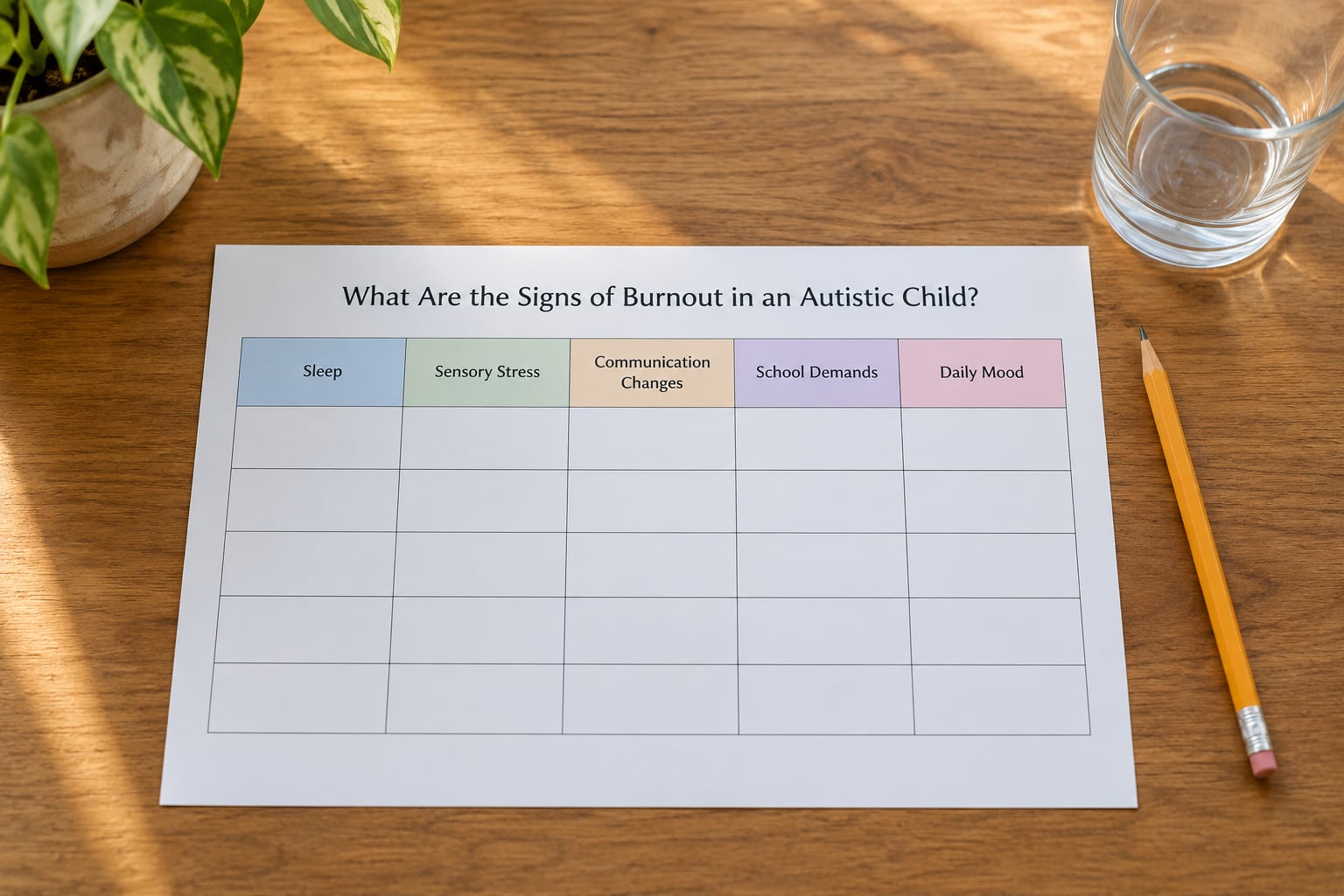
Look for change rather than for a checklist item. Compare your child to how they were a few months ago, not to how another child behaves. The most useful signs cluster into a handful of groups.
Emotional and behavioral signs
- A sudden jump in the frequency or intensity of meltdowns
- Withdrawing from interests, activities or people they used to seek out
- Flattened mood, appearing disconnected or unusually hard to reach
- More shutdowns, where a child goes quiet and unresponsive rather than explosive
- New or escalating anxiety around ordinary routines
Communication signs
- Dropping words, sentences or conversation they managed before
- Losing speech skills in a child who had them
- Longer pauses searching for a familiar word
- Stopping answering questions they could answer last month
Sensory and physical signs
- Clothes, foods, sounds or textures that were fine becoming unbearable
- Increased stimming, or stimming that changes character
- Trouble falling asleep or staying asleep
- Changes in appetite, or new food refusal
- Stomachaches, headaches or body complaints without a clear cause
Daily functioning signs
- Loss of self-care skills such as toileting or self-feeding
- Refusing school, or refusing only certain classes or days
- Homework, chores or therapy tasks becoming impossible to begin
- Struggling to follow a once-familiar routine
Skill regression deserves particular attention. Losing toileting, speech or feeding skills is one of the signs parents most often notice first, and it is one of the ones that most warrants a call to the pediatrician rather than a wait-and-see approach.
Autism Burnout in Children Signs and Recovery: What to Track
A two-week observation makes the pattern visible in a way that memory rarely does. Pick a notebook and record the same handful of things each evening for fourteen days.
Write down sleep: bedtime, estimated asleep time, night waking, and how hard it was to settle. Note sensory stress, especially situations where the child left distressed or needed longer to calm. Record communication changes, such as words or sentences that seemed to disappear. Track school demands, including attendance, how the morning went, and any assignment that caused distress. Log eating, because narrowing foods or skipping meals matters more than it looks on paper. Mark sensory responses to specific triggers rather than a general good or bad day. And record recovery time, which is often the clearest signal: how long the child takes to return to baseline after a hard moment.
Include the moments that look like improvement. Note the day they played for forty minutes, the morning they got themselves dressed, the conversation they started on their own. Without those entries the notebook becomes a list of failures and you will misread the whole picture.
At the end of two weeks, look for lines that move together. A child whose sleep got worse in week one and whose recovery time doubled in week two is telling you something that any single observation would miss.
What Causes or Triggers Autistic Burnout?
Burnout rarely has one cause. It usually builds from demands that stack up until something gives way.
- Prolonged masking, where a child holds back stimming, forces eye contact or suppresses reactions for hours
- A change in routine, such as a new school year, a move, a new sibling or a change in teacher
- Sensory overload from environments that used to be manageable
- Difficult transitions between activities, places or people
- Pressure to conform at school or in social settings
- School stress, including workload, peer conflict, noise levels and unpredictable schedules
- Illness or injury, which add physical load and disrupt routine
- Disrupted sleep, whether from sleep disorders, night waking or an early start time
Transition periods deserve special mention. New school years and puberty are frequent triggers, because the number of unfamiliar people and settings jumps while support often drops away.
A pattern that parents describe often is masking all day at school and then falling apart the moment they get home. That is not contradictory behavior. The homecoming meltdown is often the delayed cost of the hours held together at school.
How Is Autistic Burnout Different From Tiredness, Meltdowns, or Depression?
The differences below are rough guides, not diagnostic tests. Several of these features overlap, and only a qualified professional can say which applies to your child.
| State | Typical context | Duration | What you see | Recovery pattern |
|---|---|---|---|---|
| Ordinary tiredness | Busy days, growth spurts, poor sleep the night before | A day or two | Grumpy, less patient, still able to do usual things | Improves with rest and sleep |
| Autism meltdown | A specific trigger or build-up of demands | Minutes to hours | Outward distress, crying, aggression or shutdown | Returns to baseline, then carries on |
| Autistic burnout | Chronic demand-capacity mismatch over weeks or months | Weeks to months, sometimes longer | Exhaustion, skill loss, reduced tolerance across several areas at once | Slow, uneven, and dependent on demands being reduced |
| Possible depression or anxiety | May follow burnout, overlap with it, or be separate | Weeks and up | Low or anxious mood, hopelessness, loss of interest, physical complaints | Usually needs professional support alongside environment changes |
Two distinctions help most parents. A meltdown tends to be intense and relatively short, tied to something that just happened. Burnout is quieter and broader: it touches sleep, speech, sensory tolerance and motivation at the same time.
Depression can sit alongside burnout rather than replace it. Some children show the same hopelessness and withdrawal that adults describe. When low mood, self-harm thoughts or prolonged loss of interest are present, ask a professional rather than waiting it out.
What Does Recovery From Autistic Burnout Look Like?
Recovery is a gradual return of capacity, not a switch. There is no fixed timeline, and progress rarely moves in a straight line. A week that looks good can be followed by a difficult one without meaning something has gone wrong.
Early signs of recovery tend to show up in small ways:
- Sleep begins to settle
- Recovery time after a hard moment shortens
- Less avoidance of places the child used to tolerate
- Words or skills start coming back
- Stimming or special interests reappear and feel more natural
- More consistent communication with family
Rest alone rarely fixes burnout, which is the part most parents find hardest to accept. Lowering demands does. Parents who write down what changed and what stayed the same over several weeks tend to see patterns earlier than parents waiting for a clear milestone.
How Can Parents Support a Child Recovering From Burnout?
Support works best as a set of small, specific changes rather than one big decision.
Reduce avoidable demands first
Look at the week and cut what is not essential. One extracurricular instead of two. Homework reduced to the hardest item. A skipped family gathering. Low-demand parenting during a crisis can feel extreme, and it is also the strategy parents most often report as the turning point.
Protect recovery time
Build in genuine low-demand time each day: no goals, no schedule, no skills to practise. Screen time rules can relax during burnout because connection and rest matter more than screen rules right then.
Preserve predictability
Visual schedules, written warnings about changes and clear morning routines reduce the mental work of transitions. Uncertainty costs an autistic child more than the activity itself.
Offer sensory choices
Let your child choose between two manageable options rather than asking them to tolerate what you have planned. Keep sensory tools available in the places where distress happens most often.
Lower masking expectations
Stimming, fidgeting, noise and movement are regulation, not rudeness. Letting your child stop camouflaging at home gives them somewhere to put the effort down. If eating becomes a battle, our guide to handling extreme picky eating in autism has practical steps for that specific struggle.
Communicate with the school
Ask for specifics rather than a general concern. What does the morning look like, where does the child break down, what happens in the one class that goes badly. If your child holds it together at school and unravels at home, that is data, not contradiction. Bring it to the school meeting and ask about accommodations. When a child is already in meltdown, our steps for handling autism meltdowns at home can help in the moment.
Support safe routines
Keep eating, movement and sleep as steady as you can. Predictable meals, daily movement and a consistent wind-down give a depleted child anchors while other capacity comes back.
Look after yourself
Supporting a burned-out child is demanding, and caregiver burnout is real. Our caregiver burnout steps are worth reading even if your own plate looks fine.
When Should a Parent Contact the Child’s Doctor?
Contact your pediatrician rather than waiting when you notice:
- Loss of previously acquired skills, especially speech, toileting or self-feeding
- Persistent sleep or appetite changes that persist for more than a couple of weeks
- A prolonged inability to function, attend school or complete basic routines
- Concerning physical symptoms such as ongoing pain, fatigue or unexplained changes
- Marked mood changes, withdrawal from everything, or hopelessness
- Any sign of self-harm or talk of harming themselves
Sudden neurological changes, new seizures, loss of consciousness or a fast change in behavior over hours or days need prompt medical assessment, because those patterns can point to medical causes that burnout does not explain.
If your child talks about suicide or immediate danger, call or text 988 for the Suicide and Crisis Lifeline in the US. If you are elsewhere, contact your local emergency number or crisis line. In an emergency, always call 911 or your local equivalent.
How Do You Build a Sustainable Support Plan?

A plan that fits a bad week is useless in a bad month. Build one you can keep going with when you are tired.
Start with a baseline. Use your two-week notes to record where things stand right now: sleep, sensory load, school attendance, communication and mood. That record becomes the reference point when you wonder later whether something is helping.
Then name the two or three biggest stressors. Rank them. Working on the loudest one matters more than a long list of small fixes, and families usually have more capacity for two changes than for twelve.
Choose small support changes with a clear start date. Remove one demand, add one sensory break, schedule one low-demand hour, send one message to the school. Write down the date so you can look back rather than guessing.
Add short communication check-ins. A few minutes at the end of the day asking what was hard and what helped is often enough. Keep it light; a debrief that feels like an interrogation will not work.
Decide in advance what you will ask at the next review, and who is on the team. Your child’s pediatrician, any therapist, and the school contact are the usual three. For recovering children, occupational or speech therapy may be part of the picture, and any therapy should be neurodiversity-affirming rather than focused on making your child appear less autistic.
Here is a sample weekly plan to adapt:
| Day | One demand reduced | Recovery support | What I am watching |
|---|---|---|---|
| Monday | No homework club | 30 minutes of preferred activity after school | Evening routine, meltdown frequency |
| Tuesday | Homework to two items | Sensory break before dinner | Words used in conversation |
| Wednesday | No extracurricular | Earlier bedtime, screens off | Sleep onset and night waking |
| Thursday | Shortened school morning if possible | Quiet hour after school | Recovery time after hard moments |
| Friday | Family outing chosen by child | Low-demand evening | Eating and food variety |
| Weekend | One scheduled outing, one blank afternoon | Family check-in on what helped | Overall mood versus Monday |
Review the notes once a week and change one thing at a time. Changing everything at once makes it impossible to know what worked.
Frequently Asked Questions
Can an autistic child experience burnout?
Yes. Autistic burnout is widely reported in children, including young children and teenagers, though it is not a formal diagnosis. It tends to appear when demands stay above what the child’s nervous system can manage. Look for several changes at once: exhaustion that rest does not fix, loss of skills that were reliable, and reduced tolerance for sensory input or routine. A pediatrician can help rule out other causes of the same signs.
How is autistic burnout different from a meltdown?
A meltdown is usually intense, relatively short and tied to a specific trigger or build-up. It ends, the child returns to baseline, and the next day can look normal. Autistic burnout is broader and longer. It affects sleep, communication, sensory tolerance, mood and daily functioning across weeks or months. A child can have both at once, with meltdowns becoming more frequent as burnout deepens.
How long does recovery from autistic burnout take in children?
There is no fixed timeline and progress is rarely linear. Families often see early shifts within a few weeks of lowering demands, while fuller recovery of skills and daily functioning commonly takes several months and sometimes longer. Recovery depends heavily on whether the demands causing burnout are actually reduced. Track sleep, recovery time and communication weekly rather than looking for a single finish line.
Does autistic burnout mean my child’s autism is getting worse?
Usually not. Burnout is generally understood as a response to demands that exceed current capacity, not a change in the child’s underlying autism. That said, a period of burnout sometimes leads families to notice features that were missed earlier, and some children are identified during or after a burnout crisis. A developmental evaluation through your pediatrician is the right route if you have questions about skills or development.
When should a parent contact a pediatrician about burnout symptoms?
Contact your pediatrician if you notice loss of previously acquired skills, persistent sleep or appetite changes, a prolonged inability to function or attend school, ongoing physical complaints, marked mood changes or any sign of self-harm. Seek urgent medical care for sudden neurological changes or a rapid shift in behavior over hours or days. If your child expresses suicidal thoughts, call or text 988 in the US for immediate support.
Conclusion
Start with three things. Write down what has changed and when, so you can see the pattern instead of guessing at it. Lower the demands you control this week, even if that means one activity, one commitment or one expectation. And contact your pediatrician if warning signs such as skill loss, persistent sleep or appetite changes, or self-harm concerns are present.
Recovery is individualized and it is rarely a straight line, but the direction of change tends to follow the demands. Reduce the load, protect the conditions your child needs to regulate, and give it time.