

ARFID in children explained in short: avoidant/restrictive food intake disorder is a feeding and eating disorder in which a child persistently limits the types or amount of food eaten, because of sensory sensitivity, low interest in eating, or fear of choking, vomiting or other aversive consequences. Unlike anorexia, body image is not the driver.
Most parents arrive here after months of quietly counting how many foods their child will accept. That number matters less than the direction it is moving.
This article is general information, not medical advice. Your child’s pediatrician can assess whether restricted eating needs a full workup.
Table of Contents
- ARFID in Children: Signs, Causes, and Diagnosis
- What Signs of ARFID Do Parents Usually Notice?
- Physical signs parents report
- Behavioral signs at the table and beyond
- How Is ARFID in Children Diagnosed?
- How Is ARFID Different From Picky Eating?
- What Causes ARFID in Children?
- Can a Child With Autism Have ARFID?
- When Does Eating Behavior Need Urgent Medical Attention?
- How Can Parents Support a Child With ARFID?
- What Does Support or Treatment Usually Involve?
- What Should Parents Avoid Doing?
- How Can Schools and Caregivers Help?
- Frequently Asked Questions
- What is ARFID in children, and is picky eating the same thing?
- Can a child with autism have ARFID?
- How do doctors diagnose ARFID in a child?
- What can parents do at home when a child refuses food?
- When should a child with restricted eating see a doctor urgently?
- What Should Parents Do First?
ARFID in Children: Signs, Causes, and Diagnosis
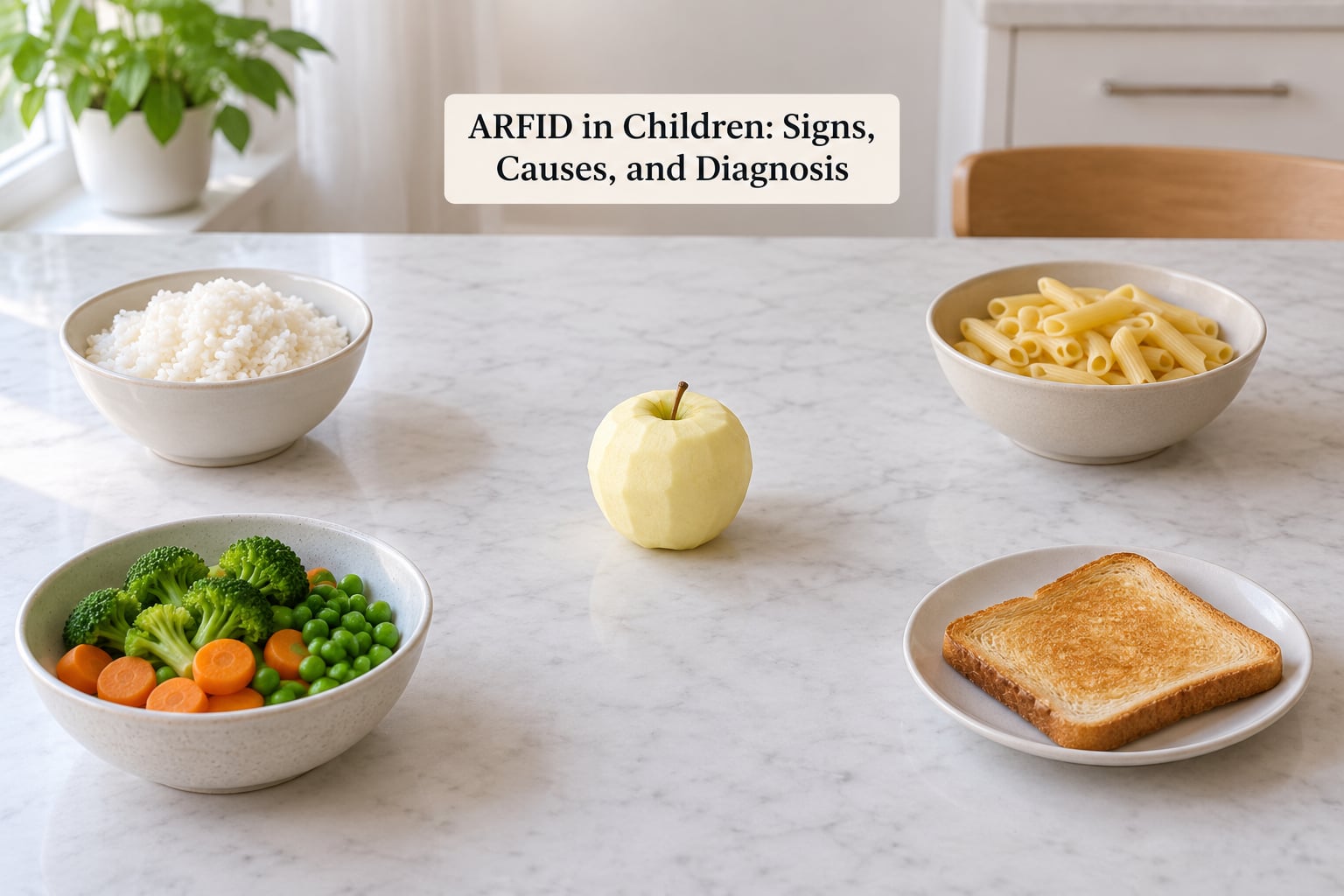
Severity varies widely across children with ARFID. One child might eat fifteen reliable items across four food groups and grow steadily. Another might survive on six brand-specific foods with no reliable protein or fat source, and that pattern is the closer match to the diagnosis.
Some children narrow to a handful of items and stay there. Others lose whole categories at once, such as every solid, or every food that is not beige. Still others restrict mainly in certain settings, eating fine at home and nowhere else, or eating only foods they have handled themselves.
That last pattern matters because it is where many families get dismissed. A child who eats crackers in the car but not in the school cafeteria is not being difficult. The setting is doing work.
ARFID also gets confused with ordinary food refusal, with a normal picky phase, and with appetite changes that come with illness. Those are genuinely different things, and a clinician is the only person who can sort them out. A child recovering from a stomach bug is not in the same category as a child whose safe-food list has shrunk every year since age three.
What Signs of ARFID Do Parents Usually Notice?
Most families notice the pattern before they have a name for it. The earliest and most telling signal is a safe-food list that is shrinking rather than expanding. Everything else tends to follow from that.
Physical signs parents report
- Slower-than-expected weight gain, or a growth curve that has started to drop
- Fatigue, pallor, dizziness, or trouble concentrating in the afternoon
- Frequent stomachaches, constipation or reflux with no clear medical cause
- Feeling cold, weak, or unusually tired for a child that age
- Clothes that fit last season but not this one
Behavioral signs at the table and beyond
- Distress, gagging, crying or outright refusal when a new food is placed nearby
- Chewing difficulty, or food held in the mouth for a long time
- Hiding prepared food rather than eating it
- Refusing to eat away from home, at restaurants, or at school lunch
- Long, rigid mealtime rituals that have to happen in a fixed order
- Eating only in private, or only when no one is watching
Not every child shows every sign, and several of these have medical causes that have nothing to do with eating behavior. Constipation, reflux and abdominal pain deserve a clinician’s attention first. Fatigue and slowed growth deserve bloodwork. That is why assessment, not self-labeling, is the right next step.
How Is ARFID in Children Diagnosed?
There is no single home test for ARFID in children explained as a checklist. Diagnosis comes from a qualified clinician working through history, growth, nutrition, physical, functional and psychosocial pieces, following CDC and NIH guidance on feeding and eating disorders.
In practice, that usually means reviewing the child’s medical history and growth chart, examining them physically, and assessing eating patterns, mealtime behavior and daily functioning. Clinicians may screen for developmental and mental health conditions and ask about other diagnoses that can look similar.
Depending on what they find, they may also order bloodwork, involve a registered dietitian nutritionist, or refer to a pediatric feeding team or specialist. Laboratory evaluation helps catch deficiencies that are not visible from the outside, such as iron-deficiency anemia.
One step cannot be skipped. A clinician needs to rule out gastrointestinal, oral-motor, swallowing and other medical causes before landing on ARFID, because treatment for those problems is completely different.
Parents often worry about being told this is just picky eating. It helps to arrive with specifics rather than impressions. A short written record of the foods accepted, when the range last narrowed, and any changes in growth or weight gives a clinician far more to work with than a description at the door.
How Is ARFID Different From Picky Eating?
The distinction that matters most is direction. Typical picky eating narrows in the toddler years and then widens. ARFID tends to keep narrowing, and it affects nutrition, growth or daily life along the way.
| Factor | Typical picky eating | ARFID |
|---|---|---|
| Food variety over time | Peaks around age 3, widens through preschool and the early school years | Narrows steadily, or stays stuck at a very small range |
| Food group coverage | Mostly intact, with a few vegetables rejected by texture | Whole groups drop out, sometimes with no reliable protein or fat source |
| Growth pattern | Normal height and weight gain | Slower gain, stalled gain, or weight loss |
| Nutritional status | Generally adequate | Deficiencies such as iron, vitamin D, calcium or B12 |
| Mealtime distress | Some grumbling and refusal | Gagging, panic, vomiting, meltdown, or prolonged ritual |
| Eating in front of others | Unusual, but usually manageable | Avoiding restaurants, school lunch and celebrations |
| Social impact | Mostly limited to mealtimes at home | School, parties, family life and eating out are all affected |
| Typical onset | Toddlerhood, with steady improvement | Any age, often earlier in children with neurodevelopmental conditions |
| What to do | Keep offering, keep routines, stay relaxed | Request a feeding and eating disorder assessment |
Fussiness on its own is never an ARFID diagnosis. So is a rough month. What turns picky eating into a clinical conversation is a shrinking range combined with a real cost, whether that cost is low iron, a stalled growth curve, or a child who no longer eats at school.
What Causes ARFID in Children?
There is no single cause, and for many children the exact reason is never identified. What clinicians do see is a pattern of biological, environmental and clinical factors sitting together.
On the biological side, some children have genuinely heightened taste sensitivity, sometimes described as supertasting, or differences in how they register internal hunger and fullness signals. Others have sensory processing differences, particularly around texture, smell, temperature or mixed textures.
Environmental factors often include a frightening eating event. A choking episode, a vomiting illness or food poisoning can start a chain where one avoidance is reinforced because nothing bad happens afterward, and the range quietly contracts.
Co-occurring conditions matter too. Anxiety disorders, ADHD, obsessive-compulsive disorder and autism are common alongside ARFID, and in a child who already struggles with regulation, eating can become the place those difficulties land.
What is not a cause: parenting choices, discipline, a parent’s cooking, or a child refusing to try hard enough. Blame is never the explanation, and shame consistently makes things worse.
Can a Child With Autism Have ARFID?
Yes. An autistic child can have ARFID, and the two often show up together. But autism does not cause ARFID, and having one does not mean having the other.
Autistic children may be more likely to experience food selectivity because of sensory sensitivity, rigidity, or anxiety around unfamiliar food. Those are real drivers of restriction, and they deserve to be taken seriously rather than explained away as a behavioral quirk.
The important distinction is that many children with the sensory subtype of ARFID are not autistic at all. The overlap is meaningful, not definitional. Treating one as proof of the other delays proper assessment in both directions.
If your child is autistic, ask their team to look at eating specifically, alongside growth, nutrition and development. If your child is not autistic and eats a very narrow range, the same assessment is still warranted.
When Does Eating Behavior Need Urgent Medical Attention?
Some symptoms need same-day attention rather than a routine appointment. This list is a prompt to contact a clinician quickly, not a diagnosis, and not something to manage at the table.
| Warning sign | What to do |
|---|---|
| Fainting, or feeling faint and unsteady | Seek urgent medical evaluation the same day |
| Severe or persistent abdominal pain | Contact the pediatrician promptly; go to urgent care if severe |
| Difficulty swallowing, pain with swallowing, or coughing or choking on most foods | Prompt clinical assessment, because swallowing causes need specific checks |
| Signs of dehydration such as very few wet diapers or urine, dry mouth, no tears, unusual sleepiness | Same-day contact with the pediatrician or urgent care |
| Inability to keep fluids down | Emergency care |
| Rapid weight loss or a clear drop across several growth-chart points | Prompt appointment, and mention the rate of change |
Individual thresholds belong to your child’s clinician, who knows their history and growth curve. If you are unsure whether something counts, calling the pediatrician’s nurse line is a reasonable move. Restricting what a child eats while waiting for a specialist is better than a long stretch of very little.
How Can Parents Support a Child With ARFID?
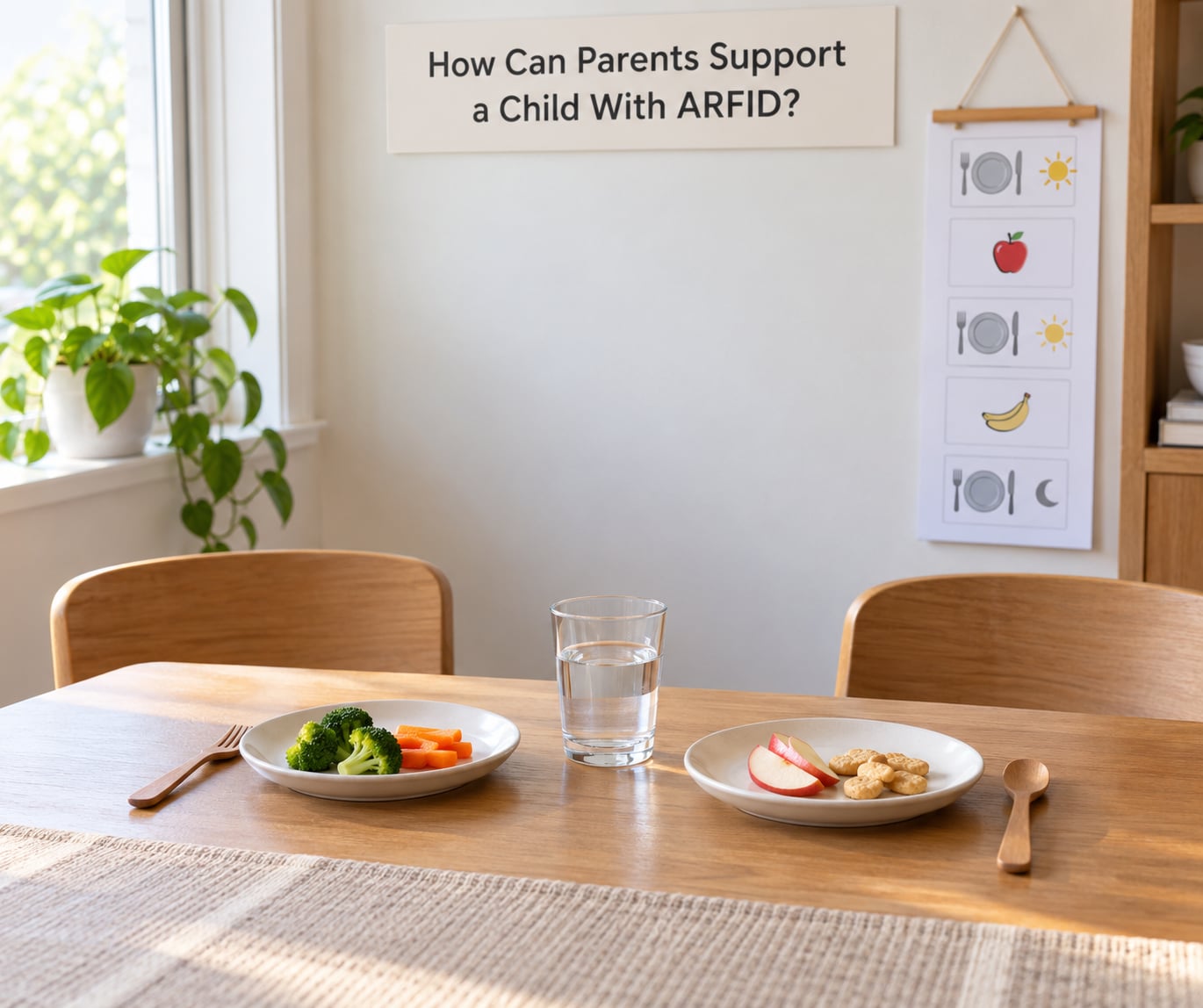
Daily support is mostly about structure and calm, not persuasion. The child with ARFID is not refusing to annoy you, and pressure adds a second problem on top of the first.
Keep meals and snacks on a predictable schedule, roughly every two to four hours, so hunger is more likely to build on its own. Offer safe foods without requiring them to be eaten, and keep offering them so the list never shrinks further.
Introduce anything new gradually, in tiny portions, without a demand. Many families are told that a new food takes 30 to 40 neutral exposures before a response. Touch it, smell it, have it on the table, leave it there. Eating is not the only goal and pressure turns a neutral try into a refused one.
Reduce sensory overload. A noisy dining room, mixed textures and strong smells can end a meal before hunger enters the picture. Soft lighting, fewer competing items and a consistent seat help more than they sound like they should.
Keep a simple log of what was eaten, where, and with what result. It helps at appointments, it shows you that days are not all the same, and it is the single most useful thing to bring to a feeding team.
Watch volume before variety. Widening textures first, then flavors, is usually easier than the other way round, and it is the principle behind approaches like food chaining for picky eaters.
Involve your child according to their developmental ability. A young child decides whether and how much. An older one can help plan a grocery list or a safe meal, which builds ownership without turning food into a negotiation.
What Does Support or Treatment Usually Involve?
Treatment is individualized and usually built by a team. There is no at-home program that replaces it, and the components depend on the type of ARFID, the child’s age and the medical findings.
A plan may include medical monitoring with regular weight checks and bloodwork, nutrition support from a registered dietitian nutritionist, and nutritional rehabilitation when intake is not enough. Feeding therapy, often delivered by an occupational therapist or a speech-language pathologist, addresses the mechanics of eating and the sensory experience around it.
Behavioral and exposure-based approaches such as Cognitive Behavioral Therapy for ARFID (CBT-AR) work on the thoughts and safety behaviors that keep avoidance in place. Family-based treatment (FBT-ARFID) involves parents directly, and parent-support approaches such as Supportive Parenting for Anxious Childhood Emotions (SPACE-ARFID) target the anxiety a child brings to the table.
School accommodations and, in some cases, supplemental nutrition support or hospitalization for medical stabilization may be part of the picture.
One framing matters more than any specific therapy: the goal is nutrition, growth and the ability to function at school and socially. It is not eating a particular way. A child who can sit through a school lunch, join a birthday party and eat a birthday cake has arrived, regardless of what is on the plate.
Medication is not a primary treatment for ARFID. Any plan should come from your child’s pediatrician, a registered dietitian nutritionist and a feeding team or pediatric specialist, working from their records rather than a generic protocol.
What Should Parents Avoid Doing?
Most of what gets recommended online at this stage makes the problem worse. Pressure reliably shrinks the safe-food list rather than growing it.
- Forcing or pressuring. Coercive feeding and short-meal battles teach a child that eating is a threat. Offer the food; let them decide about eating it.
- Threats and consequences. “No dessert until you finish” makes dessert a battleground and rarely changes intake.
- Insulting the food or the child. Calling something disgusting teaches a child to distrust you and the meal.
- Shortening meals indefinitely. A brief limit now and then is one thing; a routine of five-minute dinners leaves a child short on calories all day.
- Letting milk or juice replace food. A child can drink a large volume of calories and still be short on iron, protein and other nutrients. Raise this with a dietitian rather than guessing.
- Waiting for it to pass. Some children improve over time. Do not assume yours will without a clinician’s opinion on how their growth is tracking.
Shame and pressure do not create appetite. They create avoidance, and the more a child senses eating has become a battle, the smaller the range gets.
How Can Schools and Caregivers Help?
School is often the hardest daily setting, and it is also where support is easiest to organize. Parents describe cafeteria exposure, being watched by other children, and school lunch refusal as the most exhausting part of the week.
Write the safe-food list down and share it with the school nurse, the cafeteria staff and the teacher, then again with any respite caregiver or relative who does meals. A one-page document that travels with your child prevents a lot of daily negotiation.
Preserve routine wherever you can. Predictable timing helps a child arrive at lunch hungry enough to manage a safe item rather than too overwhelmed to attempt anything.
Plan for field trips, celebrations and fire drills before they happen. Most schools can accommodate a packed lunch in a quieter room, and asking early is far easier than improvising on the day.
If the child qualifies, a 504 plan or IEP can put accommodations in writing, which is more durable than a verbal arrangement with a substitute teacher. Ask the school what documentation they need.
The caregiving side of this goes beyond meals. For families where eating is also tied to safety behaviors or elopement risk, preventing wandering in autistic children covers the plan side that often has to be built alongside feeding support.
Frequently Asked Questions
What is ARFID in children, and is picky eating the same thing?
ARFID in children explained plainly: avoidant/restrictive food intake disorder is a feeding and eating disorder where a child persistently limits the types or amount of food eaten, because of sensory sensitivity, low interest in eating, or fear of choking or vomiting. Unlike anorexia, body image is not the cause. Picky eating is a normal phase that narrows then widens; ARFID keeps narrowing and affects growth, nutrition or daily life. One is a preference, the other is a medical condition.
Can a child with autism have ARFID?
Yes, and the two often co-occur. Autistic children may be more likely to experience food selectivity because of sensory sensitivity, rigidity or anxiety around unfamiliar food. But autism does not cause ARFID, and many children with the sensory subtype of ARFID are not autistic. Treat the overlap as a reason to assess eating carefully, not as a diagnosis in itself. Ask for evaluation of eating, growth, nutrition and development together.
How do doctors diagnose ARFID in a child?
There is no single test. A clinician reviews medical history, growth charts and nutrition status, examines the child physically, and assesses eating patterns, mealtime behavior and daily functioning, following CDC and NIH guidance on feeding and eating disorders. Bloodwork, a registered dietitian nutritionist or a pediatric feeding team may be involved. Ruling out gastrointestinal, oral-motor and swallowing causes is an essential first step, since those need different treatment.
What can parents do at home when a child refuses food?
Keep a predictable meal and snack schedule, offer safe foods without pressure, and offer them again often so the list does not shrink further. Introduce new foods in tiny portions without a demand, since a new food may take 30 to 40 neutral exposures. Reduce sensory overload at mealtimes and keep a simple log of what was eaten and where. Individualized therapy should be directed by a qualified feeding or occupational therapy team.
When should a child with restricted eating see a doctor urgently?
Seek same-day care for fainting, signs of dehydration such as very few wet diapers or no tears, or an inability to keep fluids down. Get prompt assessment for severe abdominal pain, difficulty or pain with swallowing, and rapid or concerning weight loss. These can signal medical or nutritional problems rather than avoidance behavior alone. When you are unsure, call your pediatrician’s nurse line rather than waiting, and describe the rate of change.
What Should Parents Do First?
Book the pediatric appointment and write down what you have seen before you go. A record of accepted foods, when the range last narrowed, and any change in weight or energy gives a clinician something concrete to work from.
Ask specifically for a feeding and eating disorder assessment, a registered dietitian nutritionist, and growth and bloodwork review. You do not need to diagnose your child to justify the referral.
Until then, keep routines steady, keep offering safe foods without pressure, and stop the food battles. If any of the urgent warning signs above appear, seek same-day care instead of waiting.
Support for a child with ARFID works best when it is patient, structured and individualized, and it is worth remembering that the goal is a child who can eat, join in and grow, not a plate that looks a particular way.