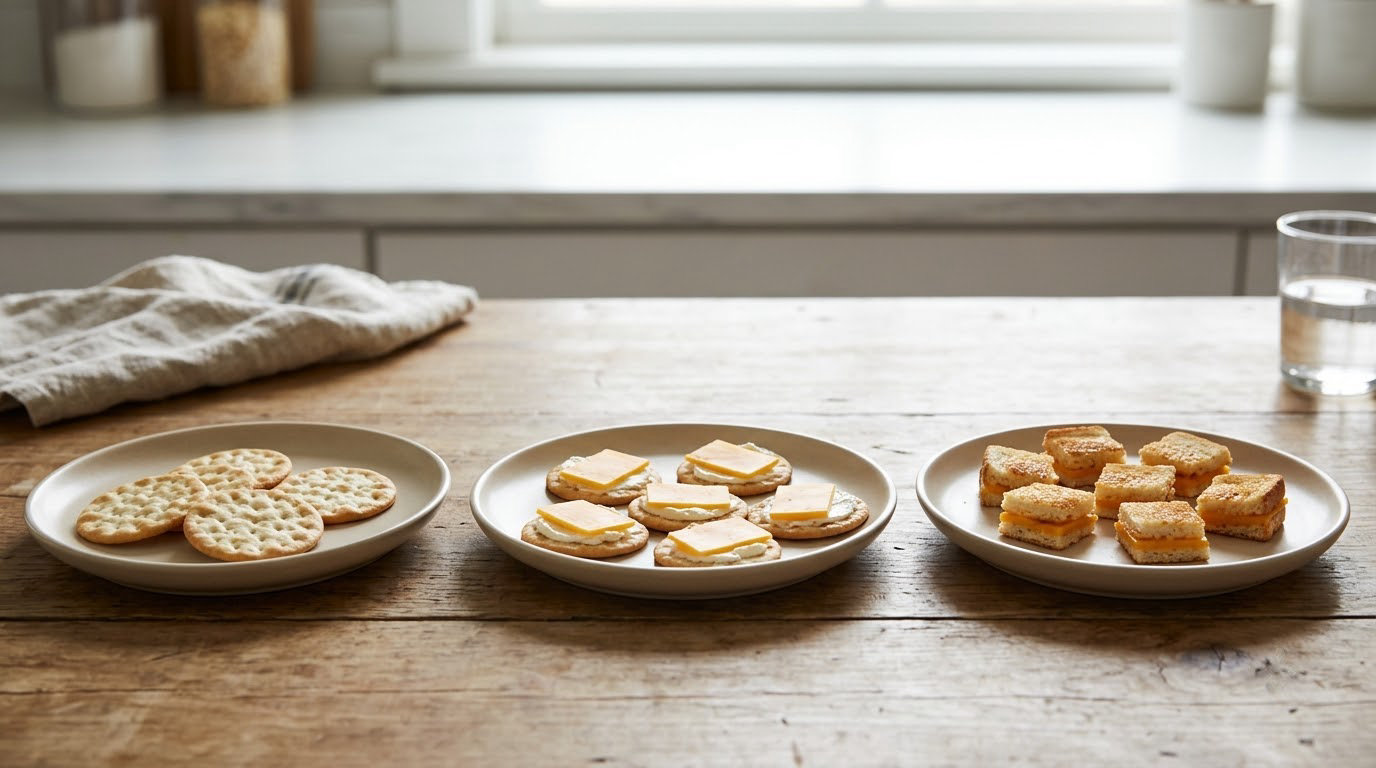
Food chaining for picky eaters is a step-by-step way of widening what a child will eat: you start with a food they already reliably eat, add one small change to it, and repeat until something new lands on the plate without a fight. It runs on no pressure, lots of repetition, and letting the child decide whether to eat. Most families can begin this week without buying a single thing.
Parents usually arrive here after the third bad dinner in a row, when the pasta is the only thing that gets eaten and the rest of the plate is a place to put things they do not want. The instinct is to make that food less boring. That instinct is exactly what food chaining is.
Table of Contents
- What Is Food Chaining?
- How Does Food Chaining Work for Picky Eaters?
- Which Foods Should You Pair?
- How Do You Start Food Chaining at Home?
- What Does Success Look Like in Food Chaining?
- Common Food Chaining Mistakes and Easy Fixes
- When Should You Ask a Feeding Professional for Help?
- Frequently Asked Questions
- How to Begin Food Chaining Safely
What Is Food Chaining?
Food chaining is a feeding therapy technique that expands a child’s accepted foods by starting with something they already reliably eat and making one small change at a time, moving through the closest matches until a new food is introduced alongside it. The child never faces a plate of something entirely unfamiliar.
It comes out of pediatric feeding therapy, and the step-by-step versions clinics use were written up by feeding therapists including occupational therapist Kay Toomey. Today it shows up in pediatric offices, feeding clinics, and speech-language pathology and occupational therapy practices. Caregivers can use the same principles at home, and a lot of families do.
What usually gets paired is a preferred food with a similar food, then that similar food becomes the new preferred food and the chain continues. Similar can mean the same category, the same protein, the same texture, the same flavor family, the same color, or the same temperature. You pick the one dimension your child is most comfortable with.
Food chaining for picky eaters versus pressure to eat
The difference matters more than the technique itself. Food chaining has no bite requirement. There is no count of how many times the child has to try something, and there is no consequence for saying no.
Feeding therapists frequently use Ellyn Satter’s division of responsibility as the frame: adults decide what is offered, when, and where; the child decides whether to eat it and how much. That model is why pressuring a child to eat, insisting on one bite, or making a safe food a reward works against the whole method. Parents on r/Autism_Parenting and r/ARFID describe the same thing from the other side: pressure tactics and the one-bite rule made eating harder for their kids.
How Does Food Chaining Work for Picky Eaters?
One chain step takes about two minutes of table time. You serve a small amount of the safe food the child already eats and a very small sample of the near-match beside it, you say nothing about the new part, and you let the child do whatever they want with it. Gaze counts. So does nothing.
When the near-match starts being eaten, you retire the old rung and build from the new one. That is the entire mechanism.
The similarity ladder: where to start and how to climb
- The same food, prepared differently. Apple sauce becomes thin apple slices. Diced cucumber becomes cucumber sticks.
- The same brand, a different variety. The cereal box they already ask for, in a flavor they have not tried yet.
- Same category, different color. Goldfish crackers become a different-colored fish-shaped cracker.
- Same protein, different form. Chicken nuggets to fish sticks. Beef meatballs to a slice of roast beef.
- Same flavor family. Vanilla milk to vanilla yogurt. Cheddar to a milder white cheese.
- Same texture, different food. Thick yogurt to a soft, smooth pudding of a different color.
- Same color, different food. Broccoli to green beans, both green and both bite-sized.
- Same temperature. Warm milk to a warm yogurt drink, chilled juice to chilled melon.
- Cooked instead of raw. Raw carrot sticks to soft cooked carrot coins, or the reverse.
- Same shape, different food. Cheese cubes to cucumber cubes, both firm and cube-shaped.
You do not work down this list in order. Rung four might be easier for your child than rung one, and that is normal. Start where the gap is smallest.
Repetition is the part that surprises people. Clinicians commonly describe needing somewhere around 10 to 15 neutral exposures before a child moves from tolerating a food to actually eating it, and some foods take far longer. A neutral exposure is no reaction at all, which is why progress feels invisible for weeks. A food that gets a dirty look and no interest is not a failure; it is exposure four.
Choice is what keeps it workable. Letting the child decide whether to eat, and sometimes offering two safe foods instead of one, is what keeps the table from turning into a negotiation. On r/Parenting, parents describe the version that sticks: your child will go hungry rather than eat a disliked food, and that preference for safety is the thing the chain is working with.
Food chaining vs. food pairing vs. hiding food
| Approach | How it works | Best used for | Main drawback |
|---|---|---|---|
| Food chaining | Walks a child up a ladder of similar foods until the new one is familiar | Long-term variety and skill building | Slow, and it needs repetition most weeks |
| Food pairing | Puts a brand-new food next to a reliably accepted one, no ladder | Quick wins with a wide safe-food list | Only works if at least one solid food is already accepted |
| Hiding food | Blends or mixes food into something the child eats without noticing | Getting extra calories or nutrients in | Does not build acceptance, and kids often find it |
Which Foods Should You Pair?
Pair on whichever dimension your child already tolerates, and start with the food they eat most happily. Below is a working table you can copy into a notebook and adjust.
| What your child reliably eats | Next food in the chain | Why it works |
|---|---|---|
| Plain buttery pasta | Pasta with a light tomato sauce on the side | Same ingredient, sauce added gradually |
| Chicken nuggets | Fish sticks | Same shape and similar coating |
| Crackers with cheese | Crackers with sliced apple | Same vehicle, softer topping |
| White rice | Rice with a spoonful of sauce beside it | Plain base, flavor added not mixed in |
| Vanilla yogurt | Vanilla pudding | Same flavor, different texture |
| Applesauce | Mashed banana | Same spoonable texture, different color |
| Broccoli | Green beans | Same green color, same bite size |
| Milk | Cheese melted into a slice of toast | Same dairy, warm and soft |
| Sandwich bread | Tortilla wrap with the same filling | Same filling, different wrapper |
| Goldfish crackers | A different-colored fish-shaped cracker | Same category, new color |
| Plain oatmeal | Oatmeal with sliced banana on top | Base stays untouched, new item sits separately |
| Frozen waffles | Toast with butter | Similar sweet starch, different shape |
Two rules keep this safe. Keep the familiar food in the same amount as always, so the child never worries about losing it. And keep new items physically separate at first, side by side rather than mixed in, because some children react to a mixed texture before they react to the flavor.
If your child has a food allergy, do not put an allergen on the chain table to test the waters. Early allergen introduction has its own guidance from allergists, and a reaction at dinner is a bad place to find out. With a dairy-free, gluten-free, or vegetarian household, chaining still works fine inside the foods already cleared for your child.
How Do You Start Food Chaining at Home?
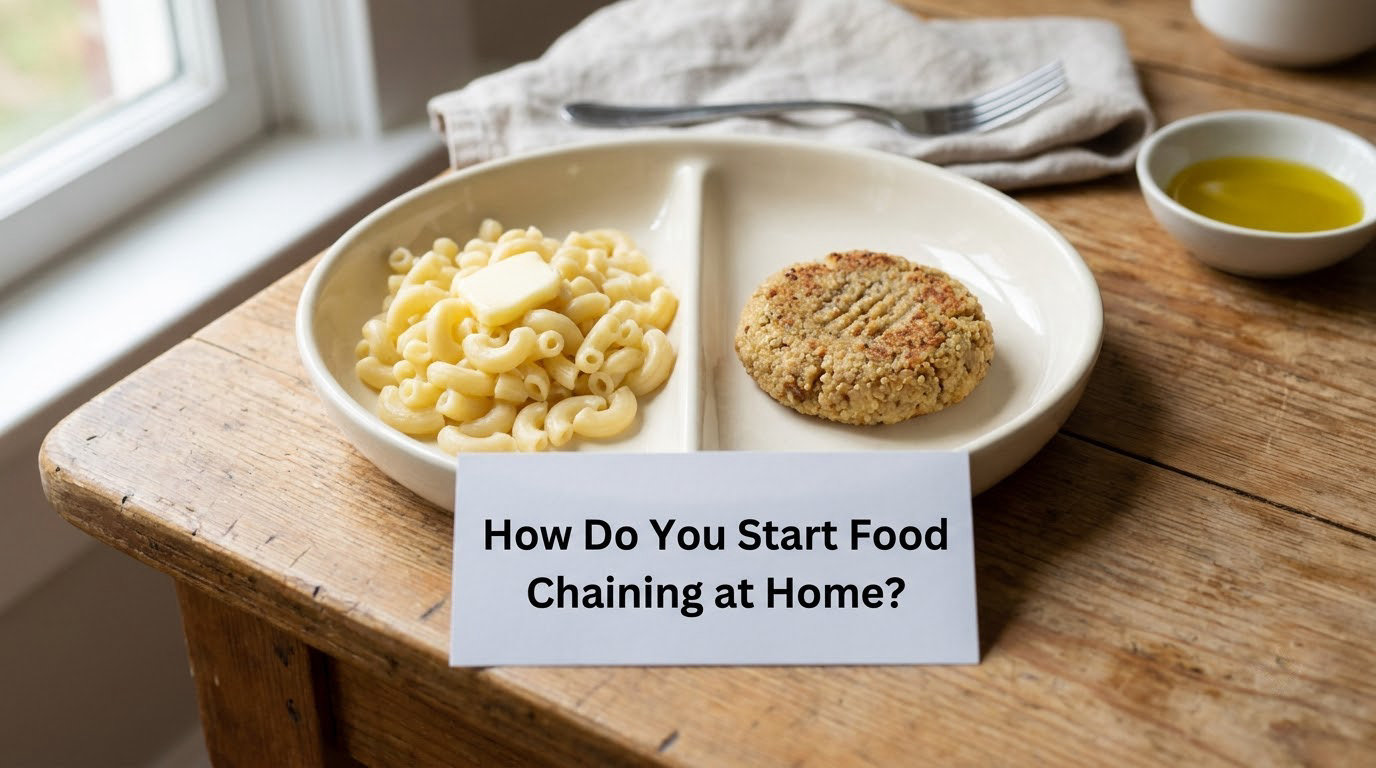
Pick one safe food and one near-match. That is the whole setup. Then repeat it at several meals over about two weeks before you judge anything.
- Choose the safest food on the menu. Whatever your child eats without a single prompt, complaint, or negotiation, every day.
- Find the smallest visible difference. One change only, and make it small: sliced instead of diced, sauce on the side, a different color, one step in texture.
- Put the sample on the plate. A single spoonful or a cube-sized piece. Not a pile. A large serving reads as a demand.
- Say nothing about it. No naming the food, no encouraging, no reminders mid-meal. Announcing it usually makes it worse.
- Keep eating the rest of the meal normally. Conversation, screens if that is your routine, staying at the table yourself.
- Log one line per meal. Touched, smelled, licked, bit, swallowed, requested, refused, gagged. One row per food is plenty.
- Build the next rung only after the current one is eaten. Then the sample becomes the new safe food and the process repeats.
A parent on r/Autism_Parenting described a format that works well and costs nothing extra: three bowls at lunch, one of accepted foods, one of foods being worked on, one for exploring. It looks like a normal lunch rather than a test, and that same parent reported her son started eating more vegetables once the working bowl became routine.
It also solves the meal-by-meal cooking problem. If you are currently making a separate dinner every night, the working bowl usually means you cook one meal and portion the safe part before the rest goes on the table.
What Does Success Look Like in Food Chaining?
For the first week or two, success is a child who does not leave the table. Everything after that is incremental, and it rarely moves in a straight line.
- Looking at the new food, then looking away without distress
- Touching it, or moving it on the plate
- Smelling it
- Licking a finger that touched it
- Taking a bite and spitting it out, which is a real and normal step
- Eating it when nobody is watching
- Asking for it, which is the step parents notice first and rarely mention
- Joining the family meal without a separate plate
Weeks of no change is normal, especially with textures. Progress also shows up away from food: fewer battles, less anxiety before dinner, a child who stays in the room when something new is on the table. Pediatricians weigh growth, so keep up appointments even when eating looks unchanged.
Common Food Chaining Mistakes and Easy Fixes
Moving up too fast. When a food finally gets eaten, most families jump several rungs. Change one thing at a time or you will not know what worked.
Offering a big portion. A heaped spoonful communicates expectation. Match the safe portion and use a teaspoon for the new one.
Talking about the new food. Naming it, praising the first contact, asking for a bite all add pressure. Put it on the plate and move on.
Hiding food to speed things up. It gets calories in and teaches nothing, and children who catch it start checking their plates. If a clinician recommends pureeing for nutrition, keep it separate from the visible chain.
Requiring one bite. Parents across r/ARFID and r/PickyEaters describe this rule making meals worse, not better. It converts tasting into a test the child can fail.
Making the safe food a reward. You lose the reliable food as a reliable food, and the child learns to negotiate for it. Offer it as usual, every meal.
Changing several variables at once. A new plate, a new time, a new utensil and a new food in the same week means you cannot read the result.
Dropping the routine on a bad day. Consistency across ordinary meals matters more than any single dinner.
When Should You Ask a Feeding Professional for Help?
Talk to your pediatrician first if any of these show up, since they can order a feeding evaluation and refer you to the right discipline.
- Weight loss, a flattening growth curve, or a child who is not gaining as expected
- Coughing, choking, or a wet or gurgly voice during or after meals
- Recurring gagging, vomiting, or obvious pain while eating
- Refusal that leaves the child eating only a handful of foods across every group
- Distress that is intense and ongoing, or eating that takes hours
- Pica, or eating non-food items
- Dehydration, fatigue, or irritability that lines up with meals
The team usually includes a pediatrician, an occupational therapist, a speech-language pathologist, and sometimes a registered dietitian. For ARFID, look for someone who specifically works with it, since general weight-focused nutrition advice often misses what is driving the restriction. Co-occurring GI symptoms, which are common in autistic children, are worth naming explicitly at the appointment.
This guide is general information about a feeding approach, not a diagnosis or a treatment plan for your child. Individual medical advice belongs with your pediatrician or feeding team.
Frequently Asked Questions
How long does food chaining usually take?
Most families notice something changing within three to four weeks and real progress over three to six months, but the range is wide. It depends on how narrow the accepted list started and how much exposure your child gets. Treat any promise of a fix in days with suspicion. Weeks of boring repetition is the normal part, not evidence it is failing.
Can food chaining work for a child with autism?
Yes. Food chaining is used widely in feeding therapy with autistic children because it works with a safety behavior instead of arguing against it. Many autistic children refuse foods because of sensory properties such as texture, smell, or temperature, so matching the new food to something already tolerated is usually what makes the step land. If your child is already in feeding therapy, let that team set the pace.
Should I hide new foods in familiar foods?
Hiding gets calories and nutrients in, but it does not teach a child to accept a food, and it can cost you their trust at the table when they work it out. Chaining aims at the second goal. Pureeing a vegetable into an accepted food is reasonable when a clinician recommends it for nutrition, and the visible chain should still run alongside it.
What if my child gags or refuses every new food?
Back up one rung rather than pushing forward. Shrink the sample, offer it for touching only, or return to the rung the child is comfortable with. Never push food into the mouth to produce a gag. Some children gag from anxiety rather than the food itself. Persistent gagging, choking, or a wet voice after meals is a reason to call your pediatrician.
How many foods should I introduce at once?
One. With two new foods on the table you cannot tell which one caused the reaction, and most children are already handling a lot of new sensory information at a meal. Once the first food has been touched and tolerated across several meals, bring in the second. Over time, running three or four chains in parallel is plenty.
Can food chaining help with allergies or a special diet?
Often, within the foods already cleared for your child, which matters in dairy-free, gluten-free, or vegetarian households. With a confirmed allergy, do not put the allergen on the chain table to test it, since early allergen introduction has its own guidance from allergists. Plan any reintroduction with your allergist or dietitian rather than at dinner.
How to Begin Food Chaining Safely
Start tonight with one food your child already eats and the smallest possible change to it, served side by side and free of commentary. Log one line per meal and keep going for two weeks before you judge it.
Keep the pressure off, keep the safe food unlimited, and let the child’s no be a complete sentence. If there is weight loss, choking, pain, or vomiting, that is a pediatrician conversation, not a home experiment.