If your child covers their ears at the school door, wears ear defenders for the supermarket, or asks for protection before a party even starts, you are not the only parent Googling this at 10pm. The short answer to when to use ear defenders vs earplugs is simple: ear defenders first for most children, because they are quicker to put on and easier to take off yourself. Earplugs come in when the noise is sustained and loud, or when your child prefers something small and discreet that fits under a hat or a hood.
Neither is automatically better. Comfort decides more than protection level does, because protection that gets yanked off in the first five minutes protects nothing at all.
What follows covers how each one works, where each one wins, and the questions parents ask most on r/autism and r/AutisticAdults about comfort, communication, and whether a child should wear protection all day.
Table of Contents
- When to Use Ear Defenders vs Earplugs at a Glance
- What Are Ear Defenders and Earplugs?
- Ear Defenders vs Earplugs: Noise Protection
- Ear Defenders vs Earplugs: Comfort and Fit
- When to Use Ear Defenders
- When to Use Earplugs
- Ear Defenders vs Earplugs for Children
- Which Is Better for Autism and Sensory Sensitivity?
- Safety, Hearing Loss, and When to Ask a Professional
- Which Should You Choose?
- Frequently Asked Questions
- Are ear defenders better than earplugs for a child with autism?
- Can a child wear ear defenders or earplugs all day?
- What is the best option for a child at school?
- Do earplugs help with sleep or sensory overload?
- Can ear defenders or earplugs cause ear pain?
- When should I ask an audiologist about my child’s hearing sensitivity?
- Conclusion
When to Use Ear Defenders vs Earplugs at a Glance
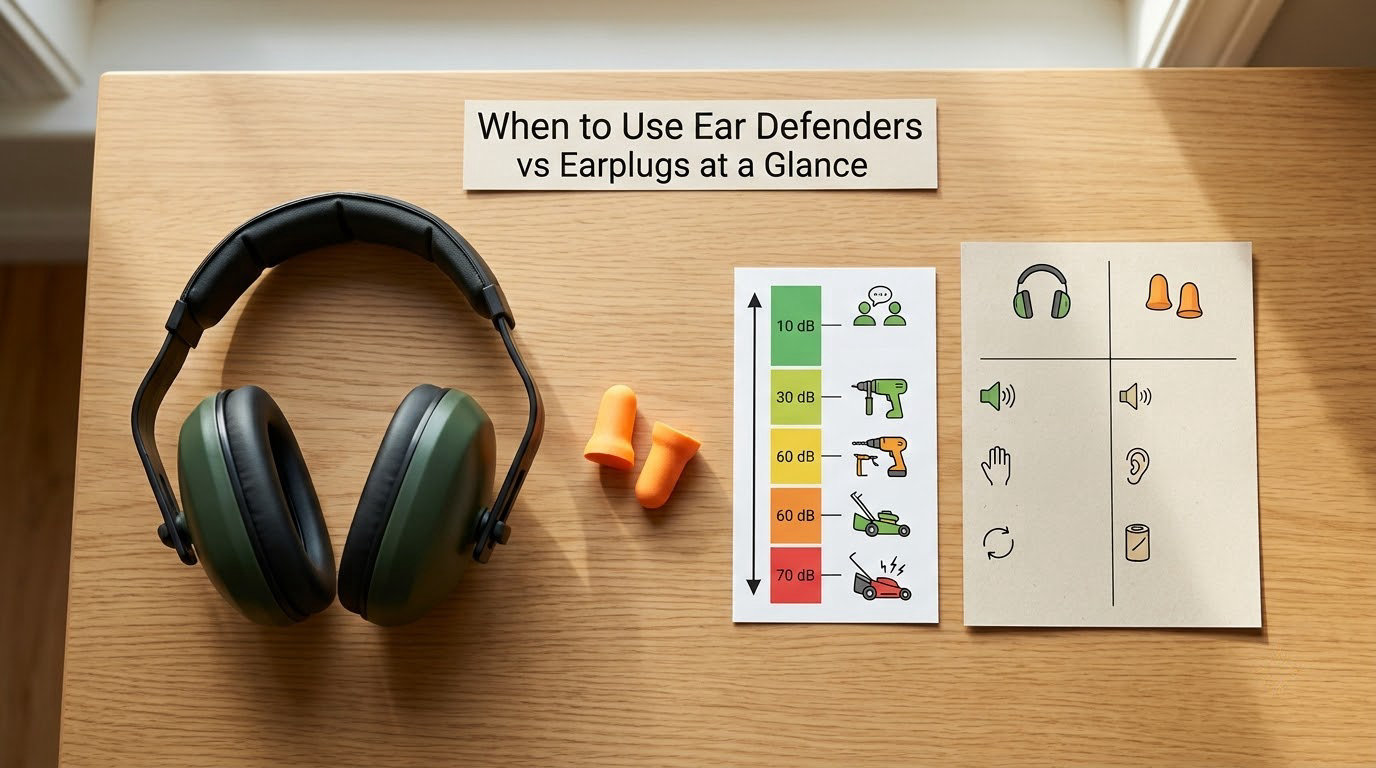
Ear defenders suit louder, longer, or unpredictable noise where your child needs to hear a voice nearby. Earplugs suit quieter, controlled settings or sustained loud noise where the highest possible reduction matters more than hearing the room.
| Consideration | Ear defenders (earmuffs) | Earplugs |
|---|---|---|
| How it works | Cups seal around the outer ear on a headband | Foam or silicone plugs sit inside the ear canal |
| Best noise situations | Moderate, unpredictable bursts such as a school corridor, supermarket, cinema, travel | Sustained loud noise such as power tools, concerts, fireworks, flights |
| Ease of communication | Easier to hear a parent speak through or beside the cups | Harder to hear and be heard; the child often cannot reply easily |
| Awareness of surroundings | Keeps most surroundings audible, which feels less isolating | Blocks most sound, which some children find disorienting |
| Comfort in heat | Warm and sweaty around the headband, especially in a car or hall | Cool, since nothing covers the head |
| Glasses, hats, helmets | Can press on spectacle arms or sit badly under a helmet | Works under almost any headwear |
| Removing it quickly | Seconds, one-handed, no adult help needed | Needs a squashed, rolled plug and often adult help |
| Hygiene | Cups can be wiped or washed | Foam is single-use; reusable silicone needs cleaning |
What Are Ear Defenders and Earplugs?
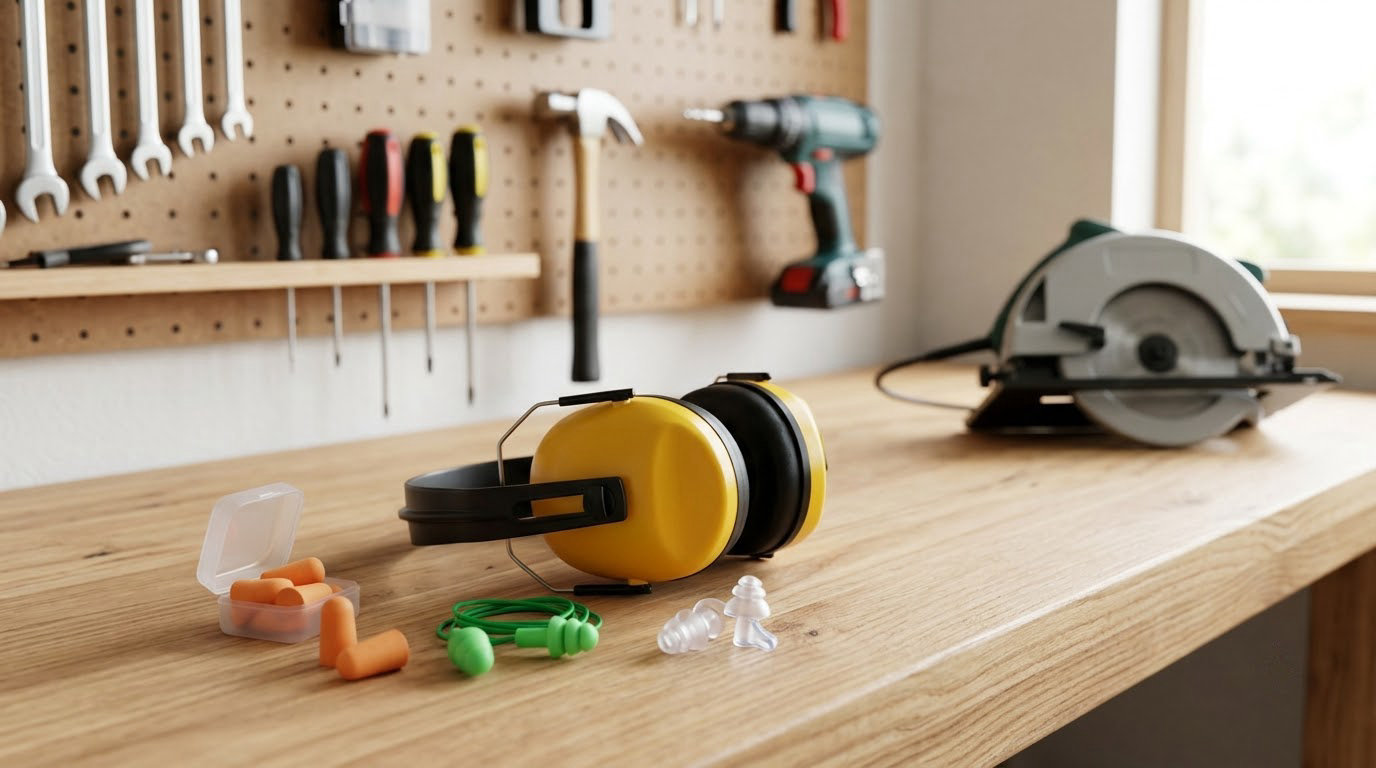
Ear defenders are two padded cups joined by a headband that rests on top of the head. The soft seal forms around the outside of the ear and muffles sound before it reaches the eardrum. You have probably seen the same design on a construction site, just in a version built for adults.
Earplugs are small foam or moulded silicone inserts that go partway into the ear canal. Because they block the sound path earlier, they usually reduce more sound than a pair of defenders, as long as they are fitted well and the canal is clear.
There is a third category worth naming because it confuses people: electronic or active hearing protection. Those devices use microphones to either cancel low, steady noise or pass ambient sound through while taming peaks. For a sound-sensitive child who cannot cope with total silence, that filtering behaviour is often the most useful thing they can wear.
Ear Defenders vs Earplugs: Noise Protection
Protection depends on two things: how much reduction the product is rated for, and how well it fits you. A badly fitted earplug can deliver a fraction of its printed rating, which is why comfort and correct fit matter so much for a child.
Two labels appear on hearing protection. NRR, the noise reduction rating, is the US figure and tends to be optimistic. SNR, the signal-to-noise ratio, is the European equivalent and is usually more cautious. Both are measured in decibels, and decibels are logarithmic, so a 6 dB drop is a large change in perceived loudness while a 2 dB drop is close to nothing.
For everyday sensory situations, defenders usually handle enough. They soften a 70 to 80 dB environment, which is a busy shop or a dining hall, down to something manageable. Plugs are the stronger tool when the source is genuinely loud, such as a lawnmower, a live gig, or a fireworks display.
Guidance for workplaces is a useful marker even at home: occupational limits treat 85 dB as the point where exposure needs controlling, and NIOSH advises doubling up, plugs under defenders, at or above 100 dBA. You can hear a real difference when you put both on. That said, doubling up is about noise-induced hearing loss in noisy work, not about a child at a birthday party. For sensory comfort, more reduction is often worse rather than better.
Ear Defenders vs Earplugs: Comfort and Fit
Comfort is the deciding factor in almost every case I have seen discussed. Bulky defenders, constant clamping, and sweat inside the headband are the most repeated complaints in sensory communities, and there is a real reason it comes up: those cups are worn for hours, often in a warm car or a stuffy hall.
Earplugs have their own set of problems. A poor fit in a small ear canal can press, itch, or push earwax deeper, and a child who cannot remove them independently becomes dependent on an adult to stop the sound. Foam plugs are also single-use, which adds up fast across a school week.
Fit details that change everything: defenders need a headband that is narrow enough for a small head, and defenders with a flexible or adjustable band sit better over glasses arms than rigid ones. Plugs need the canal end clean and dry, correct size, and a gentle roll before insertion.
One rule I would give any parent: if your child says it hurts, treat that as information, not fussing. Stop, and change the option rather than persuading them to tolerate it.
When to Use Ear Defenders
Ear defenders earn their place when the noise is loud enough to be distressing but not loud enough to threaten hearing, and when your child still needs to hear you or the person teaching them.
- School settings: corridors, dining halls, assembly, and PE changing rooms, where the noise is unpredictable and the volume changes without warning.
- Supermarkets and shopping centres: door chimes, trolleys, tannoy announcements, and a wall of people talking at once.
- Salons, barbers, and the dentist: a hair dryer or a drill is close, sudden, and deeply unpleasant for a sound-sensitive child.
- Travel: airports, terminals, and aeroplanes, where announcements you cannot control arrive at any volume.
- Sports events and family gatherings: crowds, whistles, and a birthday party that does not end on schedule.
- Home appliances: vacuums, blenders, and the hairdryer, which is why many children wear them in places adults never notice.
The pattern is the same each time: the sound is loud, close, and someone can take the defenders off the second it becomes unbearable.
When to Use Earplugs
Earplugs make more sense when the noise is loud and sustained, when the environment is predictable, and when a smaller, less visible option suits your child better socially.
- Sustained loud sound: power tools, construction, garden machinery, hunting, shooting ranges, and concerts.
- Sleep and wind-down: a low, steady hum, a snoring household member, or an early light-sensitive wake-up.
- Under headwear: motorbike helmets, winter hats, and headphones, where defenders would not fit.
- Discreet wear at school or work: adults on r/autism describe small reusable silicone plugs as socially easier because nobody comments on them.
- Very short, sharp bursts: a door slamming, a whistle, a nearby bark.
Two caveats. First, insertion matters: roll the plug into a thin cylinder, reach over the head to pull the ear up and back, insert, and hold it in place for a few seconds until it expands and holds a seal. A plug that is loosely dropped in protects almost nothing. Second, never use plugs as a substitute for rated protective equipment in a genuinely hazardous setting, and never use them in a child who has ear tubes, drainage, or an active ear infection without medical advice.
On r/autism, parents describe silicone plugs as the option that survives a full day, and also report earwax and itching problems. Both are true at once, so fit matters more than brand.
Ear Defenders vs Earplugs for Children
With children, the practical question is not which blocks more sound. It is which one your child will actually put on before they are overwhelmed, and take off when they have had enough.
Communication is the big one. With defenders, a parent can often speak to the child and still be heard, and the child sees a familiar gesture or lip movement. With plugs, a conversation becomes half-over. For a child already stressed, losing the ability to ask for something is a real cost, and plenty of parents have described a child who panicked because they could not hear a question.
Removal is the other one. Defenders come off in a second and a child can do it lying down, in the car, or in the middle of a meltdown. Plugs generally need an adult. If a child cannot remove their own protection, that is a strong practical argument for starting with defenders.
Sensory preference settles the rest. Some children refuse anything touching the head, which rules out defenders. Others cannot stand anything inside the ear. Neither is unusual. Trial and error, and letting the child handle the options in a calm moment, beats being told what works best.
Which Is Better for Autism and Sensory Sensitivity?
There is no universal best option for autism and sensory sensitivity. Sound sensitivity varies enormously, from mild startle at a hand dryer to distress that stops a child leaving the house, and the level of reduction that calms one person disorients another.
The distinction that matters most is filtering versus blocking. Filters reduce the loudest peaks and let speech through. Blockers muffle everything into a flat, quiet world. Many sound-sensitive people find filters far more tolerable, and some filtering ear defenders are the most useful item in the drawer. Others genuinely need the flat quiet, especially at a party or in a club.
Protection works best as prevention, not as a reaction. r/autism parents repeatedly say the same thing: the meltdown starts faster than a child can ask for help, so protection goes on before entering the space, not after things go wrong. That reframes ear defenders from a comfort item to a tool a child uses proactively.
Non-diagnosed but sensitive people are in the same boat. You do not need a diagnosis to need quieter, and asking the question on a forum is completely reasonable.
Safety, Hearing Loss, and When to Ask a Professional
This is general information, not medical advice, and children deserve a professional view when something is off. Hearing protection at home and school is about comfort, not about managing hazardous noise, and it should never replace rated protective equipment in a workplace or on a shooting range.
Stop and see someone if your child reports pain, pressure, ringing in the ears, dizziness, or drainage, or if they are constantly adjusting or removing protection. These can point to an ear infection, earwax build-up, or a middle ear problem rather than a need for better defenders. A pediatrician is the right first stop, and an audiologist can check hearing and fit an appropriate device. An occupational therapist is often the most useful person for the sensory side, especially for graded introduction and desensitisation plans.
Also speak to a professional if a child consistently cannot hear you, seems not to react to sounds they should, or is in a very loud environment often enough that hearing protection is needed for safety.
Which Should You Choose?
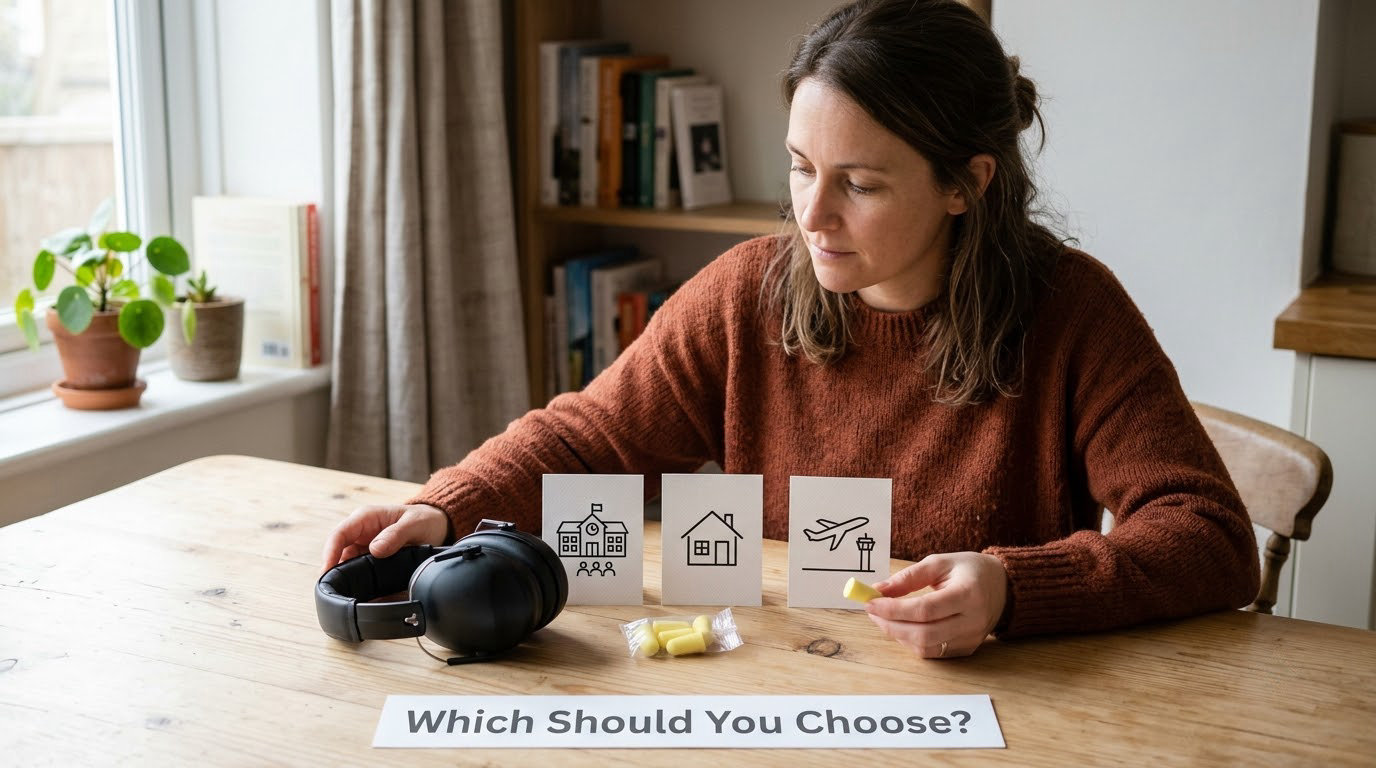
Match the option to the situation rather than to a rule. Use this as a starting point and change it as you learn what your child tolerates.
- Choose ear defenders when the noise is moderate to loud, unpredictable, or long-lasting, and your child needs to hear you, the teacher, or a friend while wearing them.
- Choose earplugs when the noise is sustained and genuinely loud, when the setting is predictable, when a child is under a helmet or hat, or when discretion matters more than visibility.
- Choose filtered protection when total blocking feels disorienting and the goal is to take the edge off peaks rather than silence the room.
- Choose a professionally fitted custom option when nothing off the shelf holds up, or when hearing loss risk is real and constant.
- Talk to a pediatrician, audiologist, or occupational therapist when there is pain, ear infections, hearing concerns, or a child who is distressed by nearly every environment.
A sensible routine is to keep both in the bag. Defenders for the corridor and the checkout, plugs for the flight and the concert, and a plan to rehearse both before the day they are needed.
Frequently Asked Questions
Are ear defenders better than earplugs for a child with autism?
Neither is better in general. Ear defenders usually win for children because they are quick to put on and quick to remove without adult help, and because the child can still hear you through or beside them. Earplugs reduce more sound, which matters in sustained loud noise, but a small child often cannot remove them alone. Let your child try both calmly and pick the one they will keep on.
Can a child wear ear defenders or earplugs all day?
A child can wear hearing protection for a full school day if it is comfortable, correctly fitted and removed at sensible intervals. Long stretches of ear defenders can trap heat and cause clamping headaches, and all-day plug wear can irritate the canal, especially with foam. Check in regularly, take breaks, and treat complaints of pain as a signal to stop rather than push through. Constant heavy use with distress is worth discussing with a professional.
What is the best option for a child at school?
Ear defenders are usually the best school option. School noise is loud but not hazardous, it is unpredictable, and the child needs to hear the teacher, so a pair that softens peaks without sealing off the room works well. Check that the headband clears glasses and is not too wide for a small head, and agree a signal with the child for when it is coming off. Many schools allow them once the child can explain why.
Do earplugs help with sleep or sensory overload?
Yes, many sound-sensitive people use earplugs for sleep and for sensory overload, because a flat, quieter input can settle a nervous system that is overwhelmed by unpredictable sound. Reusable silicone plugs are often more comfortable for longer stretches, while foam is usually better for short bursts of high noise. If your child is not yet inserting plugs safely or independently, use defenders for daytime and address sleep routines another way until they can.
Can ear defenders or earplugs cause ear pain?
They can, and the cause is usually fit rather than the product. Earplugs that are the wrong size, inserted too deeply, or used with earwax build-up can cause pressure, itching, or pain, and a headband that is too narrow clamps the head over hours. Persistent pain, drainage, dizziness, or ringing in the ears needs a medical opinion, not a different brand. Stop using them and speak to a pediatrician or audiologist.
When should I ask an audiologist about my child’s hearing sensitivity?
Ask an audiologist when the sensitivity goes beyond annoyance, when your child seems startled by ordinary sounds, does not respond to speech, asks for protection in almost every environment, or has ear pain, drainage or repeated infections. An audiologist can rule out hearing loss and check that the sensitivity is sensory rather than a medical problem. For the sensory side, an occupational therapist can build a graded plan for using protection without distress.
Conclusion
Start with the least protection that works. Try ear defenders first, because they are fast and reversible, and let your child handle them in a quiet moment so they are already used to the feel. If the noise is sustained and loud, or a smaller discreet option is what they will keep in, move to earplugs and take time over the fit.
Watch comfort closely and treat pain, drainage or constant distress as a reason to stop and talk to a pediatrician or audiologist. You are not over-protecting your child by being prepared for a hard environment.