
Recognizing the signs of gluten intolerance in kids is harder than it sounds, because the clues usually show up as ordinary complaints: tummy aches after school, a kid who picks the crusts off bread, or a toddler whose poops smell strong enough to clear a room. The honest answer is that no single symptom points at gluten. What matters is the pattern, and writing that pattern down before you change a single thing on the menu.
Here is the short version. Digestive signs are the most common, and they cover abdominal pain, bloating, gas, diarrhea, constipation, and sometimes alternating between the two. Non-digestive signs show up as itchy skin patches, poor sleep, irritability, fatigue, and trouble concentrating. And timing varies wildly, from during the meal to two days later.
Most parents notice something is off long before anyone names a cause. Pediatricians hear the same story repeatedly, and the parents who get useful answers are the ones who arrive with dates, foods, and a sense of what changed.
Table of Contents
- Signs of Gluten Intolerance in Kids to Watch For
- Signs of Gluten Intolerance in Kids Change With Age
- Can Signs of Gluten Intolerance in Kids Appear After Eating Gluten?
- Digestive Signs Parents Most Often Notice
- Skin, Sleep, Mood, and Behavior Signs
- How Quickly Should You Talk to a Pediatrician?
- What Is Gluten Intolerance in a Child?
- Gluten Intolerance, Celiac Disease, or Wheat Allergy?
- How Do You Know Gluten Is the Trigger?
- How to Build a Food Journal Your Pediatrician Can Actually Use
- Silent Celiac Disease in Kids: When the Signs Are Easy to Miss
- Should You Put Your Child on a Gluten-Free Diet?
- What a Gluten-Free Diet Can and Cannot Do for a Child
- How Do You Keep a Child Safe While Evaluating Symptoms?
- Preventing Cross-Contact at Home and School
- Keep the Diet Normal While You Watch
- Frequently Asked Questions
- Can a child have constipation instead of diarrhea with gluten sensitivity?
- How long after eating gluten can symptoms start in children?
- Is there a blood test for gluten intolerance in kids?
- What foods usually contain gluten?
- Is a gluten-free diet safe for young children?
- Can gluten intolerance in kids cause behavioral changes?
- What to Do First
Signs of Gluten Intolerance in Kids to Watch For
Start with the digestive list, because that is where most families start. Watch for recurring stomachaches that come back on a schedule, bloating after meals, and excessive gas. Also note changes in bowel habits: loose and frequent stools, hard and painful stools, or a child who simply stops going as often as they used to.
Then widen the lens. Signs of gluten intolerance in kids are not always digestive, and parents who only track tummy symptoms often miss the pattern.
- Skin: eczema-like patches, an itchy rash on the elbows, knees, or buttocks, rough skin that flares and clears without a clear cause.
- Sleep: trouble falling asleep, night waking that has no obvious cause, or waking up with a sore, bloated belly.
- Mood and behavior: irritability, tantrums that come out of nowhere, clinginess, withdrawing from usual activities, or sudden tearfulness.
- Cognitive: difficulty concentrating, forgetting things they normally know, complaints of headaches, or what families describe as brain fog.
- Growth and nutrition: a child falling across percentile lines on the growth chart, dropping weight, looking pale, complaining of tummy hunger soon after eating, or refusing foods they used to enjoy.
- Dental and bone: enamel defects or pitted, discolored teeth that were not explained by a dental injury.
None of these are proof. A toddler gets a bellyache for a dozen reasons, eczema flares for weather and detergent reasons, and growth wobbles happen with normal childhood. What makes a sign worth reporting is repetition, a change from your child’s usual baseline, and a pattern you cannot otherwise explain.
Signs of Gluten Intolerance in Kids Change With Age
A 2-year-old cannot tell you their stomach hurts, so you read it through behavior: sudden food refusal, fussiness after meals, a distended tummy, very loose or very hard stools, and refusal to grow. Parents often first assume a viral bug that never quite goes away.
School-age children have words, and they use them. Stomach aches that appear on school mornings, trouble focusing in the afternoon after a lunch sandwich, and bathroom trips during class are the patterns families report most. Teens describe fatigue, acne, joint pain, anxiety around food, and the general sense of feeling off without being able to name why.
That age spread matters because it changes what you watch for. A toddler tells you through their plate, a school-age child through their day, and a teen through their mood and skin.
Can Signs of Gluten Intolerance in Kids Appear After Eating Gluten?
Yes, but the timing is not predictable, and that unpredictability is exactly why parents misattribute symptoms. Some children feel it within minutes of eating, some a few hours later, and some after a day or two of delay. Parents on celiac and gluten-free forums describe the whole range, from immediate stomach pain to symptoms that only show up two days later.
Because timing drifts, a single bad afternoon is weak evidence. You cannot point to one meal and call it the cause when a symptom pattern spans the whole week. Track the timing anyway, because the trend across several weeks usually tells you more than any single episode.
Digestive Signs Parents Most Often Notice
Abdominal pain is the most frequently reported sign, usually dull and centered around the belly button or lower abdomen. It may come and go in waves rather than sit in one spot.
Bloating and abdominal distention show up as a child looking uncomfortable after a normal-sized meal, and sometimes as tight clothing by the afternoon. Excessive gas and foul-smelling stools get mentioned often enough that pediatricians instantly know the family has been living with it.
Bowel changes can go either direction. Chronic diarrhea, recurring constipation, alternating loose and hard stools, and nausea or vomiting are all reported. Acid reflux and a general sense of fullness after a few bites turn up too.
Constipation deserves special mention because it gets overlooked. Many families only think of diarrhea as the gluten symptom, so a constipated child never gets considered. If your child is having painful, infrequent stools despite regular fluids and fiber, bring it up. Our guide to how to manage constipation in autistic kids covers the tracking side of that in more detail.
Skin, Sleep, Mood, and Behavior Signs
The itchy, blistering rash on the elbows, knees, and buttocks called dermatitis herpetiformis is a strong signal for a clinician because it points at celiac rather than plain gluten sensitivity. Doctors routinely misdiagnose it as eczema first, and families report years of treated eczema that never quite resolves.
Other skin complaints include general itching without a rash and rashes that appear and disappear without a pattern. Uncomfortable teeth and mouth sores get mentioned too.
On the mood side, parents describe irritability, low energy, and difficulty concentrating, especially in the afternoon after a carb-heavy lunch. Some children feel anxious about food or about eating in front of others. Behavioral changes are the hardest to pin on any one food, because plenty of other things move a child’s mood: sleep debt, school stress, sensory overload, and hormone shifts during the teen years.
Treat all of these as supporting evidence, never as the main proof. A pattern that repeats across months is worth a phone call to your pediatrician. A bad Tuesday is not.
How Quickly Should You Talk to a Pediatrician?
Call sooner rather than later if any of these show up, because they point at more than a food sensitivity.
- Blood in the stool, or stools that look black or tarry.
- Weight loss, or a child sliding down the growth chart across two or more checkups.
- Persistent vomiting, severe abdominal pain, or a belly that is hard and swollen.
- Signs of dehydration: no urine for many hours, dry mouth, no tears when crying.
- Extreme fatigue, constant sleepiness, or a child who cannot keep up with school.
- Symptoms that wake your child from sleep or land your child in the nurse’s office repeatedly.
Same-day care is warranted for severe pain, blood in the stool, a swollen abdomen with vomiting, or any sign of dehydration. Everything else on this list deserves an appointment within weeks, not months of watching.
What Is Gluten Intolerance in a Child?
Gluten intolerance in a child usually means non-celiac gluten sensitivity, a term written as NCGS. A child with NCGS has symptoms that improve when gluten is removed and return when it comes back, and blood testing and any other needed evaluation come back normal for celiac disease and wheat allergy.
That last part is where the definition gets uncomfortable. There is no single home test, no at-home kit, and no blood panel that confirms non-celiac gluten sensitivity on its own. Clinicians diagnose it the way they diagnose most things that resolve with a dietary change: rule out the conditions with clear tests, then watch the response to a supervised elimination and reintroduction.
Gluten itself is a protein found in wheat, barley, and rye. It gives bread its stretch and structure. In celiac disease, that same protein triggers an autoimmune reaction that damages the lining of the small intestine. In wheat allergy, the immune system reacts to wheat proteins directly. In NCGS, symptoms appear without the celiac damage and without the allergic mechanism, and the exact reason is still not fully understood.
NCGS is real, and parents who have seen a child’s stomach pain resolve with a diet change are not imagining it. It is also frequently over-attributed, because IBS, FODMAP sensitivity, lactose intolerance, anxiety, and iron deficiency all produce overlapping symptoms.
Gluten Intolerance, Celiac Disease, or Wheat Allergy?

These three get lumped together constantly, and separating them is the single most useful thing a parent can do before changing a diet. They share symptoms, but they are different conditions with different tests and different consequences.
| Factor | Non-Celiac Gluten Sensitivity | Celiac Disease | Wheat Allergy |
|---|---|---|---|
| What it is | Symptoms linked to gluten with no celiac damage | Autoimmune condition triggered by gluten | Immune reaction to wheat proteins |
| Typical signs | Bloating, abdominal pain, gas, diarrhea or constipation, fatigue, brain fog | Same digestive signs plus poor growth, iron deficiency anemia, fatigue, dermatitis herpetiformis, dental enamel defects | Hives, swelling, wheezing, vomiting, itchy throat, in severe cases breathing difficulty |
| Mechanism | Not fully understood; not an allergy and not autoimmune damage | Immune reaction that flattens the intestinal villi | Allergic reaction, sometimes IgE-mediated and immediate |
| How it is diagnosed | Exclusion plus supervised gluten-free trial and reintroduction | Blood antibodies (anti-tTG IgA) while eating gluten, sometimes followed by endoscopy with biopsy | Skin prick or blood testing, plus history of immediate reactions |
| Nutritional risk | Risk comes from unnecessary long-term restriction | Real malabsorption risk, nutrient deficiencies, ongoing monitoring needed | Strict avoidance to prevent reactions |
Two practical notes. First, a wheat allergy often shows up quickly, sometimes within minutes of exposure, while gluten sensitivity and celiac tend to build over hours or days. Second, celiac disease is the one that damages the intestine, so it is the one you must not miss.
None of this is something to diagnose at home. Take the symptoms to a pediatrician, and expect to be referred to a pediatric gastroenterologist or a registered dietitian who works with children.
How Do You Know Gluten Is the Trigger?
You work backward from evidence rather than forward from suspicion. Write things down before you remove anything from the kitchen, because once gluten is out of the diet and testing comes back normal, you may never know whether celiac was ever ruled out properly.
That last point is not a small thing. Parents on celiac forums talk about the most common regret in this whole process: starting a gluten-free diet first, testing later, and getting a false negative because the child was no longer eating gluten when the blood draw happened. If celiac disease is a possibility, testing happens while your child is still eating gluten regularly.
How to Build a Food Journal Your Pediatrician Can Actually Use
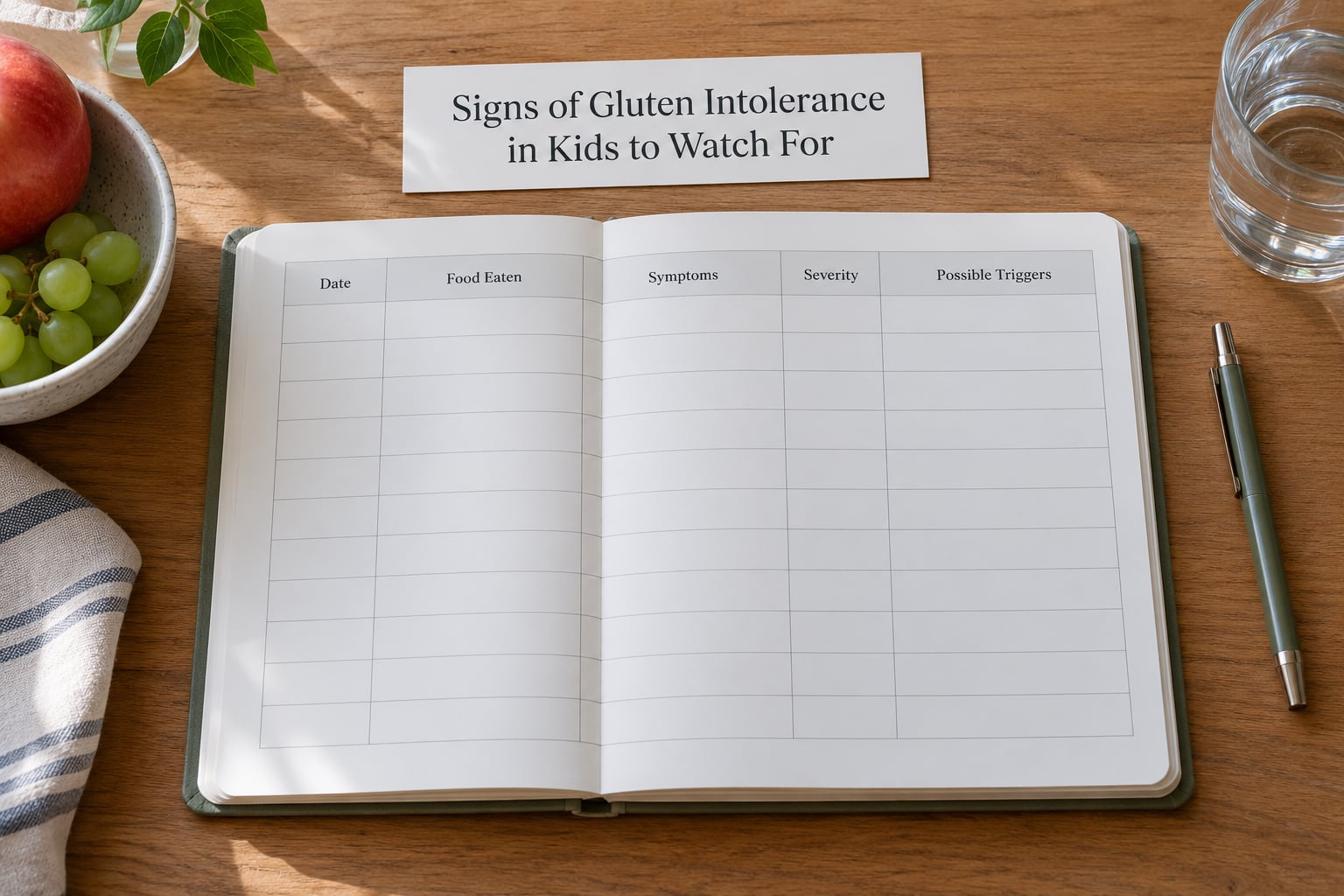
Keep it simple enough that you will still be filling it out in three weeks. One row per meal or per day, on your phone or a notebook.
- Date and time of the meal, and roughly what was eaten including the portion size.
- What the child was doing right before, such as a birthday party, a sports practice, or a long school day.
- Symptoms, with a severity score from 1 to 10 and how long they lasted.
- Bowel movements, including timing, consistency, and anything unusual.
- Any medication, antibiotic, or new supplement, and any illness in the past few days.
- Sleep the night before, and any change in mood or behavior.
Bring two to four weeks of this to the appointment. Patterns emerge quickly when the data sits in front of a clinician, and it turns a vague complaint into something actionable.
Silent Celiac Disease in Kids: When the Signs Are Easy to Miss
Some children with celiac disease have obvious digestive symptoms. Others have very few, and get labeled as picky eaters, anxious, or just fussy. Families sometimes find out only after a sibling or parent is diagnosed and the child gets screened too.
Watch for a child with no dramatic symptoms but a slow drift: dropping percentiles, low energy, unexplained anemia, an unexplained rash, or a school note about difficulty concentrating. Silence is not reassurance. If celiac disease runs in the family, ask your pediatrician about testing your child even when the symptoms are mild.
If you do go on to eliminate gluten, do it with a plan and a finish line: a set period of strict removal, then a careful reintroduction to see whether symptoms return. That reintroduction step is what turns a guess into a finding, and it should be supervised by a pediatric clinician or registered dietitian.
Should You Put Your Child on a Gluten-Free Diet?
Only with medical guidance, and only after celiac disease and wheat allergy have been considered. Starting a gluten-free diet on your own can create false test results, hide a condition that needs treating, and add nutritional gaps to a child’s day.
The list of naturally gluten-free grains is short, and so are the naturally gluten-free foods at a regular school lunch. Many packaged gluten-free products trade fiber for starch and can leave a child short on vitamins and minerals, especially if the diet removes whole grains without replacing them.
There is also a social cost that families describe vividly: separate lunches, birthday parties skipped, playdates that require a full explanation before your child can eat anything. Parents report their kids feeling left out of the pizza party far more often than they report physical trouble.
If a clinician does recommend gluten-free eating, our guide to how to start a gluten-free casein-free diet for kids covers the setup, and how to read a label for hidden gluten covers the ingredient-reading part. If no one recommends it, keeping your child’s diet normal is the safer and kinder default.
What a Gluten-Free Diet Can and Cannot Do for a Child
It can ease symptoms in a child who reacts to gluten, and it is the correct treatment for celiac disease and wheat allergy. It can also be genuinely hard to do well, which is why guidance from a dietitian matters.
It cannot diagnose anything on its own, it cannot replace follow-up testing, and it cannot fix symptoms caused by something else, such as IBS, anxiety, or an infection that has not fully cleared. Removing gluten from a child who does not need it removed adds stress and cost with no offsetting benefit.
How Do You Keep a Child Safe While Evaluating Symptoms?
While you watch and document, your job is to keep your child well-fed, unstressed, and connected to their doctor. Four habits cover most of it.
Preventing Cross-Contact at Home and School
Use separate toasters, cutting boards, and utensils if you are testing a gluten-free diet at home. Keep shared condiments, jams, and oils away from bread crumbs, and wipe surfaces before and after food prep. Check cereal, crackers, and granola bars, since malt and barley appear in more products than most parents expect.
Hidden gluten also turns up outside food. Prescription medications, vitamins, play dough, modeling clay, and even licking an envelope seal can add up. A pharmacist can check medications for you in a single call.
At school, ask about the cafeteria’s cross-contact practices and whether a written plan is possible. If symptoms are significant enough to interfere with the school day, a parent can ask about a 504 plan, which is the formal mechanism for documenting a medically related accommodation.
Keep the Diet Normal While You Watch
Keep your child eating a regular, varied diet. Do not skip meals, remove whole grains without a plan, or start multiple diets at once. Eliminating several foods together makes it impossible to know what caused what, and it usually ends with a fussy eater and no answers.
Do the same with medications and supplements. Note anything new, including antibiotics, since gut symptoms often follow infections.
Frequently Asked Questions
Can a child have constipation instead of diarrhea with gluten sensitivity?
Yes. Constipation is reported in children with gluten sensitivity and celiac disease, and families often miss it because they assume diarrhea is the only gluten-related bowel symptom. Signs include hard, painful stools, fewer bowel movements than usual, and a bloated or uncomfortable belly. Constipation has many common causes in kids, including low fiber, low fluid intake, and toilet timing, so it needs to be discussed with a pediatrician rather than treated as proof of anything.
How long after eating gluten can symptoms start in children?
It varies by child. Some show symptoms during the meal or within a couple of hours, others later the same day, and some not until a day or two afterward. Because the delay is unpredictable, a single episode rarely identifies the trigger. Look for a pattern across several weeks rather than a reaction after one meal, and keep a written record of foods, timing, and symptoms to bring to your pediatrician.
Is there a blood test for gluten intolerance in kids?
There is a blood test for celiac disease, not for non-celiac gluten sensitivity. The celiac screening panel checks antibodies such as anti-tTG IgA while your child is eating gluten, and a positive result may lead to an endoscopy with biopsy. NCGS is diagnosed by ruling out celiac and wheat allergy first, then watching how symptoms respond to a supervised gluten-free trial and reintroduction. Your pediatrician orders all of this.
What foods usually contain gluten?
Gluten is a protein in wheat, barley, and rye. Obvious sources include bread, pasta, pizza, cereal, crackers, and baked goods, plus beer and some baked snacks. Less obvious sources are malt, malt extract, brewer’s yeast, soy sauce made with wheat, and many packaged soups, gravies, and salad dressings. Naturally gluten-free grains include rice, corn, millet, sorghum, and quinoa, and oats are only gluten-free if certified.
Is a gluten-free diet safe for young children?
A gluten-free diet can be done safely, but only with planning and guidance. Many gluten-free packaged products replace fiber with starch, so a child can end up short on fiber, iron, and B vitamins if whole grains are simply removed. It is also harder at daycare and school because of shared toasters, fryers, and crumbs. If your child needs it for celiac disease or wheat allergy, ask a registered dietitian to build a balanced plan.
Can gluten intolerance in kids cause behavioral changes?
Parents report irritability, difficulty concentrating, low energy, and anxious or withdrawn behavior in children who react to gluten. These reports are consistent enough that doctors take them seriously. The problem is that none of these signs point only at gluten, and anxiety, sleep debt, sensory overload, and ADHD produce very similar patterns. Behavior changes are worth mentioning to a pediatrician, but they are supporting evidence, never a diagnosis on their own.
What to Do First
Start a simple food and symptom journal this week. Record what your child ate, when symptoms showed up, how bad they were, and what the bowel movements looked like. Two to four weeks of that gives a pediatrician something concrete to work with.
Do not remove gluten yet if celiac disease is even a possibility, because testing done after the diet starts can come back falsely normal. And do not restrict several foods at once, since you will lose the ability to tell what caused what.
If symptoms are recurring, changing your child’s growth, or interfering with school and sleep, book a pediatric appointment and ask whether screening for celiac disease or a referral to a pediatric gastroenterologist or registered dietitian makes sense. For blood in the stool, weight loss, persistent vomiting, severe pain, or dehydration, seek same-day care.