Cerebral palsy is usually described by the pattern of movement it produces: stiff muscles, involuntary writhing, poor balance, or a combination. The four main types are spastic, dyskinetic, ataxic and mixed, with unclassifiable cerebral palsy used when no single pattern fits. Here is what each one means and what the label does not tell you.
Table of Contents
- Types of Cerebral Palsy Explained for Parents
- What Is Cerebral Palsy?
- How Are the Types of Cerebral Palsy Classified?
- How Common Are the Main Types?
- What Is Spastic Cerebral Palsy?
- What spastic cerebral palsy looks like day to day
- Spastic subtypes by limb pattern
- What Is Dyskinetic Cerebral Palsy?
- Athetoid, dystonic and choreoathetoid
- What Is Ataxic Cerebral Palsy?
- What Is Mixed Cerebral Palsy?
- What Does the Level of Cerebral Palsy Tell You?
- How types of cerebral palsy explained for parents usually end up in two separate labels
- How Do Doctors Describe Cerebral Palsy in Practice?
- What Support Can Help a Child With Cerebral Palsy?
- What Should Parents Ask at the Next Appointment?
- Frequently Asked Questions
- Does every child with cerebral palsy walk?
- Can the type of cerebral palsy change as a child grows?
- Does cerebral palsy affect intelligence?
- How are therapy decisions actually made?
- Can cerebral palsy be diagnosed late?
- Is the GMFCS level permanent?
- A Calm First Step for Parents
Types of Cerebral Palsy Explained for Parents
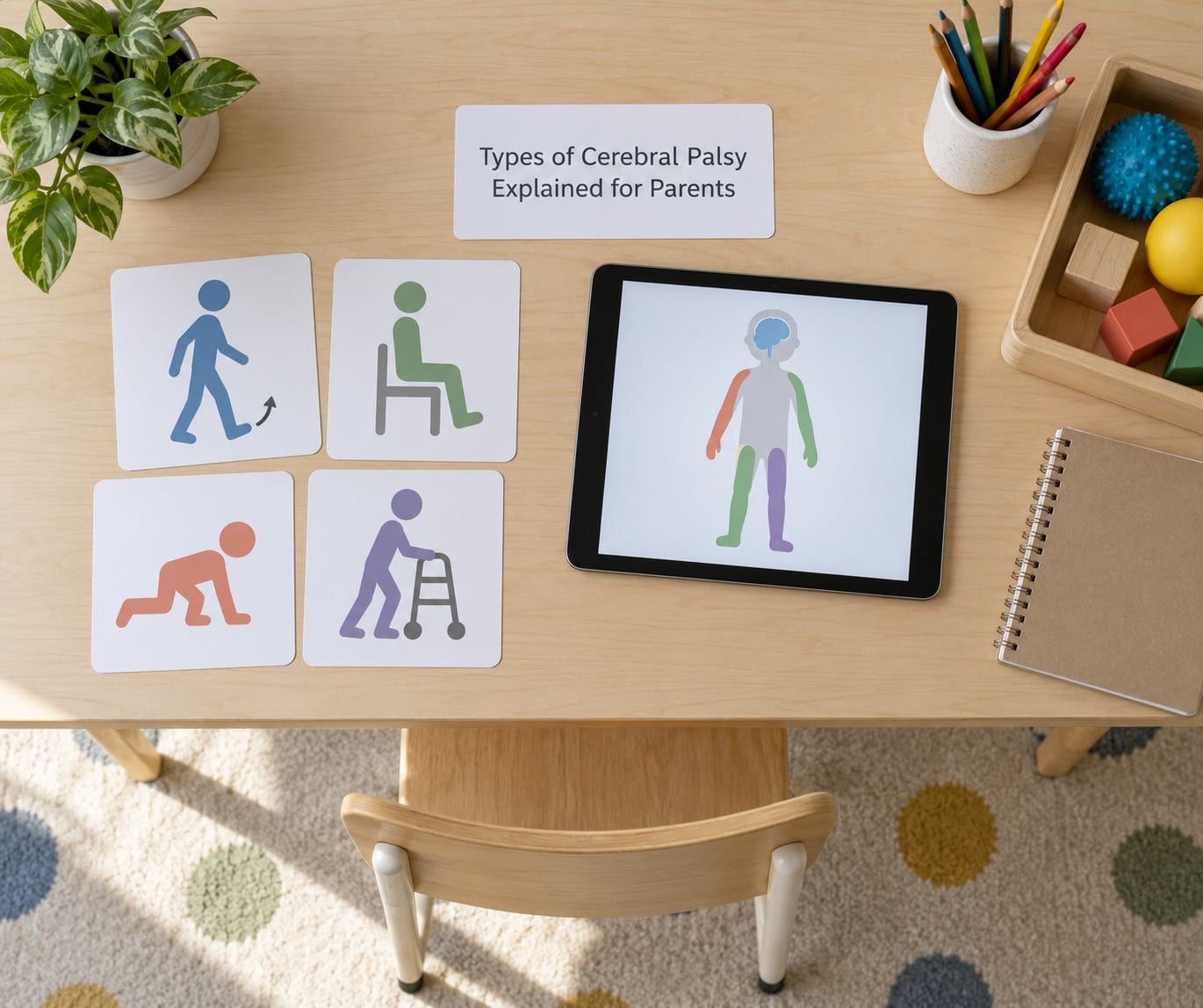
Parents rarely hear the diagnosis and the explanation in the same breath. A clinician says “spastic diplegia,” or “mixed CP,” or “GMFCS level III,” and then the appointment is over and you are googling abbreviations at 11pm. This section is the short version of types of cerebral palsy explained for parents, written so you can read it once and actually understand the words before the next visit.
Four main types are recognised, and each is defined by how the muscles behave rather than by how hard the condition is:
- Spastic cerebral palsy — muscles feel stiff or tight and resist being moved smoothly. It is by far the most common type, accounting for roughly 70 to 80 percent of cases.
- Dyskinetic cerebral palsy — muscle tone fluctuates and involuntary twisting, writhing or drifting movements appear, especially during effort or excitement.
- Ataxic cerebral palsy — balance and coordination are the main difficulty, including judging distance and depth, so movements look unsteady rather than stiff.
- Mixed cerebral palsy — the movement pattern shows features of more than one type, most often spasticity together with dystonia or athetosis.
Some children do not fit cleanly into any of the four. When no single pattern dominates, clinicians may describe the movement as unclassifiable cerebral palsy rather than force a category that does not fit.
What Is Cerebral Palsy?
Cerebral palsy is a lifelong condition that affects a person’s ability to control movement and posture. It happens when the developing brain is injured or develops differently before or around birth, and the areas that send movement instructions send imperfect signals.
It is described as non-progressive, and that word matters more than most parents expect. The brain injury itself does not spread and the condition does not march through stages. What does change is the child, and the supports they need.
Here is the part that surprises people: muscle tone is one symptom, not the whole picture. Movement, posture, balance, fine motor control, speech, swallowing, vision and cognition can each be involved in different combinations. A child who cannot walk may speak fluently. A child who walks may need help with handwriting and eating.
CP is also not one disease with one appearance. Two children both described as spastic cerebral palsy can differ enormously in mobility, communication, learning and daily support needs.
How Are the Types of Cerebral Palsy Classified?
Clinicians classify cerebral palsy by describing three things: the movement pattern, the distribution across the body, and what the person can functionally do. The type name comes from the movement pattern, not from severity.
If you have seen two different lists of the four types, you are not imagining it. Most resources use spastic, dyskinetic, ataxic and mixed. Some children’s hospital pages use hypotonic cerebral palsy in place of mixed, classifying by low muscle tone rather than by combination. Both approaches are used in practice, which is why a careful clinician will describe the actual movement instead of leaning on the label alone.
For a parent, the practical version of this classification is simple: the label is a description, not a forecast.
How Common Are the Main Types?
Roughly 70 to 80 percent of cerebral palsy cases are spastic, which is why spastic terms appear in so many clinic notes. The CDC reports that about 85 to 90 percent of cases are congenital, meaning the underlying brain difference was present at birth even when it was not identified until later.
| Type | Movement signature | Muscle tone | What the label does not predict |
|---|---|---|---|
| Spastic | Stiff, slow or awkward voluntary movement | Increased; stiff or tight | Whether the child walks, talks, or needs equipment |
| Dyskinetic | Involuntary twisting, writhing, drifting | Changes from low to high, often with sudden spikes | Speech, swallowing and seating needs, which vary a lot |
| Ataxic | Unsteady, wide-based, poorly judged movement | Often fluctuating or low in the trunk | Reading, writing and fine motor ability |
| Mixed | Features of more than one pattern | May be both increased and fluctuating | Which combination dominates day to day |
| Unclassifiable | No single pattern fits the description | Varies | Anything at all; the description is provisional |
Percentages vary by source and by population, so treat them as orientation rather than as a prediction about your child.
What Is Spastic Cerebral Palsy?
Spastic cerebral palsy is the most common type, and it is defined by increased muscle tone. Muscles resist being stretched, movements feel stiff or tight, and a child’s hand may stay fisted or an arm may pull in toward the body at rest.
What spastic cerebral palsy looks like day to day
A toddler may reach for something and have difficulty letting go. Legs may stay close together and stiff, or the heels may press down when trying to stand. Walking, when it happens, may use a scissoring pattern with legs crossing over each other. Speech, drooling and difficulty with fine motor tasks such as fastening buttons can occur alongside the stiffness.
Spastic subtypes by limb pattern
Clinicians add a second word to spastic that describes which parts of the body are most affected:
- Hemiplegic spastic CP — one side of the body is more affected than the other, so one arm and one leg may be stiff and harder to use. Some children with this pattern walk independently.
- Diplegic spastic CP — both legs are affected more than the arms. This pattern is very common in children born early, and it is the one most parents mean when they hear the word “spastic.”
- Quadriplegic spastic CP — all four limbs and often the trunk and face are affected. Because oral and bulking muscles can be involved, speech, swallowing and feeding support are more often part of the picture.
These subtype names describe distribution, not ability. Two children with spastic diplegia can sit, walk and communicate in completely different ways.
What Is Dyskinetic Cerebral Palsy?
Dyskinetic cerebral palsy is marked by involuntary movements and muscle tone that shifts. Movements often become more pronounced during effort, excitement, stress or fatigue, and may quiet down when the child is calm and focused.
The movements can be writhing and twisting, slow and flowing, or faster and more irregular. Posture control is often harder, and many children have significant difficulty with speech and swallowing because the same muscles of the mouth, throat and jaw move involuntarily.
Athetoid, dystonic and choreoathetoid
These terms are often used loosely. Athetoid describes slow, continuous, writhing movements, particularly in the hands and feet. Dystonic describes a sustained or fluctuating tightening of a muscle group that twists the body into a held position. Choreoathetosis describes a combination of faster, irregular movements with the slower writhing ones.
Dyskinetic cerebral palsy is also associated with a higher share of hearing and speech differences, so hearing checks and speech-language support are commonly part of the plan.
What Is Ataxic Cerebral Palsy?
Ataxic cerebral palsy is the least common of the four main types. Instead of stiffness, the defining difficulty is coordination and balance. Movement tends to be unsteady and wide-based, and judging distance or depth is hard, which is why depth perception comes up so often in descriptions.
Reaching for an object may miss. Sitting independently can take longer and involve more support. Balance reactions that most children develop automatically can be reduced, so falls may be more common. Fine motor tasks, including writing, drawing and handling utensils, are often the areas that need the most support.
Cognitive and communication ability are not defined by the ataxic label. A movement pattern that looks unstable on the outside can sit alongside very strong language, memory and reasoning.
What Is Mixed Cerebral Palsy?
Mixed cerebral palsy means the movement pattern shows features of more than one of the main types. The most common combination is spastic cerebral palsy features such as stiffness alongside dystonia or athetosis.
Because two patterns are present, “mixed” is the least informative word in the whole classification. It tells you there is more than one movement signature, and very little about which one shapes the day. That is why experienced clinicians describe the individual movement rather than stopping at the label.
If your child’s notes say mixed CP, a fair follow-up question is which pattern is most limiting right now, because that is usually the part therapy and equipment planning focus on.
What Does the Level of Cerebral Palsy Tell You?
How types of cerebral palsy explained for parents usually end up in two separate labels
This is the confusion that trips up most parents, so it is worth being blunt about it. Type describes the movement pattern. Level describes how independently the child moves. They are two separate labels, and a child can be spastic at one end of the level range or the other.
The system most families hear is the Gross Motor Function Classification System, or GMFCS. It has five levels, and it describes what a child can do independently at home, at school and in the community, not what therapy they deserve.
- Level I — walks without limitations; activities typical of a peer are possible, though fine motor tasks may need extra care.
- Level II — walks with limitations; activities often possible with hands free, and physical assistance is generally needed on uneven terrain or stairs.
- Level III — walks using a hand-held mobility device; support of the arms and trunk is often needed, and manual wheelchair use is common for longer distances.
- Level IV — self-propels a manual wheelchair, often with adapted seating; support is usually required when starting and stopping and over uneven ground.
- Level V — transported in a manual wheelchair in most settings; head and trunk posture support is usually needed, and comprehensive support is required.
There is also a similar scale for hands, called MACS, which describes manual ability during everyday objects and activities. Many families find it as useful as GMFCS because it speaks to the everyday fiddly stuff rather than walking.
What a level does not tell you: nothing about intelligence, communication ability, personality, emotional life, or potential. Parents in support communities say this repeatedly, and it is the part of the label clinicians most want families to hear.
How Do Doctors Describe Cerebral Palsy in Practice?
A pediatric neurologist or developmental pediatrician typically builds the description from several things they watch and review: how the child moves in a typical session, the feel of muscle tone in the arms, legs and trunk, which motor milestones have been reached and in what order, whether infant reflexes such as grasping or fanning persist beyond the expected age, and what the child can do independently.
They will also weigh medical history, including prematurity, low birth weight, multiple birth, infection during pregnancy, birth injury or a stroke, and they may consider imaging such as an MRI, an EEG if seizures are suspected, or genetic testing when the history does not fit the usual pattern.
Two honest caveats. First, the type is often provisional in a young baby, because the movement pattern can change as the nervous system develops, and a clinician may describe it as “most consistent with” a particular type and revisit it as your child grows. Second, no one should be attempting to assign a type from home. If you are reading this and wondering which box your child fits, that is a question for the clinician who examined them.
What Support Can Help a Child With Cerebral Palsy?
Support is always individualised, so think of what follows as examples of things families discuss with a care team rather than as a recommendation. What any one child uses depends on their type, their GMFCS level, their age and what they want to do.
- Physical therapy — movement, strength, positioning and mobility goals, including how to move safely.
- Occupational therapy — hands, dressing, feeding, and the everyday tasks that take independence.
- Speech and language therapy — communication, and swallowing safety when that is part of the picture.
- Equipment evaluation — orthotics, standing frames, seating, mobility devices and communication aids, assessed individually rather than bought on a list.
- Caregiver support — parent training, respite and parent groups, which are part of a plan rather than an afterthought.
Feeding often deserves its own plan. Many families run into texture refusal, gagging, or mealtime taking over the evening, and if your child is on a restricted range of foods, our guide to food chaining for picky eaters explained covers the general approach. Any changes to a child’s diet or swallowing plan need to come from their own clinical team.
In the United States, early intervention services for infants and toddlers and school-based services for older children are where most of this is coordinated. Eligibility rules differ by location, and your pediatrician can point you at the right intake office.
What Should Parents Ask at the Next Appointment?
Most parents leave a diagnosis appointment with a label and no question list. Bring these. They are written to be read straight off your phone.
- What movement pattern does my child have, and what specifically does that mean in daily life right now?
- Is the type description provisional, and at what age would you revisit it?
- What is my child’s GMFCS level, and what can I expect from that level in ordinary settings?
- What are my child’s clear strengths right now, not just the areas that need work?
- What therapy goals do you have for the next six months, and how will we know if they are working?
- What equipment might help, and what does an assessment for that equipment involve?
- Should we be watching for feeding, swallowing, vision, hearing or seizure concerns with this pattern?
- What changes should make us call sooner rather than wait for the next visit?
- Is a specialist cerebral palsy clinic or a second opinion worth pursuing?
- Who is our single point person for coordinating all of this?
That last question fixes more frustration than any equipment decision. Families in parent communities describe the coordinator problem constantly, because a care team without a contact person means every appointment starts from zero.
Frequently Asked Questions
Does every child with cerebral palsy walk?
No, and the type label alone will not tell you. Walking ability relates most closely to the GMFCS level and the pattern of movement, so a spastic diplegic child at one level may walk independently while another at a higher level uses a mobility device. A gait specialist can give you a more useful answer for your own child than any general statistic.
Can the type of cerebral palsy change as a child grows?
Sometimes the description changes, because young children’s movement patterns are still shifting and a provisional label gets revised. The underlying brain injury does not change, and the diagnosis of cerebral palsy itself is lifelong. If your child’s notes use words like most consistent with or provisional, ask the clinician when they would expect to re-describe the pattern.
Does cerebral palsy affect intelligence?
No, not as a rule. Cerebral palsy is a movement and posture condition, and cognitive ability varies widely across every type and level. Plenty of children with the most significant motor needs have typical or above-typical thinking, learning and communication. Avoid letting a mobility description stand in for a description of the child’s mind.
How are therapy decisions actually made?
Therapy goals come from the movement pattern, the GMFCS level, the child’s age and what matters to them, so the same type can lead to very different programmes. Goals are usually written as functional tasks your child is working toward rather than as amounts of therapy. Your child’s own team decides the plan, and you can ask them to explain why each goal was chosen.
Can cerebral palsy be diagnosed late?
Yes, sometimes noticeably later, especially in milder cases or where the early signs were read as a late-developer stretch. Diagnosis involves motor history, observation of movement and tone, milestone review, and often imaging. A later diagnosis is not a missed window in most cases, because early intervention support can still be arranged once the description is clear.
Is the GMFCS level permanent?
Levels can shift, particularly in early childhood, because a child may develop new skills or need a change of mobility support as they grow. Clinicians often describe a level as provisional and re-assess at intervals. A level that changes does not mean the condition worsened; it usually reflects development and a different support need at a new age.
A Calm First Step for Parents
Write down what your child can do well and what worries you, in plain words and with dates. Bring that page to the next appointment and ask for the movement pattern, the level, and the name of the person coordinating your child’s care.
Then let the type label do its small job: describing movement. The bigger things, how your child communicates, learns, plays and grows, are yours and your team’s to build, and they are not limited by a four-letter acronym.
This article is general educational information about how cerebral palsy types are classified. It is not a diagnosis and not a substitute for advice from your child’s own pediatric team. For guidance about an individual child, speak with a qualified clinician.