To teach kids coping skills, you name the feeling, model the strategy yourself, rehearse it while your child is calm, keep the tools within reach, and praise the effort instead of the result. If you learn only one thing from this guide, make it the second one: the teaching almost never lands in the middle of a meltdown, because a dysregulated child cannot process a new instruction. Aim for two or three calm minutes of practice a day, and you can start this week with nothing but a notebook.
I work with autistic kids and kids with sensory processing differences, and the most common mistake I see is well-meaning parents buying a whole coping curriculum and then trying to introduce it during a grocery store collapse. It does not work. The children who make progress are the ones whose parents pick one tiny skill, practice it in low-stakes moments for weeks, and stay boringly consistent about it.
Table of Contents
- What You Need — Less Than You Think
- Step-by-Step: How to Teach Kids Coping Skills
- Step 1: Observe Your Child’s Triggers and Early Signs
- Step 2: Teach One Coping Skill at a Time
- Step 3: Model the Skill Yourself
- Step 4: Practice When the Child Is Calm
- Step 5: Use Simple Cues and Visual Supports
- Step 6: Practice With Real but Manageable Situations
- Step 7: Generalize the Skill and Keep Supporting Practice
- Common Mistakes When Teaching Coping Skills
- Frequently Asked Questions
- How long does it take for a child to learn a coping skill?
- When should I start teaching coping skills?
- My child knows the coping skill but refuses to use it. What now?
- How do I teach coping skills to a child who is autistic or has limited communication?
- When should I talk to my child’s doctor or a therapist?
- What are the five R’s of coping?
- Conclusion: Start With One Small Coping Skill
What You Need — Less Than You Think
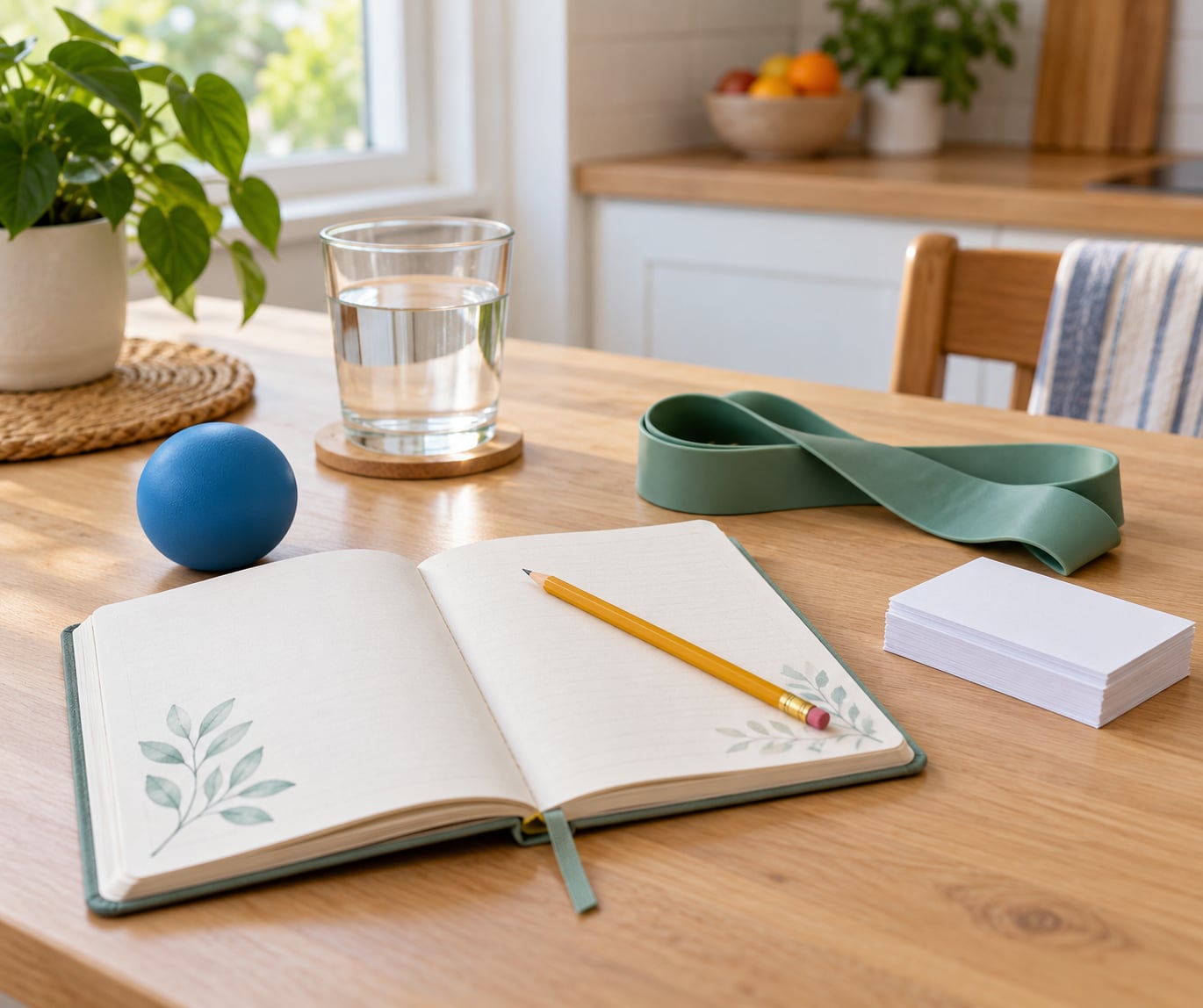
You do not need a curriculum, a printable deck, or a special room. Every family I have seen make progress was working with a short list of ordinary items, most of which are already in a drawer at home.
- A coping-skills notebook. A cheap spiral notebook is perfect. One page per day, three columns: what happened, what I noticed early, what we practiced. After two weeks it becomes your trigger map, and it is far more useful than any list of generic strategies.
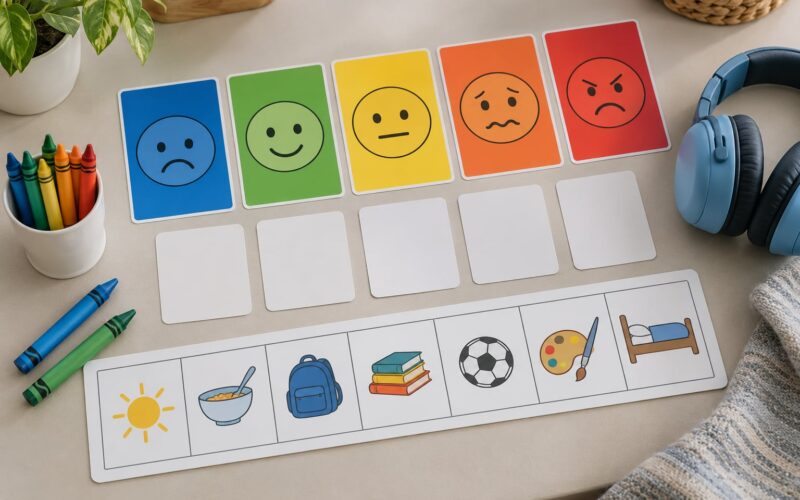
- Emotion or sensory cards. Photos of faces, or your child’s own expressions. Simple ones work: take ten phone photos of your kid mid-laugh, mid-frown, mid-meltdown, print them, and laminate them if you feel like it.
- A calm practice space. It does not need to be a corner with a cushion and fairy lights. It needs to be a spot where your child can sit for two minutes without an audience, and where you can sit with them.
- One or two sensory tools. A ball to squeeze, a resistance band to pull on, a small blanket, a water bottle. Check the label before you buy anything for a child under three, and skip scented or fragranced products entirely for little ones.
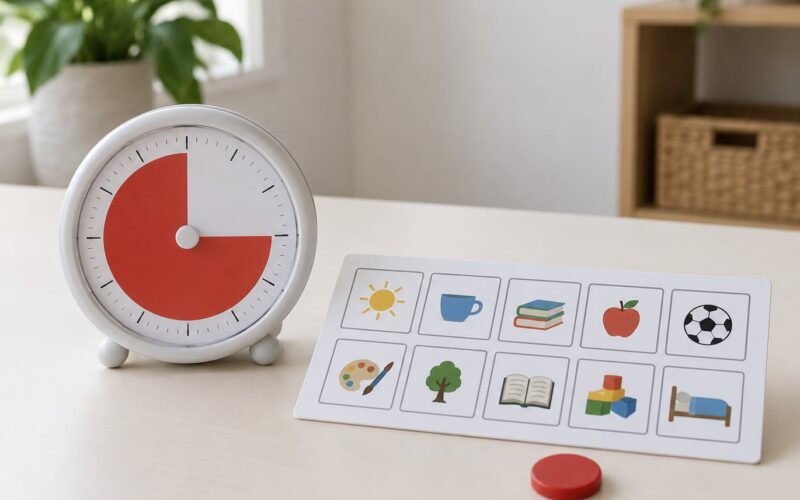
- Visual supports. Index cards, a whiteboard, a photo schedule on the fridge. Anything that lets your child see the plan instead of hear it.
If you want the movement-based version, I have written up 10 easy proprioceptive activities for kids at home that work with ordinary household items.
Step-by-Step: How to Teach Kids Coping Skills
Seven steps, in this order. The order matters more than the pace, and you can stay on one step for weeks without falling behind.
Step 1: Observe Your Child’s Triggers and Early Signs
Every child has a recognizable runway. Something happens, then a body signal appears, then the behavior arrives, and the adult usually notices at the third stage. Move your noticing to the second stage and you have bought yourself five to ten minutes of teaching time.
For my own kids the pattern is obvious once written down: dropped nap, then rubbing eyes, then the small whines that escalate. For a friend it was a change in routine, a redrawn path to the bathroom, a loss of control with no way to fix it. Log three triggers a day for a week. Common ones across kids: a noisy room, fatigue, hunger, a demand that requires waiting, or a transition with no warning.
How do you know it worked? You catch yourself offering a coping prompt while your child is still merely irritated, not already escalated. That is the whole win.
Step 2: Teach One Coping Skill at a Time
Pick one skill and only one for two weeks. A toddler will learn a single reliable move. A child who is handed five options usually tries none of them, and that is a choice they make, not a failure.
Good first picks are concrete and physical: asking for a break, saying “help me,” three belly breaths with a pinwheel, wall pushes, a calm-down card handed to an adult, or getting permission to leave the room. Waiting for a turn is one I would not start with, because it asks for a large amount of self-control at once.
Keep the goal small enough that your child can succeed while tired. If they use it once in a week, that is a win. If they use it five times, you are ready for the next skill.
Step 3: Model the Skill Yourself
Children copy regulation long before they perform it. Narrate your own coping out loud in plain words: “I am frustrated, so I am going to pause and breathe first, then we will try the puzzle again.” Say it while you actually do it, and come back to the task afterward so your child sees the whole sequence.
The follow-up is the part parents skip. Saying “I’m taking a break” and then never returning teaches avoidance instead of regulation. Return every time, and say one plain sentence about what happened next.
If your child learns better from watching than from listening, record yourself doing the sequence once and replay it. I wrote more on that here: how to use video modeling to teach life skills.
Step 4: Practice When the Child Is Calm
Teaching happens in the good moments, which is the least intuitive part of this whole plan. A calm child can hear you, hold a thought, and copy a sequence. An overwhelmed child can do none of that, no matter how much you want them to.
Rehearse in two-minute blocks. A five-minute puppet show where the bear asks for a break and then gets one. Picture cards laid out on the table. Pretend play at the doctor so the real appointment is not the first try. A video of a kid using the skill calmly, watched twice in one week.
How do you know it worked? Your child starts using the words or the gesture before you prompt, in a moment when nothing much is happening. That is the skill moving from practice to automatic.
Step 5: Use Simple Cues and Visual Supports
Give your child one short cue word and one consistent response. The word can be “break,” “breathe,” or “help.” The response can be a hand signal, handing you a card, or touching the wall. The fewer words, the better, because a dysregulated child has almost no working memory left for a sentence.
For children who do not yet read, speak, or connect a face to a feeling word, the cue has to be physical. A picture on a lanyard, a button on a board, a hand over the heart, or a device with a single icon they can tap. Two words that mean the same thing (calm and relax) create confusion, not options. Pick one label and use it every single time.
Step 6: Practice With Real but Manageable Situations
Once the rehearsed skill holds up in play, try it in a situation that is mildly hard and completely safe. A short wait for a turn at the playground. Pausing a preferred activity one minute before a transition, with a timer your child can see. A change of plans you announce ten minutes ahead.
Praise the attempt, not the performance. “You asked for a break and then came back” is the sentence that builds self-regulation. “Good job, you did it perfectly” teaches nothing and often makes a child avoid trying a skill where they might fail.
For neurodivergent children, add one sensory tool to the situation. A wall push before a transition, a resistance band in a pocket, headphones available without being asked for. Talk-based strategies alone rarely touch a sensory-driven meltdown, which is a pattern parents on sensory and ADHD threads describe again and again.
Step 7: Generalize the Skill and Keep Supporting Practice
A skill only counts once it works with a different person, in a different room, at a slightly harder level. Keep the cue word and the response identical, and change only the setting at first: home, then the car, then the school pickup line.
Then fade your prompting in small steps. Full prompt, partial prompt (you point, they act), gesture only, no prompt. Most parents quit at the gesture stage and assume the skill did not stick, when the child simply needs another two weeks at that level of support.
Keep practicing the retired skill for a few weeks even after a new one starts. A coping repertoire grows rather than replaces, and skills get used again in situations you did not plan for.
Common Mistakes When Teaching Coping Skills
Teaching five skills at once. A child chooses the one that is easiest to refuse. Fix: one skill, two weeks, written at the top of the notebook page so you remember too.
Waiting until the child is already overwhelmed. This is the number one reason coping programs feel like they do nothing. Fix: use your notebook log to intervene at the early body-signal stage, and accept that the goal during a real meltdown is safety and regulation, never instruction.
Using the skill as a threat. “Use your breathing or you go to your room” turns a regulation tool into a punishment, and kids will drop it. Fix: the coping space is always available, voluntarily, and nothing bad happens there. A calm corner nobody is sent to as a consequence stays a place children will actually go.
Trying to correct harmless sensory behavior. A child who rocks, spins, or fidgets during an overload is doing something regulating, not misbehaving. Fix: add input (a push, a weighted blanket, movement) rather than asking them to stop, and check with their occupational therapist about what helps their particular profile.
Praising only clean results. If only a perfect performance earns praise, children stop attempting the skill in situations where it is hard. Fix: praise the noticing and the effort, which is the part you want them to repeat.
Expecting a skill to transfer immediately. A skill taught at the table does not appear at the school playground on its own. Fix: expect six to eight weeks of the same practice before you call it learned, and expect co-regulation from an adult to be the first stage rather than a failure of the method.
Two habits matter more than any tool: regulate yourself first, because a regulated adult is the regulation your child borrows, and individualize, because a skill that works for one child is often useless for another who is wired differently.
Frequently Asked Questions
How long does it take for a child to learn a coping skill?
Most children need six to eight weeks of consistent practice before a coping skill shows up without a prompt, and the first two weeks often look like nothing is happening. Judge progress by early signs, not by the big moments: an easier recovery, a shorter meltdown, or a request for the tool a week earlier than before. If your child uses the skill once a week when you have offered it daily, that is real progress, not failure.
When should I start teaching coping skills?
Start as soon as your child can recognize that something feels different inside them, which is often around age two, though there is no such thing as starting too early. Keep it concrete at first: a breath, a push, asking for help. Toddlers learn physical and sensory strategies fastest, and words-based strategies catch up years later, so a two-year-old’s coping skill should be something they do with their body, not something they say.
My child knows the coping skill but refuses to use it. What now?
Refusal is usually not defiance. A child who is already dysregulated cannot access the skill, and a child who was taught it as a condition tends to reject it. Offer it as a choice rather than a requirement, keep the tool visible and within reach instead of handing it over, and go back to rehearsing during calm moments for a few more weeks. If the child uses it for you during play but not in real situations, the problem is prompting, not the skill.
How do I teach coping skills to a child who is autistic or has limited communication?
Replace talk with a physical cue, because sensory-driven dysregulation is not fixed by verbal reasoning. Use one word, one gesture, or one icon on a communication device, and keep it exactly the same every time. Pair every coping skill with sensory input such as wall pushes, a resistance band, or a weighted item, and build in adult co-regulation, where a calm adult helps regulate alongside the child rather than waiting for the child to do it alone.
When should I talk to my child’s doctor or a therapist?
Talk to your pediatrician or a licensed therapist when distress lasts most of the day, when it interferes with sleep, eating, or school, when there is physical aggression you are worried about, when the child loses skills they had, or when you see a flat or very cheerful mood most of the time. Seek urgent help for any talk or plan of self-harm. You do not need to wait for a crisis to ask for help, and a waitlist is a good reason to call now.
What are the five R’s of coping?
The five R’s are a memory structure parents use to teach the whole sequence rather than a single trick: Recognize the feeling and its body signals, Regulate the body first, Relate to the feeling without judging it, Reason through the problem once the body is calmer, and Reflect afterward on what worked. Kids reliably learn Recognize and Regulate first, and Reason and Reflect usually only come online in the elementary years, so expect a partial sequence to be normal.
Conclusion: Start With One Small Coping Skill
Pick one trigger you can now catch early, choose one skill your child could physically do tomorrow, and practice it for two calm minutes a day for two weeks. Write it in the notebook, keep the cue word identical every time, and judge it by easier recoveries rather than by perfect performance.
Then adjust everything to your child’s communication style, sensory profile, developmental level, and the real stress happening in your home right now. A skill that fits your child beats a longer list that does not, every time.