Positive reinforcement ideas for kids with autism come down to one thing: add something your child genuinely enjoys right after a behavior you want to see more of, so that behavior gets stronger. The reward does not have to be a toy or a treat. For many autistic children, a specific piece of praise, a short movement break, or two acceptable choices does more work than anything bought.
What follows is twelve approaches that families have found usable at home, grouped by what they reinforce and how they are set up. I have kept the examples concrete, because vague praise is the most common reason reinforcement stalls. Pick one routine, one behavior, and one reward before you read any further.
Table of Contents
- 12 Positive Reinforcement Ideas for Kids at a Glance
- 1. Reinforce the First Step of a Difficult Routine
- How do positive reinforcement ideas for kids work in practice?
- 2. Use Specific Praise Instead of Generic Compliments
- 3. Add a Preferred Activity After a Successful Routine
- 4. Use a Visual Token System
- 5. Reinforce Helpful Coping Behaviors
- 6. Offer Choice as a Lightweight Reward
- 7. Use Interest-Based Reinforcement
- 8. Reinforce Trying or Repairing After a Mistake
- 9. Build a Simple ‘First, Then’ Board
- 10. Provide a Calm Social Reward
- 11. Use Sensory or Movement Reinforcement
- 12. Celebrate Visible Progress, Not Perfect Performance
- Frequently Asked Questions
- How often should I reinforce my autistic child?
- Are food rewards okay for autistic children?
- What if my child does not respond to praise or high-fives?
- Can positive reinforcement make a child more dependent on rewards?
- When should I ask a pediatrician or behavior specialist for help with behavior?
- Conclusion
12 Positive Reinforcement Ideas for Kids at a Glance
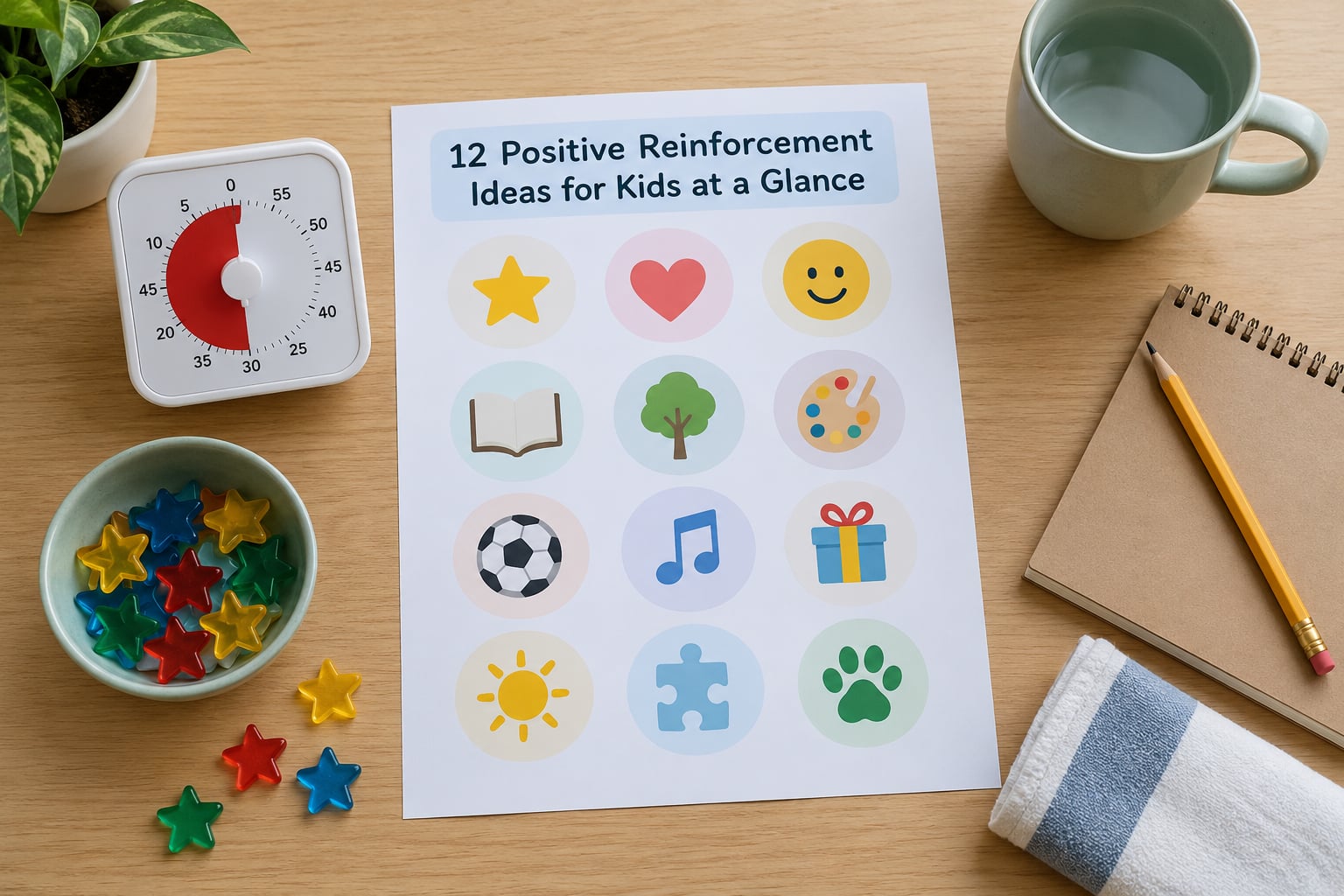
Every idea below targets a different part of a day. Match the row to the routine that is currently hardest, rather than working through the whole table at once.
| Idea | Routine or behavior it supports | Reinforcement used | Why it can fit an autistic child |
|---|---|---|---|
| 1. First step | Morning dressing, leaving home, homework | Immediate praise for the opening action only | Makes an intimidating routine startable without over-demanding |
| 2. Specific praise | Any task, retry, or wait | A sentence naming the exact action | Reduces guessing about what the adult wanted |
| 3. Preferred activity | Brushing teeth, clean-up, homework ending | Short child-chosen activity | Uses interests that already hold attention, in a small dose |
| 4. Token system | Multi-step routines over a week | Tickets, check marks, or a jar | Makes effort visible without public comparison |
| 5. Coping behaviors | Meltdowns, transitions, overload | Reinforcing the break request itself | Supports regulation instead of only rewarding compliance |
| 6. Choice | Snacks, clothes, next activity | Two acceptable options | Adds control cheaply, with no prize required |
| 7. Interest-based | One specific routine | A small piece of the special interest | Holds motivation already known to work |
| 8. Trying and repairing | Puzzles, spills, mistakes | Acknowledging the attempt and the recovery | Rewards persistence rather than perfection |
| 9. First, then board | Bedtime, school prep, appointments | Visual sequence plus the follow-up activity | Removes the question of what comes next |
| 10. Calm social reward | Transitions and finished tasks | Short, predictable one-to-one time | Connection without the noise of group praise |
| 11. Sensory or movement | High-energy or under-stimulated stretches | Water, swinging, heavy work, brief obstacle course | Meets sensory needs instead of fighting them |
| 12. Visible progress | Longer-term skills | A note, photo, symbol, or plain sentence | Marks real gains that a task-based chart misses |
1. Reinforce the First Step of a Difficult Routine
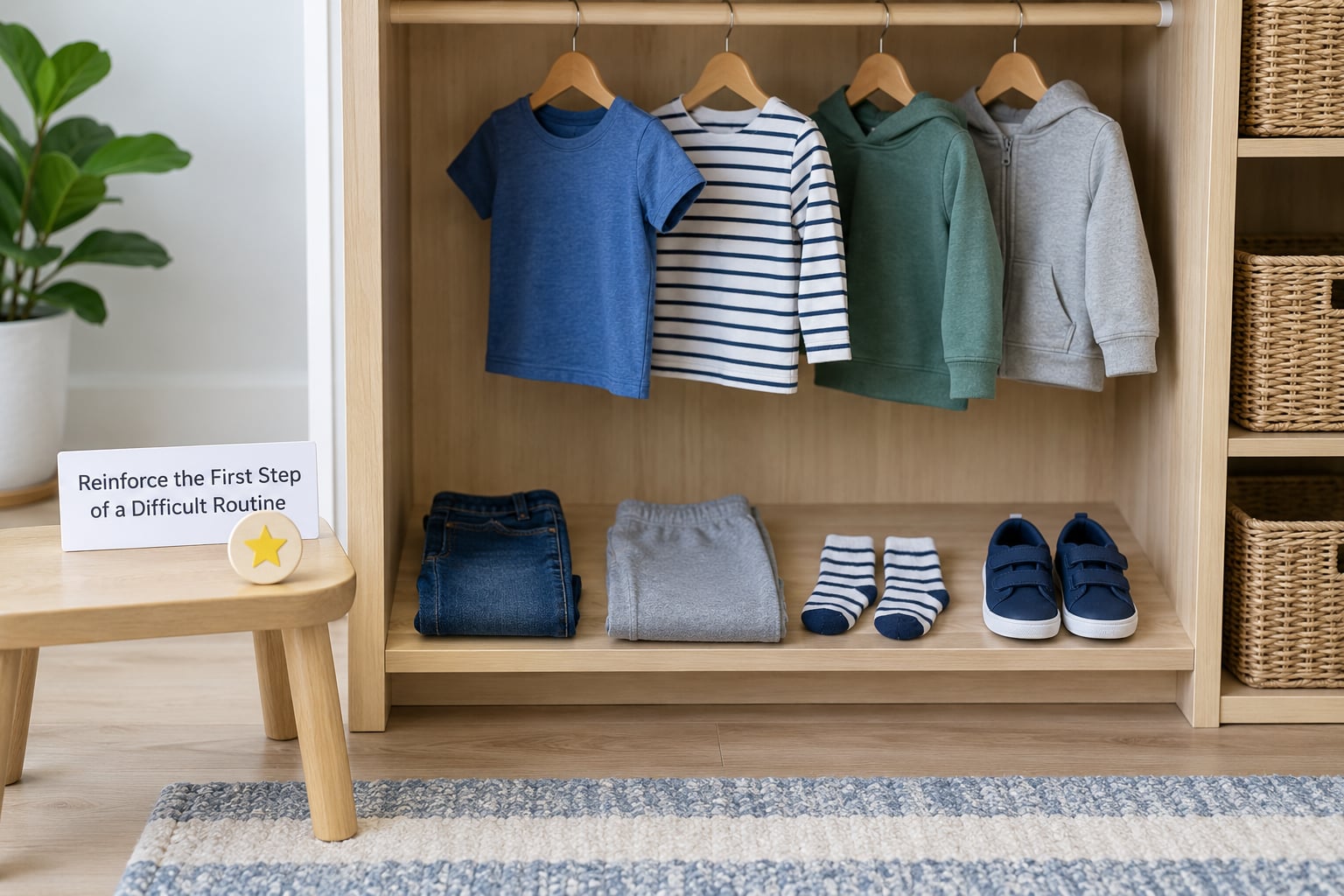
The hardest part of a hard routine is the beginning. If mornings collapse at the point where socks go on, reinforcing the whole morning routine is a goal that is simply too distant to aim at. Reinforce the socks and nothing else for the first week.
Say it plainly, within seconds: “You got your socks on by yourself. That was the hard part.” For leaving the house, reinforce the step at the door, not the drive. For homework, reinforce opening the book and writing the date, then stop. The rest tends to follow more often than parents expect.
How do positive reinforcement ideas for kids work in practice?
Four steps do most of the work. Define one behavior you can count, make it small enough to happen today, reinforce it immediately, then fade the support gradually rather than removing it all at once.
Concretely: choose socks, not morning routine. Make it achievable by doing the first one together. Reinforce within seconds with something the child likes. Fade by going from doing it with them, to pointing at it, to trusting them, over two or three weeks.
Timing matters more than size. A reward delivered an hour later teaches a child that the connection between the two is loose, which is why end-of-day totals often disappoint while immediate praise works.
2. Use Specific Praise Instead of Generic Compliments
“Good job” tells a child almost nothing. They cannot act on it tomorrow, and for a child who reads language literally, vague praise is close to no information at all. Name the action, then add one honest detail about how they did it.
Scripts worth copying: “You put your socks on without asking.” “You waited while I finished on the phone.” “You tried that puzzle again after it broke.” “You finished all six pages before dinner.” Notice how each one describes an action rather than a personality trait. “You are such a good helper” is pleasant but vague; “you brought the shoes over before I asked” is usable.
Keep it short. A long speech of praise is harder to process than a single sentence, and for a child who finds social input tiring, three words delivered quietly can land better than a paragraph delivered loudly.
3. Add a Preferred Activity After a Successful Routine
Once the teeth are brushed and the room is clear, hand over something the child actually chooses. Two minutes of the thing they picked beats a long promised outing they have to wait a week for.
Size the reward to the child’s regulation. A child who is already activated at the end of homework needs something calm, like a blanket in a favorite corner, not a bouncing game. A child who shuts down after a hard morning routine needs the swing or the sensory break before anything else happens.
Decide in advance what the activity is and how long it lasts, then stop at the agreed time without negotiation. If the reward expands every day, it stops being a reinforcer and turns into a negotiation.
4. Use a Visual Token System
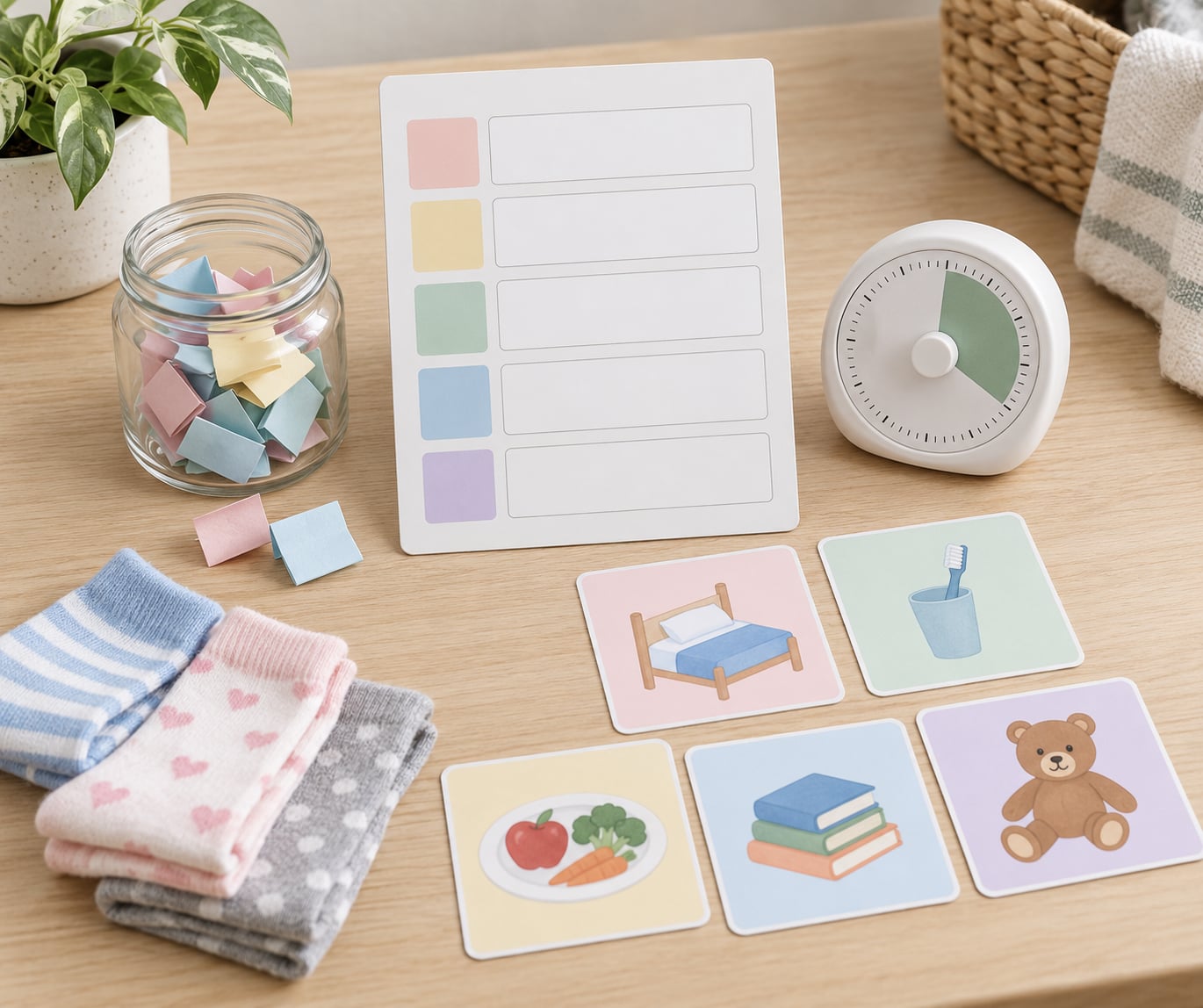
A token economy is simple: one token for one instance of the behavior, exchanged for something at the end. A glass jar, paper tickets, poker chips, or check marks on a calendar all work. The value comes from the exchange being visible.
Keep the target inside one week. If a five-token goal needs three weeks to reach, most children lose interest first. Younger children usually stay motivated with smaller counts and quicker exchanges; older children can handle a longer horizon if the exchange value is clear.
Never put the board on the fridge where siblings can compare. Parents report the fastest way to end a reward system is a sibling who counts a higher number out loud. Keep it in the child’s own space, and keep the exchange one-to-one.
If tokens stop working after a few days, do not add a bigger prize. Change something else: shorten the target, swap the reward, or move to idea 12 and mark progress instead.
5. Reinforce Helpful Coping Behaviors
Most plans only reward finished tasks. That misses the behaviors a child needs most when things go wrong. Reinforce asking for a break, handing over a calm-down card, walking to the quiet space, taking a movement break, and coming back to the activity.
This is the one that changes a hard afternoon fastest. A child who is told “good job asking for a break” learns that the request itself earns something, rather than that the request is a problem to be resisted.
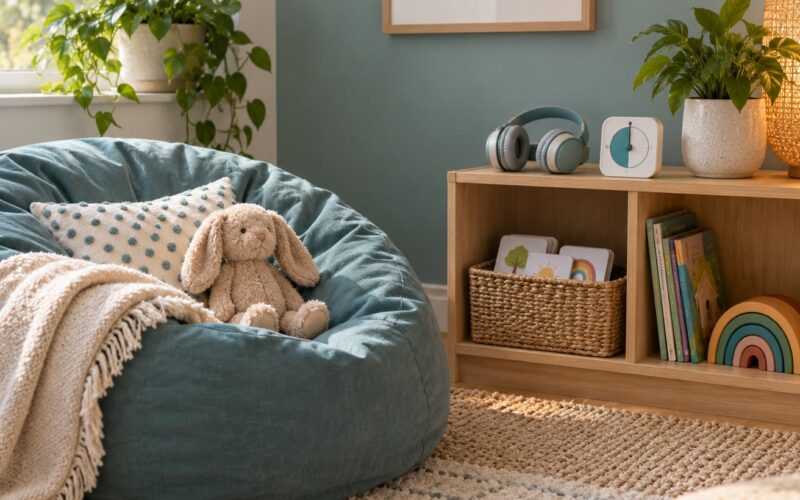
It also gives adults a cleaner alternative to arguing about whether a meltdown was justified. The rule stays simple: the coping behavior is reinforced, the behavior that came before it is addressed separately and calmly. Our guide to building a calm down corner at home has practical setups if you need somewhere for that break to happen.
6. Offer Choice as a Lightweight Reward
Two acceptable options, offered calmly, often increase cooperation more than any sticker. It costs nothing and it returns something a child wants: control over a small piece of a day.
Try it for snacks (apple or pear), clothes (blue or green shirt), what happens first (teeth or pajamas), or where a transition starts (you carry the shoes, or I do). Keep both options acceptable to you, and say them the same way each time so the offer itself becomes predictable.
One caution: choices used as rewards stop feeling like rewards fast. If every snack is a choice, save it for the moments where you need a little purchase.
7. Use Interest-Based Reinforcement
Whatever your child fixates on is already worth more than anything in the cupboard. A character sticker, two minutes of a favorite music clip, a vehicle printed on a card, or the chance to talk about a preferred topic for five extra minutes can be tied to one specific routine.
Tie it to something narrow, like idea 1. Shoes on, then one clip. Finish the homework page, then two minutes of talking about trains. Narrow links are easy to repeat, and repetition is what builds the routine.
Watch for the drift where the interest becomes the only reason to participate. If the child insists on the clip or refuses the routine without it, shorten the reward rather than removing it abruptly, and add something else they genuinely enjoy.
8. Reinforce Trying or Repairing After a Mistake
Perfect results are not a realistic target for most children. Persistence and recovery are. Reinforce the attempt, the retry, and the cleanup, and those are the habits that carry into harder things later.
Concrete moments worth naming: picking the puzzle pieces back up, asking you to repeat the instruction, taking a break and coming back, wiping up spilled water, or saying “I need another try.” Praise the behavior at the moment it happens: “You tried that three times and kept going.”
This one is unusually useful for autistic children, who may already be hard on themselves about mistakes. Recognizing the effort instead of the result gives them a script for handling frustration that does not depend on things going well.
9. Build a Simple ‘First, Then’ Board
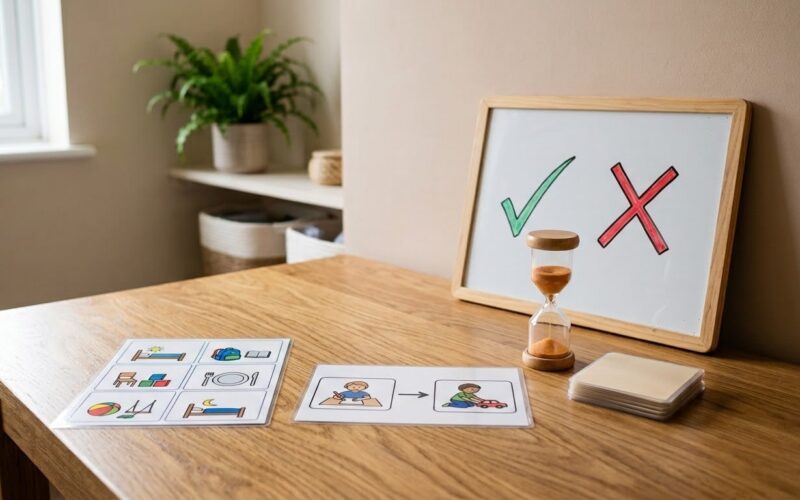
A first-then board is two panels: the task that comes first on one side, the predictable follow-up on the other. It removes the daily negotiation about what happens next, which for many autistic children is a bigger source of distress than the task itself.
Bedtime works well: first pajamas, then one story. School morning: first shoes, then a song in the car. Appointments: first socks and coat, then a stop at the park on the way back. Photos beat drawings for many children, and keep the follow-up one your child can actually picture.
Attach the exchange and this becomes a reinforcement system rather than a schedule. Then fade it. Once the sequence is stable, drop to just the photo of the activity that follows, and after a few more weeks, drop that too.
10. Provide a Calm Social Reward
Some children find praise exhausting. Attention from a parent can be more stimulating than the task deserved, especially after a noisy day. For those children, the best social reward is quiet and short.
Ten minutes of undivided time with no request attached works as well as anything bought. So does a slow dance, a special greeting that becomes a ritual, a knock on the door before a goodnight visit, or sitting together with the lights dim and nothing else scheduled.
Keep it predictable and keep it brief. The pattern should be the same each time: same time of day, same short phrase, same activity. And avoid group praise formats like announcing good behavior to everyone, which parents of sensory-sensitive children consistently report as more punishing than rewarding.
For practice with shared activities rather than adult-led praise, our turn taking games for kids are built around small, repeatable steps.
11. Use Sensory or Movement Reinforcement
For a child with high energy or a strong need for movement, a short sensory or movement break is not a consolation prize. It is the reinforcement, and it gets used more consistently than any sticker.
Options that take under five minutes: a water break at the sink, swinging, wall pushes or a bear crawl for heavy work, a lap around the hallway, or a two-step obstacle course made from cushions. For children who seek input, keep it available often; for children who avoid input, keep it short and predictable.
The line between a reward and regulation is blurry here, and that is fine. A movement break after a finished routine serves both purposes at once, and the proprioceptive activities we use at home give you a wider set of options when the short ones wear thin.
12. Celebrate Visible Progress, Not Perfect Performance
The last idea is the one that outlasts the rest. As tasks get easier to do, reward the shrinking of support instead of the finished product. Fewer prompts, less protest at the transition, one step done without a reminder. Those are the gains worth naming.
Mark them simply. A note on the fridge, a photo in an album, a symbol on a calendar, or one spoken sentence you deliberately say out loud: “That took one reminder today instead of five.” Specific and visible beats a general sense of progress you never quite articulate.
Families who fade out of tokens and charts usually report the same result: the behavior holds once the external reward disappears, because the child can now name what they gained from it. That is the point of the whole system, and it arrives quietly rather than all at once.
Frequently Asked Questions
How often should I reinforce my autistic child?
Reinforce the chosen behavior every single time it happens in the first week, even if that means constant comments. Consistency teaches the link between the action and the payoff. After the behavior feels more automatic, move to intermittent reinforcement: catch most occurrences, not every one. Reward effort and progress too, not just completion, so the connection lasts once rewards thin out.
Are food rewards okay for autistic children?
Food works as a reinforcer, but it is easiest to handle as a celebration of a shared moment rather than a per-occurrence payment. Routine payments of sweets can teach a child that food is something earned by performing, which many parents find uncomfortable later on. If you do use food, keep it small, non-routine, and separate from the daily routine, and always offer it alongside something social like a shared activity.
What if my child does not respond to praise or high-fives?
Some autistic children find verbal praise and physical attention uncomfortable or meaningless, and that is not a failure on your part. Switch the channel rather than pushing harder. Try a written note, a quiet high-five they can choose to accept, or something entirely non-social like tokens, a first-then board, or a movement break. Reinforcement only works if the child finds the reward genuinely pleasant.
Can positive reinforcement make a child more dependent on rewards?
It can, if the reward stays exciting and the child never learns the behavior is worth something on its own. The fix is fading: after two or three stable weeks, add descriptive feedback that names the value of the behavior, then reduce the reward to something predictable and small. If a behavior collapses the moment you remove the chart, the habit was never formed yet.
When should I ask a pediatrician or behavior specialist for help with behavior?
Ask for advice when a behavior is physically risky, when it is consistently getting worse rather than better, when it is affecting sleep or eating, when your own stress is high, or when nothing you try changes anything over several weeks. A pediatrician can rule out pain, sleep problems and constipation, which often look like behavior. An occupational therapist or behavior specialist can help you read what the behavior is communicating.
Conclusion
These twelve positive reinforcement ideas for kids with autism all follow the same simple order: name one behavior small enough to happen today, choose a reward your child genuinely enjoys, deliver it immediately, and fade the support gradually. Start tonight with one routine, one achievable action, and a reward that costs nothing.