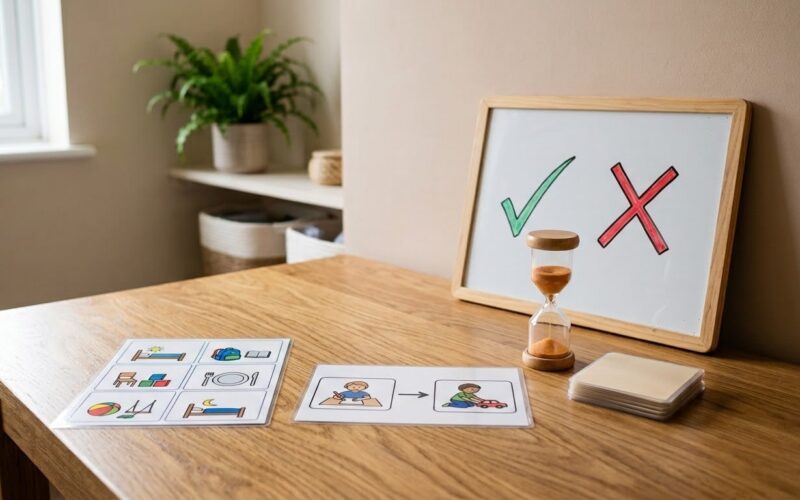

Disciplining a child with autism works best when you treat it as teaching, not punishing: clear visual rules, few calm words, a predictable consequence, and specific praise for the behavior you want more of. It takes a week or two of steady practice before most families notice a change, and the first few days are usually the hardest.
Most parents I talk to are not looking for a technique that makes their child obey. They are looking for a way to stop the hitting, the screaming in the grocery aisle, the refusal to put on socks, without their child learning to fear them. That is a different goal, and it is a reachable one.
What follows is the plan I would hand a tired caregiver on a Tuesday night: what to gather, the seven steps in order, and the mistakes that quietly undo everything. Updated for 2026.
Table of Contents
- What You Need
- Step-by-Step
- 1. Identify the behavior and its trigger
- 2. Teach and rehearse the expected behavior
- 3. Choose a clear, proportionate consequence
- 4. Set the limit with brief, neutral language
- 5. Follow through consistently
- 6. Help the child regulate and repair
- 7. Review what worked
- Common Mistakes
- Arguing the point
- Overexplaining
- Changing rules without warning
- Delaying the consequence
- Punishing a meltdown or stimming
- Ignoring the communication signal
- Taking away earned rewards
- Losing your own composure
- Frequently Asked Questions
- Why does my child with autism not follow instructions?
- How do I discipline my child for hitting without making them afraid of me?
- How do I calm an autistic child having a tantrum or meltdown?
- How do I stop an autistic child from screaming when there is no obvious trigger?
- How do I discipline a nonverbal autistic child?
- When should I see a behavior analyst or therapist about my child’s behavior?
- Conclusion
What You Need
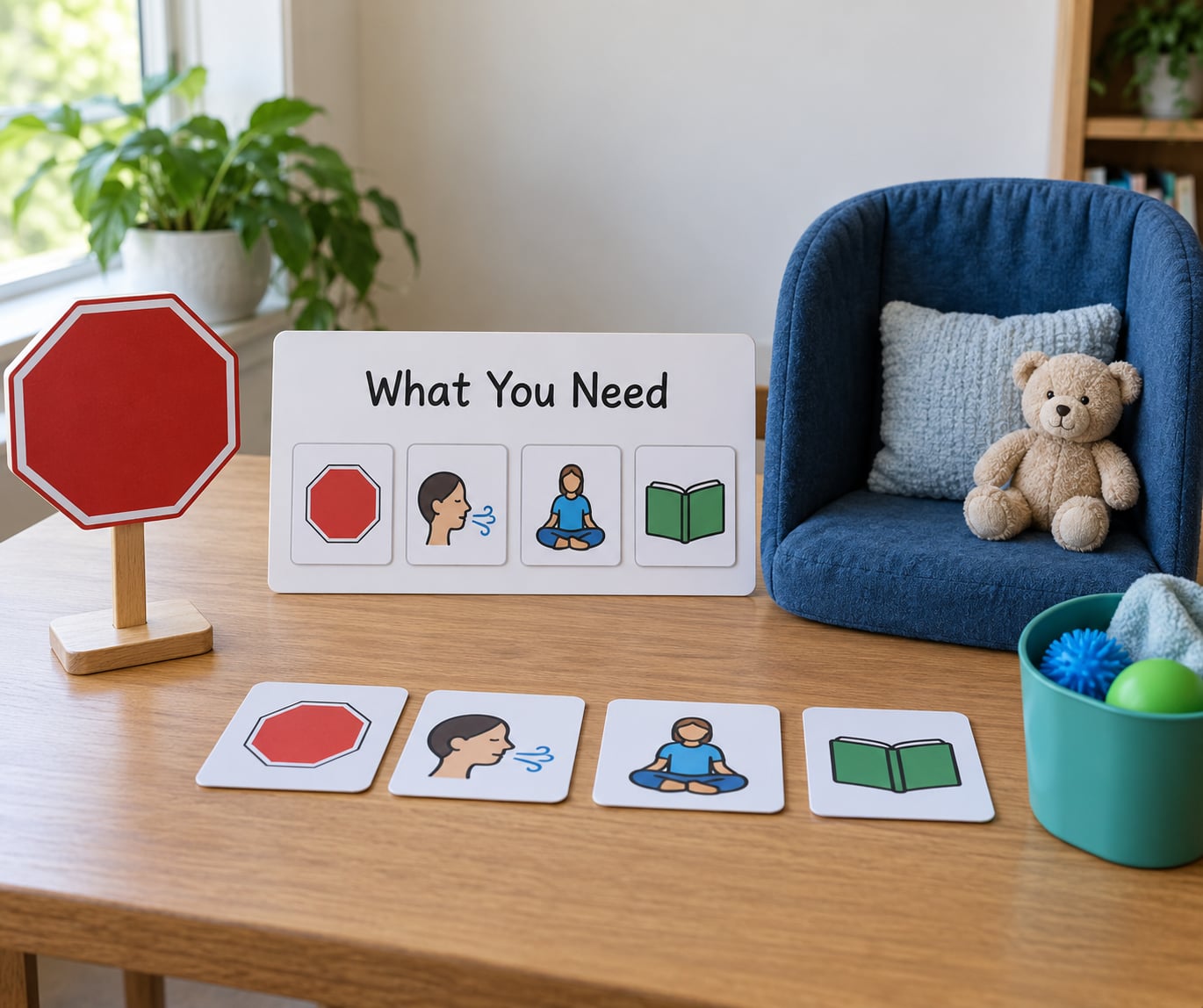
You need very little to start. Gather it before you need it, because searching for a card while a child is mid-meltdown guarantees you will not find it.
- One written behavior description. Write the observable action, not the label. “Pushed his brother twice during the 20 minute block” beats “gets aggressive.”
- Picture rule cards. Two or three rules, each one photo or drawing plus three or four words. Laminate them if you have the chance.
- A first-then board. “First shoes, then iPad.” This is the single most useful tool for transitions.
- A quiet space already set up. Not a time-out chair facing a wall, but a spot with headphones, a weighted blanket, or a fidget that belongs there by default.
- Your consequence, decided in advance. One sentence, written down, so you are not inventing it while furious.
- Reinforcers tied to what your child actually likes. Most autistic children care less about stickers than adults assume, and more about their special interest.
- A one-page data sheet. Date, what happened right before, what the child did, what you did. Fifteen seconds a day.
Step-by-Step
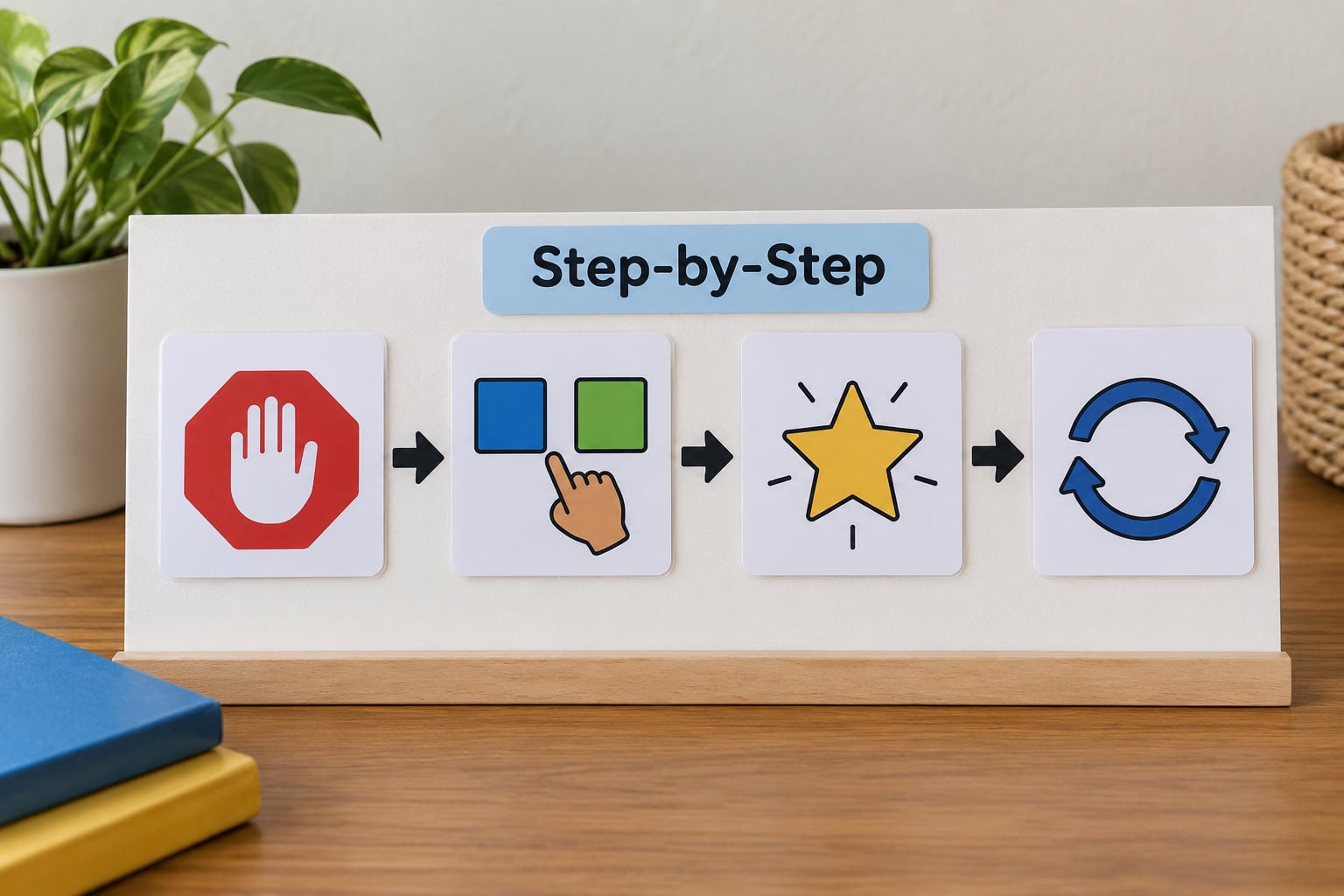
Run these in order. Skipping step one is why so many discipline plans fail in week two.
1. Identify the behavior and its trigger
Write down what happened immediately before. Noise level, how many demands were stacked up, whether there was a transition warning, how long since sleep or food, and what the child was trying to say. A screaming episode that always lands on Thursday afternoon at 4pm is a scheduling problem, not a character problem.
Then decide how serious it is. Hitting another person and throwing a toy are not in the same category. Sorting them early stops you from treating a sensory release the same way you treat a dangerous act.
2. Teach and rehearse the expected behavior
A new rule introduced during a crisis is a new rule the child will not absorb. Break the expectation into one visible action, model it, and practice it when things are calm. Play through the scenario like a rehearsal: it is shoes, then socks, and here is how the first-then board works.
Give a warning before every transition. A visual timer set for five minutes does more for a resistant child than asking nicely three times.
3. Choose a clear, proportionate consequence
Pick something safe, logical, and short: a supported break in the quiet space, the noisy activity ends for now, or losing the next turn of a game. Keep it connected to the behavior. A child who is overwhelmed by noise does not need a day without television on top of it.
Consequences that are far away teach nothing. An hour later, the connection between the two events is gone.
4. Set the limit with brief, neutral language
Few words, flat tone, one warning, then the next action. “Hands off your brother. I am stopping you. Now the break card.”
Skip the lecture about why hitting hurts. Many autistic children process tone and facial expression literally, so an angry face adds a new variable to a moment that is already too loud. Autistic adults describe this same experience from the other side: they often remember being told they were bad long before they understood the rule.
5. Follow through consistently
Every adult in the house runs the same plan. If you stop at the first sign, every other time is a practice run for the child. Agree on the wording and the timing with your partner, your co-parents, and the school so the response matches in every setting.
While the behavior is happening, do not argue, lecture, or negotiate. If it is safe, wait through the pause. And do not hand out extra attention in the middle of the episode, which is often exactly what is reinforcing it.
6. Help the child regulate and repair
Lower the demands first. Turn down the volume, close the blinds, drop the next instruction entirely. Offer the quiet space without calling it a punishment, and help your child come back when they are ready rather than when you are done waiting.
Then reconnect without a forced apology. Sitting together quietly is a repair. “You are safe now, I am here” is a repair. A lecture at the end is not.
For the harder end-of-day cases, our guide to how to help a child with homework meltdowns has the same regulation steps written out for schoolwork.
7. Review what worked
At the end of the week, read the sheet. Look for the trigger that shows up most, how long recovery took, and which response actually changed the next occurrence. Most plans get simpler once you can see the pattern.
Share what you found with the people who work with your child. If home rules and classroom rules drift apart, the child is the one paying for it. A weekly check-in with the teacher is a good place to keep the language identical on both sides.
Common Mistakes
These are the errors I see most, and each one has a fix you can make this week.
Arguing the point
Debating rules while a child escalates teaches nobody. Name the boundary once, then stop talking. Words stop landing somewhere around the fifth sentence.
Overexplaining
A long explanation gives more chances for the words to be misunderstood. Cut it to under ten words and add a visual instead. If your child does not speak, a card or AAC app does the work your words cannot.
Changing rules without warning
New rules appear after a bad afternoon and the child decides the world is random. Introduce one rule at a time, show it ahead of the day, and let it run for two weeks before adding another.
Delaying the consequence
You mention the hitting at dinner and take away a later activity. Nothing is connected. Respond inside the moment or skip the consequence entirely rather than making an unrelated one.
Punishing a meltdown or stimming
Never punish a child for a sensory overload or a meltdown they could not control. Stimming is self-regulation, and taking it away removes the coping tool. Parents describe the relief of taking stimming off the behavior list entirely.
Ignoring the communication signal
Repetitive screaming is often a message about pain, noise, or being stuck. A parent on one forum put it well: redirecting to another sensory outlet fixes the cause, while a punitive consequence only fixes your anxiety. If the behavior returns unchanged for weeks, that is a sign to get assessment help rather than more discipline.
Taking away earned rewards
Stickers already on the chart stay on the chart. Removing them retroactively teaches that effort can be erased, which is the opposite of what you want.
Losing your own composure
A reactive punishment after a bad day is the most common failure mode, and it is a you problem, not a child problem. Use the pause protocol: hand the child to another adult if one is there, leave the room for sixty seconds, breathe, and come back. You cannot co-regulate from inside a meltdown of your own.
Frequently Asked Questions
Why does my child with autism not follow instructions?
Most often because the instruction was too long, too abstract, or arrived with no warning. Autistic children also struggle to shift attention, so a task change needs a transition cue rather than a verbal command. Add a five-minute visual timer, offer two choices instead of one open request, and check whether noise, hunger, or fatigue is driving it before you call it defiance.
How do I discipline my child for hitting without making them afraid of me?
Block the hit safely, keep your voice flat and your face neutral, and state one short sentence: hands off, hitting stops, now the break. Then move to a supported quiet space and reconnect when the child is calm. No lecture and no eye contact demand. Research links harsh parenting with worsening emotional and behavioral problems over time, so the low-conflict route protects the relationship you rely on.
How do I calm an autistic child having a tantrum or meltdown?
Drop your demands first, then lower sensory input: lights down, volume down, fewer people in the room. Offer the quiet space without calling it a punishment and stay nearby without talking. A meltdown is not a teaching moment, so hold off on consequences and reconnect once the body settles.
How do I stop an autistic child from screaming when there is no obvious trigger?
Track it before you try to fix it. Write down the time, noise level, demands, sleep, and food for a week, and a pattern usually appears. Meanwhile lower the arousal around the hot spots and teach a replacement signal, such as handing you a card or squeezing a fidget. Screaming that never changes in response to your approach is worth an OT or behavior specialist review.
How do I discipline a nonverbal autistic child?
Discipline still works, but everything moves to visuals and AAC. Use picture cards for the rule and the consequence, keep the teaching session very short, and praise with something your child can enjoy rather than verbal approval alone. Never withhold communication access, since it is the one tool they need most.
When should I see a behavior analyst or therapist about my child’s behavior?
Ask for a functional behavior assessment if the behavior risks injury, targets other people, or has not changed after six to eight weeks of a consistent plan. Bring your data sheet, since analysts work from patterns. A board certified behavior analyst, occupational therapist, or your child’s pediatrician can help, and self-injury or harm to others warrants a call sooner rather than later.
Conclusion
Learning how to discipline a child with autism comes down to four things you can start tonight: pick one behavior, write down what happens right before it, choose one short consequence, and run the same calm plan every time. No shouting, no punishing a meltdown, no withdrawing the things your child uses to cope.
Then bring the plan to the people around your child. School, therapy, and home should say the same words and follow the same sequence, and you can start that conversation with keeping pace with the classroom demands in view.
If you would like help working this out, share your child’s age, how they communicate, and the one behavior you most want to change, and I can help you draft the exact script and the one-page plan.