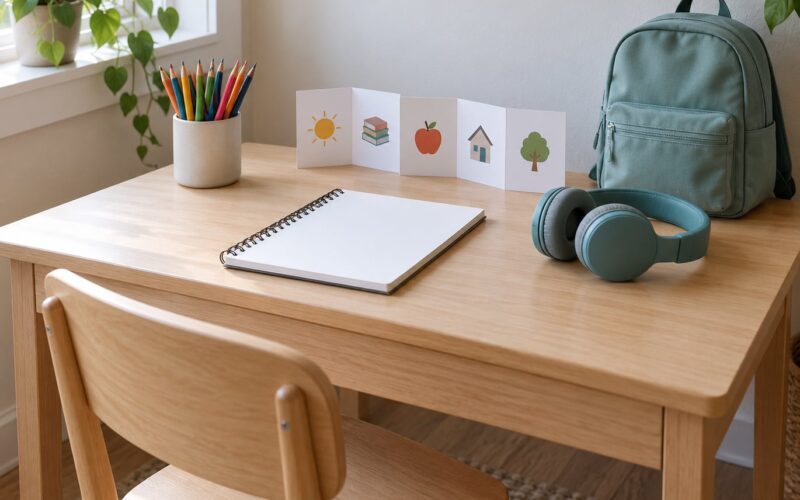
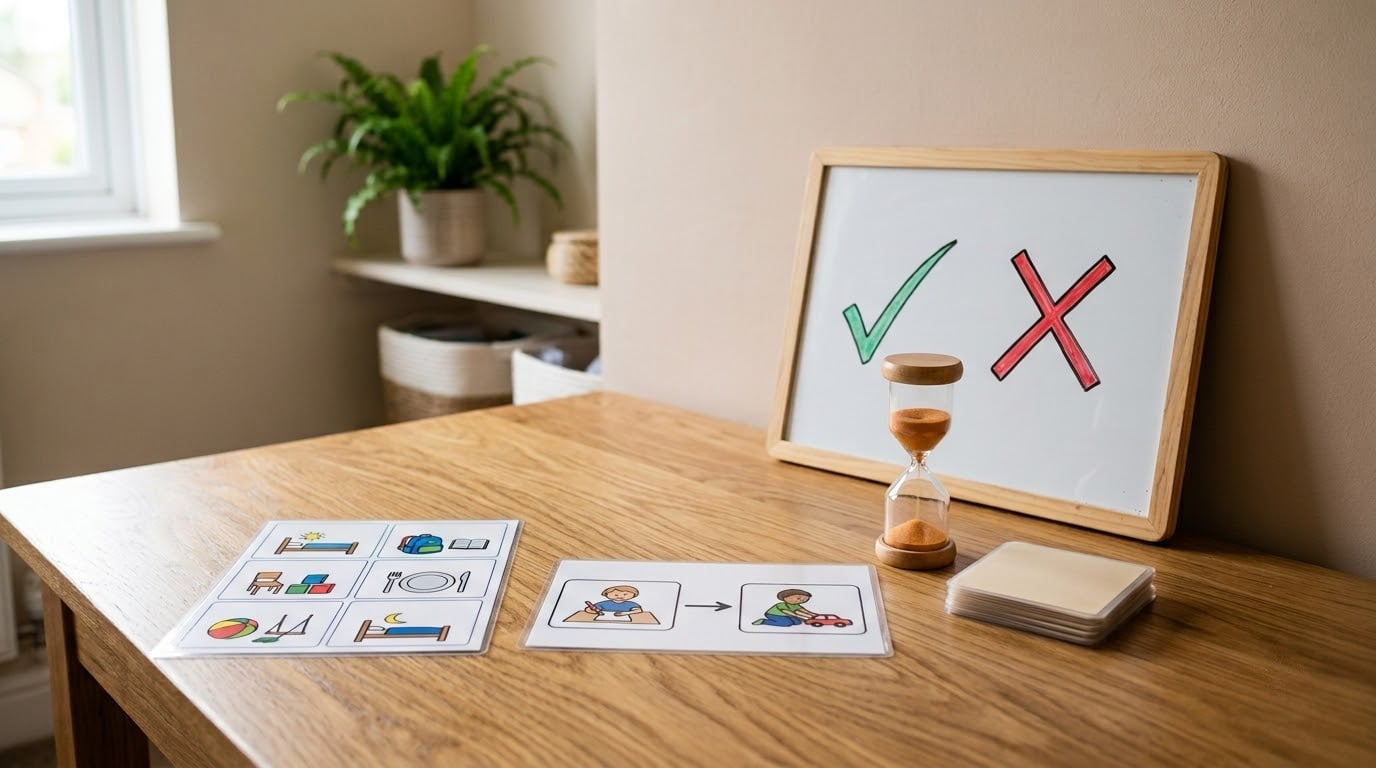
Saying no to an autistic child is one of those ordinary moments that becomes a crisis fast. The short answer for how to teach an autistic child to accept no: keep the word concrete, pair it with a picture or card, say it the same way every time, and show that a no has a visible end. Then practice it in short, calm rounds instead of in the middle of a meltdown. Most families see a shift within a few weeks of five focused minutes a day.
Autistic children frequently hear a no as three things at once: no, finished, discussion over. Parents on r/Autism_Parenting describe exactly this, and it matches the black-and-white thinking many autistic children rely on when information is unclear. Polite language can quietly make things worse, because words like please and when you can imply the request was optional all along.
That is not a character flaw and it is not stubbornness. Accepting a boundary is a skill, and skills get taught rather than absorbed. This guide walks through the whole process as it stands in 2026, from the visual supports you set up to how you handle the round when it goes sideways.
Table of Contents
- What You Need
- Step-by-Step: How to Teach an Autistic Child to Accept No
- 1. Choose a calm, low-stakes moment
- 2. Say no clearly, once, and mean it
- 3. Pair the no with a visual and a finish signal
- 4. Teach wait before you teach no
- 5. Practice with one tiny request first
- 6. Let your child practice the response
- 7. Handle tears, meltdowns, and outright refusal
- 8. Track progress and generalize slowly
- Common Mistakes
- Frequently Asked Questions
- How old should my autistic child be before practicing accepting no?
- What if my autistic child does not speak or understand the word no?
- Why does my child become more upset when I say no?
- Should I repeat the same request after my child accepts no?
- How can I teach accepting no without forcing my child to comply?
- When should I ask an occupational therapist or behavior specialist for help?
- A Gentle Place to Begin
What You Need
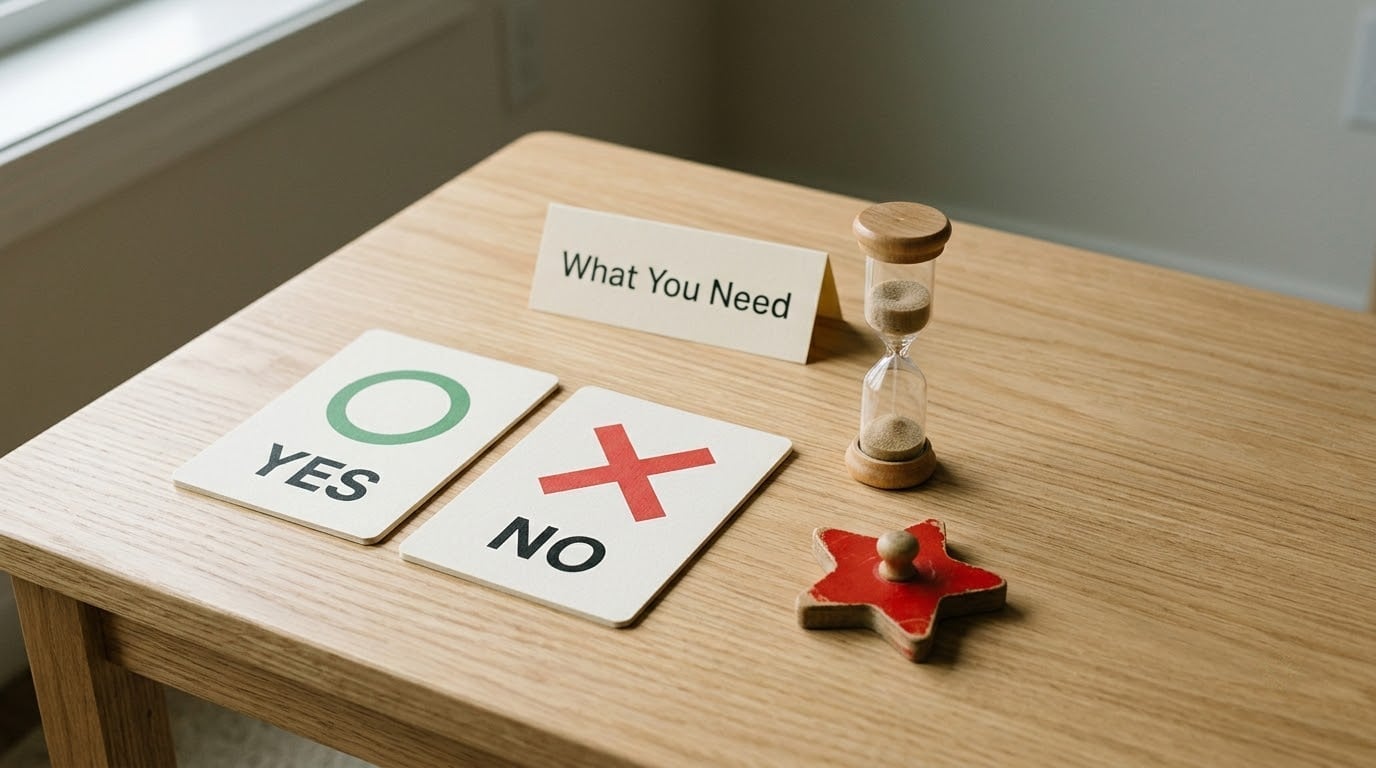
You need less than the parenting aisle suggests. None of this requires an app, a program, or a specialist to begin, and most of it costs nothing.
- A calm, low-demand moment. A fed, rested child who is not already overloaded is the entire prerequisite. Rushing this is the most common reason practice fails.
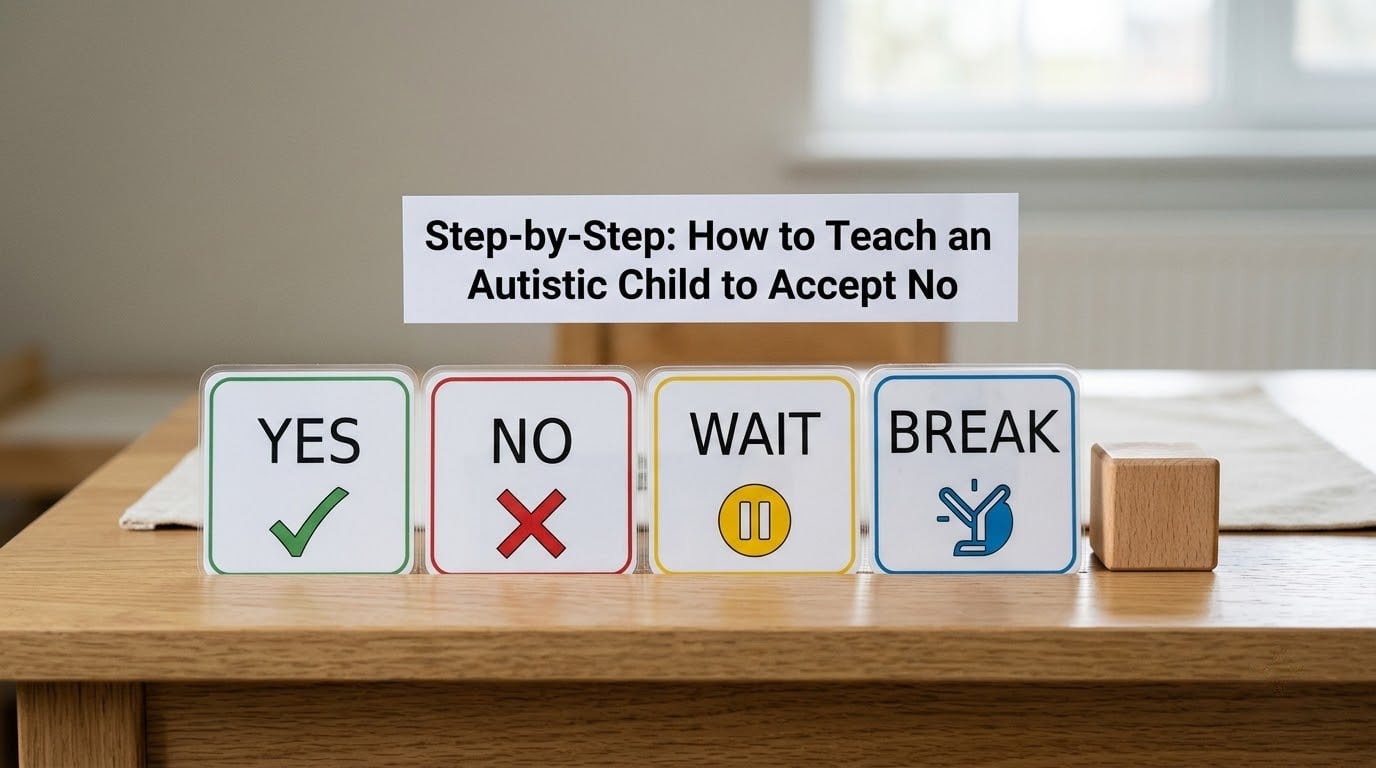
- One visual. A printed NO card, a STOP card, a YES card, or three lines on a whiteboard. Consistency matters far more than how it looks.
- A first-then board, even a homemade one. FIRST: Legos. THEN: the park. That is the Premack Principle, often called Grandma’s Rule, in its simplest form.
- One short script you can say from memory, the same way every single time.
- One small request that matters enough to be real and small enough to be safe to refuse.
- A preferred item or activity to hand over right after your child handles the no well.
- A timer, so the no has an end you can show rather than describe.
- Something to jot notes in. Two minutes of tally marks is enough to track progress.
For a nonverbal child, add a communication route before you add practice. A picture exchange board, a speech-generating app, or a laminated break card the child can hand you all count.
Timing matters more than most parents expect. If evenings are already the hardest part of your day because everything runs late and sensory load is high, read our guide to [helping an autistic child sleep through the night](https://www.embracingimperfect.com/how-to-help-an-autistic-child-sleep-through-the-night/) first. Lowering the load makes every other skill easier to teach.
Step-by-Step: How to Teach an Autistic Child to Accept No
1. Choose a calm, low-stakes moment
Pick a moment when the answer does not matter much. Your child wants the second banana and you have one. They want to stay in the car and the park is closed. Real enough to feel like something, small enough that you can survive the answer.
Then protect that moment. If you start practice at 7pm after a rough afternoon, the first round will teach you nothing. Two good rounds a week beat seven rounds in a week that already went sideways.
Before you begin, decide what you are actually teaching. Not obedience. You are teaching that a boundary can be heard without the world ending.
2. Say no clearly, once, and mean it
Keep it short, flat, and single. The script that works for most families: No. That choice is finished. Then you move on, physically and verbally.
Skip the softening. Not no, but maybe later. Not no sweetie, you can have it after dinner. Hedging teaches that the answer is under review, and many children will immediately open a negotiation.
Keep the answer the same every time it comes up. If you said no to the extra snack twice, the third time is not a fresh decision. Parents often say the word more than they think they do, and repeating it to make it clearer rarely does.
Do not defend yourself mid-sentence. If there is a real reason, give it before the answer: the banana is the last one, so today it is one. Your child needs a rule, not a case.
3. Pair the no with a visual and a finish signal
Show the NO card at the instant you say the word, every time. Repetition builds the association, and it also removes ambiguity for children who hear words literally and miss tone entirely.
Leave the card up for a few seconds, then put it away. That way your child sees the signal arrive and sees it end, which is the part most of us skip.
Pair the no with a timer. Say no, start the timer, and when it rings you move to the THEN side of the board. Now the no has a shape. Many autistic children struggle with time concepts, so a visible end does work the word later cannot.
Check the room before you start. Dim lights, move your child away from the window, offer a weighted item or a fidget, and lower your own voice. A bright, noisy kitchen is a hard testing ground for a brand-new skill.
If your child uses AAC, add a no symbol to their board right away, not later. The card they hand you is not a consolation prize, it is the whole lesson.
4. Teach wait before you teach no
Waiting is the prerequisite skill. A child who cannot tolerate a 30-second delay will not absorb a boundary at the end of a preferred activity, and asking them to do both at once usually ends in noise.
Start with waiting for something small. Ask for the marker, pause, hand it over. Ask again, pause, hand it over. Stretch to five seconds, then ten. Reinforce the wait itself, every single time, even when it is hard, because that is what makes it durable.
Only then move the wait to the end of something preferred. Legos, then wait, then snack. Parking, then wait, then music. You are teaching the pause as a bridge to the good thing, and once that bridge exists, a no at the end of it is no longer an ambush.
5. Practice with one tiny request first
One request per round. Say no, show the card, wait, then hand over the preferred item the moment your child does something acceptable: hands off the bananas, break card returned, move to the calming spot, a verbal check-in, or simply a body that stops escalating.
That last one is the reinforcement. You are not rewarding obedience or silence. You are reinforcing any response that keeps the child and the moment safe, which is a far lower bar and a much more honest one.
Keep rounds under a minute at the start, five rounds at a time. Stop while it is still working. Ending early means the next round starts with a child who has a positive memory of the last one, and that memory is the fuel for everything after.
Name what you saw while it is happening. You handled that well. You asked and then you waited. Specific praise teaches more than a general good job, because it tells your child exactly what to repeat.
6. Let your child practice the response
Give your child acceptable ways to answer a no. Some of these are words and some are not, and all of them count.
- No back, in their own way, including a nod or handing you the card
- Why? You answer briefly, once, and you do not negotiate
- A break card, then a return to the routine
- Moving to a calming spot without being sent there
- Signing, pointing, or typing it on an AAC device
Accept a gesture, a push away, a sound, or a steady look as a real no and respond to it exactly the way you would respond to the spoken word. When you stay calm, you are teaching that communication pays off, which is a bigger win than compliance.
Let your child say no to you when it is accurate, too. If they genuinely do not want the banana, that is useful information. Letting one no land teaches the skill in the direction you want, not just the direction you want control.
7. Handle tears, meltdowns, and outright refusal
When it escalates, drop the demand. Reduce words, reduce volume, reduce distance. Sit nearby and say I hear you, this is still no, then hand over the break card and stop talking. A meltdown is not a teaching window, and arguing inside one only teaches you both something worse.
Protect everyone. If there is risk, do what you need to do and put the teaching back on the calendar. You can revise a plan on Tuesday. You cannot un-teach the idea that a no means a fight.
Regulate yourself first. Say the whole script out loud beforehand, or breathe out for four counts before you open your mouth. Much of what exhausted parents describe in this space is a pattern: the adult lost capacity first, the child escalated second. A parent who recovers quickly ends rounds. A parent who floods ends the afternoon.
Come back the next day at a lower difficulty. A meltdown tells you the load was too high. It is not evidence that your child cannot learn this.
8. Track progress and generalize slowly
Write three things after each round: what you asked, what your child did, how long the distress lasted. Most parents are looking for the wrong number. Compliance percentages go nowhere. The numbers that move are how many rounds your child can manage, how many asks before the first no, and how fast they come back down.
Once it holds at home, move one setting at a time. The supermarket is louder than the kitchen. The school pickup line has a different adult and no visual schedule of yours. Plan for the difference instead of assuming the skill traveled.
Teach the adults too. Grandparents, babysitters, and teachers need your exact script, or your child learns that the rules depend on who is in the room. Share the same three words and the same card.
Expect weeks rather than days, and expect it to look uneven. A skill that was solid on Tuesday can disappear after a bad night of sleep. That is the honest pattern of teaching a nervous system something new, not regression.
If your child is heading toward school or already there, the social side matters here. Our piece on [how to help an autistic child make friends at school](https://www.embracingimperfect.com/how-to-help-an-autistic-child-make-friends-at-school/) covers how much of a day social friction takes up, and hearing no from peers sits right in the middle of that.
Bedtime is the classic hard case, because the no usually arrives at the end of a long day. When the only no your child ever hears is the one about turning out the light, you are teaching under maximum load forever. Our guide to [helping a child with homework meltdowns](https://www.embracingimperfect.com/how-to-help-a-child-with-homework-meltdowns/) covers the same principle for after school.
Common Mistakes
These are the errors that come up most often in homes, and each one has a fix you can apply this week.
Explaining too much. A paragraph about why the park is closed opens five negotiation threads. Cut the reason to one concrete sentence before the no, then stop talking.
Changing the answer after they push back. This teaches that escalation works. If you need to change a decision later, frame it as a new one, in different words, at a calm moment.
Arguing during a meltdown. Nothing is being processed. Say your one line, lower your voice, stay physically available without being in their face.
Practicing only in crisis. Build the low-stakes rounds first, where nothing is at stake. If the only time no comes up is at bedtime when everyone is exhausted, you are training under maximum load forever.
Rewarding escalation. If tears buy a second snack, tears are the strategy. Reinforce the calm response instead and expect a dip in tears during the changeover, because the old method stopped paying out.
Aiming at compliance. The goal is a child who can hear a no, meet a boundary, and manage the disappointment with support. How loudly they do it matters much less than whether they come back down.
Flooding first. The fastest fix I know is deciding your script tonight and saying it out loud twice. If you are the one escalating, everything you teach gets quieter.
Skipping the sensory check. Before round one, ask whether the room is loud, bright, or crowded. A skill that works in a quiet kitchen on Sunday can fail in a restaurant on Saturday for reasons that have nothing to do with the skill.
Teaching no before wait. If your child cannot hold a ten-second delay, they will not absorb a boundary at the end of something they love. Go back to waiting and stay there until it holds.
Frequently Asked Questions
How old should my autistic child be before practicing accepting no?
Any age works, but what you teach changes. Toddlers and preschoolers learn the concrete version: the no card goes up, the break comes, the activity returns. School-age children can start rehearsing words and handing you a break card. Teens usually want the boundary explained in terms of what stays the same afterwards. Keep rounds under a minute at the start and only add length once your child stays regulated through several of them.
What if my autistic child does not speak or understand the word no?
Pair everything. Show the no card at the same moment you say the word, every time, so the sound and the symbol travel together. Give your child a way to say it back on a picture exchange board, an AAC app, or a printed card, plus a break card they can hand you or point to. Accept a gesture, a push away, a sound, or a look as a genuine no and respond to it the way you would respond to the spoken word.
Why does my child become more upset when I say no?
Usually because the no arrived with no warning. A sudden boundary, no preview, and no visible end is a lot to process, especially for a child who reads things in black-and-white terms. Add a visual, a first-then preview, and a timer before you try again so the no comes with a shape. If distress grows every time you repeat yourself, your child may be checking whether the answer will change, which is useful to know.
Should I repeat the same request after my child accepts no?
No. Once your child handles the boundary, move on and deliver on what you said. Repeating the request teaches that the first no was worth arguing about, and it drops you back into the conversation you just finished. Go to the activity on the then side of the board and let the no stand. If you catch yourself adding reasons afterwards, save them for next time and lead with the reason instead.
How can I teach accepting no without forcing my child to comply?
Swap forced compliance for a teachable response. Accept moving away, handing over a break card, a verbal check-in, or calm eye contact as the goal behaviour and reinforce that instead of stillness. Your child does not have to agree, say yes, or go quietly. What you are teaching is that other people’s decisions hold, that asking why is allowed once, and that there is a safe way to handle the disappointment.
When should I ask an occupational therapist or behavior specialist for help?
Ask when practice stops moving, not after a single bad round. Signs it is time: distress at the word no outlasts the whole round, your child is losing skills rather than gaining them, or you are getting through most days by carrying, avoiding, or negotiating around the problem. A board certified behavior analyst can write a plan around your real routines, a speech-language pathologist can strengthen the communication route, and an occupational therapist can look at sensory load around transitions.
A Gentle Place to Begin
Pick one calm moment this week and one small request. Say the word once, show the card, hand over something good, jot two words in your notes, and stop. That is the whole first week, and most families find it easier than the crisis it prevents.
Judge it in weeks, not minutes. You are looking for a child who is upset for less time, asks fewer times, or recovers faster, and a parent who is still speaking to their child at the end of the day. That counts as progress on the weeks it barely looks like it. If the household needs help before you get there, adding a board certified behavior analyst, a speech-language pathologist, or an occupational therapist is not giving up. It is putting more hands on a job that deserves them.