
How to choose a safer toothpaste for kids comes down to three checks: the active ingredient matches your child’s age, the ingredient list holds nothing your child reacts to, and the flavor and texture are ones they will accept twice a day. Do it in that order and it takes about ten minutes with the tube in front of you. The order matters, because the fluoride decision changes what the rest of the label needs to prove.
Sensory sensitivities, mouth injuries, restricted diets, and medicines that dry the mouth all change what a safe tube looks like for your child. There is no single safest toothpaste for kids, only the safest one for your child’s age, swallowing habits, and history.
Table of Contents
- What You Need to Choose a Safer Toothpaste for Kids
- How to Choose a Safer Toothpaste for Kids, Step by Step
- Start With Fluoride and Your Child’s Age
- Read the Ingredient List for Irritants
- Consider Flavor, Texture, and Sensory Needs
- Check the Label, Directions, and Packaging
- Ask a Pediatric Dental Professional
- Common Mistakes Parents Make
- Frequently Asked Questions
- Is fluoride-free toothpaste safer for kids?
- What toothpaste is best for a child who swallows too much?
- How much fluoride toothpaste should a child use?
- Can toothpaste ingredients cause irritation or sensory problems?
- What should parents look for on a toothpaste label?
- When should a parent ask a dentist about children’s toothpaste?
- Conclusion
What You Need to Choose a Safer Toothpaste for Kids
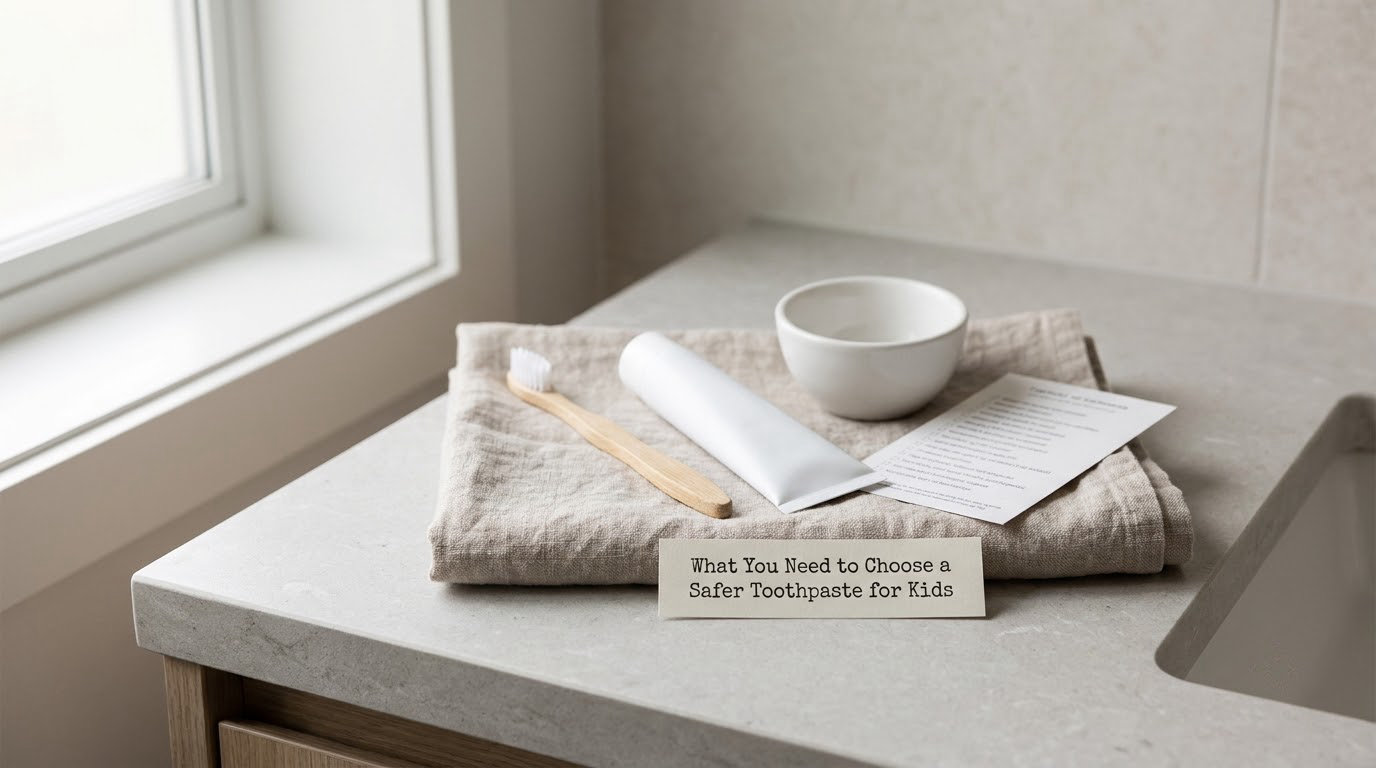
You do not need any special equipment. You need the tube itself, or a clear photo of the ingredient list, plus a little information you probably already know.
- The tube and its packaging. Keep the box, because the intended age and the warnings usually sit there, not on the tube.
- Your child’s exact age and whether they can spit reliably yet. Age sets the fluoride amount; spitting sets how much risk the ingredient carries.
- The swallowing and sensory history. Does your child gag on strong flavors? Do they avoid the foamy film? Do they get mouth sores often?
- Current guidance from your child’s dentist or pediatrician, especially if there is high cavity risk, a dry-mouth medicine, or a history of enamel problems.
- A way to compare two or three tubes. A notes app or a scrap of paper with five rows keeps the comparison honest instead of impressionistic.
Write down the fluoride amount in ppm first, before any other line. Everything else on the label matters less once you know that number.
How to Choose a Safer Toothpaste for Kids, Step by Step
Work through these five checks in order. Each one ends with a checkpoint, so you can tell whether the tube passed before you move on.
Start With Fluoride and Your Child’s Age
Fluoride is the most studied cavity-prevention ingredient in dentistry, and no fluoride-free paste has replaced it in the evidence base. The safety question is not whether fluoride is good, it is how much of it a child swallows.
Young children swallow a surprising share of what goes on the brush. Research on toddlers between 18 and 30 months found swallowing rates of roughly 64 to 84 percent of the toothpaste used. That number is the reason age-appropriate dosing exists.
Public guidance from bodies such as the American Dental Association and the American Academy of Pediatrics is simple: a rice-sized smear from the first tooth until age 3, a pea-sized amount from 3 to 6, and a pea-sized amount for older children, brushing twice a day with an adult supervising until the child can brush well alone.
Those amounts are general guidance, not a plan for your child. If your child has high cavity risk, is on a medicine that reduces saliva, has special healthcare needs, or you are not sure how well they spit, ask their dentist or pediatrician for the concentration and amount that fit them.
Checkpoint: you know the ppm number on this tube and the amount your child’s age calls for.
Read the Ingredient List for Irritants
Flip the tube over and read top to bottom. The active ingredient sits first, then the base, then the additives in descending order. Here is what to look for as you go.
- Surfactants, listed as sodium lauryl sulfate (SLS) or sodium laureth sulfate (SLES). These create the foam. In sensitive mouths they can dry the tissue, leave a film some children dislike, and are frequently named in connection with recurring mouth sores.
- Artificial dyes. Purely cosmetic, and worth skipping for a child who reacts to strong sensory input or coloured products elsewhere in their routine.
- Artificial sweeteners and sugar alcohols. Sugar alcohols such as sorbitol and glycerin are normal in toothpaste, and xylitol is a cavity-prevention ingredient in its own right. Swallowed in quantity, sugar alcohols can loosen stools in a young child.
- Preservatives and parabens. Preserved formulas are the norm; many parents still prefer parabens absent, especially for a product used several times a day on a small child.
- Abrasives. The RDA value tells you how much scrubbing the paste does. Higher numbers matter more for brand new teeth.
- Flavor oils and essential oils. Mint and strong peppermint are the most common reasons a child gags.
Keep the framing calm: an ingredient is not automatically unsafe, and reactions are individual. Dose and frequency matter far more than a name on a label.
Checkpoint: you can say out loud which line on this label gave you pause, and why.
Consider Flavor, Texture, and Sensory Needs
A paste your child refuses is not a safer paste, it is no paste. Compliance beats formulation every single day, and that is where most sensory-sensitive families lose ground.
Mild fruit flavors such as strawberry or watermelon are usually better received than mint, and mint is the single most common gag trigger in young children. Foaming is the other big one, so a low-foam or SLS-free formula can turn a daily fight into a two-minute job.
For the most sensitive children, flavor-free or very lightly flavored formulas exist, and they are worth the switch. Grit matters too: some children object to a grainy paste, others only object to a smooth one. Texture is personal.
Test before you commit. Put a small dab on your finger or the handle of the toothbrush and let your child smell and taste it without any brushing attached.
Checkpoint: your child tolerates a sample on a finger, with no gagging and no refusal.
Check the Label, Directions, and Packaging
Now verify what the box claims. Look for the intended age range, the active ingredient with its ppm, the directions, the warnings, the net weight, and whether the tamper seal is intact.
Words like natural, organic, non-toxic, fluoride-free, sensitive teeth, or dentist-formulated are marketing claims, not proof of anything on their own. If a claim matters to your family, look for the body that stands behind it. In the United States the ADA Seal of Acceptance on a box is a concrete third-party mark; a certified organic mark tells you the agricultural inputs were standard.
Packaging is a safety factor too. A smaller tube limits how much a child could swallow in one go, a screw cap is easier for small hands to open than a flip top, and a flattened end tells you how much is likely left behind and inaccessible.
Checkpoint: every claim you care about traces back to a named certifier or to the active ingredient list.
Ask a Pediatric Dental Professional
This is the step most parents skip and most benefit from. Bring the tube with you to the appointment and let the dentist or pediatrician weigh it against your child’s actual risk: cavity history, diet and snack frequency, medicines, enamel condition, saliva, and how reliably your child spits.
A dental office can also apply a professional fluoride varnish, which sidesteps the daily-dose question entirely for a period of time. Mention any specialist care your child has, including feeding therapy or an autism-related dental plan, because many offices adjust their technique and their product advice once they know what the routine actually looks like.
Checkpoint: you have guidance for your child, not just a rule from the internet.
Common Mistakes Parents Make
Assuming fluoride-free means safer. It removes a proven cavity-prevention ingredient, so it is a trade rather than a free win. It makes the most sense when your child truly cannot spit, gags on fluoride formulas, or your own dentist recommends it.
Choosing by the packaging. Characters, fruit flavours and cartoon tubes sell the paste. They say nothing about the active ingredient or the dose.
Ignoring the directions. Supervision and the right amount do as much for your child as the formula does, and they are free.
Comparing only the front panel. The claims are on the front. The ingredients are on the back, and that is where the decision gets made.
Switching without watching. Give a new paste a week or two and look for redness around the lips, swelling, new sores, or a child who suddenly refuses the routine.
Expecting more foam to mean a better clean. Foam is a surfactant doing its job in water. It is not a measure of how well the paste protects teeth.
Sticking with a paste that gets used once a day. Twice-daily brushing with a tolerated paste beats once-daily brushing with the perfect one on the shelf.
Frequently Asked Questions
Is fluoride-free toothpaste safer for kids?
Not automatically. Fluoride-free removes a proven cavity-prevention ingredient, so it trades protection for a lower swallowing risk rather than improving on fluoride. It makes sense when your child cannot spit, gags on fluoride formulas, or your dentist recommends it. Once your child reliably spits, most dental bodies favour a fluoride paste in an age-appropriate amount with supervision.
What toothpaste is best for a child who swallows too much?
For a child still learning to spit, a lower-concentration fluoride paste used in a rice-sized smear, or a fluoride-free paste such as a nano-hydroxyapatite formula, both reduce what gets swallowed. The amount and the supervision matter more than the brand. Ask your child dentist or pediatrician which concentration suits your child swallowing pattern and cavity risk.
How much fluoride toothpaste should a child use?
Public guidance is a rice-sized smear from the first tooth until age 3, then a pea-sized amount from age 3 to 6 and continuing at pea-sized for older children. Brush twice a day and supervise until a child can brush well alone. These are general amounts, so ask your child dentist or pediatrician to confirm for your child, especially with high cavity risk.
Can toothpaste ingredients cause irritation or sensory problems?
Yes. Sodium lauryl sulfate is commonly named in connection with irritation and recurring mouth sores, strong mint flavours frequently trigger gagging, and foam is a dealbreaker for many sensory-sensitive children. Artificial dyes and flavours add more sensory load for some kids. Reactions are individual, so watch for redness, swelling, sores, or refusal after any change.
What should parents look for on a toothpaste label?
Start with the active ingredient and its ppm, then the intended age range, directions, warnings, and net weight. Check for sodium lauryl sulfate, artificial dyes, and artificial sweeteners if your child reacts to them. Marketing words such as natural or non-toxic mean nothing on their own, so look for a named third-party mark such as the ADA Seal of Acceptance.
When should a parent ask a dentist about children’s toothpaste?
Ask at your child’s first dental visit, and again if your child swallows toothpaste, gags, has mouth sores, has high cavity risk, takes a medicine that reduces saliva, or has special healthcare needs. Bring the tube so the dentist can read the actual product. A dentist can also discuss professional fluoride varnish as an alternative for a period.
Conclusion
Turn the tube over first. Read the active ingredient and the ppm, find the age band it is meant for, and check whether your child reliably spits. Then take that label to your child’s dentist or pediatrician, who can tell you whether the fluoride amount suits your child’s risk.
After that, choose the simplest paste that passes the ingredient check and that your child will actually use twice a day. That is the safer choice, and it is the one that keeps working.