
Reading a personal care ingredient list comes down to one rule: ingredients appear in descending order of the amount used, from the biggest amount down to about 1%, and below that line the order tells you nothing at all. The first three names on the label usually make up the bulk of the product, and everything past the 1% mark is a set of traces. Learn that one habit and you can tell in about a minute what a lotion, shampoo or toothpaste actually is.
I have taught this to family members who thought the chemistry names were there to confuse them. They were not. The list is the only regulated, checkable part of the package, and it takes less time to read than the front-of-pack claims do.
Table of Contents
- What You Need
- Step-by-Step: How to Read a Personal Care Ingredient List
- Step 1: Identify the product type and intended use before you read a single name
- Step 2: Find the complete ingredient panel
- Step 3: Understand ingredient order on a personal care ingredient list
- Step 4: Decode common ingredient names by what they do
- Step 5: Check active, fragrance and allergen information
- Step 6: Compare two products without assuming more is better
- Step 7: Record the label and patch test carefully
- Common Mistakes
- Frequently Asked Questions
- What is the 1% rule in skincare?
- Can you give me an example of an ingredient list?
- Is a shorter ingredient list better?
- Should I worry if an active ingredient is near the end of the list?
- What should people with sensitive skin look for on a label?
- What does hypoallergenic or free-from actually mean?
What You Need
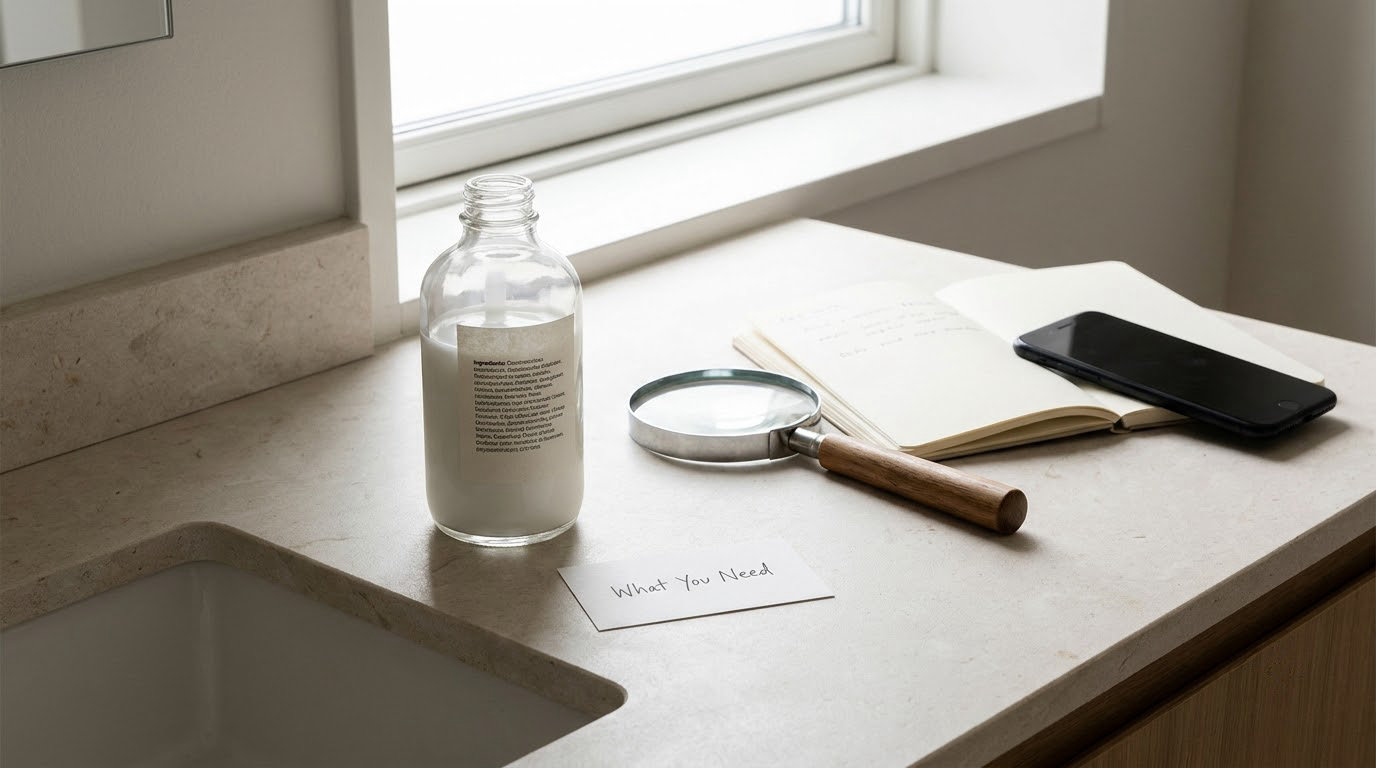
You need the product itself, or a clear photo of the back panel. That is genuinely it. A magnifying glass or your phone camera helps with small print, and a notebook is useful if you are tracking reactions.
A few terms come up before you start. INCI stands for the International Nomenclature of Cosmetic Ingredients, the standardised naming system every label uses, which is why you see Aqua instead of water and Parfum instead of a scent blend. Ingredient order tells you roughly how much of each thing is in the bottle, but not an exact percentage. Allergen and fragrance details sit wherever the manufacturer puts them, and no label tells you how a formula will feel on your skin.
Step-by-Step: How to Read a Personal Care Ingredient List
Step 1: Identify the product type and intended use before you read a single name
Work out what the product is for first, because the same ingredient means different things in different rooms. Water leads a body wash, a toothpaste, a sunscreen and a laundry detergent, for four completely different reasons. Note the job: cleanser, moisturiser, deodorant, sunscreen, nappy product, or treatment-style product.
Then check the claims on the front. A product that says soothing, brightening or anti-itch is telling you what the marketing wants you to buy, not what the formula does. Matching the claim to the ingredient list is where the useful reading starts.
Step 2: Find the complete ingredient panel
Turn the product over. The ingredient list is usually on the back or the bottom, printed in small type, often in a language you will not recognise if you shop online. If the print is worn or the panel is scratched, take a photo of it or look for the same product on the manufacturer’s site, where the full list is usually listed.
Look at both panels, not just one. Front claims and the ingredient list can contradict each other, and the back is the part that is regulated. If you are shopping on a marketplace where the list is text-only in the description, scroll. Sellers often put a shortened version up top and the full one further down.
Step 3: Understand ingredient order on a personal care ingredient list
Ingredients are listed in descending order of weight, which means the first one is the largest amount in the bottle and the last one is the smallest. Below roughly 1%, the law allows the order to be arbitrary, so two products can list the same ingredients in a completely different sequence below that line. That is where the 1% rule comes in, and it is the single most useful thing on the label.
Find the 1% line by looking for the first preservative. Phenoxyethanol, caprylyl glycol, sodium benzoate and potassium sorbate are typically used at 0.1 to 0.3%, so the first one of those on the list is roughly your 1% marker. Above it, order is meaningful. Below it, treat everything as a trace and stop ranking.
The rule of thirds works well in practice. The top third is the base formula. The middle third adds texture, scent and stability, usually somewhere between 1 and 10%. The bottom third is colour, trace actives and the preservative system, in no particular order.
Step 4: Decode common ingredient names by what they do
You do not need to memorise thousands of names. Group them by job and most labels become readable. Here is the shortcut table I keep going back to.
| What the ingredient does | Names you will see | Where it usually shows up |
|---|---|---|
| Base or solvent | Aqua, Water, Butylene Glycol, Propanediol | First line of almost every product |
| Humectant, pulls in water | Glycerin, Sodium Hyaluronate, Panthenol, Niacinamide | Moisturisers, serums, toners |
| Emollient, softens and smooths | Squalane, Cetyl Alcohol, Stearyl Alcohol, Shea Butter | Near the top of moisturisers and conditioners |
| Occlusive, seals moisture in | Dimethicone, Petrolatum, Mineral Oil | Barrier creams, heavier moisturisers |
| Surfactant, the cleansing agent | Sodium Cocoyl Isethionate, Coco-Glucoside, Sodium Lauryl Sulfate | The first five lines of body wash, shampoo, face wash |
| Conditioning agent | Behentrimonium Chloride, Cetrimonium Chloride, Panthenol | Conditioners and leave-ins |
| Abrasive | Hydrated Silica, Calcium Carbonate | Toothpaste, usually right after water |
| Preservative | Phenoxyethanol, Caprylyl Glycol, Sodium Benzoate, Potassium Sorbate | Bottom third, and your 1% marker |
| Fragrance | Parfum, Fragrance, Aromatic | Disclosed as one item, or as essential oils listed individually |
| Emulsifier or thickener | Glycerin, Lecithin, Xanthan Gum, Carbomer | Middle of the list |
One nuance trips most people up. Not all alcohol is drying. Cetyl alcohol and stearyl alcohol are fatty alcohols that thicken and soften, and they are useful in products for dry or reactive skin. Denatured alcohol, listed as Alcohol Denat. or SD Alcohol, evaporates quickly and can sting. Read the whole name rather than reacting to the word.
Step 5: Check active, fragrance and allergen information
In the US, an over-the-counter product such as an acne treatment or a medicated sunscreen is regulated as a drug, so the label separates active ingredients from inactive ones and states the active percentage. Cosmetics do not follow that rule, which is why a retinol or niacinamide product never has to tell you how much is in there.
Fragrance appears as Parfum or Fragrance, which covers a blend of many aromatic chemicals the manufacturer does not have to break down. Essential oils may be listed individually and still count as fragrance. If someone in your house reacts to scented products, treat any essential oil as scent.
Allergen information depends on the person and the product. Some packaging lists common allergens, most does not, and nobody can tell from a label whether you personally will react. That is the limit of reading, and it is worth saying plainly.
Step 6: Compare two products without assuming more is better
Put the two lists side by side and compare the same things: purpose, order, any allergens you already avoid, scent, base formula and packaging size. A longer list is not automatically worse, and a short list is not automatically purer. Twenty ingredients can all be doing steady work at useful amounts.
Ignore the words on the front when you compare. Natural, clean, chemical-free, hypoallergenic and dermatologist tested have no legal definition for cosmetics in the US, so they cannot tell you anything comparable. Watch for proprietary blend, which hides a whole group of ingredients, and for trade names such as branded peptide complexes, which are unresolved rather than listed.
Step 7: Record the label and patch test carefully
Save the list before you bin the container. Photograph the panel, or write the ingredients in date order in your notes app, and keep it with any reaction you have later. Recipes change, so also check the manufacturer’s site periodically to see whether the list has been updated.
Patch test anything that touches skin: a small amount on the inside of the arm, left in place as the directions say, watched over the following days. Follow the directions on the package. If someone reacts badly, stop using the product and speak to a dermatologist or healthcare professional rather than working it out from the label alone.
Common Mistakes
Treating order as exact percentages. It is not. You know the first ingredient outweighs the last, nothing more. The fix is to use order as a ranking and look for the 1% marker instead of guessing at numbers.
Assuming every synthetic ingredient is dangerous. Everything on the list is a chemical, including the water. Suffixes such as -ate, -ide and -ium usually describe a salt form of something familiar. The fix is to look a specific name up rather than judge by the look of it.
Ignoring the fragrance disclosure. Parfum is a category, not a single substance, and essential oils are scent. The fix is to treat scent as a single trigger for anyone in the house who reacts to it.
Comparing products built for different jobs. A heavy occlusive cream and a light gel are not competing on the same thing. The fix is to compare products that serve the same purpose before you judge the lists.
Believing free-from claims. Free-from parabens only tells you what a company left out, and it says nothing about the rest. The fix is to read the full list and ignore the marketing badge.
Making health claims from a label. A label cannot tell you whether a formula will work for you or for anyone else. The fix is to treat the list as one input, and take individual concerns to a clinician.
A few habits keep the whole thing quick. Read the first five ingredients and the preservative line, and ignore everything in between on the first pass. Compare within one product type at a time. And keep your own avoid list, built from what your skin has actually reacted to, rather than from a published list of scary words.
Frequently Asked Questions
What is the 1% rule in skincare?
Ingredients are listed in descending order of weight, but below roughly 1% the law lets the order be arbitrary. In practice the 1% line sits near the first preservative, such as phenoxyethanol or sodium benzoate, because those are used at 0.1 to 0.3%. Above that line order means something. Below it, treat the list as traces.
Can you give me an example of an ingredient list?
A simple moisturiser reads like this: Aqua, Glycerin, Butylene Glycol, Dimethicone, Cetyl Alcohol, Sodium Hyaluronate, Panthenol, Tocopherol, Phenoxyethanol, Citric Acid. Water is the base, glycerin and sodium hyaluronate are humectants, dimethicone and cetyl alcohol soften and seal, and phenoxyethanol is the preservative marking the 1% line.
Is a shorter ingredient list better?
Not by itself. A short list usually means a simple, concentrated formula, which suits some people, but a longer list can still be well made with every ingredient at a useful amount. Read the order and the job each ingredient does instead of counting names. What matters is whether the formula matches your skin and how you will use it.
Should I worry if an active ingredient is near the end of the list?
It is worth noticing, because an active below the 1% line may be present at an amount too small to do much. That said, some actives work at low concentrations, and preservative systems often sit just above them. If a product depends on one active for its effect, check whether the brand states a percentage anywhere on the pack or its website.
What should people with sensitive skin look for on a label?
Look for a short ingredient list, a base of water and glycerin, bland emollients such as squalane or fatty alcohols, and ceramides if the skin barrier is the concern. Check for parfum or fragrance, denatured alcohol, and any essential oils. None of these are automatically harmful, but they are common triggers worth avoiding while your skin is settling.
What does hypoallergenic or free-from actually mean?
Very little legally. In the US, cosmetic labels such as hypoallergenic, natural, clean, chemical-free and dermatologist tested have no regulated definition, so any manufacturer can print them. Free-from tells you what a company left out and nothing about the other forty ingredients. Read the full list and ignore the badge.
Start with the back of the bottle, not the front. Read the first three ingredients, find the first preservative to mark your 1% line, and check whether the fragrance disclosure is one you want in your house. That is the whole method, and it takes about a minute. Everything else you can work out later, one product at a time.