
Transition planning begins at age 14 for students with an IEP. Under IDEA, the plan your teen’s team writes must include measurable postsecondary goals in education and training, employment, and independent living, with the student involved in the conversation. Those goals are required in the IEP in effect when your child turns 16, which makes 14 the year to start building them.
If nobody has mentioned transition planning yet, you are not behind. Most families first hear the word from a school counselor or case manager in the same breath as “we’re going to start thinking about the future,” which is often code for “graduation is coming and we have not done anything.” Fourteen gives you roughly four years of school time to test-drive options before they have to become decisions. If you have been searching for how to start transition planning at fourteen, this is the order that has worked for other families.
I write for parents of autistic teens, and the pattern is consistent: the paperwork arrives long after the wondering starts. A parent on a special education forum described it better than any guide could, saying the most useful thing in the whole process was simply having a written list of questions in front of her at the meeting. This guide is that list, plus the structure to fill it in.
Table of Contents
- What You Need
- Step-by-Step: How to Start Transition Planning at Fourteen
- How to start transition planning at fourteen by looking ahead three years
- How to start transition planning at fourteen with a strengths-based assessment
- How to start transition planning at fourteen by asking for official support
- How to start transition planning at fourteen by teaching everyday independence
- How to start transition planning at fourteen with a written transition plan
- Common Mistakes to Avoid
- Frequently Asked Questions
- Is fourteen too early to start transition planning for a child with autism?
- How can I involve my teenager in transition planning without overwhelming them?
- What should a school transition plan include when my child is fourteen?
- How do I teach independence skills when my teen needs support with daily tasks?
- Who should be included in the first transition-planning meeting?
- When should I revisit the plan if my teenager’s needs or goals change?
- Conclusion
What You Need
You do not need a lawyer or a curriculum to begin. You need a place to keep things and enough information to make the meeting useful rather than vague.
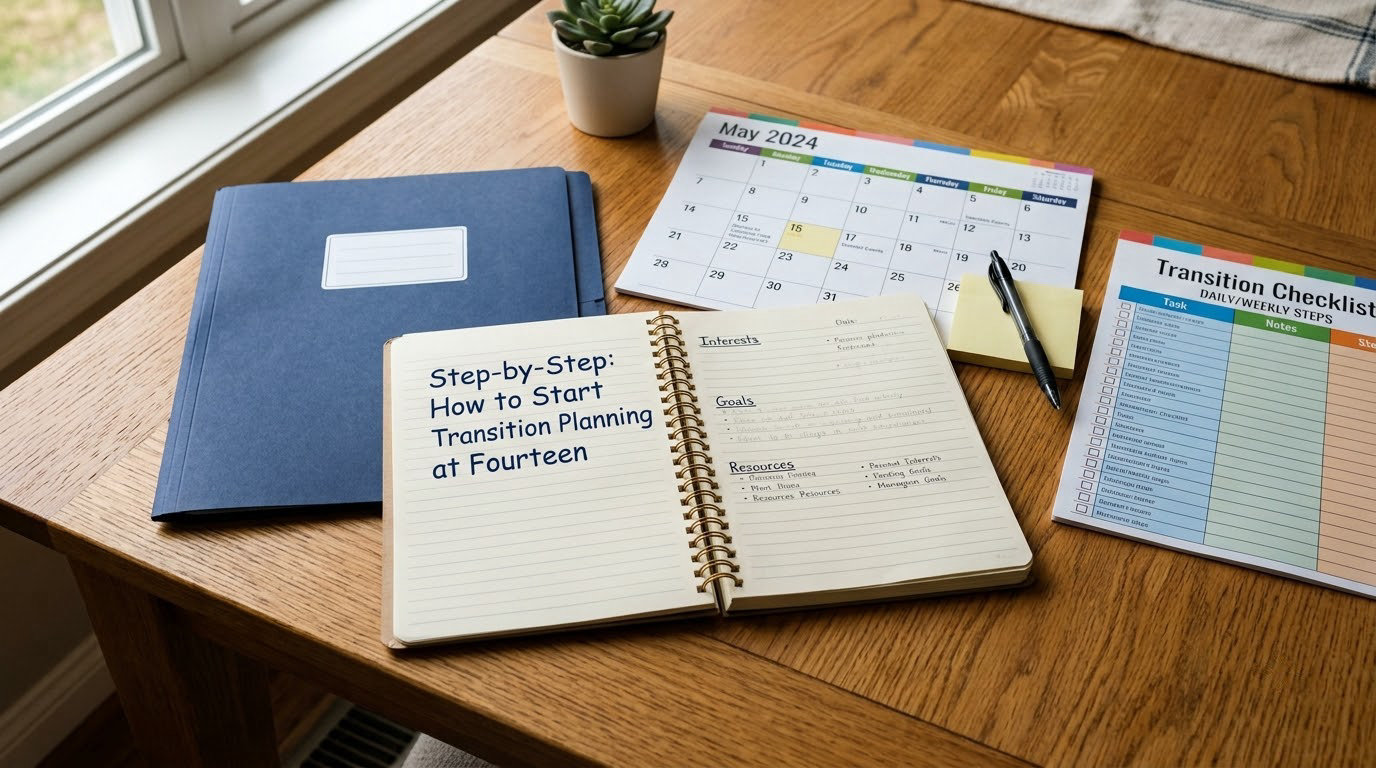
- A transition-planning notebook. A three-ring binder or a single document with tabs works. Most parents who keep one going say the binder beats the app, because IEP teams expect you to flip to a page.
- Current records. The most recent IEP, any progress reports, prior evaluations, your 504 plan if you have one, and whatever your state developmental disability agency has on file.
- A contact list with names, not just roles. Case manager, special education teacher, school counselor, vocational rehabilitation counselor, and any outside OT, SLP, or behavioral provider who writes into the IEP.
- A strengths and interests list. Written before the meeting, not during it. Families who lead with what their teen enjoys tend to get more responsive teams than families who open with deficits.
- A calendar with review dates. Annual IEP review, progress check at six months, and a family-only review before each school year.
- A realistic timeline. Two to three meetings a year is plenty. Annual IEP review in spring, one mid-year check-in, one short family review over summer.
Add one thing many parents overlook: a running list of questions you did not get answered. That list is the spine of the next meeting.
Step-by-Step: How to Start Transition Planning at Fourteen
Five steps, in this order. The first two happen at home and need nobody’s permission. The third is the meeting request. The fourth is the practice you control. The fifth is the writing.
How to start transition planning at fourteen by looking ahead three years
Start by writing down what the next three years actually look like, then work backward. Not a vision board. A plain list of what changes.
Answer four questions in writing. Where will they be on a Tuesday in two years, and is that the school you’d choose? Which adults need to be in the picture then, and do they exist yet? What support works right now, and which of those supports does school provide that will not come with them? And what do they want to be doing more of, in their own words if you can get them?
Then look at services. Public school supports generally end when a student turns 21, or 22 in some states. That cutoff is real and it is the reason this step matters. Speech, OT, behavioral support, assistive technology, a paraprofessional for toileting or lunch, transportation to a job site, and school-based counseling are all things a school provides daily and an adult world does not. Write each one down next to the question: who replaces this, and by when do we have to apply?
Answers for the long-range ones live outside the school. Vocational rehabilitation (voc rehab) starts at 16 in most states, though early counseling exists in some. Your state’s Medicaid waiver waiting list can run years, so ask about it at 14 rather than at 20. SSI can be applied for before 18, and applying while benefits from a parent are still being counted often produces a more realistic picture. An ABLE account, once your teen has a diagnosis, gives them their own savings account that does not threaten means-tested benefits.
How to start transition planning at fourteen with a strengths-based assessment
Write down what your teen is good at, what they tolerate, and what reliably goes wrong. This is the assessment, and it takes one evening.
Cover eight areas: daily living (showering, laundry, hygiene, medication), organization (knowing what is due and when), decision-making (choosing between two options and accepting the result), communication (asking for help, declining, texting and calling), money (counting, saving, spending, a debit card), technology (logins, passwords, appointments, camera for documents), transportation (which routes, what a transfer looks like, safe behavior on a platform), and community safety (what to do when lost, how to read a stranger’s question, who to call).
For each one, note the current level in plain words and the next tiny step. “Showering: will start with reminders, currently needs prompting for each step. Next: a picture card on the bathroom door.” Goals written that way can be measured, and measurable is what the law requires.
Add sensory and energy information. Adolescents on the spectrum often run out of capacity by mid-afternoon, wear headphones to get through noise, and come home from school visibly emptied. Note when the overload happens and what actually helps, because a plan built around your teen’s worst hour is a plan that fails. If masking at school is costing them, say so plainly at the meeting. Fatigue is not a character flaw and it is relevant to any employment goal you write.
Finish with interests. What does your teen gravitate toward when nobody assigns it? Music, animals, sorting, gaming, mechanics, working with hands, being alone, being around one particular person? Interests are the raw material for a job-shadow day, a work-based learning placement, or an internship, and they are the part of the meeting that usually gets the most energy from a team.
How to start transition planning at fourteen by asking for official support
Put the request in writing to the case manager or special education teacher, then ask for it again at the annual IEP review. Written requests create a record, and a record is what you will want later if the plan quietly does not happen.
Here is a message you can copy and adjust:
“I would like transition planning added as an agenda item at our next IEP meeting. [Name] turns 14 this year and I understand postsecondary goals will be required in the IEP that is in effect when they turn 16. I would like us to start building those goals now rather than next year. I have a strengths and interests list and some ideas for transition services I would like to discuss.”
Bring these questions. Print them. One page is plenty.
- Are we adding postsecondary goals and transition services to the IEP this year, or waiting until 16?
- Which of the three goal areas are we covering, and why those three?
- What does a measurable postsecondary goal look like in this IEP, and can you show me last year’s example?
- Which transition services are available to us now, and which of those need a referral or a waitlist?
- Is there a work-based learning or job-shadow placement, and when can we start one?
- What does vocational rehabilitation offer in our state, and how do I get my teen on their radar before 16?
- Who is our contact at the state developmental disability agency, and what is the waiver waitlist situation?
- What will our high school look like, and does that change the services we should write now?
- How will we know a goal was met, and who reports progress to us?
- What has to be in place before graduation, and by what date?
Two more things to ask out loud. First, if a written goal about classroom skill can be reframed as a real-life goal, ask for it. Parents often describe goals written as percent accuracy on a worksheet, which help nobody after graduation. Second, ask for a date and a person for every service. “Career counseling in the spring” is weaker than “Ms. Ruiz, one session per month, starting October.”
If your school says it starts at 16, do not argue about the law. Ask what will be on the agenda next year, request that your strengths list be added to the student’s file now, and ask for a mid-year check-in anyway. Federal rules set a floor, and states can and do start earlier. Some states set their own earlier age, so check what yours requires.
How to start transition planning at fourteen by teaching everyday independence
This is the step with the most control and the least credit. Nobody signs off on it, and it changes the most.
Practice one skill at a time, in the real place it will happen, and fade your help on a written schedule. Start the plan for bathing or laundry with you doing step one and prompting step two, then swap. Write the swap dates on the calendar, because fading faster than the skill is ready is how a family ends up back at step one six months later.
Work money in small, real amounts. A ten dollar budget for a school lunch day, with a paper list and a checkout at the register. Then a debit card with a low limit and notifications turned on, with you reviewing the statements together at first. Never start with a large balance and an error.
Teach the appointment and paperwork loop early, because adulthood is mostly this loop. Making a phone call, navigating a website, filling a form, confirming by email, arriving on time, rescheduling when you cannot make it. One successful appointment is worth a month of rehearsal.
For transportation, practice the route before the route is load-bearing. Ride the bus with no destination. Then ride it to a specific place. Then let them ride it alone with a check-in text at the end. Give them a card with your phone number and a script for what to say if they are lost, because improvising under stress is exactly when they will not have words.
Keep a record of what worked. A two-column sheet, date on the left, what your teen managed on the right, is genuinely useful evidence at the next IEP meeting, and it is the material a functional employment goal gets built from.
How to start transition planning at fourteen with a written transition plan
Now put it on one page. Not the IEP, which is a legal document the school produces. Your family’s version, one page, that you bring to every meeting.
| Element | What it looks like |
|---|---|
| Near-term goal (this year) | One behavior with a measure and a date, such as using a phone script to make two appointment calls by March. |
| Long-term option | The direction, not the destination. College program, competitive employment, supported employment, day program, or a combination. |
| Who is responsible | A named person per item, not a department. |
| When it happens | Start date, end date, how often. |
| Service needed | Which IEP service, waiver service, or agency makes it possible. |
| How we will know | The measure. A checklist, a call log, a photo, a check with the provider. |
| Review date | The date you will decide whether this still fits. |
Fill in the three goal domains next. Each one needs at least one sentence, written so a stranger could tell whether it happened.
| Domain | Sample goal for a fourteen-year-old |
|---|---|
| Education and training | In order to choose a training program, [Name] will complete two job-shadow days and one campus tour by the end of this school year, with transportation provided by the school. |
| Employment | In order to hold a job with support, [Name] will sustain one 30-minute work-based learning placement for eight consecutive weeks, with a job coach present for the first four. |
| Independent living | In order to manage appointments independently, [Name] will use a written and visual checklist to prepare for and attend two health or service appointments per month with no more than one verbal prompt. |
Notice the phrase in order to. It is a quick test: if you cannot finish the sentence with what the person is actually going to do in adult life, the goal is a classroom goal in disguise. Audit every existing goal that way and ask for revisions where it fails.
Finally, set a date. Put the mid-year check and the family review in the calendar before you close the notebook. A plan nobody revisits is a document, not planning.
| Age | What happens | Your job |
|---|---|---|
| 14 to 15 | Informal planning begins. Strengths and interests documented, first transition services requested, high school options explored. | Build the notebook. Start independence practice. Open the waiver and voc rehab conversations early. |
| 16 | Measurable postsecondary goals are required in the IEP in effect at your teen’s 16th birthday. Voc rehab eligibility typically opens. Summary of performance begins. | Push for real-life goals, not classroom goals. Attend every meeting or send a written request for the ones you miss. |
| 17 to 18 | Work-based learning, internships, and job coaching. At 18, legal rights transfer to the student unless a court says otherwise. | Apply for SSI before 18. Open an ABLE account. Look at guardianship versus supported decision-making. |
| 19 to 21 | Final IEP years. Adult services and benefits applications in earnest. Transportation and medical transition planning. | Line up post-school supports so nothing lands at 21 with no plan behind it. |
| 21 to 22 | Public school services end, depending on the state. This is the service cliff. | Everything you arranged in the last three years either has a replacement or does not. |
Common Mistakes to Avoid
Waiting because nothing is due yet. The 16-year requirement is a deadline for the document, not a start date for the thinking. A parent who starts at 15 is writing goals from a guess; a parent who started at 14 has evidence. Both hit 16, only one of them has something usable.
Planning only for a crisis. Emergency planning is not a plan. If your teen’s behavior has deteriorated this year and you are meeting about placement or a behavior plan, transition work can wait a month. If everything you write is about stopping a behavior, there is no adult life in the document.
Leaving your teen out of the room. Some families do it to protect a kid from stress, and sometimes that is the right call for the day. Some autistic teens cannot speak in a meeting of adults who do not understand them, and sitting there for 90 minutes is its own harm. The middle path works better: let them choose one or two decisions, hand them a card, or let them submit a written or recorded answer. Involving them in small ways counts. Silence in the room does not equal consent.
Setting a five-year timeline when you cannot hold a five-day one. Long-range goals are necessary and they are not the same as the plan. Keep the one-page sheet but give yourself one near-term goal per quarter that you can actually check.
Relying on a single person or agency. School is not the whole system. Voc rehab, the state developmental disability agency, Medicaid waiver providers, SSI, and adult-serving nonprofits all hold pieces. One missed referral can cost a year.
Writing the plan and never opening it again. A six-month review that looks at the near-term goals and changes what no longer fits prevents the slow drift where you are still working on goals from two years ago.
One more worth naming: confusing school transition with life transition. When a counselor says they will help with transition planning, they may mean moving from one classroom to the next. Ask what age the plan is about. If the answer is vague, ask who owns the adult-life plan.
And the emotional part, which nobody puts on the form. Grieving what you imagined for your child is a normal response to planning, not a sign you are doing it wrong. Many mothers describe the post-high-school years as a cliff, and the honest reason is that school currently holds a large share of the structure their kid gets. Planning is how you start rebuilding that structure somewhere else, and it is a lot of work to do while also holding the feeling.
Frequently Asked Questions
Is fourteen too early to start transition planning for a child with autism?
No. Fourteen is the recommended starting age because the IEP in effect when your child turns 16 must contain measurable postsecondary goals. Starting at 14 gives you two years of evidence, job shadows, and skill practice so the goals you write at 16 describe something real. It is never too early to document strengths, interests, and support needs, even in the years before formal goals are required.
How can I involve my teenager in transition planning without overwhelming them?
Give them a small, real decision instead of a big abstract one. Options include choosing which job shadow to try, picking one goal to work on this year, or writing their answer to a question and letting you read it at the meeting. Autistic teens often know what they want and cannot say it in a room of adults, so pre-written cards and advance notice of the meeting matter more than speaking up live.
What should a school transition plan include when my child is fourteen?
A transition plan should cover postsecondary goals in education and training, employment, and independent living, plus the transition services that support each goal. For a fourteen-year-old it can be brief, but it should name what is being tried this year, who provides it, how progress is measured, and when you will review it. It also needs the student’s input, recorded somewhere, even if it is a note or a spoken preference captured by an adult.
How do I teach independence skills when my teen needs support with daily tasks?
Teach one skill at a time, in the real place it happens, and fade your help on a written schedule. Start by doing step one yourself and prompting step two, then swap the roles on a set date. Keep a dated log of what your teen managed so you have evidence at the next IEP meeting. A back-pocket checklist works better than a verbal reminder for many autistic teens, because it removes the need to remember.
Who should be included in the first transition-planning meeting?
Bring your teen if they can handle it, plus the case manager, special education teacher, school counselor, and a vocational rehabilitation representative if you can get one. Add any outside OT, SLP, or behavioral provider who writes into the IEP. Ask in advance whether the school can bring a vocational rehab counselor, because most families have never met one before the meeting that needs them. Send your questions in writing so nothing depends on your memory afterward.
When should I revisit the plan if my teenager’s needs or goals change?
Do not wait for the annual IEP review. Interests change at this age, sometimes quickly, and a plan built on a direction from last spring can be stale by fall. Review the one-page plan every six months on your own, and send a short written note to the team when something shifts so the change is on record. Ask at the meeting how you can request a revision between annual reviews if needs change sooner.
Conclusion
If you take one action this month, make it this: schedule a fifteen-minute conversation with your case manager and ask to put transition planning on the next IEP agenda. Then write down five things your teen is good at and pick one independence skill to practice this month with a fade date.
That is how to start transition planning at fourteen, and it is enough to start. The goals you are required to write at 16 will be better because two years of evidence exist behind them. Put a review date in the calendar before you close the notebook, and keep going from there.