To teach chores to an autistic child, pick one short chore they can finish on their own, write the steps down in order, teach those steps one at a time, then fade your help over two or three weeks of short, predictable practice. No punishment, no earning back screen time.
That last part matters more than it sounds. Most of the parents I hear from are not disciplining badly. They are asking for a whole task, at a moment when a brain with real trouble starting a task and holding steps in working memory cannot carry it yet, and then reading the resistance as defiance.
Here is the short version before the detail:
- Choose one chore your child can finish entirely alone.
- Write or photograph the steps in the order they happen.
- Post the visual list where the chore happens.
- Teach one step at a time, starting at either end.
- Give the least help that works, then take it away.
- Use specific praise at the same time every day.
- Add more steps only after the routine feels predictable.
Realistically, budget two to three weeks before anything changes, and pick a ten-minute window that is not bedtime. Children who are starting late, at 10 or 12, do this fine; the only cost of starting late is that you have fewer years of habit-building ahead of you.
Table of Contents
- What You Need
- Pick the first chore
- Set up the visual routine
- Prepare the space and the supplies
- Decide how you will track progress
- Step-by-Step: How to Teach Chores to an Autistic Child
- 1. Start With One Easy Chore
- 2. Explain Each Step When You Teach Chores to an Autistic Child
- 3. Create a Visual Routine
- 4. Practice Together
- 5. Celebrate Effort and Specific Progress
- 6. Repeat on a Predictable Schedule
- 7. Gradually Add More Responsibility
- Common Mistakes
- Adding several chores at once
- Giving broad instructions
- Doing half of it for them
- Expecting it the first time
- Using vague or sarcastic praise
- Making the reward the main event
- Adding consequences on top
- Scheduling chores late at night
- Frequently Asked Questions
- At what age should I start teaching chores to an autistic child?
- How do I teach chores to a non-speaking autistic child?
- What do I do when my autistic child refuses to do chores?
- Do reward charts actually work for autistic children?
- What if my child only does half the chore?
- Is stubbornness an autistic trait?
- Conclusion
What You Need
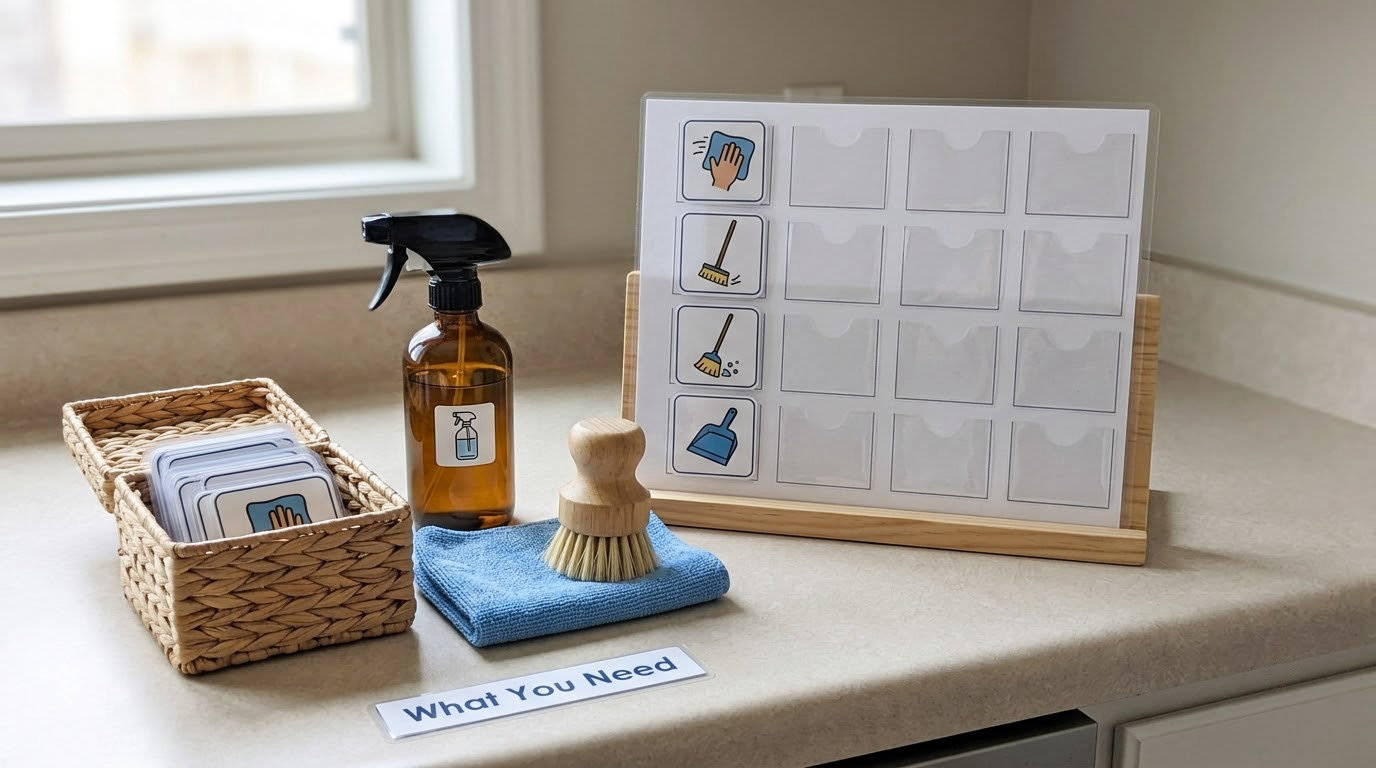
You need four things before the first attempt, and none of them cost money. A chore small enough to finish in about three minutes, some way to show the steps visually, the physical supplies set out in the same place every time, and a way to note progress.
Pick the first chore
Choose something your child can own from start to finish, including putting the result away. Putting clothes in the hamper, moving a spoon to the sink, or dropping toy blocks into one specific bin all work because the job has a visible beginning and a visible end.
Skip anything with a hidden ending. A messy bedroom is not a chore, it is a mood. Ask instead: can my child tell that this is finished? If they cannot point at the finished version, the chore is too vague and it will fail even when they try.
Here is roughly what fits at each age, with the kind of support that usually works:
| Age | Chores that tend to work first | Typical support |
|---|---|---|
| 2 to 5 | Drop toys in one bin, put clothes in the hamper, wipe a table with a cloth, put a spoon in the sink | You do the first one together every single time, picture cards, spoken praise |
| 6 to 9 | Make the bed, feed a pet, sort a laundry load, clear the table, water plants | Checklist with photos, one step taught at a time, timer for 10 to 15 minutes |
| 10 to 12 | Load the dishwasher, put away groceries, sweep one room, take out the bins, fold one type of laundry | Written steps, one check-in from you instead of hovering, choice of two jobs |
| 13 and up | Own a rotating household job, cook one simple meal, manage their own laundry, care for a younger sibling for set minutes | Written routine, they track their own progress, you check in weekly |
The narrowness is the whole trick. Parents on parenting forums describe the difference plainly: tidy your room fails, put all the train tracks back in the box works. Same child, same energy, different size of job.
Set up the visual routine
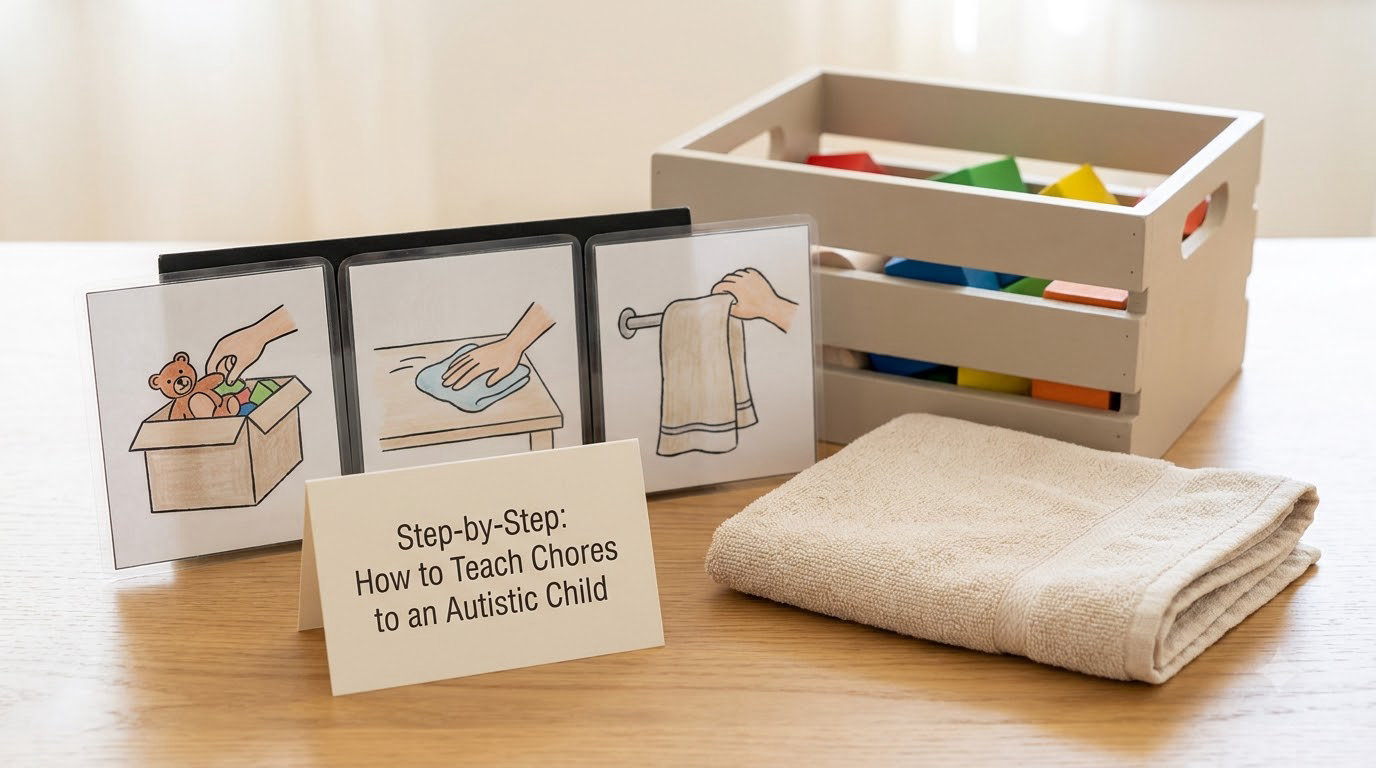
Before the first practice, decide how your child will see the steps. The simplest version is a strip of paper with one picture per step, taped where the chore happens. A laminated chart on the fridge works too, though proximity matters more than location of the chart itself.
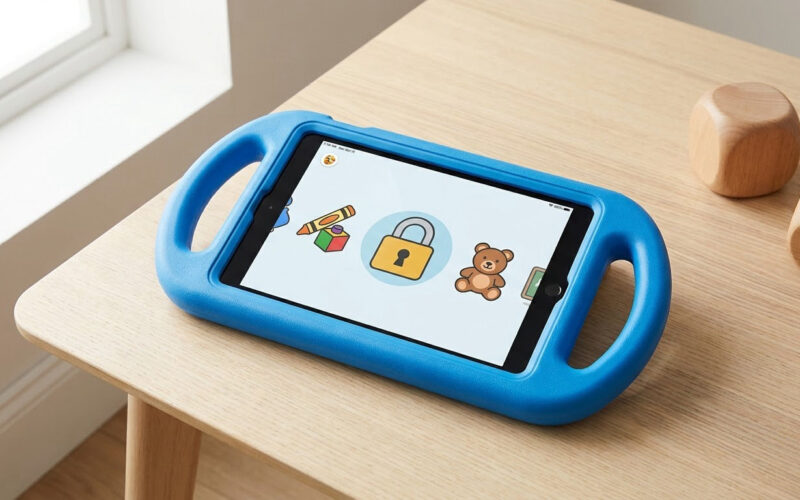
Other formats that work: photos of each step on a phone or tablet, a check-off list your child marks, a first-then board showing the chore followed by what comes next, or a physical system such as a dirty-clothes basket and a clean-clothes basket so the handoff is visible.
Prepare the space and the supplies
Put the cloth, the bin, the hamper and the laundry basket in the same spot every time. If a chore needs a spray bottle, set it out. Chores fail more often over a missing supply than over a lack of motivation.
One exception: you may need ear defenders or noise-reducing headphones for the vacuum or the dishwasher, and that is a legitimate accommodation, not a bribe.
Decide how you will track progress
Pick something simple: a check mark on a chart each time the chore is finished, or a note on your phone with the date and how much help you gave. The help level is the more useful number. Write down how many prompts it took, and you will see the fade even when your memory says nothing has changed.
Step-by-Step: How to Teach Chores to an Autistic Child
1. Start With One Easy Chore
Start with a single chore, and let your child own all of it, including the last step. A chore your child does halfway while you finish the other half is worse than no chore at all, because it teaches them to wait for you.
A useful test for whether the chore is manageable: could your child complete it on a bad day, with poor sleep and a full meltdown history, using no more than one or two prompts? If yes, start there. If no, split it.
The split matters more than the wording. Emptying the dishwasher becomes loading the dishwasher, which becomes putting the bowls in the rack and the cups in the top. Each smaller version is a whole chore your child can finish and be praised for finishing.
Say what you are choosing and why, in plain language. I am starting with feeding the cat because it takes two minutes and always ends the same way. Autistic children tend to remember the reasoning behind a rule, not just the rule.
2. Explain Each Step When You Teach Chores to an Autistic Child
Write the chore out as a numbered list of small, observable actions. Loading the dishwasher might become: take bowls from the table, carry each bowl to the sink, put bowls in the rack, put cups on the top shelf, put forks in the cutlery basket, close the door.
This is called a task analysis, and it is the single most useful tool here. It works because it moves the chore out of your head, where you can see the whole thing at once, and into a list, where each step is small enough to hold.
Demonstrate once, slowly, then hand the job over. Do not demonstrate three times. Repetition of the demonstration reads as insistence rather than teaching, and the third run is usually when your child walks away.
Use literal language. Say put these clothes in the basket, not can you do me a favour with your laundry. Avoid sarcasm entirely, because literal interpretation of a joke is genuinely painful rather than funny, and avoid assumption. If your child has never loaded a dishwasher, do not assume they know which way a bowl faces.
Give one instruction at a time. Six instructions shouted together is a wall of noise; one instruction, a pause, then the next, is a conversation your child can stay in.
3. Create a Visual Routine
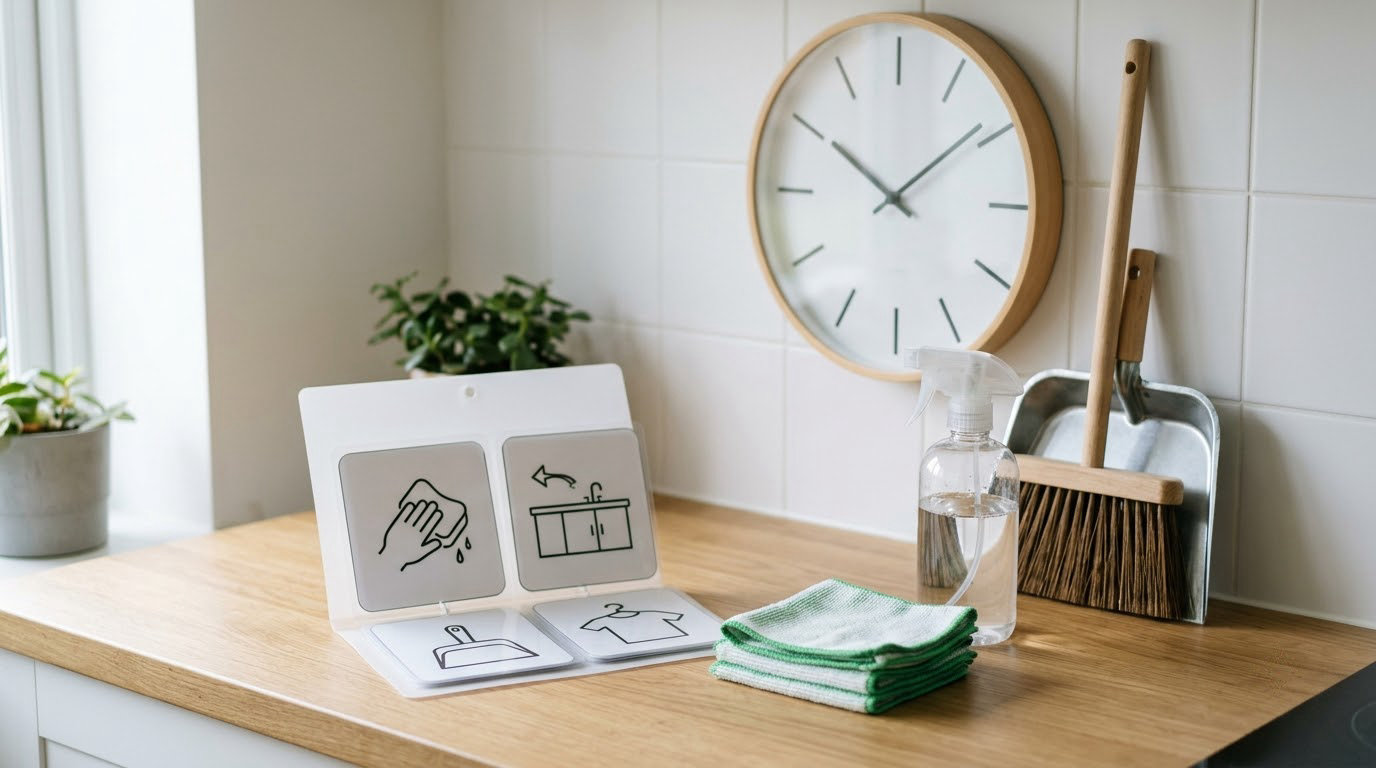
A visual schedule for chores is simply the task analysis made permanent, so your child does not have to hold it in working memory while they do the chore. Number the steps, photograph each one, or draw them. Most parents find photos faster to make than drawings and more literal to follow.
Two formats do most of the work. A check-off chart on the fridge gives a clear start and finish signal, and it can show a run of days rather than a single attempt. A first-then board shows what comes after the chore, which matters more for some children than the chore itself.
Put it where the chore happens. A chart on the fridge that the child has to walk to and interpret is a memory test wearing a schedule costume. Tape the step list to the inside of the laundry door and it just works.
Keep the wording identical each time. If the picture says put clothes in the hamper, your spoken version should say the same thing. Autistic children treat differences in phrasing as differences in meaning, so do not improvise synonyms.
For non-speaking children, the visual does more work than it does for verbal children. A photo sequence plus a pointing gesture, or a simple sign for done, gives them a way to request help or signal completion without needing to produce words.
4. Practice Together
Stand nearby and do as little as possible. The goal on any given day is that your child does the work and you hold the help you would normally use. Over-help is the most common reason a chore never becomes independent.
You can use hand-over-hand guiding for a genuinely new motor step, such as how to fold a towel in half, but treat it as a teaching tool rather than a habit. The skill you are building is doing, not being walked through.
Now choose where to begin. Forward chaining means teaching the first step, then the second, then the third, so your child starts the whole task each time. Backward chaining means teaching the last step first, then the step before it, so your child finishes the task each time.
For many autistic children, backward chaining is the stronger starting point, because ending on the completed chore is a clear, satisfying finish and a natural reward. Try one and then try the other if the first one stalls.
Fade the help on a schedule rather than by feel. Move from full model, to hand-over-hand, to pointing at the step, to a gesture, to waiting silently, to saying only the first step and walking away. Most children need a fixed number of days at each level before moving down.
Timers and music help some children and bother others. A visual timer that empties rather than one that ticks can reduce the pressure, and a 20-minute window with a song your child likes is often more workable than asking them to judge when a job is done. Notice which one your child actually tolerates before adding both.
5. Celebrate Effort and Specific Progress
Praise the specific thing you saw, said soon after it happened. You put the fork in the dishwasher is the sentence. Good job with your chores is not, because it gives your child nothing to repeat.
A check mark on the chart works as long as the mark means something. Some families use a token system with a small reward attached; others just keep the running record visible, which for a lot of children is reward enough.
What I would not do is make a routine chore a surprise event. A chore that lands every single day at the same time is not a treat, and treating it as one tends to produce the opposite of what you want.
Also be careful with rewards you take away. Do not withhold television time, device time or access to a favoured activity as a consequence for a missed chore. That approach reliably produces bargaining rather than independence, and it teaches your child that the chore is a trap rather than a job.
There is another approach worth naming, because many autistic children respond to it far better than any chart. Some have a clear sense of ownership over particular things: this is my backpack, so it is my responsibility. The work is extending that switch to household tasks. Say this is your job, it belongs to everyone, and let them hold it.
6. Repeat on a Predictable Schedule
Same time, same wording, same place, for two to three weeks before you judge whether it is working. Single days tell you almost nothing. Autistic children consolidate a routine over repetitions, and most need far more repetitions than a neurotypical child before it sticks without a prompt.
Pick a slot that is not bedtime. Chores squeezed into the last hour of the day run into a child who is already overloaded, and then you are measuring tiredness rather than learning.
Track two things: whether it happened, and how much help it took. When the help level drops from six prompts to two, that is the evidence that prompted fading is working, and it is easy to miss if you are only tracking done or not done.
If the chore collapses after a week, shrink it rather than adding pressure. Fewer steps, same schedule. And if a week of solid success sits behind you, do not immediately stack a second chore on top; let the first one get boring before you add more.
7. Gradually Add More Responsibility
Once the current chore feels predictable, add exactly one new step, then let it settle. Two new steps at once puts you back where you started, only with a longer list.
Add chores slowly, too. One new chore every two or three weeks, and only while the previous one is still going without a fight. A child holding three independent routines is doing far better than a child failing at five.
Watch your child’s capacity rather than the calendar. A chore that reliably falls apart on days with poor sleep or a rough transition home needs to move earlier in the day or shrink further, not get a firmer reminder.
If your child has ADHD alongside autism, the visual system is doing more work than usual here. Attention limits and working memory gaps mean the routine has to be shorter, more concrete and more physical, so pre-set bins beat a written list every time. Sticking to fewer jobs also protects you, because parenting an ADHD brain while running the house is genuinely a lot.
Worth doing this year if your child is 14 or older: mention chores in the transition planning meeting. IDEA requires transition services for students with disabilities, beginning no later than the year they turn 16, and the case team can build daily living skills into that plan. Turning a chore you already teach at home into documented evidence takes minutes and gives your child a record that says what they can already do.
Common Mistakes
Most of what I have seen go wrong fits into eight patterns, and each one has a fix that takes about a minute to apply.
Adding several chores at once
Three new chores produce three refusals and no data about which one is the problem. Fix: one chore for two or three weeks, then one more.
Giving broad instructions
Tidy your room is not a task a child can act on. Fix: name the objects and the destination. Put the cans in the recycling bag.
Doing half of it for them
The half you finish teaches waiting. Fix: the child owns the whole task including the tidying away, even if it takes longer, or choose a smaller whole task.
Expecting it the first time
Teaching and learning are not the same event. Fix: judge the chore after two weeks of the same routine, not after Tuesday.
Using vague or sarcastic praise
Great job is a sound effect, not feedback. Fix: name the action. You carried the bowl all the way to the sink.
Making the reward the main event
When the treat matters more than the job, the child is working for the treat. Fix: keep a daily chore ordinary, mark it, and reserve surprises for effort you saw.
Adding consequences on top
Loss of device time for a missed chore produces appeals and resentment, not independence. Fix: if the chore does not happen, the visual routine still does not change, and neither does the reward system. Nothing is taken away.
Scheduling chores late at night
A tired child cannot learn a new sequence. Fix: move it to after school or straight after dinner, with 10 to 15 minutes protected for it.
If the pattern is refusal every single day, with meltdowns attached, that is worth taking to an occupational therapist for a look at the sensory and motor demands, or to a behaviour analyst for a functional behaviour assessment. A good clinician helps you change the task, not the child.
Frequently Asked Questions
At what age should I start teaching chores to an autistic child?
Readiness beats age, and the gap between the two is often wide. Most children are ready when they can follow a two-step visual routine and hold attention through it, which commonly lands somewhere between 2 and 6 in autistic children, sometimes much later. If your child is 10 and has never done a chore, start today with a two-minute job and expect to be a few years behind typical timelines. Nothing about starting late is lost for good.
How do I teach chores to a non-speaking autistic child?
Lean entirely on visuals and pair every step with a gesture. Photograph each step, show one photo at a time, and point to the next. Teach a sign or a picture card for finished and for help so your child can tell you when the chore is done without words. Do not add language your child does not use just to make teaching easier, and expect slow progress rather than independence at a specific month.
What do I do when my autistic child refuses to do chores?
Treat refusal as information about size, timing or sensory load rather than as a character problem. Ask which of three things is true: the task is too big, too late in the day, or too sensory. Shrink the task, move it earlier, or add ear defenders, then try again the next day at the same time. If refusal comes with a meltdown, stop for that day and keep the routine in place. Consistency without pressure is what changes the pattern over weeks.
Do reward charts actually work for autistic children?
They work best as a visible record rather than as a bargain. A check-off chart shows your child that the routine is real and shows you how the support level is changing. Token systems can work when the reward is genuinely motivating and predictable. Charts tend to stop working when the child is only completing the routine to collect something, or when a missed day triggers a lecture. Keep the mark, skip the leverage.
What if my child only does half the chore?
Shrink it so there is no half. Most often the remaining half is the invisible part, like tidying away or putting things back, so pick a job that ends somewhere visible, such as shoes in the basket rather than shoes and socks matched and put away. Teach it that way for two weeks, then add the last step back. Half-finished routines are data about task size, not about your child.
Is stubbornness an autistic trait?
Rigidity and resistance to change are widely recognised autistic features, and a fixed plan genuinely costs more to change than it does for many other children. That does not make it stubbornness in the everyday sense. It means the routine is doing what autistic brains do, and the fix is a smaller task, more predictability or a first-then board rather than a battle over whether the plan should change.
Conclusion
Start tomorrow with one chore, three minutes long, that your child can finish from beginning to end. Write the steps down, put the list where the job happens, and do it at the same time every day for two weeks.
Give less help than feels natural. Name the thing you saw them do. Do not take anything away when the chore does not happen, and do not add a second job until the first one feels ordinary.
If you want to know how to teach chores to an autistic child in a way that holds up over years, that consistency is the whole method. One owned chore, repeated until it is boring, is worth more than five chores you still finish for them.