

You can tell if your child needs speech therapy by watching for missed age milestones, speech that strangers cannot understand, and frustration when they try to talk. The most useful answer to how to know if your child needs speech therapy is not a list of worries but a record: a few dated examples of what your child said, where, and what they meant, so a pediatrician or speech-language pathologist can see the pattern instead of your impression.
First, the thing nobody tells you. A speech delay is not something you caused. Screen time, talking over a child, or skipping a milestone at 14 months are not the story parents think they are writing.
Next steps are two, and they are simple. Ask your child’s pediatrician for a referral, then book an evaluation with a certified speech-language pathologist. In the United States, children under 3 are served through the state’s early intervention program at no charge to families, which many parents never hear about.
Table of Contents
- What You Need Before You Book Anything
- How to Know If Your Child Needs Speech Therapy: Step by Step
- Step 1: Notice Changes in Your Child’s Communication
- Step 2: Look for Signs That Speech or Language May Need Support
- Step 3: Write Down Specific Examples
- Step 4: Compare the Concern With Age-Expected Communication
- Step 5: Talk With Your Child’s Pediatrician
- Step 6: Request a Speech-Language Evaluation
- Step 7: Understand What Happens After the Evaluation
- Common Mistakes Parents Make
- Frequently Asked Questions
- Does my child need speech therapy?
- Can a toddler have a speech delay and not be autistic?
- At what age should a child get speech therapy?
- Is 4 too late for speech therapy?
- How much does a speech therapy evaluation cost, and is it covered by insurance?
- What can I do while I wait for an evaluation?
- A Clear First Step for Your Child
What You Need Before You Book Anything
You do not need to diagnose anything. Parents go into evaluations far more prepared with five minutes of organized notes than with three months of worrying, because a clinician cannot weigh a vague feeling.
Three to five real examples. Write down what your child actually said, not a summary. “Asked for milk” is useful. “Doesn’t communicate well” is not.
A short timeline. When did you first notice? Has anything changed since — a new word, a loss of a word, a new setting like preschool? Regression is treated very differently from a slow climb.
Medical and developmental history. Birth history, prematurity, diagnoses, surgeries, medications, feeding history, ear infections, and any hearing screening results. If your child has a condition such as Down syndrome or a cleft palate, an evaluation is generally recommended regardless of how many words they use. Reading goals often come up early in that conversation, and there is a good starting point in how to teach reading to a child with Down syndrome.
Notes from more than one setting. A child can sound clear at home and be unintelligible in a noisy classroom. If they are in childcare, school, or a playgroup, ask whether a teacher or caregiver has noticed something too.
Your own questions. Write them down now. The most common one is what therapy actually involves, and the second is how long it takes. Nobody minds a list.
How to Know If Your Child Needs Speech Therapy: Step by Step
Step 1: Notice Changes in Your Child’s Communication
Watch for change, not perfection. Toddlers talk to themselves, mix up word order, and say things that make no sense. Normal development is messy, so the signal is usually a change in a child’s pattern or a gap between what they do and what peers do.
Look at six areas. Spoken words, gestures, listening, back-and-forth conversation, play with other children, and understanding. A child who talks plenty but never follows a one-step direction has a different concern than a child who understands everything and cannot put two words together.
Check three places: home, any care setting, and play with peers. Problems that only appear in a loud room are still real problems, and they are easy to miss if you only watch your child in a quiet kitchen.
Step 2: Look for Signs That Speech or Language May Need Support
Clinicians group concerns into categories, and grouping them helps you see whether what you have noticed is scattered or clustered. Speech and language are not the same thing: speech is the sounds a child makes, language is the meaning behind them.
Speech sounds (articulation). Speech that is hard to understand for their age, sounds made inconsistently in the same word, or sounds that other children their age already produce. A toddler whose speech is under about 50 percent understandable to an adult by age 2 is a common reason parents call.
Receptive language (understanding). Not turning when their name is called, not following simple directions, not pointing or waving, not responding to a question. A child who hears but does not understand needs a different plan than one who cannot find the words.
Expressive language (using words). Very small vocabulary, no two-word combinations, sentences that stay at one word, or needing help to say something they clearly want.
Voice and fluency. A consistently hoarse or breathy voice, or repeating sounds and syllables and stretching words in a way that goes on for weeks rather than a few days. Occasional stuttering in preschoolers is common and usually passes.
Social communication. Very little back-and-forth, not sharing attention, limited eye contact, and play that does not involve other people. Parents of autistic children often notice these first, and they overlap with other conditions, so nobody should read a list and settle on a label.
Bilingual word-splitting. A toddler with two languages may put all nouns in English and all verbs in another, or mix them inside one sentence. That pattern is not a disorder.
One sign alone decides nothing. Two or more signs that persist across weeks, and that show up in more than one category, are a solid reason to ask for an evaluation.
Step 3: Write Down Specific Examples
Specifics beat impressions every time. Use a simple four-part format for each note: what your child said, when it happened, what happened right before, and what they were trying to communicate.
Instead of “she never asks for things,” write: “Asked for the blue cup at 4:15pm on Sunday by pulling my arm and pointing, no words, after I put it on the high shelf.” That example tells a clinician about gestures, expressive language, and daily impact in one line.
Add a quick tally when you can. Counting how many distinct words your child uses takes ten minutes with a note app and gives you a number instead of a feeling. Re-tally every few weeks and you can show a flat line or real movement.
Video helps more than most parents expect. A short clip of a normal evening, with the date in the corner, captures rhythm, gestures, and frustration in a way that a memory cannot.
Step 4: Compare the Concern With Age-Expected Communication
Milestones are guideposts, not a scoring test. The CDC and ASHA both publish age-based checklists, and no single missed item means a disorder. What matters is how far behind the pattern sits and whether it is moving.
| Age | What you often see | Worth raising with your doctor |
|---|---|---|
| 6 to 9 months | Babbling with varied sounds, turns toward sound, smiles at a familiar voice | No babbling at all, no response to loud sounds or their name |
| 12 months | A few first words, gestures such as pointing and waving, follows simple directions like “give me the ball” | No single words, no gestures, does not turn when called |
| 18 months | Roughly 20 or more words, tries to name objects, one-step directions understood | Few or no words, does not follow simple directions, no pointing |
| 24 months | 50 or more words, two-word phrases beginning, speech about half understandable to strangers | Fewer than about 50 words, no two-word combinations, very limited speech for age |
| 3 years | Short sentences, 200 or more words, strangers can follow most of what is said | Strangers cannot understand most speech, very short phrases, no progress over three months |
| 4 to 5 years | Sentences with three or more words, most speech sounds emerging, story telling begins | Speech still hard to understand, frustration, avoided conversations |
| Any age | — | Loses words or skills they had, stops talking almost entirely, or is not understood at all |
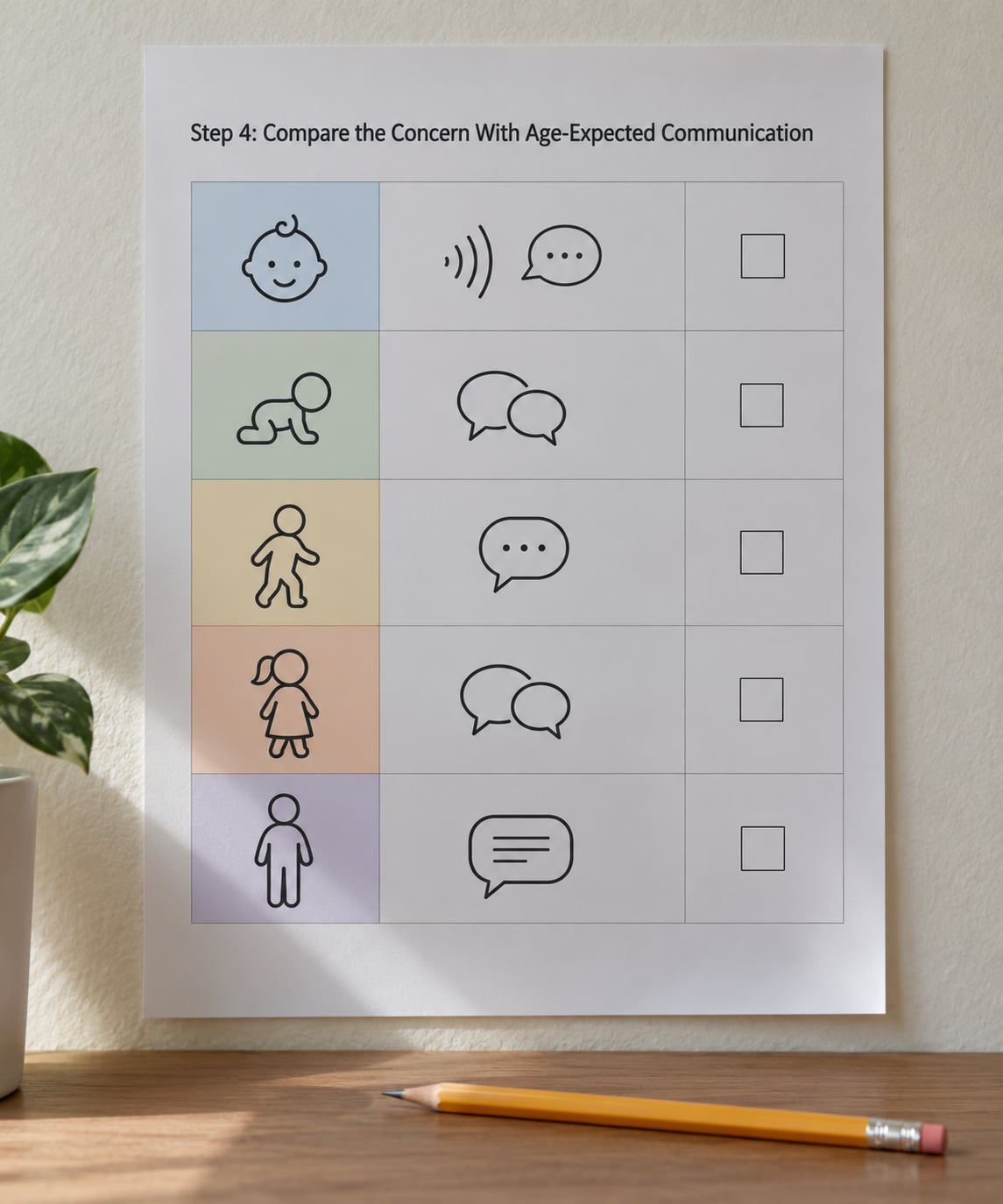
The last row is the urgent one. Losing words a child already had, going quiet, or stopping responding to their name is not a “wait and see” situation. Call the pediatrician this week and ask about a hearing check as well as a speech referral.
It also helps to separate three words parents often treat as synonyms.
| Late talker | Speech delay | Language disorder | |
|---|---|---|---|
| Understanding language | Typical | Typical | Can also be affected |
| Number of words | Behind, then catches up | Behind and still climbing slowly | Behind, and progress plateaus |
| Pattern over months | Steady catch-up | Flat or slow | Flat or losing ground |
| Gestures and social use | Typical | Typical | May be limited |
| Typical follow-up | Recheck in 2 to 3 months | Evaluate and likely therapy | Evaluate, plus possible hearing and developmental assessment |
Other things change the picture: how much language a child hears at home, how many languages they are navigating, hearing, motor skills, and any condition they were born with. A child who has never had consistent access to language is not delayed in the same way as a child who has and stopped using it.
Step 5: Talk With Your Child’s Pediatrician
Bring your notes. Start with the examples rather than the worry, because a clinician can act on one but only listen to the other.
Say something like: “I have been keeping track for six weeks. He uses about twenty words, no two-word phrases yet, and does not turn when I call his name. I would like a hearing check and a speech-language evaluation.” That sentence takes fifteen seconds and is easy to act on.
Be ready for questions about hearing history, ear infections, medications, feeding and oral-motor skills, sleep, social interaction, and any other developmental concerns. Share the whole picture, because the answer often sits in a different domain than speech itself.
Five common reasons a child is delayed, and worth mentioning so nothing gets skipped:
1. Hearing. Chronic ear infections, fluid, or a hearing loss can explain delay that looks like a language problem. A hearing screening is often the first step, not an afterthought.
2. A medical or genetic condition. Cleft palate, Down syndrome, cerebral palsy, Fragile X syndrome, and other conditions carry known communication profiles, and evaluation is usually recommended rather than optional.
3. Prematurity or birth history. Premature babies are often evaluated for language as a matter of routine follow-up.
4. Developmental differences. Autism, global developmental delay, and intellectual disability often show up first in communication, which is why a speech-language pathologist works alongside other providers rather than alone.
5. Environment. Limited language exposure, a very responsive caregiver doing everything for the child, or heavy background media all affect how much talking practice a child gets.
Whatever your doctor advises is the right next step. If they want a wait-and-see approach, agree on a timeline and a specific list of signs that would change the plan.
Step 6: Request a Speech-Language Evaluation
For children under 3 in the US, contact your state’s early intervention program, sometimes called Part C, and ask for an evaluation. It is free, it is not a diagnosis, and being evaluated does not commit you to services.
For school-age children, the school is the first call. A request for evaluation can lead to a 504 plan or an IEP with speech-language services written into it, which covers therapy at school at no cost to the family. You can also go to a private clinic, and some families do both while waiting.
Private evaluations are the other route. Ask what a session involves, whether the clinician is a certified speech-language pathologist, and whether your insurance requires a referral or a pre-authorization before you book. Evaluations commonly fall in the low hundreds of dollars, and coverage varies widely by plan, so the two phone calls that settle it are worth making early: one to your insurer about coverage, one to the clinic about the referral requirement.
Look for a clinician who works with children your child’s age. A good sign is that they will talk you through play-based assessment rather than describe a test your child has to perform.
What a speech evaluation actually involves, which is the question parents ask most:
It is usually a mix of standardized testing for children old enough, informal play-based observation for younger ones, input from you, and sometimes a hearing check. The clinician watches how your child plays, requests, responds to language, and interacts. You get a written report with findings, specific goals, and a recommended plan. A 20-month-old is not asked to sit at a table and name pictures, so the session usually looks like playing.
Bring your notes to the appointment and ask for the goals in writing. You leave knowing what is being worked on, how often, and how progress will be checked.
Step 7: Understand What Happens After the Evaluation
Sessions with toddlers and preschoolers are play-based and low-pressure. That is the most common relief parents report, because the fear of a child being made to feel bad is usually the biggest thing standing in the way. A child at a young age is often getting language through a parent while the clinician coaches the parent in the room.
One number you will hear often is the 3:1 rule, which comes from early intervention practice: roughly three hours of adult-directed interaction for every one hour of direct therapy. It is why home practice matters as much as the session itself, and why a plan heavy on clinic time alone is worth questioning.
Progress is measured against the goals from the report, often every few months, and goals get revised as the child changes. Ask how the clinician knows whether therapy is working, and what would happen if it is not.
Sometimes a plan includes an alternative way to communicate, such as a picture board or speech device, for a child who has a lot to say and few words available. Parents often worry this replaces talking. It does not. There is a clear explanation in why AAC will not stop your child from talking.
While you wait, which can be weeks or longer depending on where you live, keep talking with your child in short, warm, ordinary moments. Narrate what you are doing. Expand what they say, so a child who says “ball” hears “you found the big ball.” Pause after a question and wait. Follow their lead in play. Cut background media during conversations. These are small habits, not homework.
Common Mistakes Parents Make
Comparing your child to a sibling or a friend’s child. Development is too variable for that to tell you anything useful. Compare your child to your own child over time.
Waiting for a diagnosis before asking for help. You do not need a label to make a call. Asking for an evaluation is a request for information, and an evaluation itself is not a diagnosis that follows your child around.
Focusing only on pronunciation. “Th” sounds are late-developing and usually fine. Hard-to-understand speech, limited understanding, or no two-word phrases matter far more.
Dismissing concerns because the child gestures well. Strong gesturing shows good communication instinct, but it does not rule out a language need. Plenty of children with a real language disorder point beautifully.
Treating a screening result as a diagnosis. Screenings are quick and broad. A diagnostic evaluation is deeper, and only a qualified clinician can give you one.
Assuming bilingual children are behind. Distributing words across two languages, code-switching mid-sentence, and mixing sound systems are normal development. Look at total understanding and total intent instead of the word count per language.
Blaming yourselves. Speech and language develop out of biology, hearing, opportunity, and chance. Guilt does not help your child say a new word tomorrow, and it tends to stop parents from writing down the very examples a clinician needs.
One habit helps more than the rest: write down three specific examples before your next appointment. Bring them, ask about a hearing check, and ask for an evaluation. That is a complete first step, and it is available to you this week.
Frequently Asked Questions
Does my child need speech therapy?
You cannot tell from one sign, and neither can a checklist. Look for two or more signs that persist across several weeks and appear in more than one area, such as a small vocabulary, speech strangers cannot follow, trouble understanding directions, or frustration when talking. If those things are getting in the way of communicating, learning, or playing with other children, book an evaluation. An evaluation is information, not a label.
Can a toddler have a speech delay and not be autistic?
Yes. A speech and language delay is one of the most common reasons young children are referred for evaluation, and most children with a delay do not have autism. Language delay can also come from hearing loss, a medical condition, prematurity, or limited language exposure. Autism features a wider pattern that often includes social communication differences and restricted or repetitive behaviors. Only a thorough evaluation can sort that out.
At what age should a child get speech therapy?
As soon as you notice a pattern, at any age. Most families are referred between 18 months and 3 years, when delayed language becomes clearer. Under 3 in the US, the state early intervention program provides free evaluation and services, and parents do not need a diagnosis or a doctor’s referral to ask. Waiting months to see if speech improves is the most common regret parents report.
Is 4 too late for speech therapy?
No. Plenty of children start speech therapy at 4, 5, or 6 and make real progress, and school-based services through an IEP or 504 plan can begin at any point during the school year. Younger is usually easier because the brain is more flexible, but starting later is far better than not starting. A good clinician will give you a realistic timeline for your child specifically.
How much does a speech therapy evaluation cost, and is it covered by insurance?
Private evaluations commonly fall in the low hundreds of dollars before insurance, and coverage depends entirely on your plan. Ask your insurer two questions before booking: is the clinician in network, and is a referral or pre-authorization required. In the US, early intervention services for children under 3 and school-based services are provided at no cost to the family, so the public routes are the cheapest place to start.
What can I do while I wait for an evaluation?
Talk with your child in short, warm, ordinary moments. Narrate routines, expand what your child says, pause a few seconds after a question, and follow their lead in play. Keep a weekly word tally and a dated note of three real examples, which will help the clinician. Turn down background media during conversations. And if your child loses words or stops talking, call the pediatrician instead of waiting.
A Clear First Step for Your Child
Write down three specific examples of your child’s communication this week. Add their age, the setting, and when each one happened.
Then call the pediatrician. Mention the examples, ask about a hearing check, and ask for a speech-language evaluation referral. If your child is under 3, contact your state’s early intervention program as well — you can do that on your own, without waiting for anyone.
If the concerns interfere with communicating, learning, social interaction, or daily life, do not wait to see whether they resolve. Early support is easier for your child to receive at two than at five.