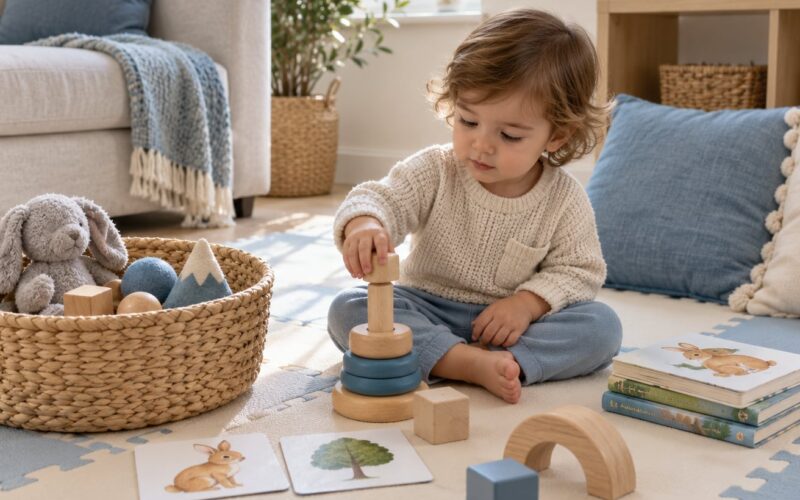
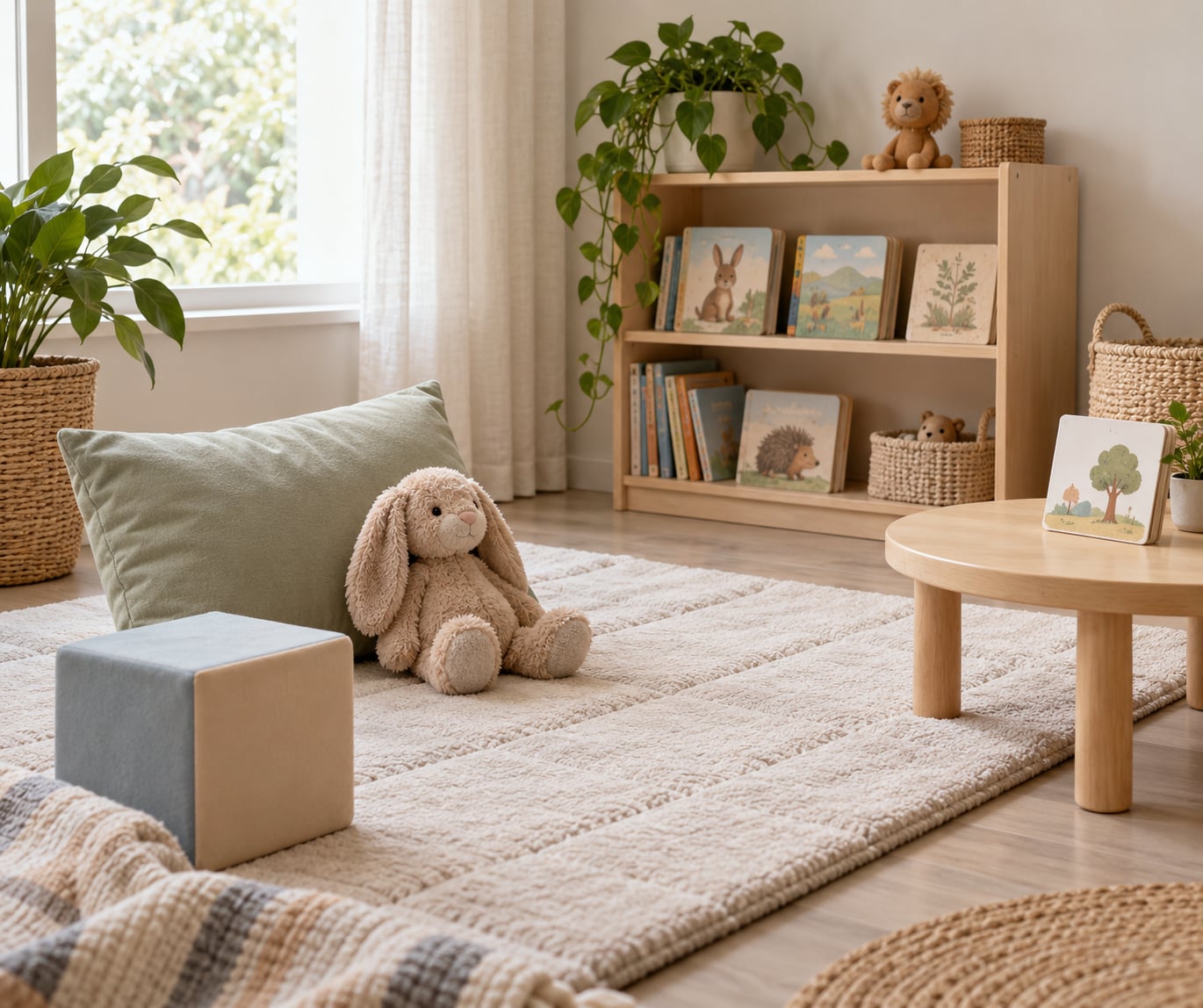
The short answer is this: to stop a toddler from hitting, protect people first, keep your voice low and your body steady, say one short sentence that names the limit, and teach the replacement behavior later when everyone is calm. That is the whole method. No spanking, no chair, no fifteen-minute speech about their feelings while they are still swinging.
Most hitting between 12 months and 3 years comes from a toddler with a big feeling and no other way to get it out. The impulse to hit arrives before the impulse control to stop it, and language for what they feel is still a year or two away. Hitting is a symptom, not a character defect, and neither is your child for doing it.
I have talked to a lot of parents who assume they are doing something wrong because they are the one getting hit. Usually they are not. They are the one the toddler comes to when the feelings get loud, which means the problem is that the toddler has exactly one tool, and your job is to help them get a second one.
Below is the plan I would follow, in the order you would actually need it at 4pm on a Tuesday.
Table of Contents
- What You Need
- Step-by-Step
- 1. Stay Safe and Stay Calm
- 2. Remove the Immediate Trigger
- 3. Name the Behavior Without a Lecture
- 4. Offer a Safe Replacement
- 5. Follow Through Consistently
- 6. Track Patterns and Adjust
- Common Mistakes
- Frequently Asked Questions
- Does time-out work for toddlers who hit?
- Why does my toddler hit me but not my partner?
- At what age should a toddler stop hitting?
- Why does my toddler hit and then laugh?
- What do I do when another child hits my child?
- How do I discipline a child for hitting?
- Conclusion
What You Need
You need four things, and none of them cost money.
A safe setup comes first, because prevention does more work than correction. Put breakable or sharp-edged things out of reach, and give your toddler physical outlets that are made for hitting: a pillow, a squishy ball, a foam block, a mat on the floor. If your child is the size to swing at you, you also need to know you can move out of reach quickly.
A short list of your own triggers. Before you try to change anything, notice when it happens. Hitting clusters around a few predictable moments: transitions, being pulled from something absorbing, another child taking a toy, a schedule change, noise, and being dressed or undressed. Write the top three down on your phone and keep them where you will see them.
Simple language, and nothing else. Toddlers process about ten words of instruction at a time when flooded, so your script has to be under a sentence long. Write the three sentences you plan to use on a note in your pocket, because you will not be able to invent them while your toddler is mid-swing.
A quiet place that is not a punishment. A couch corner, a small tent in the living room, even a chair with a cushion. The difference matters, and kids notice it: this spot is for calming down, not for sitting in shame. If you want more ideas on that, how to stop a child from chewing on clothes covers the same idea for another repetitive behavior that looks a lot like a nervous habit rather than a choice.
Step-by-Step
1. Stay Safe and Stay Calm
Move your body first. If a hand is coming at your face, step back, turn your shoulder, or put a chair between you and the hit. Blocking without punishment is not the same as restraining a child to force compliance, and the difference is in your intention and your tone: you are making the hit impossible, not making your child suffer.
Then drop your volume. Zero to Three, the early-childhood resource many pediatric programs point families to, puts staying calm at the top of the list for a reason: a raised voice adds stimulation to a child who is already full up. Say the one sentence you planned, and stop talking.
2. Remove the Immediate Trigger
Ask yourself what the hit was actually about, because the same behavior has different causes. Frustration over a toy looks different from pain, and both look different from sensory overload or from a word they do not have yet.
If the trigger can be moved, move it. End the playdate, remove the drum kit, turn down the music, offer the choice of walking to the car or being carried. You are not giving in, because none of those things is the thing they were actually asking for.
Overstimulation is the cause most parents miss. A room that felt fine to you at 3pm can be unbearable to a small nervous system at 5pm, with the same number of people in it. Noise, blinking lights, tight clothing, and constant instructions all stack. If hitting shows up in busy places and not quiet ones, that is your first clue.
3. Name the Behavior Without a Lecture
Use one short sentence, said once, in a normal voice. Not angry, not soft and coaxing either. Flat and clear is the tone that works.
- “No hitting. I won’t let you hit me.”
- “Hitting hurts. Hands are for gentle.”
- “You are angry. I know. No hitting.”
Then stop. The urge to keep explaining is the hardest part of this whole plan, because silence feels like failure and a lecture feels like teaching. During a flood, the words do nothing except add input, and a child mid-tantrum is not choosing to misbehave, so the lecture lands on nobody. Say the sentence, and give your attention to the safety of the room instead.
Do not attach labels. “Bad,” “naughty,” and “why would you do that” push shame into a child who cannot yet hold it, and shame delays the very learning you are trying to trigger.
4. Offer a Safe Replacement
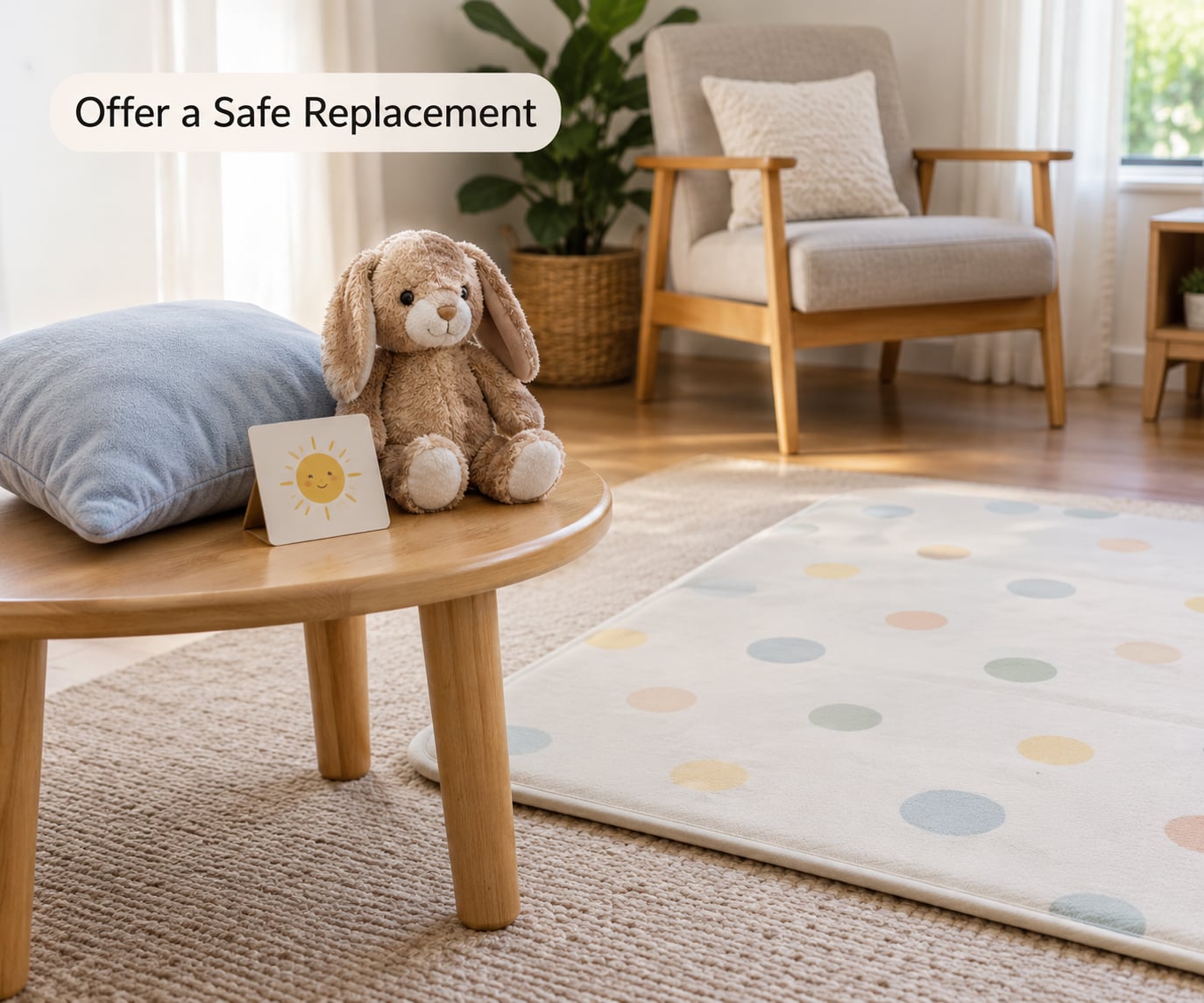
Wait for calm. This is the step parents skip and then wonder why nothing changes. A toddler in a meltdown cannot absorb a new skill, so the teaching happens in the ten quiet minutes afterward, not in the ten loud ones before.
Then name what you saw and hand over an alternative. “You were mad the block was gone, and you hit. Next time stomp your feet or hit the pillow.” Pair the feeling with the action, because the goal is not obedience, it is a second option for a very real feeling.
Build the option list ahead of time and rehearse it during calm moments, the same way you rehearse anything else: stomping feet, squeezing a stuffed animal, hitting a pillow away from people, pushing an open palm instead of a closed fist, walking to the quiet spot, signing stop, or simply saying help. If your child uses AAC or a device, that belongs on this list too, though it is worth reading why AAC will not stop your child from talking so you are using it as a real communication tool rather than a quick silencer.
5. Follow Through Consistently
The same response, from every adult, every time, in every setting. If you use one sentence at home and your partner uses a different one, or your parent gives in after five minutes, the toddler has learned something: which adult to target. That is often the real reason hitting escalates rather than fades.
Keep it logical and short rather than long and punitive. A child who hits during cleanup sits out of the cleanup for that round. A child who hits a sibling gets separated from the sibling while both are calm, not sent away to think about what they did.
Reinforce the pauses, not just the apologies. Toddlers cannot fake a sincere sorry, so a forced one teaches nothing except that the words are empty. What you can genuinely reward is the moment before: the toddler who stomps instead, who walks to the pillow, who asks for help. Catch that within a second or two and say what you saw, out loud: “You stomped. You kept your hands gentle.” Specific praise teaches more than a generic “good job” because it tells the child what to repeat.
6. Track Patterns and Adjust
For about two weeks, write down three things each time it happens: the time, what happened right before, and what helped afterward. That is all. Parents consistently find that the same three triggers account for most of the hitting, and once you can see them you can change the environment instead of correcting the child.
Also note the good stuff, because a log that only records failures will convince you nothing is changing when it is. Progress at this age looks like longer calm stretches, not a straight line to zero.
On timing, parents ask about the 3-3-3 rule, which is a parent-shared rule of thumb rather than anything from a clinical source: about three days for a new response to feel less shocking, three weeks for a new routine to hold, three months for a new normal. It is a rough marker, not a promise, and it is a useful guard against giving up in week two.
Age matters more than most parents expect, so it helps to know what is typical at each stage.
| Age | What it usually looks like | What is expected |
|---|---|---|
| 12-18 months | Open-handed swipes at faces, arms, and other children during play | Normal. Words for feelings are not there yet, and impulse control is still forming |
| 18-24 months | The peak: hard slaps, pushing, grabbing toys, hitting during transitions and handovers | Still normal, and often the hardest stretch. The hitting stage is most intense here |
| 2-3 years | Hitting when frustrated, then often alongside words like mine or stop | Language is starting to do some of the work. Some children begin to slow down here |
| 3 years and up | Hitting should be noticeably rarer and more directed at a goal, such as getting a toy back | If it is frequent, getting more intense, or happening with adults rather than children, tell your pediatrician |
Common Mistakes
Long lectures. They do not work mid-tantrum and they teach the child that the safest moment to reach for you is when you are already upset. Fix it by cutting your script to one sentence and keeping it flat.
Hitting back. It models exactly the behavior you are trying to remove, and with a much better aim, because adults rarely miss. The rule is simple: block, never strike.
Giving in right after. Handing over the contested toy, or the extra screen time, teaches that hitting works, and the next one gets bigger. A short delay is enough; you do not need to win the whole argument.
Punishing without teaching a replacement. Consequences without a new behavior leave a gap, and the gap fills with the old one. Every consequence needs a paired alternative, taught when your toddler is calm.
Assuming every hit means the same thing. A hit from frustration and a hit from pain or overload need different responses. That is the tracking log’s job, and it is why the same script sometimes feels like it is missing.
Forgiving the attention, and blaming yourself. A calm response is not something you are born with, and a loud reaction is a skill you can learn like any other. If you are the one absorbing most of the hitting, being the one who always has to hold steady is genuinely tiring. Naming that out loud to a partner, a friend, or your own pediatrician is not a failure, it is maintenance.
Frequently Asked Questions
Does time-out work for toddlers who hit?
A time-out can be useful, but only as a way to stop the behavior and get everyone safe, not as a way to make your child feel bad. Most toddler experts recommend keeping it very short, around one minute per year of age, and treating it as a return to a calm-down spot rather than a punishment chair. Sitting your toddler there while you lecture teaches nothing. Pair it with a replacement behavior taught later, when they are calm, or it becomes a ritual with no learning attached.
Why does my toddler hit me but not my partner?
It is usually a combination of access and match, not favoritism or something you did wrong. Hitting goes toward whoever is closest during the escalation, often a parent, and it is more likely with the adult whose boundaries soften fastest, or who is handling the trigger they are most reactive to, like transitions or dressing. Keep the same short sentence and the same follow-through from both adults, and tell your partner exactly which words you use so the child hears one version.
At what age should a toddler stop hitting?
Most children show a clear drop in hitting between 2 and 3 years, as language and self-control catch up with the feelings. Some still hit occasionally at 3, and many parents see a steady fade by 4. There is no exact deadline. What matters more than the number is the direction: if hitting is becoming more frequent, more forceful, aimed mainly at people rather than objects, or paired with no regard for the other child being hurt, that is worth raising with your pediatrician.
Why does my toddler hit and then laugh?
Because the reaction works. Your laugh, your gasp, your raised voice, even your stern face is attention, and for a toddler that is a reward, especially if the hit produced the exact reaction they were aiming for. The fix is not more intense reaction, which teaches escalation. It is a flat, boring response: block, one short sentence, no eye contact, turn toward the other child, and move on. Boredom is what you are going for, and it is hard to deliver the first few times.
What do I do when another child hits my child?
Check your child first, briefly, and get real distance between the two of them right away. Then speak to the other child’s parent, not the child, in a short neutral sentence about what you saw. Most families handle it quickly and without drama when it is framed that way. Tell your own child afterward what you saw them do, connect it to being hurt, and rehearse one thing to do next time, such as walking away and finding you. Do not apologize for your child’s behavior on their behalf.
How do I discipline a child for hitting?
For toddlers, discipline means a clear boundary plus a safe consequence plus a taught alternative, delivered the same way every time. Stop the hit, say one short sentence such as no hitting, I will not let you hit me, separate briefly, and give back a replacement behavior once your toddler is calm, like stomping, hitting a pillow, or asking for help. No long talk, no hitting back, and no handing over whatever caused the hitting. Consistency across adults is what makes it work within a couple of weeks.
Conclusion
Start with safety: get out of reach, put your voice down, and say one sentence that names the limit. Then find out what came before it, because the trigger decides whether you need to end the playdate, move the chair, or turn the volume down. Once your toddler is calm, teach the second tool, and keep the response identical in every room and from every adult. That is how to stop a toddler from hitting, and it takes minutes a day rather than an overhaul of your whole parenting style.