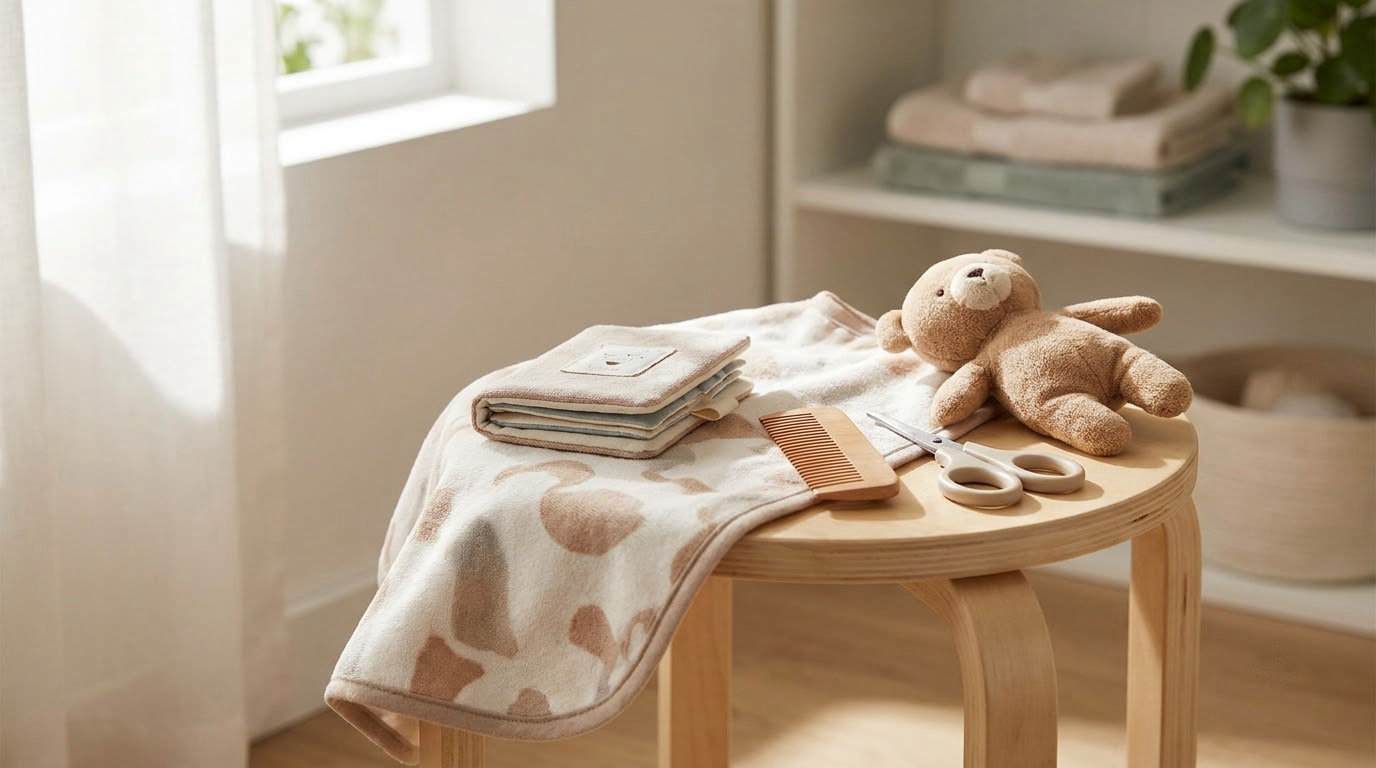
If you are searching for how to help a child who hates haircuts, the answer that works most often is a slow one: work out which single part of the haircut your child actually objects to, then build the visit around removing that one thing, and practise it in tiny steps at home for a couple of weeks before you book. Most children who hate haircuts are not being defiant. They are reacting to noise, vibration, loose hair on the neck, a stranger near their head, and a room they cannot predict.
That is genuinely good news, because a sensory problem has a practical fix. The usual mistakes are booking a full cut the first time your child touches a cape, or waiting so long between trims that the appointment has become a huge event. Both make it harder.
What works is a slower, repetitive version of what you would do for any skill: prepare, practise, go small, finish well, repeat. Here is the whole approach, step by step.
Table of Contents
- What You Need to Help a Child Who Hates Haircuts
- Step-by-Step: A Gradual Plan Starting This Week
- Step 1: Identify What Feels Overwhelming
- Step 2: Build a Predictable Plan
- Step 3: Practice Before the Appointment
- Step 4: Choose the Right Time, Place, and Stylist for a Child Who Hates Haircuts
- Step 5: Keep Each Session Short and Flexible
- Step 6: Use Communication and Gentle Boundaries
- Step 7: Finish Positively and Revisit Success
- Common Mistakes When Helping a Child Who Hates Haircuts
- Frequently Asked Questions
- Why does my autistic child hate haircuts?
- What can I use to help a child tolerate haircut sounds?
- How do I introduce haircuts to a child with sensory sensitivities?
- Is it better to cut my sensory-sensitive child’s hair at home or at a salon?
- What should I do if my child becomes overwhelmed during a haircut?
- When should I ask a doctor or therapist for help with severe haircut distress?
- Conclusion
What You Need to Help a Child Who Hates Haircuts
Gather these before you even book anything. Most of them are free, and having them ready is what turns a fight into a routine.
- A visual schedule — a simple picture sequence showing arrive, wait, cape, cut, finish, home. Laminated and reused.
- A social story — a short, specific story in your child’s own words about the last visit and the next one. Keep it honest: say the cape is scratchy, say the noise is loud, say it is hard.
- Choice cards — two or three options your child picks from, like scissors or clippers, music or no music, sitting on the chair or on your lap.
- Noise protection — noise-cancelling headphones or ear defenders. These help more than any video tablet for many children.
- A comfort object — one item that goes in the bag and stays with your child the whole time. A blanket, a toy, a fidget strap.
- A spray bottle — for dampening hair instead of a sink rinse. A rinsing sink is a common trigger and a spray bottle removes it.
- Child-safe blunt-tip scissors — plus a hand mirror, a brush, and a washable cape for home practice.
- An adult who is calm — either you, if you can stay steady, or someone else entirely.
Step-by-Step: A Gradual Plan Starting This Week
Step 1: Identify What Feels Overwhelming
Watch your child’s face the next time you brush their hair, and you will usually find the trigger faster than any question can. The usual suspects, in rough order of frequency, are the buzz of clippers, the cape collar against the neck, snippets of cut hair falling onto skin, having to hold still while an unfamiliar adult works near your head, waiting in a noisy room, and the smell of sprays and powders.
Write down the three that set your child off most. Keep it short and specific — “clipper noise and the cape” is useful, “haircuts” is not.
Watch for a physical tell too. A lot of children go blotchy and red around the face and neck after a hard visit, and parents are often surprised by it because it looks like heat or exertion. It is a recognised sign of sensory overload.
Step 2: Build a Predictable Plan
Unpredictability is what turns a hard haircut into a meltdown, so show the whole sequence in advance and keep showing it. A first-then board with two photos works as well as a full social story, and takes two minutes to make.
Keep the language flat and factual rather than reassuring. “First we wait, then the cape, then the noise, then we stop” is easier for a child to trust than “it will be fine, I promise.” Promising something will be fine, and then the cape arrives, teaches the opposite of what you mean.
Mark the end of the visit on the plan too. Children cope far better with a hard thing when they can see where it stops.
Step 3: Practice Before the Appointment
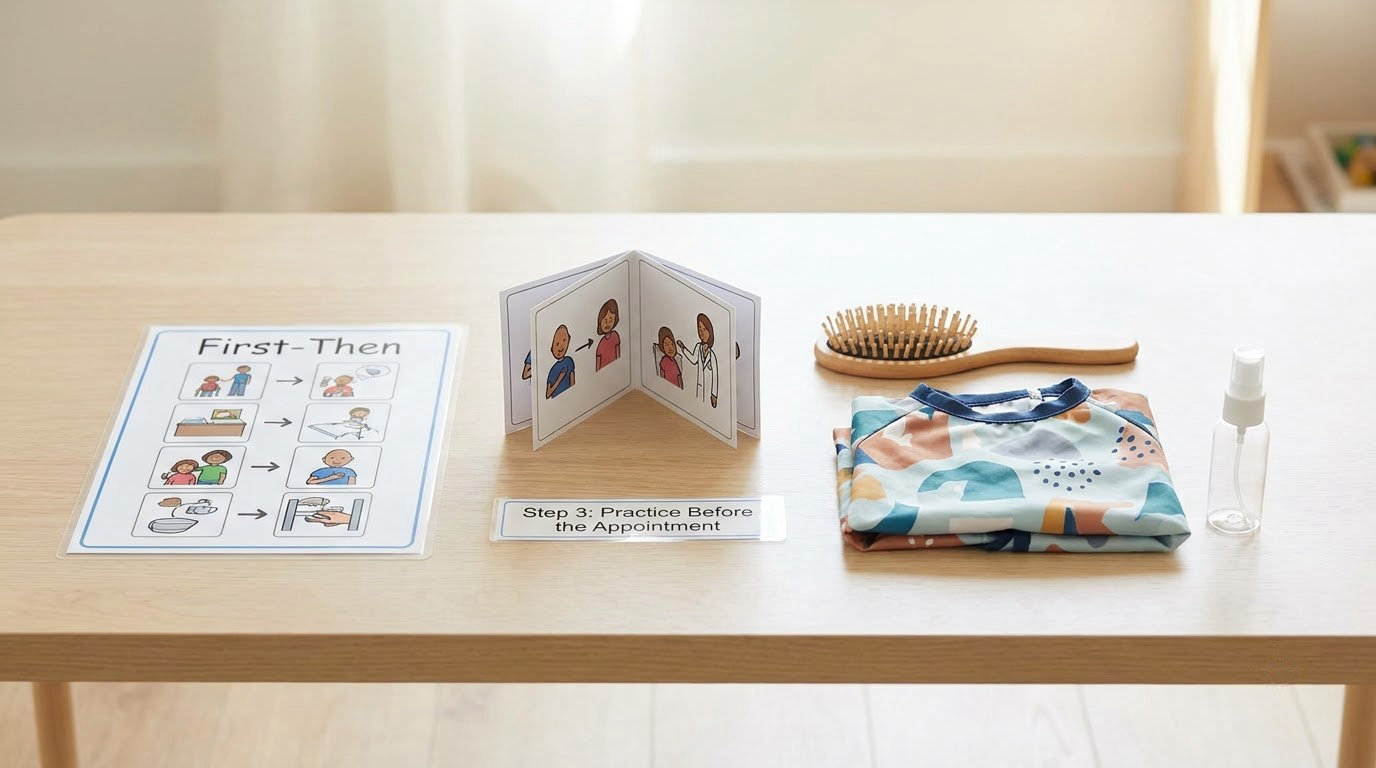
Introduce the sensory elements one at a time, in small doses, and stop while your child is still coping. That stopping point matters more than anything else in the whole plan — a child who repeatedly hits overload stops trusting the activity, and the next try becomes harder.
- Touch a comb lightly to the hair, count to three, stop. Repeat daily until that is boring.
- Drape the cape over the shoulders without fastening it. Progress to fastening, then progress to leaving it on for a minute.
- Play clipper sounds through a speaker at low volume. Add distance later, not volume.
- Cut a doll’s hair, or let your child hold the closed scissors and snip a paper strip.
- Brush the hair while the child holds a mirror and chooses when to stop.
One or two minutes a day for two weeks beats an hour of drilling the night before. Do the smallest step that still feels slightly hard, every day, and let boredom do the rest.
Step 4: Choose the Right Time, Place, and Stylist for a Child Who Hates Haircuts
Book the quietest slot you can get — early morning on a weekday, not Saturday. Waiting rooms are the single most reported trigger in parent forums, and a child who flips out before the door is even opened is reacting to the room, not the haircut.
Say what you need when you book, not when you arrive. One sentence is enough: “My child is autistic and finds the cape and clippers difficult. Could you book us in a quiet slot, and is your stylist comfortable with sensory needs?” You will quickly learn which salons actually follow up on that and which ones nod politely.
It is worth booking a no-pressure first visit where the child comes, sits in the chair, gets to play with the comb, and leaves without a cut. Parents on parenting forums describe this as the turning point more often than almost anything else.
If the salon cannot accommodate, consider a mobile stylist who comes to your home, or do a small at-home trim yourself. A bridge beats avoidance, and avoidance is what makes the next appointment enormous.
Step 5: Keep Each Session Short and Flexible
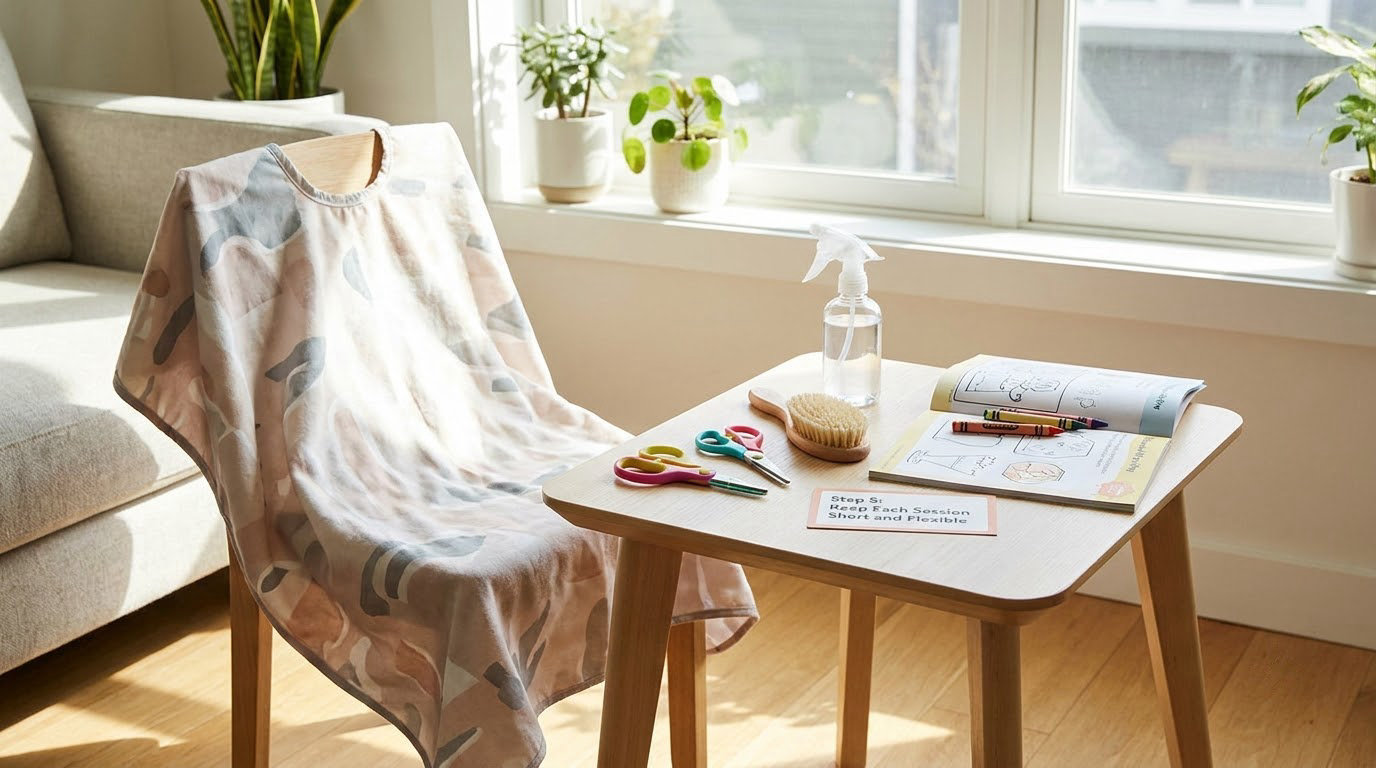
Set a finish line you can genuinely deliver. For a first visit, that might be a consultation, one tool used for two minutes, and a photo of the haircut you did manage. Agree a signal with the stylist beforehand that means stop now, so your child has the power in their hands and you do not have to choose between safety and consent.
Plan breaks between sections rather than pushing through. Three short bursts with a pause in the middle is usually more finishable than one long continuous cut.
For hair type: tangles at the nape are the most common complaint from parents, so detangle before you go, keep hair damp with a spray bottle rather than getting it wet, and tell the stylist about the cowlick or the thick patch that always grows back in your kid’s ear. A good stylist would rather hear it now.
Step 6: Use Communication and Gentle Boundaries
Give your child a way to tell the stylist what they need, whatever that is: words, a sign, a picture card, a device, or a squeeze of your hand. Practise the signal at home first, so it works under stress and not just in a calm room.
Say clearly that stopping is allowed, and mean it. Keeping a boundary does not mean forcing a full cut. It means the child can move their head, stand up, or end the session, and the adult handles sharp tools safely in the meantime.
On the question parents ask most often: holding a child down gets the hair cut, and it reliably makes the next one worse. A forced restraint breaks the trust the appointment depends on, and the fear it teaches tends to outlive the problem. There are narrow safety situations where a brief hold is unavoidable, but a full pin-down as a parenting strategy is what turns a hard appointment into years of avoidance.
Step 7: Finish Positively and Revisit Success
End on something your child chose, and let the visit be over as soon as it is. A sticker, a stop at the park, a specific small thing they wanted. Then make the next one easy and close together, because long gaps between trims are reported over and over again as what makes appointments worse.
Lower the goal each time until it is almost boring, and let the boredom spread. Two minutes of tolerating the cape, then two minutes of clipper sound, then two minutes of an actual cut — that is how children learn this, and it is usually slower than parents expect.
Do not treat your child as a problem to be fixed before the next haircut. Many children are fine with the idea of a haircut and only hate the execution. Talking to them as though they are a work in progress about to be completed is its own kind of hard.
Common Mistakes When Helping a Child Who Hates Haircuts
Forcing contact to get it done, and assuming the child understood nothing about what was coming, are the two mistakes that undo weeks of preparation. Here are the rest, each with a fix.
- Forcing contact to “just get it done.” Fix: agree a stop signal and a two-minute goal with the stylist before the appointment. Professionals treat restraint as a last resort for a reason, because it ends the appointment and usually begins a longer avoidance.
- Introducing every tool at once. Fix: one element per practice session, plus a week of boredom before you move on. A child flooded with clippers, cape, mirror and spray learns that all of them mean stress.
- Booking a full first appointment. Fix: book a ten-minute no-pressure visit and leave without a cut. Purpose first, haircut later.
- Waiting until the hair is unmanageable. Fix: trim early and often. Short gaps are kinder than one big appointment after a long silence.
- Escalating the treat every single visit. Fix: reward the attempt rather than paying for obedience, and drop the treat once the visits settle into a routine. A reward that has to grow each time teaches that haircuts are negotiable.
- Assuming the child understands what is about to happen. Fix: show the sequence visually, in the same order every time, including how it ends. Most parents are surprised how much of the distress is really about not knowing.
- Booking Saturday at the busiest hour of the week. Fix: move to a quiet weekday slot. Logistics do more work here than most parents expect.
Frequently Asked Questions
Why does my autistic child hate haircuts?
Haircuts stack many unpredictable sensory inputs at once: clipper noise and vibration, the cape collar, loose hair on the neck, water or spray, and a stranger touching your head. For an autistic or sensory-sensitive child, each of those may register as uncomfortable, and the unfamiliar room removes the ability to predict what happens next. That is why the reaction shows up as crying, thrashing or a meltdown rather than ordinary fussiness, and why naming the specific trigger usually helps more than distraction does.
What can I use to help a child tolerate haircut sounds?
Noise-cancelling headphones or ear defenders are the first thing to try, because they cut the volume without asking your child to cope with a screen at the same time. Practise with them at home beforehand so they are already familiar. You can also play clipper sounds through a speaker at low volume, starting far away, and repeat daily. For dryers, tell the stylist in advance and ask them to use a quieter model or skip the blow-dry altogether.
How do I introduce haircuts to a child with sensory sensitivities?
Introduce one element at a time, in very short doses, and stop while your child is still coping. Touch a comb to the hair for three seconds and stop. Then drape the cape without fastening it. Then fasten it. Then leave it on for a minute. Daily repetition for two weeks is usually more effective than one long session, and the crucial rule is that you end each attempt before distress, so the child stays willing to try again.
Is it better to cut my sensory-sensitive child’s hair at home or at a salon?
Neither is inherently better, and the honest answer depends on your child’s triggers and your own tolerance. A mobile stylist or a home visit gives you control over noise, timing and lighting, and removes the waiting room, which many parents say is the biggest trigger of all. A salon has an advantage if your child’s hair is thick, curly or difficult and you need a skilled cut. A home trim between salon visits often works as a useful bridge.
What should I do if my child becomes overwhelmed during a haircut?
Stop. Use the signal you agreed on before the appointment, and treat it as a normal part of the routine rather than a failure. Move somewhere quieter, let your child calm down without an audience, and cut short of the goal rather than pushing to the finish line. You can finish the remaining bits another day. Ending a session while your child is still able to feel some control is what makes the next visit easier rather than harder.
When should I ask a doctor or therapist for help with severe haircut distress?
Ask your pediatrician if the distress is severe, is getting worse rather than improving, goes beyond haircuts into other grooming or everyday routines, or is accompanied by significant sleep, feeding or sensory concerns. Requesting a referral to a pediatric occupational therapist is a reasonable step for children with diagnosed or suspected sensory processing differences. An OT can assess the specific tactile defensiveness and build a graded plan around your child rather than around a generic routine.
Conclusion
Start with one trigger and one small step: write down what your child reacts to most, then practise only that for two weeks. Book a quiet no-pressure visit rather than a full cut, keep the sessions short, and let the plan grow a minute at a time.