

If your child’s evaluation report says autism spectrum disorder and then gives you a number, that number is probably a level of support. Autism levels explained for parents comes down to this: the DSM-5-TR, published by the American Psychiatric Association, describes autism in three levels, and each one describes how much support a person needs right now. It does not describe how autistic your child is, and it does not predict their future.
Most parents hit that report and do one of two things. They spend weeks searching for what the number means, or they put the report in a drawer because the word beside it stung. Both reactions are common, and both cost you time you could have spent building a support plan.
The thing to hold onto from the start: the level is a description of support needs, not a verdict on the child. Children move between levels as they grow, as they learn new skills, and as their lives change. What follows is an explanation of the three levels and what each one tends to look like at home, at school, and in the community.
This is general information about a clinical framework, not a diagnosis for your child. Only a qualified clinician who has met your child can assign a level.
Table of Contents
- Autism Levels Explained for Parents: What the Three Levels Mean
- How Do Clinicians Determine an Autism Level?
- Autism Levels Explained for Parents: A Quick Comparison
- What Is Level 1 Autism Like for Parents Day to Day?
- What Is Level 2 Autism Like for Parents Day to Day?
- What Is Level 3 Autism Like for Parents Day to Day?
- Does an Autism Level Stay the Same Over Time?
- How Do Autism Levels Differ From Other Ways of Describing Autism?
- What Can Parents Do With Their Child’s Autism Level?
- When Should Parents Ask the Care Team for More Support?
- Frequently Asked Questions
- Is Level 1 autism the mildest form?
- Can a child move from Level 2 autism to Level 1?
- Does an autism level tell you how intelligent a child is?
- Can a nonverbal child be Level 1?
- Who can determine an autism level?
- What to Do First as a Parent
- Sources for This Guide
Autism Levels Explained for Parents: What the Three Levels Mean
The DSM-5-TR names three levels of support. Level 1 is Requiring Support. Level 2 is Requiring Substantial Support. Level 3 is Requiring Very Substantial Support. Those are the official words, and they are worth reading as written, because each one is careful about what it does not claim.
Autism is diagnosed across two core domains. The first is social communication and interaction. The second is restricted and repetitive behaviors, which includes sensory responses, insistence on routine, and highly focused interests. A clinician scores each domain separately, which means a child can be Level 1 in one and Level 2 in the other. That split is real, it is common, and most parents are never told it is there.
Here is what a level is not. It is not a measure of intelligence. It is not a prediction about school, work, or relationships. It is not a permanent identity, and it is not a ranking of children against each other. There is no Level 4 and no Level 5, whatever you may have read online.
How Do Clinicians Determine an Autism Level?
A level is assigned from the DSM-5-TR criteria, which require persistent differences in both core domains, present from early development, that limit or interfere with everyday functioning. In practice the evaluator gathers developmental history from you, reviews records and school observations, and watches your child interact and communicate directly.
Some clinicians also use standardized rating scales alongside the interview, and many formal evaluations for school purposes include a functional behavior assessment, often written by a board-certified behavior analyst. The information you contribute as a parent is not a footnote to that process. You are usually the only person who sees your child across settings, across a full day, over years.
One thing worth knowing before you go in: two qualified evaluators can score the same child differently. The criteria leave room for clinical judgment, clinicians weigh the same behaviors differently, and a child observed on a good day tests differently than the same child on a hard day. Parents raise this constantly in autism forums, and it is the most common source of self-doubt after a diagnosis. A different number from a second opinion is a reason to ask questions about the reasoning, not evidence that your child’s needs are imaginary.
Autism Levels Explained for Parents: A Quick Comparison
| Level | Official DSM-5-TR label | Often seen day to day | Supports parents commonly request |
|---|---|---|---|
| Level 1 | Requiring Support | Social and communication differences that others may miss; resistance to change; sensory sensitivities | Speech and language therapy, occupational therapy, an IEP or 504 plan, a social skills group, sensory supports at home |
| Level 2 | Requiring Substantial Support | Differences visible even with support in place; limited verbal expression sometimes; marked trouble with change and regulation | Structured daily programming, functional behavior assessment, OT and speech therapy, 1:1 support at school, parent coaching |
| Level 3 | Requiring Very Substantial Support | Substantial support with communication, social interaction, behavior, or daily self-care; minimal or no spoken language often | AAC and communication supports, intensive OT and speech therapy, adult-assisted programming, a 1:1 aide, safety planning |
Read that table as a starting point, not a rulebook. Two children with the same level on paper can need completely different things, and plenty of children sit between two rows. Within-level variation is wide, and autism self-advocates say so directly: you can show every trait people associate with autism and still be Level 1, or present in ways nobody notices and be Level 3.
What Is Level 1 Autism Like for Parents Day to Day?
Level 1 describes social communication differences that are noticeable without being disruptive, and restricted or repetitive behaviors that interfere with switching between activities. The DSM-5-TR ties this to people who may struggle to start conversations, respond, or read social cues, and who find it hard to move from one thing to another.
For parents, the hardest part of Level 1 is often that nobody else sees it. A child who talks fluently, plays near other children, and holds it together all morning at school can fall apart at bedtime at home. That gap is not your imagination and it is not a trick. Adults on forums describe exactly this, and autistic adults who were diagnosed late often describe spending years performing.
Girls in particular tend to be identified later or differently, partly because they are more likely to mask, imitate, and push through. If your daughter is bright, verbal, and seems fine at school, that is worth mentioning to the evaluator rather than assuming it rules autism out.
Supports that parents find useful at Level 1 are usually small and specific: a visual schedule so a change does not arrive as a shock, a quiet corner at school, extra processing time, headphones for a loud room, and practice with repair after a social misunderstanding. Level 1 children grow and learn, often quickly, and most need less help as they get older. The supports you build now usually become the scaffolding they use less and less.
What Is Level 2 Autism Like for Parents Day to Day?
Level 2 describes differences that are clearly evident even when support is in place, along with behaviors that interfere with the flow of everyday life. The DSM-5-TR describes challenges initiating and sustaining social communication, responses that are reduced, strained or atypical, and difficulty handling changes or moving between activities without visible distress.
Many Level 2 children have some speech but use it for requesting rather than connecting. A child might say drink when they want water, and not have words for tired, embarrassed, or overwhelmed. That gap is where a lot of parenting work happens, because behavior often fills in for the words a child does not have.
Day to day this level tends to mean your child’s day needs structure. Not discipline, structure. Predictable routines, warnings before transitions, a quiet place to reset, and adults who expect the meltdown rather than treating it as a failure of discipline. Sensory overload in a cafeteria or a crowded hall can undo an otherwise good morning, which is why the accommodations in a written plan matter more than the effort to push through.
Parenting a Level 2 child is heavier, and the load lands unevenly on whoever is home most. Siblings absorb more than parents expect. Our guide to explaining autism to siblings covers how to set up those conversations without making the older child a helper-in-residence.
Progress at Level 2 is real but rarely linear. New skills tend to arrive after a long stretch that looks like nothing is happening, and then show up all at once in a setting where you were not watching.
What Is Level 3 Autism Like for Parents Day to Day?
Level 3 describes very substantial support needs, with markedly reduced ability to communicate, respond to social interaction, or manage everyday situations and behavior. The DSM-5-TR notes that the social and communication differences are severe, that responses to social approaches are very limited, and that initiation of conversation is rarely beyond the use of very few words or phrases.
Many Level 3 children communicate through an augmentative and alternative communication device, which can be anything from printed picture exchange cards to a tablet with symbol software. If your child does not speak, communication is still happening, and it can be read. A good speech-language pathologist can help you build that channel, and a presumption of competence means you assume your child understands far more than the words coming out suggest.
On intelligence, be careful. Not speaking does not mean low cognition. Standard IQ testing asks questions out loud and expects an answer in a certain form, which disadvantages children who are autistic, who process slowly under pressure, or who do not respond verbally. Many teams include adaptive behavior measures instead, and a formal evaluation that skips those can produce a misleading picture of what your child understands.
Daily life at Level 3 is heavily supported and it can still be rich. Safety planning, help with daily self-care, structured adult-assisted programming, and a good educational placement usually do the heavy lifting. Parents of teens and young adults often find the transition out of school the hardest stretch, and our piece on finding a day program for a young adult with autism covers how to start that search early.
A level 3 diagnosis tells you nothing about potential or quality of life. It describes today’s support needs, and today’s needs change with skill, services, health, and environment.
Does an Autism Level Stay the Same Over Time?
Usually not, and a change in either direction is normal. Autism itself does not change, but a child’s skills, presentation, and support needs do. Levels get reassessed, and the number on an old report is a record of that moment rather than a permanent label.
Things that commonly shift the picture: development in general, targeted skill-building, a change of school or teacher, puberty, new academic demands, illness, and mental health. A child who coped in third grade may struggle badly in sixth with a heavier workload. Support needs can also move day to day and setting by setting, which no single number can capture, and parents often describe a child who needs very little at school and a great deal at home.
Reassessment is normal, not a setback. If your child’s level in the report no longer matches what you see, ask for a re-evaluation rather than waiting for someone else to notice.
How Do Autism Levels Differ From Other Ways of Describing Autism?
The DSM-5-TR levels are a clinical framework with defined criteria. Most other autism language parents encounter is informal, and some of it was deliberately retired because it treats a child as a fixed type.
- High-functioning and low-functioning. Both are widely used and widely disliked by autistic adults. They imply a permanent state and a ranking, and neither appears in the DSM-5-TR.
- Mild and severe. Autism itself is not described as mild or severe. The framework describes how much support is required, which is a different question from how much a person can achieve.
- Level 4, level 5, and level 0. These do not exist. There are exactly three levels. Searches for autism level 4 symptoms and for five levels of autism come up often, and every credible answer is that the diagnostic manual defines three.
- Asperger’s, PDD-NOS, and autistic disorder. These were separate diagnoses before the DSM-5 merged them into autism spectrum disorder in 2013. You will still meet them in older records and online posts.
- Nonverbal. This describes speech, not cognition, and it is not a level of its own.
If you find yourself defending a number to a relative who says he seems fine, describing the specific things your child needs tends to move the conversation much further than defending the level.
What Can Parents Do With Their Child’s Autism Level?
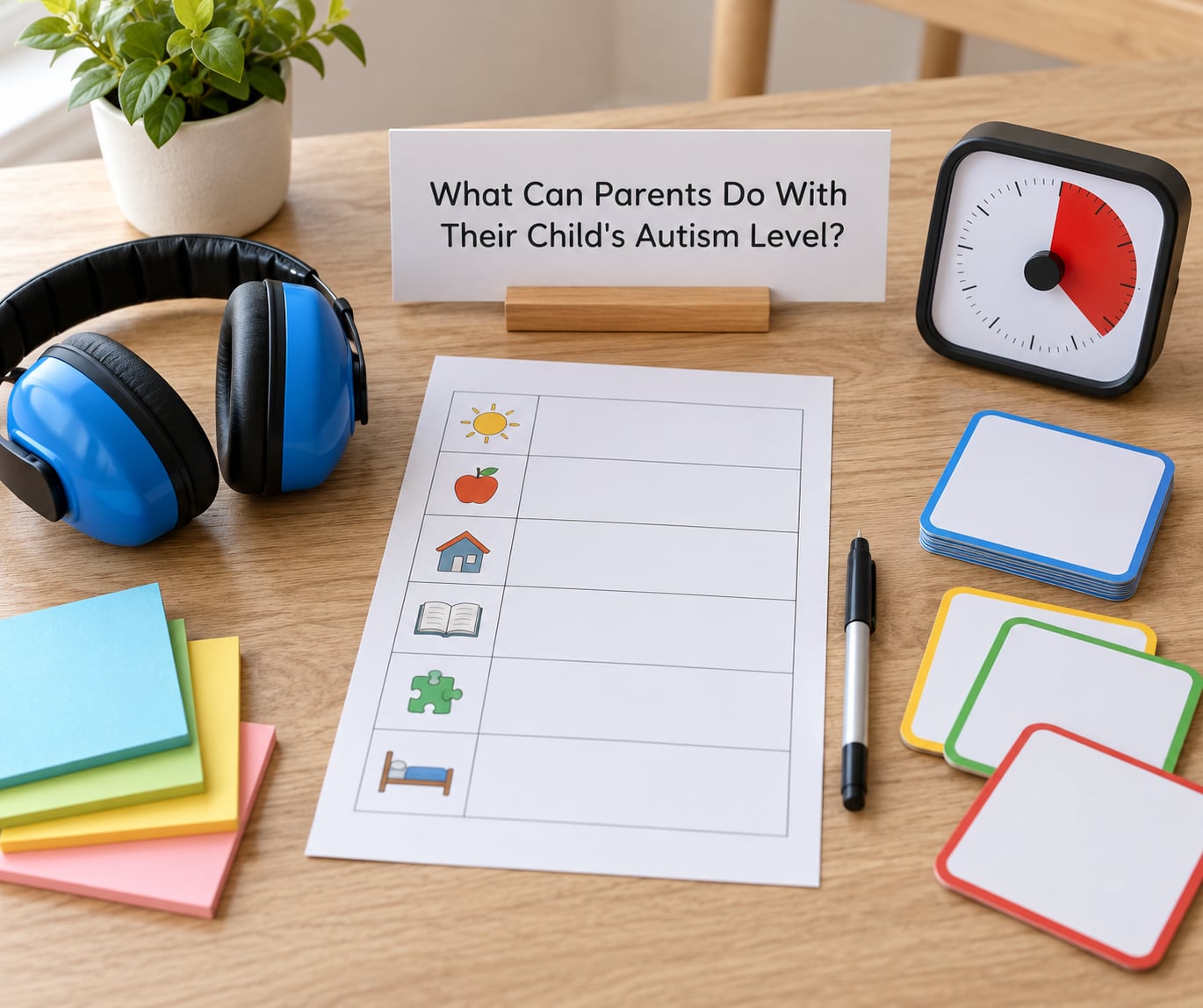
The useful move is to retire the number as a planning tool and start with a support inventory. Here is the sequence that works for most families in the first few months after a diagnosis.
- Get the written description, not just the label. Ask the evaluator for the narrative that goes with the code, including whether each domain was scored separately and what behaviors drove each score.
- List the hardest five moments in a typical week. Mornings, bedtime, the grocery store, group activities. Write them where other adults can see them.
- Request services in writing. School supports in the United States run through an individualized education program or a 504 plan. Say which environment breaks down and what you have already tried at home.
- Get a functional behavior assessment for anything that puts your child at risk. Elopement, aggression, or self-injury needs a plan built by a qualified behavior analyst, not a discipline strategy invented at 6pm.
- Set a review date on the calendar now. Twelve months out, or sooner if something changes sharply.
- Track what changes the day. A one-week note on sleep, food, noise level, and transitions tells you more than a month of guessing.
Build supports that match the environment, not just the child. Predictable warnings before change, a quieter room, written instructions instead of spoken ones, and permission to stim in ways that are safe all do more work than most families expect. If breakdowns escalate rather than settle, our guide to handling autism meltdowns at home walks through the calm steps that come before the escalation.
No level requires a fixed approach. A child at Level 3 in restricted and repetitive behaviors may need almost nothing in social communication supports, and that is a completely normal combination to see.
When Should Parents Ask the Care Team for More Support?
Contact your child’s pediatrician or primary care clinician when something changes and stays changed. New or worsening behaviors, sleep that stops working, school refusing, or a level that no longer matches what you see at home all deserve a conversation rather than a wait-and-see.
For specifics, a developmental-behavioral pediatrician, child psychologist, or psychiatrist can re-evaluate and coordinate care. A speech-language pathologist handles communication, including AAC options when your child does not speak. An occupational therapist can assess sensory processing, daily self-care, and fine motor skills. A board-certified behavior analyst writes functional behavior assessments and behavior support plans. Which of these your child needs depends on your child, and availability and eligibility rules vary by location.
Call for urgent help without waiting on a letter when your child is doing something that could cause serious harm, such as running into traffic, climbing, breaking objects in a way that puts them at risk, or causing injury to themselves or others. Say plainly what you are seeing and when it started.
Go to emergency services for a medical emergency, and tell them your child has autism, because that changes how they approach noise, touch, and instructions. When you arrive, hand over a one-page summary if you have time to write one. Caregivers consistently report that it changes the visit.
Frequently Asked Questions
Is Level 1 autism the mildest form?
Level 1 is the level with the lowest support needs, but mild is not how the DSM-5-TR describes it. Calling it mild suggests a child can live without meaningful help, which is not what requiring support means. Many Level 1 children hold together well in school and fall apart at home, and parents report the opposite is sometimes true. The word to hold onto is support, because that is what can actually change.
Can a child move from Level 2 autism to Level 1?
Yes. Levels are reassessed, and a child who has built skills or gained better services can be scored at a lower level of support later. Clinicians also weight direct observation, so how a child presents on the day matters. A move down is common and expected in many children. It says nothing about whether the earlier level was wrong, and it is not something you can force by trying harder at home.
Does an autism level tell you how intelligent a child is?
No. Intelligence and autism are measured separately, and a level describes support needs across social communication and restricted and repetitive behaviors. Standard IQ testing also disadvantages some autistic children because it requires spoken answers under time pressure. Many evaluations include adaptive behavior measures for exactly this reason. Ask your team what they measured and what they did not, because a missing measure is easy to mistake for a low score.
Can a nonverbal child be Level 1?
Rarely, and the reason is in the criteria. A Level 1 diagnosis requires that social communication differences do not interfere with functional communication, and a child who uses no spoken language is not meeting that bar at assessment. That does not mean a nonverbal child has limited understanding. Presume competence, and treat the absence of speech as a communication profile rather than a measure of what your child knows.
Who can determine an autism level?
A qualified clinician, usually a developmental-behavioral pediatrician, child psychiatrist, or clinical psychologist, assigns the level as part of a full autism evaluation. School personnel do not set it, though their observations feed into an educational evaluation. Levels get revised by the same kind of clinician during a re-evaluation. Anyone offering you a level from a checklist, an app, or a single session is not conducting an assessment.
What to Do First as a Parent
Go back to the written report and read the description, not the code. Put the level number in a drawer and make a list of the five moments in the week that go worst for your child. Those moments, described plainly, are worth more to a school or a service provider than any level you could quote.
Then pick one priority. For many families it is communication, either building words or building an AAC channel, or for a child who is safe but exhausted, it is sleep and sensory load. Choose one, get the support written into a plan, and give it a season to show results.
Finally, book the follow-up before you need it. A reassessment is a normal part of care, not a sign that something went wrong, and having the date on the calendar keeps you from drifting past the point where your child’s report has stopped matching real life.
Your child is not their level. The number was written to help you get the right help, and once you have it, the work is ordinary, unglamorous, and worth doing.
Sources for This Guide
- American Psychiatric Association. Diagnostic and Statistical Manual of Mental Disorders, Fifth Edition, Text Revision (DSM-5-TR).
- Centers for Disease Control and Prevention, Autism Spectrum Disorder information for families.
- National Institute of Mental Health, Autism Spectrum Disorder information and resources.
- Seattle Children’s Autism Center, guidance on levels of support and how support needs change.
This article is general educational information and does not replace an evaluation by a qualified clinician. For guidance about your own child, speak with their pediatrician and care team.