

If you’re searching how to support echolalia instead of stopping it, the short answer is this: treat every repeated phrase as a message, work out what it is trying to say, and answer that meaning instead of asking for silence. Most families can start shifting things the same week, without buying a single thing or waiting for an appointment.
That matters because echolalia is often the most fluent language a person has, not a symptom to be extinguished. A child who is “considered non-verbal but never stops talking,” as one parent put it on r/Autism_Parenting, is not contradicting themselves. They are speaking, in whole stored chunks of language rather than word-by-word sentences.
This is general information about communication, not medical advice. Anything involving pain, sleep disruption, aggression or safety belongs with your pediatrician and a qualified speech-language pathologist.
Table of Contents
- Step-by-Step: Six Ways to Respond Without Asking for Silence
- 1. How to support echolalia instead of stopping it when speech repeats
- 2. Respond to the meaning behind the repetition
- 3. Protect your child from pressure to speak differently
- 4. Teach one safe alternative at a time
- 5. Track whether support is helping
- 6. Build a calm support plan with the child’s team
- Common Mistakes That Make Echolalia Harder
- Frequently Asked Questions
- Is echolalia always a problem that needs to be stopped?
- Why does my child repeat the same phrase over and over?
- How can I help echolalia without forcing my child to speak?
- What should I do when echolalia happens in public or at school?
- When should I contact a pediatrician or speech-language pathologist?
- How long does it take to reduce echolalia?
- How to Support Echolalia Instead of Stopping It: Start Here
Step-by-Step: Six Ways to Respond Without Asking for Silence
1. How to support echolalia instead of stopping it when speech repeats
Echolalia is repeating words or phrases you have heard before, either straight back to you or hours or days later. It is common in autistic children and autistic adults, and it shows up in a handful of recognisable shapes.
- Immediate echolalia — repeating what you just said, often with no pause. “Do you want milk?” answered with “Want milk?”
- Delayed echolalia — a line from a cartoon or a conversation this morning, delivered out of context in the middle of dinner.
- Associative echolalia — a phrase that only loosely connects to the moment, like “to infinity and beyond” shouted at the bus stop.
- Scripted echolalia — long, fixed passages pulled from a film, show, advertisement or game.
- Functional echolalia — a stored phrase doing real work: ordering, asking to leave, protesting.
The “why” matters as much as the “what.” Many autistic people process language in gestalt chunks, storing whole phrases intact rather than breaking them into separate words they can recombine. Asking someone to stop using a chunk is a little like asking them to stop using a whole hand to pick something up.
So before changing anything, watch for a pattern. Is the echo happening during loud rooms, during transitions, when the person is tired, or right before something hard? Parents often find their child’s script was a coded message about fear or wanting out, and only decoded it once they started listening rather than correcting.
Then redefine progress. Silence is not the goal. A child who cries less at bedtime, moves through a transition with fewer repetitions, or introduces a new phrase is making progress, even if the old script stays.
2. Respond to the meaning behind the repetition
Every echo is doing a job. Your job is to find out which one, then answer the job rather than the words.
- Requesting — “Want milk?” really means milk. Deliver it without a lecture.
- Protesting — the same script during a hard transition means stop, or change something. Honour the protest before you address the activity.
- Self-regulating — repeated sound during overwhelm is sensory regulation. Lower the noise, offer movement or headphones, wait.
- Commenting — a repeated phrase mid-play is shared interest, not an interruption.
- Keeping the conversation going — echoing keeps a turn open. Stay in the interaction longer than feels natural.
Words to borrow: “Okay, you want milk.” “You don’t want the blue cup, you want the red one.” “That’s a hard one. Let’s sit.” Each one accepts the script and adds one small piece of flexible language, which is the pattern the research line around Stordeur and Schreibman describes as expansion.
Clinicians on r/slp describe this as the tension between honouring a script and expanding language. Both are legitimate. You do not have to choose today.
3. Protect your child from pressure to speak differently
Most families don’t set out to be harsh. It happens through a hundred small demands: “Say that properly,” “Can you say it in your own words?”, “Stop repeating,” “Look at me and tell me.” Each one adds pressure to a system already under load.
Here is what to cut.
- Rapid-fire questions. Three in a row is an interrogation, not a conversation.
- Mid-utterance correction and “try again.”
- Asking for imitation on demand. Modelling works; testing creates performance pressure.
- Rushing. Wait three to five seconds after you finish speaking. The answer usually arrives in the gap.
Replace them with two visual choices instead of open questions, patient models of the phrase you want to hear, and permission to communicate in whatever mode actually works, including AAC, a picture card, or a script typed into a phone.
4. Teach one safe alternative at a time
Pick a single useful phrase and model it constantly inside real routines, at the moment it would help. “My turn.” “Finished.” “Help me.” “Not that one.” Repeat the same line for weeks rather than introducing a new goal every session.
Visual supports speed this up: a photo sequence for dressing, a small first-then strip for the park, a video clip of the exact routine if your child watches and learns that way. Fading means you move from saying it, to pointing at the visual, to pointing at your own mouth, to saying nothing and waiting.
Now the honest counterpoint. There are a small number of cases where you do interrupt.
- The repeated line creates immediate risk, such as a script that includes instructions the child will act on in an unsafe setting.
- Other children are imitating the child in a way that becomes bullying.
- A specific script clearly distresses the person saying it, or repeats content that is genuinely upsetting to them.
- Sensory overload, where sound itself is the problem.
In those cases you set a calm boundary, offer a quieter alternative, and teach the child a way to regulate the environment. You are still not making silence the goal. If a script genuinely keeps a child stuck in danger, the goal changes and you need a professional alongside you.
5. Track whether support is helping
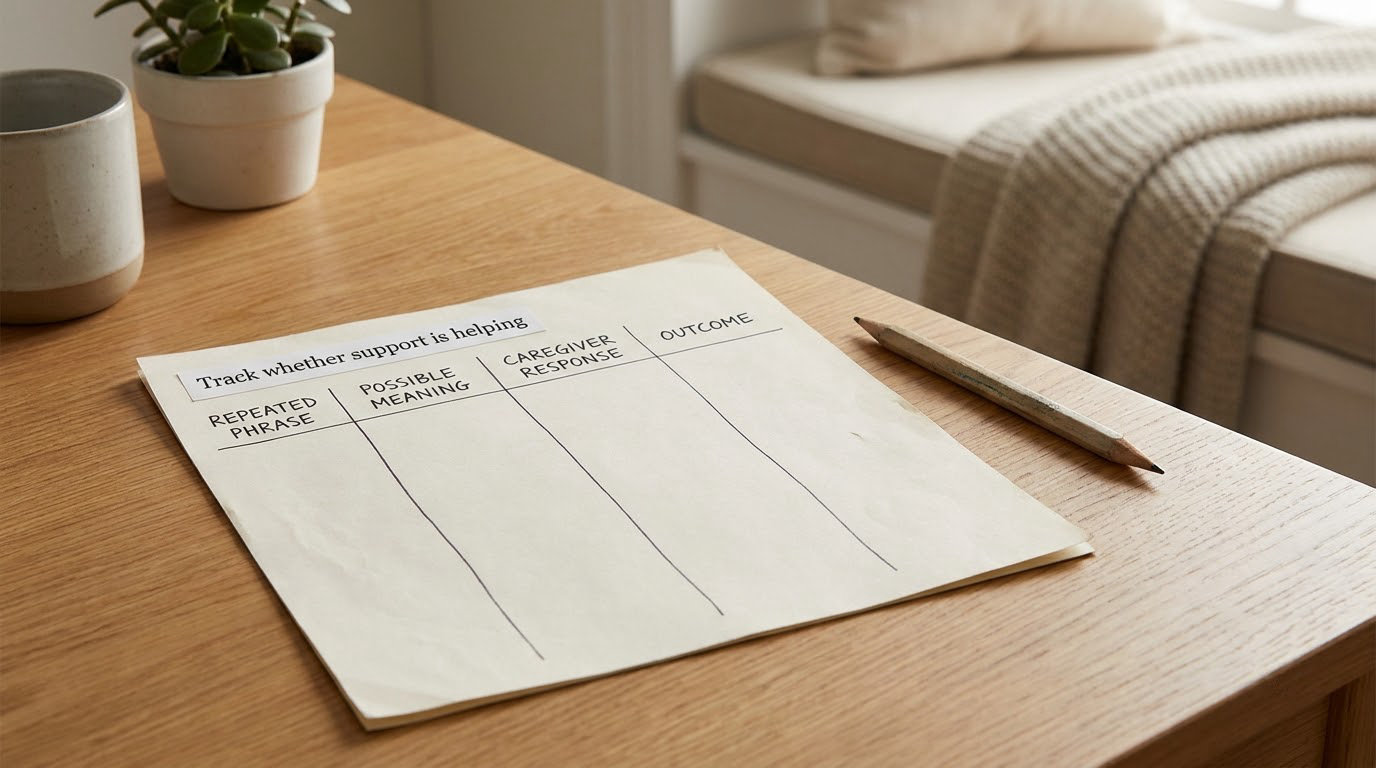
Most families change ten things at once and conclude nothing worked. Keep a short log instead, four columns and thirty seconds a day.
- What happened — where you were, roughly when, how loud or busy it was.
- What they were communicating — your best guess at the function, written in your own words.
- What you did — which response you used.
- What followed — did distress, regulation or flexibility improve?
Look at the log after two weeks, not two days. Patterns show up there: one routine carrying most of the scripting, one time of day that reliably goes wrong, one response that consistently lands better than another. Bring it to your appointments. It is the most useful thing you can hand a clinician, because it turns “he just repeats things” into something specific.
6. Build a calm support plan with the child’s team
Start with your pediatrician. Ask for a referral to a speech-language pathologist who works with autistic speakers and is comfortable with echolalia, because approaches vary widely and you may otherwise get “reduce scripting” from one provider and “honour the script” from another with no explanation of the conflict.
An occupational therapist can often make more sense of the sensory and regulatory side, especially if scripting spikes during noise, transitions or crowded places. If scripting is loud enough to interrupt a classroom, ask about what goes in the IEP or 504 — a visual schedule, an agreed signal, and a written version of your response strategy so every adult uses the same words.
Keep documentation simple: dates, what you tried, what changed. Never use punishment or taking away a preferred item over scripting. If echolalia arrives with distress, pain, sleep disruption, aggression, or a sharp change in behaviour, get medical advice promptly rather than waiting for the language appointment.
Common Mistakes That Make Echolalia Harder
Treating the echo as meaningless noise. It is not random and it is not empty. Once families start decoding instead of interrupting, communication usually expands rather than shuts down.
Asking the child to stop, again and then again. Repetition of the demand is its own pressure. One calm boundary at the point of real risk; otherwise, let it run.
Arguing with every repetition. Correcting line by line turns the day into a series of small negotiations you will lose. Respond to the function once, then move on.
Punishing. Consequences make a predictable phrase risky to use. If a script is the only reliable language someone has, you are removing their toolkit.
Expecting instant transfer. A new flexible phrase does not appear overnight. Expansion is slow, uneven and often invisible from the outside.
Ignoring the social fallout. The most common thing parents describe is strangers, relatives or classmates reading the script as mocking or rude. One r/Autism_Parenting thread is titled exactly that. Preparation beats explanation: a one-line explanation for relatives, an advance note to the teacher, and a simple answer when someone asks directly — “He’s repeating lines he knows, it’s how he talks.”
And when you get it wrong, repair it. Say “I’m sorry I snapped at you. I know that phrase is hard for you.” A quick, calm repair teaches more than a long lecture did.
A few habits carry the rest. Keep your responses consistent so every adult is predictable. Protect sensory regulation before you expect flexible language, because regulation comes first. Write down a handful of phrases everyone in the family uses, so grandparents and babysitters work from the same script. And take breaks, because supporting echolalia without respite is how families arrive at r/autism threads titled “echolalia has ruined my life.”
Frequently Asked Questions
Is echolalia always a problem that needs to be stopped?
No. Echolalia is repetition of words or phrases heard before, and it is often someone’s most fluent and reliable language. Suppressing it tends to reduce communication rather than improve it. Support means working out what the echo is communicating and answering that meaning. The exceptions are situations with real risk, imitative bullying, or scripts that visibly distress the person saying them.
Why does my child repeat the same phrase over and over?
Usually because that stored phrase does a job: it requests something, protests a transition, regulates sensory load, comments on the moment, or keeps the interaction going. Many autistic people also process language in whole chunks, so a phrase learned intact stays intact. Watching when the repeating happens tells you more about the function than the words themselves do.
How can I help echolalia without forcing my child to speak?
Stop testing, correcting and asking for imitation, and start supporting. Wait three to five seconds, answer the meaning behind the script, offer two visual choices instead of rapid questions, and model one short useful phrase at the moment it would help. Progress looks like easier transitions and more varied language, not silence. Let a speech-language pathologist set any specific goals with you.
What should I do when echolalia happens in public or at school?
Give yourself and your child a short, neutral line before you need it, such as he repeats lines he knows, it is how he talks. Tell the teacher in advance and ask for the same response strategy in writing, so the classroom matches home. Avoid arguing with the repetition in the moment. If other children start imitating it in a bullying way, tell the school and set a clear boundary together.
When should I contact a pediatrician or speech-language pathologist?
Contact your pediatrician promptly if echolalia comes with distress, pain, sleep disruption, aggression, a sudden change in behaviour, or any safety concern. Ask for a speech-language pathologist who works with autistic speakers, especially if scripting is interfering across settings or you get conflicting advice from different providers. An occupational therapist can help when sensory load clearly drives the repetition.
How long does it take to reduce echolalia?
There is no fixed timeline, and reducing repetition is rarely the right measure anyway. What tends to change over weeks or months is distress during transitions, the variety of communication, and how easily the person can use a new phrase. Keep a simple two-week log so you can see real change rather than guessing. Individual timelines vary widely, so progress should be judged by regulation and flexibility.
How to Support Echolalia Instead of Stopping It: Start Here
Start by stopping one thing: the demand for silence. That single change usually lands within days, because it removes pressure rather than adding it.
Then name what the repetition is communicating, respond to that meaning in words the person can borrow, and keep doing it consistently across adults, routines and settings.
For anything involving safety, pain, sleep or aggression, bring a qualified professional in early. Updated for 2026.