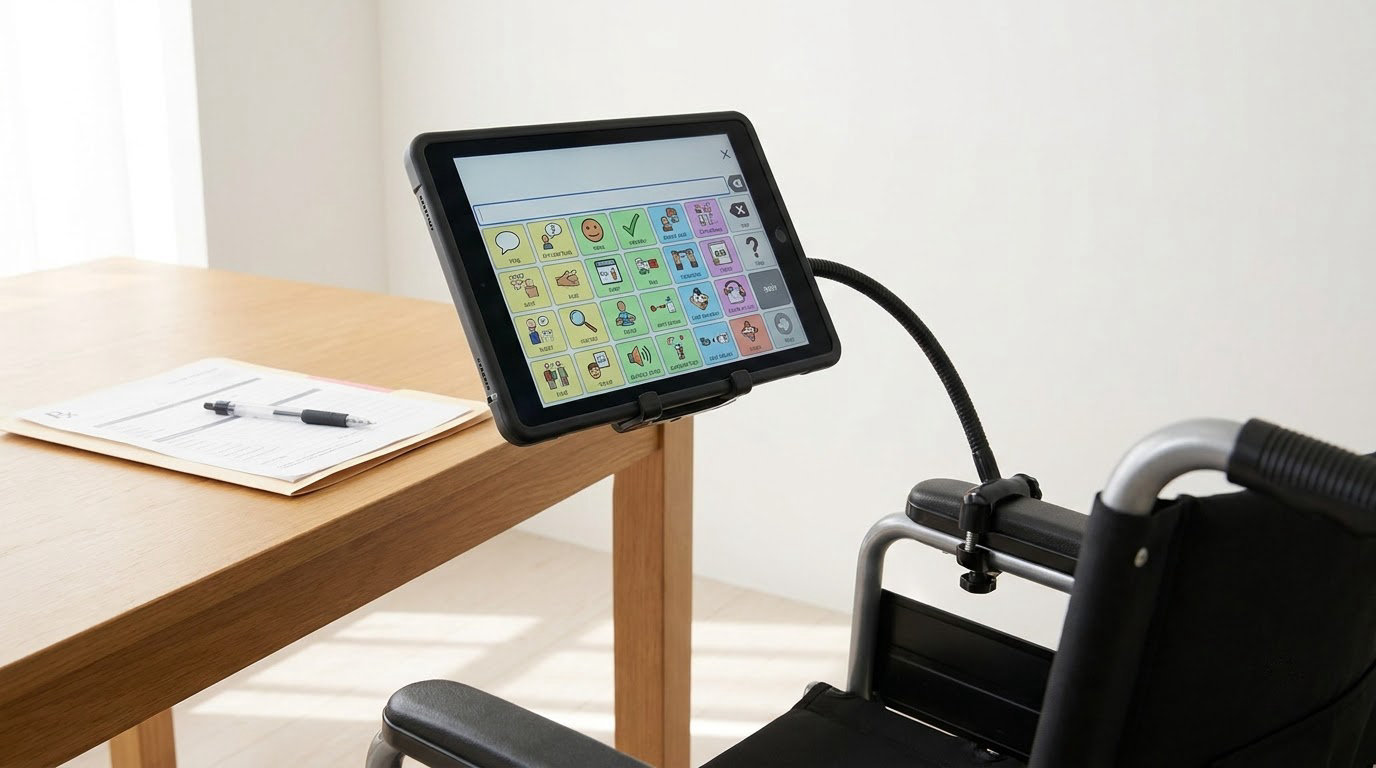
Yes — health insurance does cover speech-generating devices, as durable medical equipment, once medical necessity is documented. How to get insurance to cover a speech device comes down to four things: an augmentative and alternative communication evaluation by a speech-language pathologist, a physician’s prescription, a letter of medical necessity, and a prior authorization request filed with the correct billing code by a contracted supplier. In practice the request runs three to six months from completed evaluation to a device in hand, and most denials trace back to a missing document or a request sent under the wrong coverage category rather than to the device itself.
No specific diagnosis is required. Coverage turns on documented severe speech impairment — how the person communicates today, what happens when they cannot get a message out, and what a dedicated device would change. Autism, cerebral palsy and apraxia come up constantly in parent groups, but insurers are not scoring a diagnostic label; they are scoring function.
This guide walks the process stage by stage, then covers the appeals that come after a denial. Coverage rules vary by plan and by state, so treat this as a working method rather than a promise of payment. Last reviewed in October 2026.
Table of Contents
- What You Need
- How to Get Insurance to Cover a Speech Device: Step-by-Step
- 1. Check Whether the Plan Covers AAC or Speech Devices
- 2. Ask the Supplier to Verify Benefits First
- 3. Build the Medical-Necessity Packet
- 4. Get the Exact Device and Supplier Documentation
- 5. Submit the Request and Track Every Reference Number
- 6. Ask for a Peer-to-Peer Review If the Request Is Denied
- 7. Use the Plan’s Formal Appeal Process
- Common Mistakes
- Frequently Asked Questions
- Does insurance have to cover a speech device?
- What is a letter of medical necessity for a speech device?
- Can I use Medicaid to pay for a speech-generating device?
- What if my insurance says the device is not covered?
- Can a school help pay for a speech device?
- Should I choose a specific speech device brand?
- What to Do First, and While You Wait
What You Need
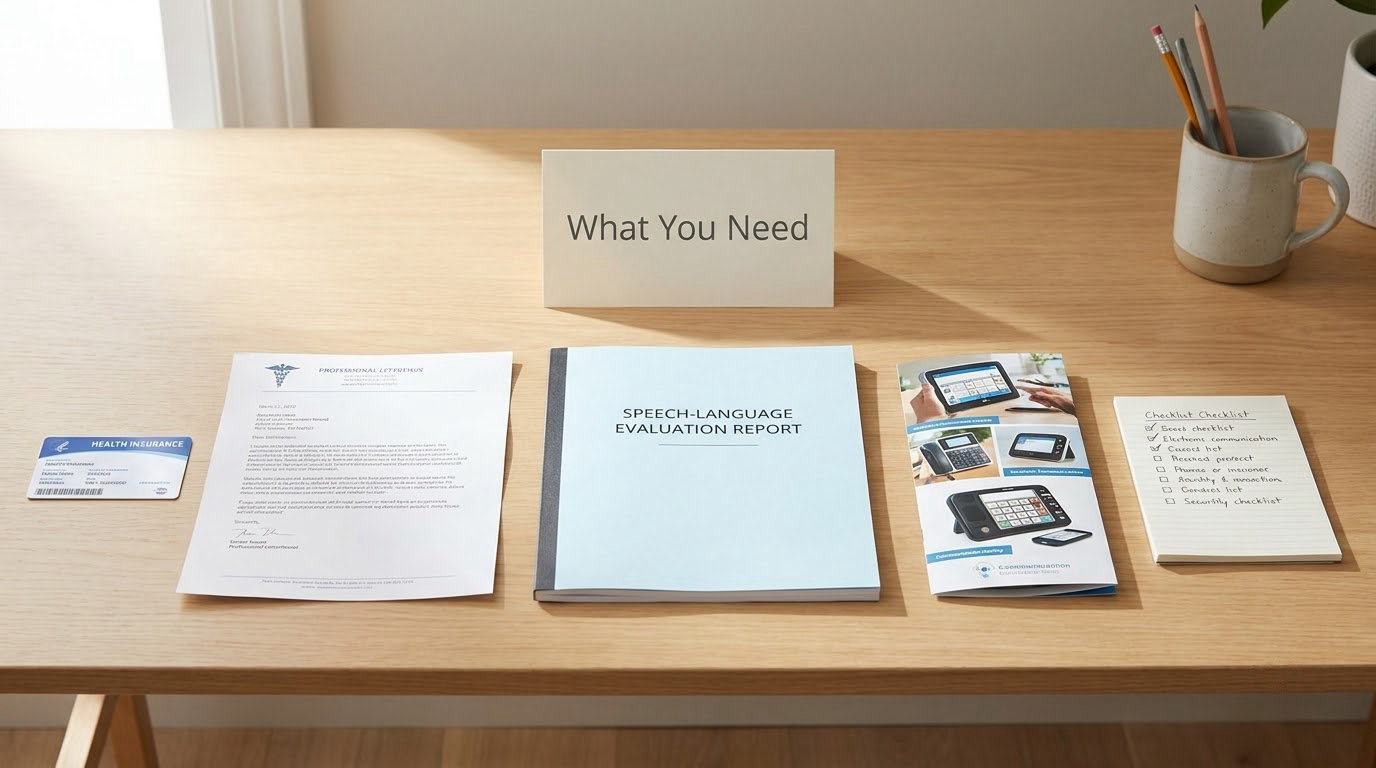
Insurers decide on a speech device by matching paperwork to a category in the medical benefit. Requests fail on gaps, so gather these before you make the first call.
- The clinical picture in plain language. Diagnosis, what the person communicates now, and where speech breaks down.
- The AAC evaluation report from a speech-language pathologist, including test results, access method recommendations and functional examples.
- The letter of medical necessity, written and signed by the treating physician or specialist.
- The prescription or physician’s order naming the device category.
- Device details from the supplier: manufacturer, model or product category, and the billing code the supplier will use.
- Your plan’s benefit language — the medical benefit section, the durable medical equipment section, and any exclusions. Self-funded employer plans also have a summary plan description worth requesting.
- Prior authorization details: who submits, through which portal or fax number, and how long a decision takes once submitted.
The single most useful document in this pile is the plan’s own written coverage criteria for speech-generating devices. Most plans will send it if you ask in writing. When your appeal letter quotes the exact criteria sentence and answers it line by line, reviewers have far less room to dismiss it.
How to Get Insurance to Cover a Speech Device: Step-by-Step

Below is the sequence that works, in the order that saves the most rework. Each step has a signal that tells you it actually landed.
1. Check Whether the Plan Covers AAC or Speech Devices
Look under the durable medical equipment benefit, not the therapy benefit. The words you are looking for are speech-generating device, augmentative and alternative communication, communication device, or assistive technology. Plans often list the category, not the everyday word “speech device”, which is why families tell their insurer they need a tablet app and get a referral to speech therapy instead.
Ask the plan one question in writing: does the plan cover a dedicated speech-generating device as durable medical equipment, and under which benefit category. Request the coverage criteria at the same time. Medicare and Medicaid work from published coverage policies, and the criteria usually reference a severe speech impairment and a device used to communicate with another person — language your clinician can mirror in the evaluation report.
You will also see HCPCS codes in that material. Digitized speech generators generally sit in the E2500–E2599 range and synthetic speech devices in the V5336–V5364 range. Codes change, so confirm the current code family with your plan or supplier rather than trusting a blog post, including this one.
2. Ask the Supplier to Verify Benefits First
Call the durable medical equipment supplier before you assemble anything. A benefits verification takes minutes and tells you whether the plan treats them as in-network, whether prior authorization is required, whether they will bill the insurer directly or expect you to pay up front, and whether a rental period comes before purchase.
Medicaid plans add a wrinkle: the state usually only reimburses approved vendors on an approved-supplier list, so an independent device shop may not be billable at all. Find out now, not after the letter of medical necessity is signed.
Ask them to put the verification in writing, then read it against the plan criteria you requested in step 1. If the supplier’s answer and the plan’s written criteria disagree, the plan’s document wins — and you now know exactly which question to put in writing to the plan.
3. Build the Medical-Necessity Packet
A complete packet usually carries five things: the SLP’s AAC evaluation, the physician’s prescription, the letter of medical necessity, supporting therapy documentation, and evidence about why a lower-cost alternative will not work.
The evaluation should show current functional communication, not a score sheet alone. Describing what happens at the dinner table, at the clinic, when the person is in pain, or when they need to say yes or no tells a medical reviewer more than any test percentile.
The physician’s letter supplies the medical conclusion. Say the need plainly: without an effective means of communication, the person cannot reliably report pain, hunger, or a safety concern. Insurers fund communication far more readily as a health and safety need than as a classroom tool.
You can draft the letter yourself and ask the clinician to review, correct and sign it. That is a normal request, and it usually produces a sharper letter than one written in five minutes between patients. The American Speech-Language-Hearing Association publishes guidance on documenting AAC need that is worth having open when you write it.
4. Get the Exact Device and Supplier Documentation
Insurers deny requests that describe a category instead of a device. The supplier should provide the device name, manufacturer, model or product category, the billing code they will submit, the quoted cost of the equipment, and a statement that the device is appropriate for the person’s age and abilities.
Ask for that in writing and attach it to the packet. If the supplier cannot say why this configuration fits the user’s access needs — eye gaze, switch scanning, touch — the packet has a hole a reviewer will find.
Also ask them to confirm the vendor is contracted with your specific plan. A claim sent to an out-of-network supplier gets denied for network reasons even when the medical necessity is impeccable.
5. Submit the Request and Track Every Reference Number
Submission usually goes through the plan’s provider portal, a fax line, or the supplier on your behalf. Whatever the route, get a case number or reference number in writing at the moment of submission and write the date next to it.
Then set calendar reminders. A request that goes quiet for weeks is normal, not a rejection — most plans allow 15 to 30 calendar days for a prior authorization decision, and Medicaid timelines vary by state.
Keep a one-page log for every contact: date, time, the name of whoever you spoke with, what they said, and the reference number. Parent advocates who eventually won reversals credit that log as much as the letters themselves. When you appeal, you are reconstructing a sequence of events from memory otherwise.
6. Ask for a Peer-to-Peer Review If the Request Is Denied
A peer-to-peer review puts your treating clinician in a conversation with the insurer’s medical reviewer. It moves the argument from a piece of paper to a clinical discussion, and reviewers change their minds here more often than families expect.
Ask for it in writing when the denial arrives, and send your clinician the denial letter first. Without seeing the stated reason, the clinician cannot argue against it.
Keep the discussion on documented functional need and on why the lower-cost option fails, rather than on a specific brand. A request framed as “this child cannot reliably request food, pain or safety needs by any other means” is far harder to deny than one framed around a particular product.
7. Use the Plan’s Formal Appeal Process
Do not write an appeal until you have the denial letter. The stated reason, plus the policy language the insurer cited, is the map for everything that follows. A denial for “not medically necessary” needs a different response than one for “educational in nature” or “not prescribed by a physician”.
| Stated denial reason | What the insurer is really saying | Your specific response |
|---|---|---|
| Not medically necessary | The report did not show severe speech impairment or an unmet functional need | Attach the SLP evaluation showing current communication ability and the specific gains a device would produce; name the health and safety risks that exist without reliable communication |
| Educational in nature | This belongs in the school benefit, not the medical benefit | Restate the need in medical terms: reporting pain, hunger, illness and safety concerns, and reducing caregiver burden; then run the IDEA request in parallel |
| Not prescribed by a physician | No order, or an order from someone without prescribing authority | Obtain a signed prescription and letter from the physician or specialist and resubmit with the clinical documentation attached |
| Not available through contracted suppliers | Network or vendor rules, not a clinical judgment | Ask the plan to name the contracted vendor in writing, then move the request to that supplier |
| Evaluation report insufficient | The report did not mirror the plan’s own criteria wording | Ask for the criteria, quote each criterion, and answer it in order within a cover letter |
Most plans give you several internal levels, and you must exhaust them before going outside the plan. Ask about an expedited appeal when a delay could seriously harm the user’s health or ability to function — those usually carry a much shorter deadline. Note the appeal deadline the day the letter arrives and set two reminders.
When the internal levels run out, the next stop depends on who funds your plan. A fully insured plan sits with your state insurance department or insurance commissioner. A self-funded employer plan sits with the U.S. Department of Labor under ERISA, and the plan’s summary plan description explains the claims procedure. A free advocate — your state’s Parent Training and Information Center, or a legal aid project — will read the letter with you at no charge.
One honest note: persistence alone does not win. Families in the advocacy community have exhausted every internal level and still been denied. What separates the successful appeals is specific rebuttal tied to the plan’s own criteria, submitted inside the deadline.
Common Mistakes
Almost every avoidable denial traces back to one of these.
- Using the everyday word instead of the coverage category. “Speech device” means nothing to a claims system. Fix: use the device’s name and its billing code, and attach the supplier’s documentation.
- Sending the request without a letter of medical necessity. An SLP evaluation alone rarely carries a medical claim. Fix: get the physician’s letter before submitting, and treat it as the anchor document.
- Skipping prior authorization. Some plans process a covered claim only when authorization came first. Fix: confirm in writing that authorization is required, then submit it.
- Submitting a sales quote instead of a clinical packet. A quote shows cost, not need. Fix: lead with the evaluation and the letter, and attach the quote as support.
- Missing the appeal deadline. This is the one error that ends the process permanently. Fix: record the date the denial arrived, the stated deadline, and set two reminders the same day.
- Treating a school device as a personal one. A device the district buys is district property and typically stays on campus, so a family can be covered at school and still have nothing at home. Fix: run the school request and the personal medical request as two separate tracks.
- Assuming a diagnosis is the deciding factor. Families lose months waiting on a label that is not the criterion. Fix: document functional impairment instead, and answer that question directly in the letter.
- Believing silence means rejection. Most requests sit for weeks without contact. Fix: keep your log, and follow up on schedule rather than at random.
One more thing worth naming, because it troubles a lot of parents: research cited by advocacy and clinical sources does not support the idea that AAC slows speech down. If that worry is part of your hesitation, say so to your SLP directly and ask for the evidence.
Frequently Asked Questions
Does insurance have to cover a speech device?
Plans are not required to cover every device, but speech-generating devices are standard covered durable medical equipment under most private plans, Medicaid programs and Medicare. The requirement is documented medical necessity, not a particular diagnosis. Coverage depends on the plan’s benefit language, so read the durable medical equipment section and request the plan’s written criteria before submitting anything.
What is a letter of medical necessity for a speech device?
It is a signed letter from the treating physician or specialist stating that the person has a severe speech impairment, that a dedicated speech-generating device is medically necessary, and why lower-cost options will not meet the need. The clinician supplies the medical conclusion; you can draft the wording and ask them to review and sign it. Attach the speech-language evaluation so the letter has data behind it.
Can I use Medicaid to pay for a speech-generating device?
Usually yes. Medicaid covers speech-generating devices as durable medical equipment, often at no cost to the family, though rules vary by state and some programs apply to children who qualify for a home and community based waiver. Two things catch families out: prior authorization must be approved before the device is supplied, and the state usually only reimburses vendors on its approved supplier list.
What if my insurance says the device is not covered?
Ask for the denial in writing before you do anything else, then find the exact reason and the policy language behind it. Answer that specific reason in your appeal, using the plan’s own criteria as your structure. If you can, request a peer-to-peer review so your clinician can argue the clinical case directly. Exhaust the internal levels, then take the case to your state insurance department or, for a self-funded employer plan, the Department of Labor.
Can a school help pay for a speech device?
Yes, under IDEA the school district must provide assistive technology a child needs for access to education. Expect to request it formally through the IEP or 504 process with clinical documentation attached. The catch is ownership: a district-provided device is school property and usually cannot go home, so many families run the school request and a personal medical request at the same time.
Should I choose a specific speech device brand?
Frame the request around the access method and the person’s needs — eye gaze, switch scanning, touch, vocabulary — rather than a brand. The vendor-neutral case is easier for a medical reviewer to approve, and a clinician tied to one manufacturer may give narrower advice. Manufacturers also fund support teams that help families with authorization paperwork, whether or not you end up buying from them.
What to Do First, and While You Wait
Start tomorrow with two requests in writing: the plan’s coverage criteria for speech-generating devices, and a benefits verification from the supplier. Everything else follows from those two answers.
While the request is moving, keep the person communicating. An interim option — a consumer tablet with an AAC app, a loaner from a state assistive technology program, or a short rental through the supplier — buys months of real communication. Ask your state’s assistive technology program and your regional AT3 Center about loan programs; they exist in most states and cost nothing to borrow.
Ask the school to start its own request in parallel. If it goes through, you will have a device at school, which is real progress even though it will not travel home.
And pace yourself. Three to six months is the normal arc from completed evaluation to delivery. The weeks of silence in the middle are the paperwork working, not failing.