

Finding a therapist as a caregiver comes down to four things: knowing what kind of support you want, checking that a provider is properly licensed, asking direct questions about their caregiver experience, and being honest about fit. Most people spend weeks on this process and it takes far less time than that, once you have a shortlist and a script.
This guide is written for parents of children with autism, disabilities, or complex medical needs, and for adults caring for an aging parent or a spouse. It covers the whole process in seven steps, including the questions to ask on a free consultation call, the credentials worth recognizing, and what to do while you wait.
Nothing here replaces advice from your child’s doctor or your own care team. If you are in crisis, contact emergency services or a crisis line in your area.
Table of Contents
- What You Need Before You Start
- Step-by-Step: How to Find a Therapist as a Caregiver
- 1. Define What Kind of Help You Need
- 2. Ask for Referrals and Check Credentials
- 3. Search for a Therapist Who Understands Neurodivergent Children
- 4. Contact Therapists and Ask the Right Questions
- 5. Compare Options and Attend a First Visit
- 6. Check That the Plan Is Practical and Collaborative
- 7. Decide Whether to Continue, Change, or Add Support
- Common Mistakes When Looking for a Therapist
- Frequently Asked Questions
- What type of therapist should I look for as a caregiver of a child with autism or another disability?
- How do I check whether a therapist is licensed and qualified in my state?
- Can I find a therapist who works with children with special needs near me or through telehealth?
- What questions should I ask before starting therapy?
- What if I cannot afford private therapy or my insurance does not cover the provider?
- When should I ask my child’s doctor or care team for help finding a therapist?
- Conclusion
What You Need Before You Start

Five minutes of preparation saves you months of searching in the wrong direction. Before you contact anyone, get these four things together.
A one-sentence description of what you want. Not a diagnosis, not a list of symptoms. Something like: “I am the parent of a nine-year-old with autism and I am exhausted and isolated, and I want to cope better.” That sentence becomes your filter for every call you make.
Your practical constraints. Write down the days and times you could realistically attend a session, whether you can leave the house, and how you would pay. A therapist who does not work with your schedule is the wrong therapist, no matter how good they are.
A short list of referrals. Ask your child’s pediatrician, your own doctor, your school team, and two or three caregivers whose judgment you trust. A single referral source is a single point of failure.
Relevant records. Have your child’s diagnosis summary, current medications, and any prior therapy notes within reach. You will not need all of it, and sharing more than you want to can wait until you trust the person.
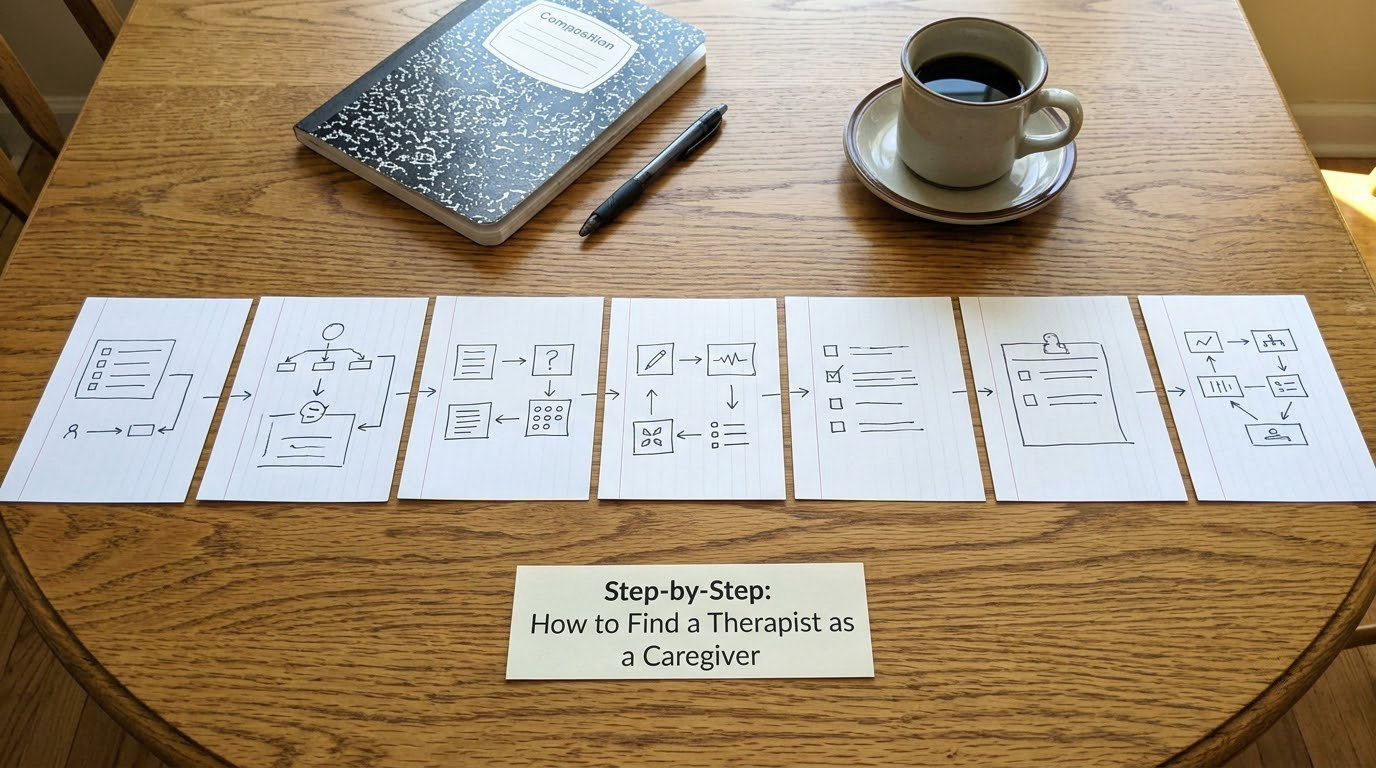
Step-by-Step: How to Find a Therapist as a Caregiver
1. Define What Kind of Help You Need
Caregiving support comes in several distinct forms, and confusing them is the most common early mistake. An individual therapist works with you, the caregiver, on stress, guilt, boundaries, and your own mental health. A parenting coach works on specific behaviors and routines with your child present. A family therapist works with the whole household, including relationships between family members.
Parents of autistic children often want both a therapist and a coach, and that is not a contradiction. The reasoning tends to be practical: a coach works on the routines and behaviors that play out in front of you, while a therapist gives you somewhere to talk about the strain itself. Plenty of general therapists have never had to think about what caring for your child does to an adult, so ask about that experience before you book.
When you are not sure which you need, ask your child’s healthcare team. They can tell you what has already been tried and what kind of support tends to fit your family’s situation.
2. Ask for Referrals and Check Credentials
Start with the people closest to your child’s care. Pediatricians, developmental pediatricians, and school-based teams see therapists constantly and can point you toward providers who work with your situation.
Then check what each provider actually is. Look for a licensed clinical social worker (LCSW), licensed professional counselor (LPC), or licensed psychologist (PsyD or PhD). Licensure means the person has completed accredited training, passed a state exam, and is permitted to practice in your state specifically.
You can verify licensure through your state’s board of behavioral science or psychology, and most boards have a public lookup that takes a minute. Check for a clean record with no unresolved disciplinary action.
Your insurance network is a starting point, not a decision. In-network lists are often long and frequently stale, and parents on caregiver forums talk constantly about finding in-network therapists who will not take new clients or who have no experience with neurodivergent families. Treat the network as one option among several.
3. Search for a Therapist Who Understands Neurodivergent Children
Experience with your child’s diagnosis changes the advice you get. A therapist who has never worked with autistic children may hear your frustration as a parenting problem when it is really a load problem.
Several practical routes work better than scrolling a generic directory:
- Ask directly on the intake call, then listen to the answer. “How many families with autistic children do you currently see?” gets a more honest response than “do you work with autism?”
- Read the bio and profile before you call. Neurodiversity-affirming clinicians usually say so plainly.
- Use directories that let you filter by specialty, such as Psychology Today, Zencare, or MentalHealthMatch, then apply the credential and fit checks on top of the results.
- Search for autism-parent groups in your area or online. Caregivers in these spaces will tell you which local names actually respond to messages.
A useful workaround, repeated often in caregiver discussions: build a local list of therapists first, then read each bio for caregiver, parenting, or neurodiversity language. The reverse order produces a lot of irrelevant calls.
4. Contact Therapists and Ask the Right Questions
Many practices offer a short free consultation call, usually ten to fifteen minutes. It is the single most useful screening tool available, and using it well matters. Send these questions in writing before the call so answers do not get lost in small talk.
About logistics:
- Are you currently accepting new clients, and what is the wait time?
- Do you take my insurance, and do you bill insurance directly or do I pay a superbill and submit it?
- What are your fees, and do you offer a sliding scale?
- Do you offer telehealth, and can sessions be scheduled around school runs and appointments?
- What is your cancellation policy?
About fit and approach:
- What do you do in a typical first session?
- How much of my child is involved, and do you work with schools or other providers on the care team?
- How do you measure progress, and how often do we review goals together?
- How do you communicate between sessions, and how fast?
- Have you worked with caregivers of children with autism before?
If a provider will not answer any of these, that is information too. So is being told, in a first call, that your child should be the patient.
5. Compare Options and Attend a First Visit
Talk to two or three people before committing. Compare them on wait time, cost, logistics, and something harder to write down: how you felt. Warmth and being taken seriously are clinical factors, not extras.
The first visit, usually called an intake or consultation, is informational. Expect questions about your history, your current situation, what is going well, and what is not. You will talk about your sleep, your mood, your supports, and what you have already tried. Some therapists follow up with a written summary and a plan.
Notice whether you did most of the talking about crisis, or whether the conversation included something you could act on this week. Pay attention to whether they asked what you want out of therapy, or only what is wrong.
Then send a short follow-up message. A note saying that the appointment helped and naming one specific thing you want to focus on sets the tone for everything that follows.
6. Check That the Plan Is Practical and Collaborative
A plan nobody can follow is not a plan. After the first visit, you should be able to answer these questions clearly.
- What are the specific goals, and what does progress look like in three months?
- How often are sessions, and how long is each one?
- What am I expected to practice between sessions, and how much time does it take?
- How do we communicate between sessions, and how quickly do you respond?
- Will you coordinate with my child’s other providers, and do I need to sign anything for that?
- What happens if I need to pause sessions for a medical month or a crisis?
- How is my information handled, including notes and any records shared with the care team?
Good plans leave room for a bad week. A plan built on perfect attendance will collapse the first time your child is sick and you are the backup.
7. Decide Whether to Continue, Change, or Add Support
Give it a fair trial, usually several sessions, before deciding. Then review honestly, because review time is when people drift out of therapy without naming why.
Signs the fit is working: you feel less alone, you can name what is different, you have at least one usable strategy, and sessions fit around your life. Signs it is not: you leave every session more drained, you feel judged or corrected, nothing changes and nobody notices, or you dread the appointment.
Changing providers is normal and reasonable. A therapist who is not right for you is not a verdict on you, and a bad fit with a great clinician is more common than people admit. The usual pattern is to keep the current provider while you look for a replacement, so you are never without support during the search.
Common Mistakes When Looking for a Therapist
Choosing purely by availability. The provider with the earliest opening is rarely the right long-term fit. Take the best of both: build a shortlist on fit, then ask about the earliest appointment among those names.
Relying on one referral source. One doctor, one group, one directory. Your child’s team sees one slice of the world and so do you. Gather five to ten names before you start calling.
Skipping the credential check. It takes a minute online and it tells you whether you are looking at a licensed professional or a coach with no clinical training. Ask directly if a title is unclear; the answer should be quick and specific.
Not asking about cost until the bill arrives. Ask about fees, insurance, superbills, and sliding scale in the first call, before you invest months of effort. It is a normal question and a legitimate filter.
Only sharing part of the picture. Caregivers often protect the family by telling the therapist a tidier version. You do not have to disclose everything in week one, but what you do share should be accurate, including the parts you feel embarrassed about.
Expecting therapy to fix things within a month. Progress with caregiver burnout is rarely linear. Some weeks are better and some are worse, and that is information, not failure.
A few habits that help. Keep a shared calendar, because the scheduling itself is often the hardest part. Decide with your partner or co-caregiver who handles what, so therapy time does not become another negotiation. And book the first appointment before you feel ready, since readiness tends to arrive late.
Frequently Asked Questions
What type of therapist should I look for as a caregiver of a child with autism or another disability?
Most caregivers benefit most from a licensed individual therapist (LCSW, LPC, or psychologist) who works with the adult providing care, not the child receiving it. A parenting coach is a useful addition for specific routines and behaviors, and family therapy helps when relationships inside the household are part of the problem. Many parents use both, and the child’s care team can help you decide which to start with.
How do I check whether a therapist is licensed and qualified in my state?
Look for a licensed clinical social worker, licensed professional counselor, or licensed psychologist, then search your state board of behavioral science or psychology for a public license lookup. You can confirm the person is currently licensed, check for unresolved disciplinary action, and confirm the license is current in the state where you live. It takes a few minutes and is worth doing before your first session.
Can I find a therapist who works with children with special needs near me or through telehealth?
Yes. Directories like Psychology Today, Zencare, and MentalHealthMatch let you filter by specialty, location, and telehealth availability, and autism-parent groups can point you to local names caregivers have actually used. Telehealth widens your options considerably, which matters in areas with few neurodivergence-experienced clinicians. Ask specifically how many families with autistic children the provider currently works with.
What questions should I ask before starting therapy?
Ask about availability and wait time, fees, whether they take your insurance and whether they bill it directly, sliding scale options, telehealth, cancellation policy, what a first session involves, how progress is measured, how you communicate between sessions, and how much of your child is involved. Also ask how many families with autistic children they currently see. Send questions in writing so you can compare answers later.
What if I cannot afford private therapy or my insurance does not cover the provider?
Ask every provider about a sliding scale, since fees are often negotiable and some clinicians ask no questions at all. University training clinics offer low-cost sessions with supervised counselors, community mental health centers serve people regardless of ability to pay, and most employers offer counseling sessions through an employee assistance program. Group therapy and caregiver support groups can also fill a gap while you work toward individual care.
When should I ask my child’s doctor or care team for help finding a therapist?
Reach out early, especially if you are unsure what kind of support would help, if previous therapy did not fit, or if your child’s needs involve several specialties. The team can share what has already been tried, refer you to providers who work with your situation, and help you decide whether the goal is caregiver therapy, parenting coaching, family work, or a combination. You do not need to wait until things get worse.
Conclusion
Learning how to find a therapist as a caregiver is less about finding the perfect person and more about running a short, clear process: write down the support goal, gather five to ten referrals from more than one source, verify credentials, and call two or three providers with a written question list.
Start with the smallest possible action today. Write the one-sentence version of what you want, then ask your child’s care team for two names.