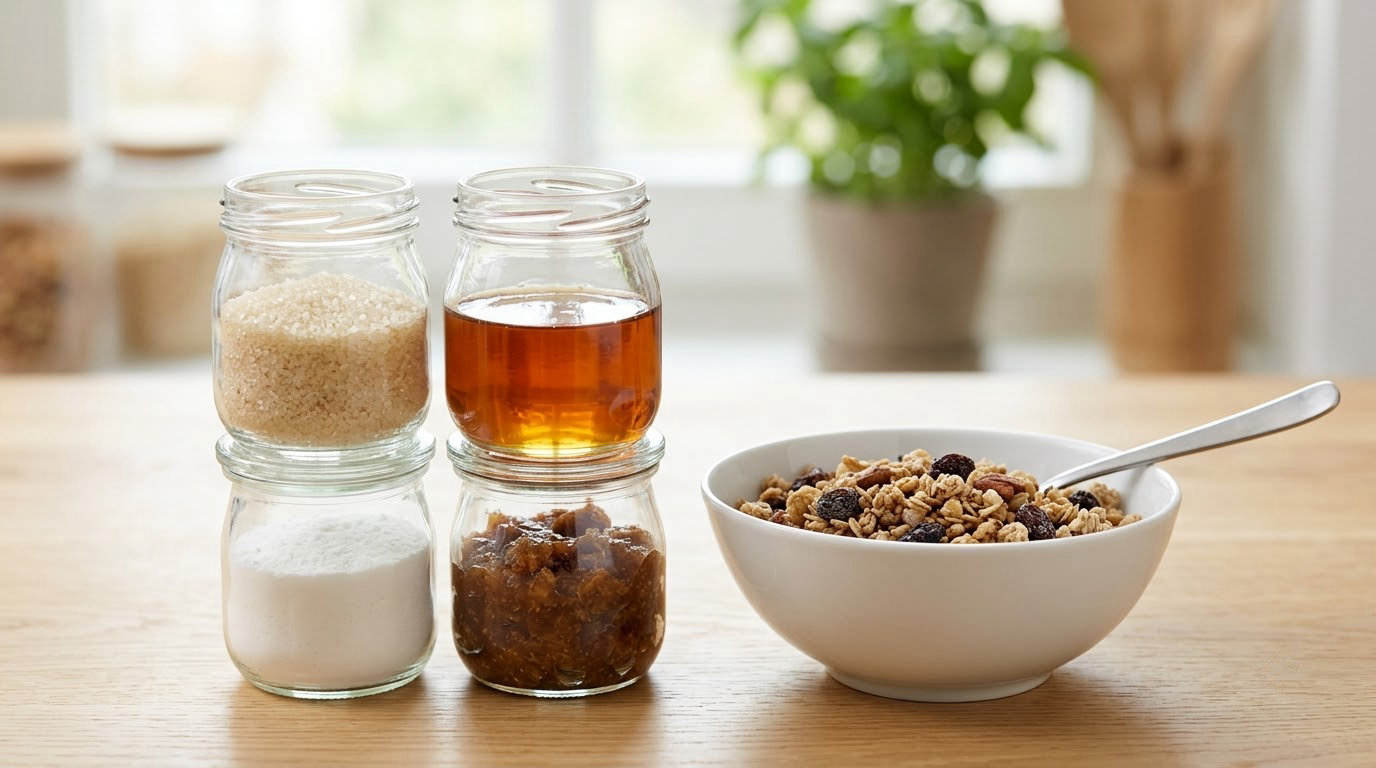
Added sugar is any sweetener added to a food during processing, and it appears on labels under dozens of names. Cane sugar, sucrose, dextrose, corn syrup, high fructose corn syrup, maltodextrin, agave nectar, honey, molasses and fruit juice concentrate are all added sugar, even when the name sounds natural or scientific rather than sweet.
That is the whole trick of how to spot added sugar under different names: there is no single word to search for, but there is one line on the panel that totals it all up.
I write about this from the angle of my own family. My son is autistic, and sweet foods are a large share of what he reliably eats, so sugar is not a villain in our house. It is one of the few predictable things. Anything I write here about cutting sugar assumes you already know that removing an accepted food cold can cost more than the sugar does.
Below is the label method I use, the names I keep in my head at the shelf, and the swaps that have not triggered a revolt at our table. General information only, and worth a conversation with your own pediatrician or a registered dietitian if your child has specific needs.
Table of Contents
- What You Need
- Step-by-Step: How to Spot Added Sugar Under Different Names on a Label
- Step 1: Read the Added Sugars Line First
- Step 2: Read the Ingredient List in Weight Order
- Step 3: Sweep for the Names Sugar Hides Behind
- Step 4: Split Added From Naturally Occurring
- Step 5: Compare Products and Serving Sizes
- Common Mistakes
- Frequently Asked Questions
- What are 5 names for added sugar?
- What are the 7 hidden sugars most worth watching for?
- Is honey considered added sugar on a nutrition label?
- Do sugar alcohols like xylitol count as added sugar?
- Is no added sugar the same as sugar free?
- How much added sugar is too much for a child?
- Start With the First Three Ingredients
What You Need
You need two panels, and one of them is doing about 90 percent of the work. The rest is optional.
The Nutrition Facts panel, and specifically the Added Sugars line. Since the FDA required it on packaged foods from mid-2016, with full compliance in 2021, every packaged item now breaks out sugar added by the manufacturer separately from sugar that arrived in the fruit, milk or vegetables it was made from. That single line counts every alias on the ingredient list together, which the ingredient list itself cannot do.
The ingredient list, read top to bottom. Ingredients are listed by weight in descending order, so the first three tell you most of the story. The ingredient list tells you which name the manufacturer chose, and names are where the camouflage happens.
That is the working kit. Two things are worth adding if you want more.
A reference for daily limits. The FDA sets a Daily Value of 50 g for added sugar on a 2,000 calorie diet, which is about 12 teaspoons, since 4 g of sugar is roughly one teaspoon. The World Health Organization advises keeping free sugars under 10 percent of energy intake, and closer to 5 percent for more benefit. The American Heart Association recommends no added sugar at all for children under two, and no more than 25 g a day for ages two through 18. Those numbers are the yardstick you compare a serving against.
A registered dietitian, if your child eats a narrow range of foods, is losing weight, or has been assessed for ARFID. Label reading gets you the facts. It does not tell you whether a given amount of sugar matters for a specific child, and that is genuinely a clinician’s call, not a label reader’s.
Step-by-Step: How to Spot Added Sugar Under Different Names on a Label
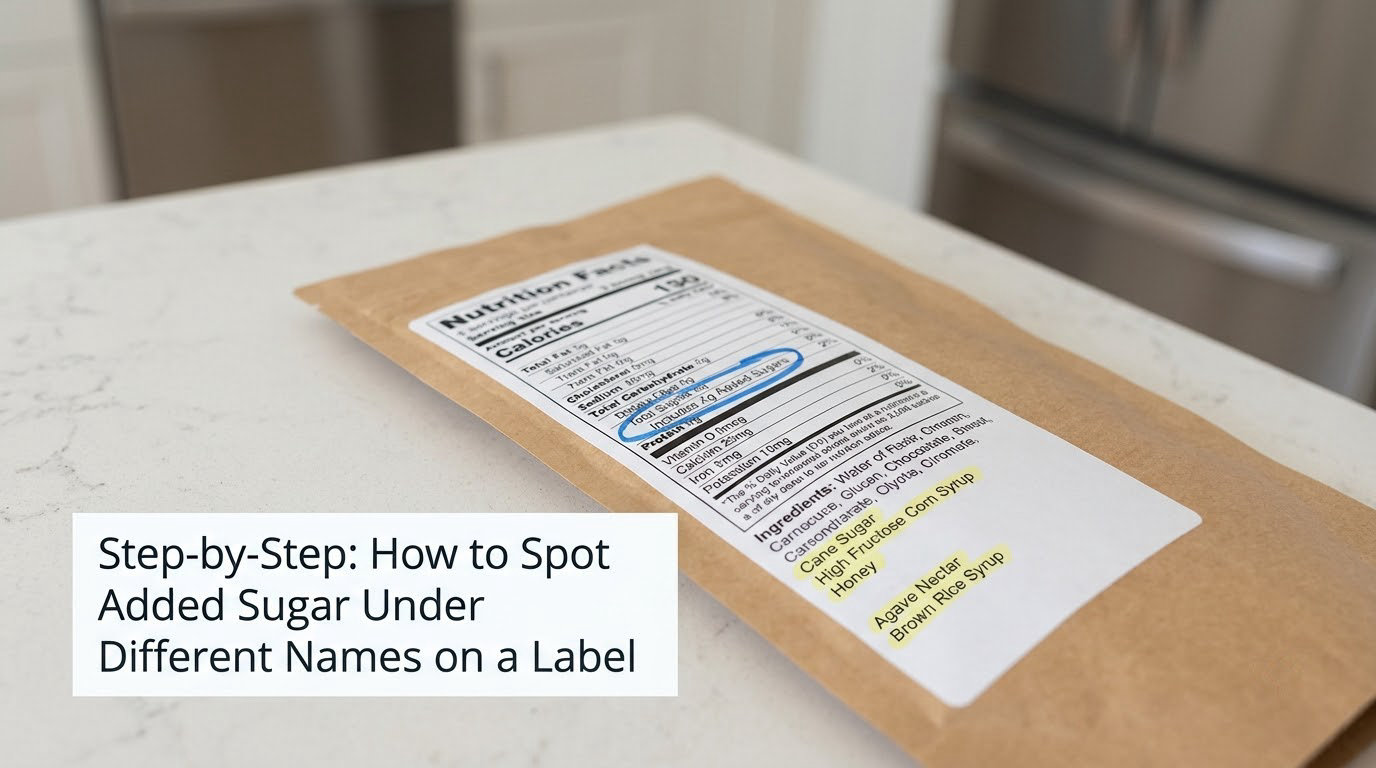
Five steps, in order, and the whole thing takes about ten seconds once you have done it a few times.
Step 1: Read the Added Sugars Line First
Find Total Sugars, then find the Added Sugars line directly under it. On the current US panel they sit in the sugars area of the carbohydrate section, and they are easy to confuse, so look twice.
Total Sugars is everything: sugar in the berries, the milk and the cane. Added Sugars is only what the manufacturer put in during processing. A cup of plain whole milk shows total sugars and zero added sugars. A sweetened yogurt shows both, and the added line is the number you actually control.
Then read the % Daily Value beside it. Twenty percent DV or more per serving is labeled high, five to 20 percent is moderate, and less than five percent is low. A single granola bar can hit 20 percent DV on its own, which is worth knowing before you hand over two.
You may also see a footnote on the panel explaining that the product contains no added sugars, or that added sugars include honey, syrups, fruit concentrates and jam. Manufacturers have to flag those cases because so many parents assume honey and juice concentrate are exempt. They are not.
Step 2: Read the Ingredient List in Weight Order
Ingredients are listed from most to least by weight, so position is a rough proxy for quantity. The rule most parents in our communities use, and a good one, is simple: if sugar in any form appears in the first three ingredients, put it back.
There is a technical detail worth knowing. The FDA does not allow the word sugar to be used as a category heading. A label cannot say sugars, then list cane sugar, dextrose and sucrose underneath and count as one item. Every sweetener has to be named individually, which is why one granola bar can show four or five different sugar ingredients scattered down the list.
So a first-three-ingredients rule is a fast screen, not a verdict. When several sweeteners show up at positions four, seven and nine, add them up and treat the product as though sugar is further up the list than it appears.
Step 3: Sweep for the Names Sugar Hides Behind
How to spot added sugar under different names comes down to three patterns: the -ose ending, the syrup family, and anything described as a concentrate, nectar or juice.
The -ose rule. Glucose, fructose, sucrose, dextrose, maltose, lactose, galactose, levulose, trehalose, cellobiose, saccharose. If a word ends in -ose on a US ingredient list, it is a sugar. Lactose is the deliberate exception you will meet in dairy labels, because milk sugar is not added sugar and the panel lists it separately.
The syrup family. Corn syrup, high fructose corn syrup, light corn syrup, rice syrup, malt syrup, maple syrup, agave nectar, cane syrup, golden syrup, invert syrup, syrup solids, corn syrup solids, dried syrup, caramel, caramel color, blackstrap molasses.
Concentrates, juices and naturals. Fruit juice concentrate, concentrated apple juice, concentrated pear juice, concentrated grape juice, grape juice concentrate, dehydrated cane juice, concentrated cane juice, cane juice, cane syrup solids, honey, honey solids, date syrup, coconut sugar, turbinado sugar, evaporated cane juice.
Plain and refined names. Sugar, cane sugar, beet sugar, brown sugar, granulated sugar, powdered sugar, raw sugar, muscovado sugar, caster sugar, demerara sugar, invert sugar, and the separate ingredient dextrin, which is a starch fragment that counts toward added sugars on the label.
Sugar alcohols and low-calorie sweeteners. Sorbitol, mannitol, maltitol, lactitol, isomalt, xylitol and erythritol. Most of these do count toward the Added Sugars line on a US panel, because polyols are treated as added sugars under the current rules. Erythritol is the low-calorie exception. Stevia and monk fruit concentrate do not, but almost every stevia blend on the shelf ships with dextrose or a sugar carrier, so read the list.
The count rule. Three or more sweeteners on one label means the sugar has been split. One product, four names, each one small enough to stay out of the top three.
Step 4: Split Added From Naturally Occurring
Some sugar is added. Some arrives in the food itself. Sorting them takes ten seconds and it prevents most of the arguments at snack time.
Counted as added sugar: cane sugar in all its forms, corn syrup and high fructose corn syrup, dextrose, sucrose, maltodextrin, honey, agave nectar, molasses, maple syrup, rice syrup, fruit juice concentrate added during processing, jam, jelly, and sweetened dairy drinks.
Not counted as added sugar: sugar in whole fruit, plain milk and plain yogurt, and plain unflavored vegetables. That is the naturally occurring part, shown on the Total Sugars line only.
Two things surprise people. Honey is added sugar on a US label, despite the natural reputation. Fruit juice concentrate added to a product that is not itself a juice is added sugar, even when the package says made with real fruit, and even when the fruit pictured on the front is a banana.
Whole fruit versus juice is a related one. A whole apple brings fiber, water and chewing along with its sugar, which slows absorption. A cup of apple juice delivers the sugar without that structure, and the mouthfeel is different enough that most autistic kids treat one as food and the other as a drink anyway.
Step 5: Compare Products and Serving Sizes
This is the step people skip, and it is where a lower number becomes misleading.
Serving size reality. The declared serving is set by the manufacturer, and it is often smaller than what actually gets eaten. A 30 g serving of cereal is roughly one cup; most bowls are three. A juice box declares one box, which is honest, but a 64 oz bottle may declare two thirds of a bottle as a serving. Multiply before you judge.
Per 100 g. When comparing two products of different sizes, the number under Carbohydrate on a European-style panel or in a database is the fairest comparison. More than 15 g of sugars per 100 g is generally treated as high; under 5 g is low.
Teaspoons. Convert grams with 4 g to a teaspoon. A 12 oz can of regular cola is about 39 g, which is roughly 10 teaspoons. A tablespoon of ketchup is usually around a teaspoon. A slice of soft sandwich bread is often a teaspoon or more. Once you see teaspoons, percentages stop being abstract, and parents in our groups find this the most persuasive conversion there is.
Savoury products count. Bread, crackers, ketchup, barbecue sauce, salad dressing, spaghetti sauce, cereal, canned vegetables, deli meat and yogurt all carry added sugar. It is there for moisture retention, fermentation, browning, texture and shelf life, not sweetness. A jar of pasta sauce can easily out-sugar a dessert cup.
Then swap like for like. The reason so much advice about cutting sugar fails with autistic and picky eaters is that it replaces a familiar food with an unfamiliar one. Plain yogurt with fresh fruit added keeps the creamy, cold, spoonable format. Unsweetened cereal keeps the bowl, the texture and the routine, even when the sweetness is gone. Same colour, same texture, same serving, and one changed variable at a time.
Common Mistakes
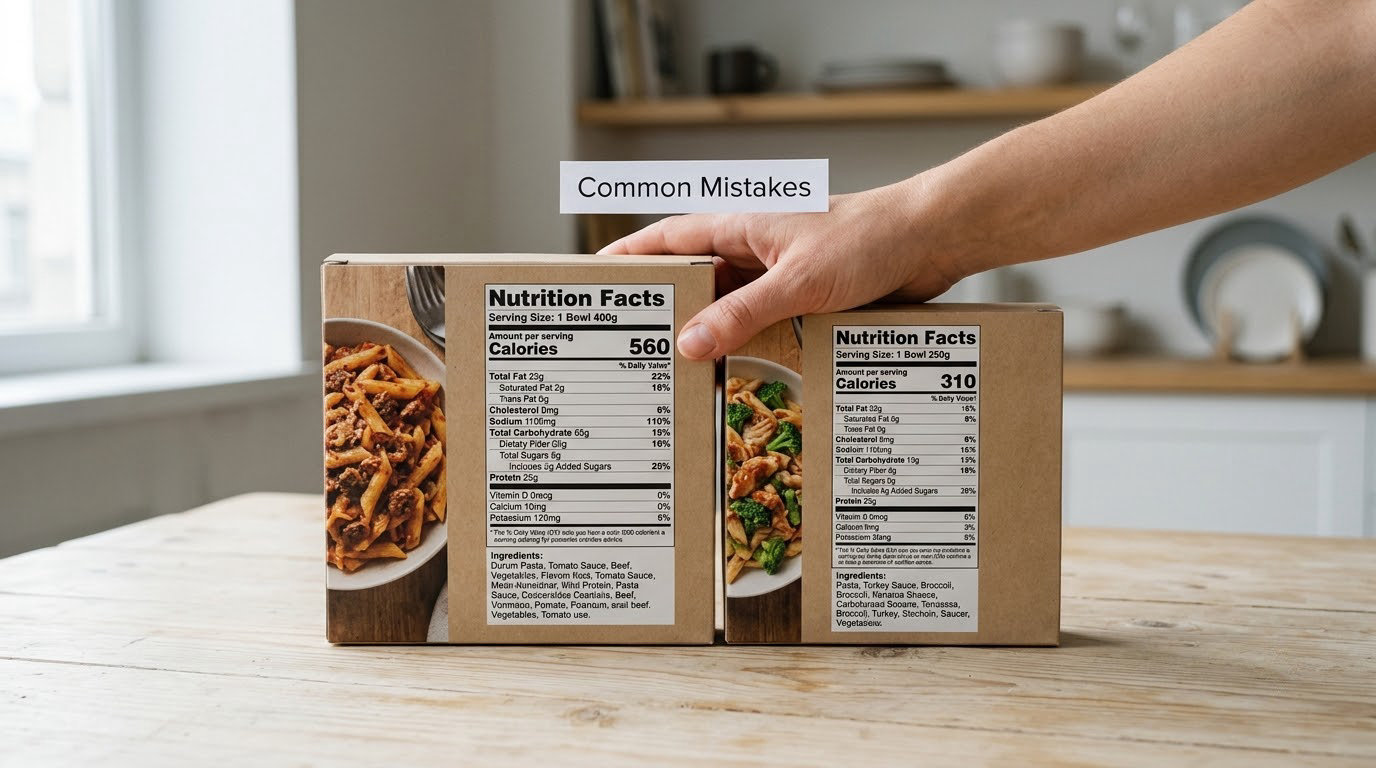
Six misreads come up over and over, and each one has a simple fix.
Confusing Total Sugars with Added Sugars. This is the single most common misread. A no-added-sugar product can show a high total sugar number because of its fruit content, and a product with modest total sugar can still be high in added sugar. Fix: read the two lines separately, and only let the Added Sugars line and its % DV drive the decision.
Treating a front-of-pack claim as a verdict. No added sugar means less than 5 g per serving, which is a real threshold but not a small one. Sugar free and no sugar mean less than 0.5 g per serving. Naturally sweetened, lightly sweetened, no refined sugars and made with real fruit are marketing phrases with no legal definition, so they tell you nothing. Fix: skip the front of the package and read the panel and the list.
Assuming sweet is the only clue. Most parents find the sugar in bread, barbecue sauce and ranch dressing first and feel misled by it. Fix: check every packaged item, including the savoury ones, and expect the ingredient list to name a sweetener in products that are not sweet at all.
Reading only the plain version. The same brand of yogurt, cereal or applesauce pouch can differ by several grams of sugar between flavors. Fix: check each variety, not the one you already know.
Checking one serving size only. Fix: look for the number of servings in the container and multiply both the serving size and the grams of added sugar. Multi-serve snack packs, juice bottles and cereal boxes are where this matters most.
Cutting the accepted food in one move. This is the mistake that costs the most, and it is the one most general advice gets wrong. If a sweet food is one of the reliable things your child eats, taking it away without replacing it often shows up as refusal somewhere else. Fix: change one variable at a time, swap a like-for-like item rather than removing the category, and give it weeks. Protecting a working food list matters more than perfecting a nutrition panel.
Treating sugar-free as automatically better. Products sweetened only with sucralose, stevia or monk fruit carry no added sugar, but they are not automatically a good trade for a child who is already narrow in what they accept. Taste is a gate. Fix: treat a no-added-sugar version as a candidate to test, not a swap to assume.
Frequently Asked Questions
What are 5 names for added sugar?
The five most common names on US packaged food are high fructose corn syrup, corn syrup, sucrose, dextrose and cane sugar. Cane sugar often shows up as sucrose on one line because manufacturers are allowed to list it either way. All five count toward the Added Sugars line, and every one of them is totaled there even when split across several positions in the ingredient list.
What are the 7 hidden sugars most worth watching for?
For a family audience, the seven worth memorising are high fructose corn syrup, corn syrup, sucrose, dextrose, maltodextrin, agave nectar and fruit juice concentrate. The first five are the ones most likely to sit near the top of an ingredient list. Agave and fruit juice concentrate usually arrive under a natural-sounding name that reads like a health benefit, while carrying the same or more sugar by weight.
Is honey considered added sugar on a nutrition label?
Yes, on a US label honey is added sugar, and the same is true for maple syrup, agave nectar, molasses, jam, jelly and any fruit juice concentrate added during processing. Many families assume honey is exempt because it sounds natural, which is why some packages now carry a footnote saying added sugars include honey and syrups. That footnote exists precisely because the exemption people assume does not exist.
Do sugar alcohols like xylitol count as added sugar?
Most of them do. Under current US labelling rules sugar alcohols, also called polyols, count toward the Added Sugars line, including sorbitol, mannitol, maltitol, lactitol and xylitol. Erythritol is the low-calorie exception. Stevia and monk fruit do not count, but blends nearly always include dextrose or another sugar carrier, so the ingredient list still decides what the product delivers.
Is no added sugar the same as sugar free?
No, and the difference is wide. No added sugar means the product contains less than 5 g of added sugar per serving, which still allows a meaningful amount. Sugar free, and its twin no sugar, means less than 0.5 g per serving. Phrases like naturally sweetened, lightly sweetened and no refined sugars have no legal definition at all, so they tell a shopper nothing reliable.
How much added sugar is too much for a child?
The FDA sets a Daily Value of 50 g of added sugar for adults, and the American Heart Association recommends no added sugar for children under two and no more than 25 g a day for ages two through 18. Since 4 g is about one teaspoon, 25 g is roughly six teaspoons for the whole day, snacks included. If your child eats a narrow range of foods, ask your pediatrician or a registered dietitian what the right target is.
Start With the First Three Ingredients
If you do one thing from this guide, make it the first three ingredients on the ingredient list. It takes seconds, it needs no numbers, and it catches most of what you would want to catch.
After that, work outward: the Added Sugars line and its % Daily Value, the teaspoon conversion, the serving size on the package. Keep the accepted foods, swap like for like, and change one variable at a time. A label tells you what is in a food. Your pediatrician or a registered dietitian tells you what matters for your child.
Sources for the label rules and limits referenced here: US Food and Drug Administration Nutrition Facts labelling requirements, World Health Organization guidance on free sugars, American Heart Association added sugar recommendations for children, and USDA FoodData Central for per-serving figures. Reviewed for 2026.