Updated for 2026. Learning how to read a nutrition label quickly comes down to one habit: start at the serving size, read calories, then scan the % Daily Value column using the 5% and 20% rule, and finish with the ingredients list. That order takes about thirty seconds per product and tells you more than anything printed on the front of the box.
Most of the confusion I hear about labels comes from skipping step one. Serving sizes are set by the manufacturer, not by how much anyone actually eats, so every number on the panel describes an amount that may have nothing to do with the portion going into a bowl or onto a plate.
This guide is written for caregivers doing a fast check in a crowded aisle, including families managing allergies, gluten-related restrictions, sensory-driven eating, or a prescribed sodium or sugar limit. Label reading is a general skill, not medical advice, and the last section of this article covers when a clinician should take over.
Table of Contents
- What You Need
- Step-by-Step: How to Read a Nutrition Label Quickly
- How to Check the Serving Size and Package Amount
- How to Compare Calories and Macronutrients
- How to Check Sodium, Added Sugars and Other Nutrients
- How to Scan the Ingredient List for Allergens and Diet Needs
- How to Use Front-of-Pack Claims Carefully
- How to Compare Two Products Before Buying
- Common Mistakes
- Frequently Asked Questions
- How do I read a nutrition label when the serving size looks small?
- Are allergens always listed in the ingredients?
- Does gluten-free mean a food is safe for every person with a gluten-related condition?
- What does 5% or 20% Daily Value mean on a nutrition label?
- How can I compare two foods if their serving sizes are different?
- When should I ask a doctor or registered dietitian for help reading food labels?
- Conclusion: Use a Simple Three-Part Check
What You Need
You need almost nothing. The method works with the package in your hand and about thirty seconds of attention.
- The package itself. Turn it over. If it has no Nutrition Facts panel, check the outer package or the website for the manufacturer.
- Your family’s priority list. One line per person, written down before you shop: for example, tree nut allergy, gluten-free, low sodium, under 10 g added sugars, or a consistent texture and flavour the child will actually eat.
- A phone or notes app. Comparing two similar products from memory is where mistakes happen.
- Your own portion. Know whether the serving size matches what your household eats from this product regularly.
Families on sensory-driven or restricted diets get an extra step, which I cover under the ingredients section. Predictability matters as much as nutrition, and a label that passes every nutrition check is still the wrong purchase if nobody will eat it.
Step-by-Step: How to Read a Nutrition Label Quickly
How to Check the Serving Size and Package Amount
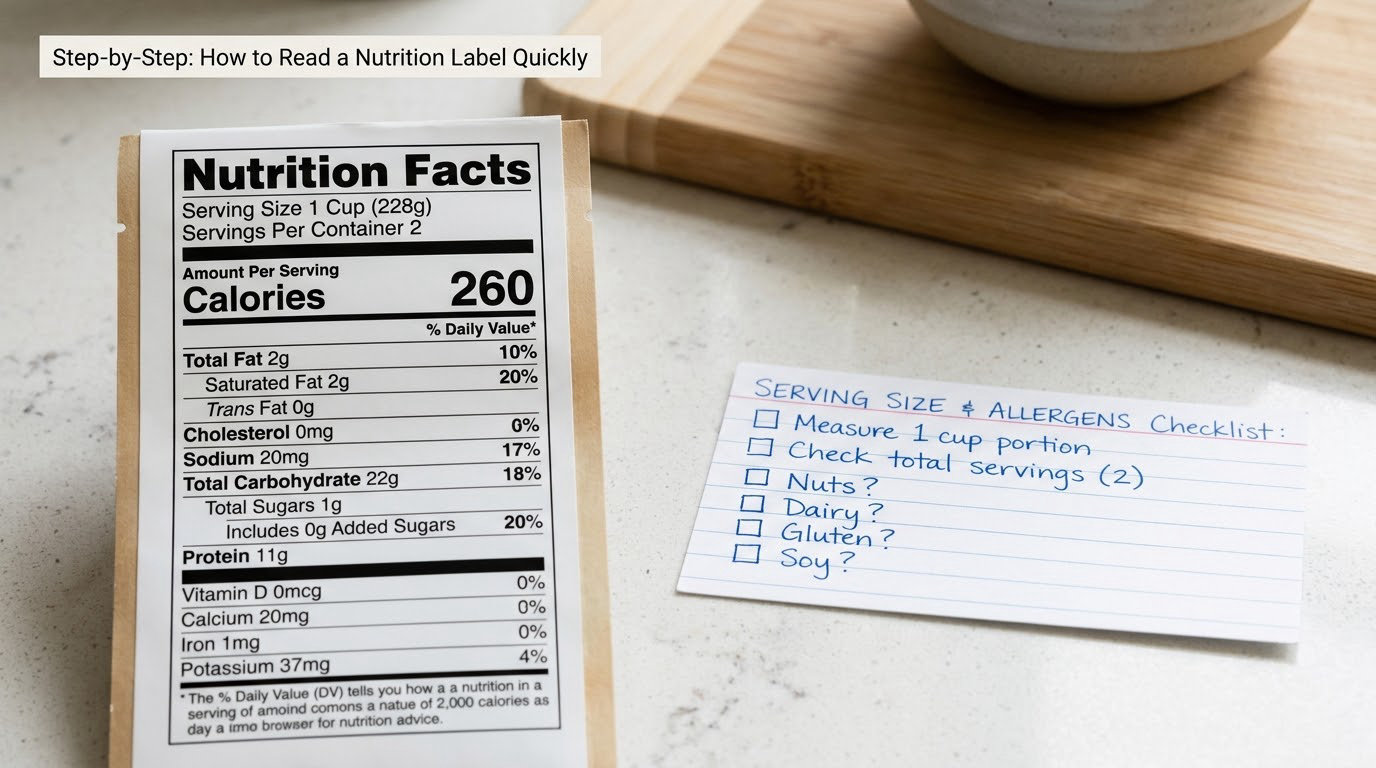
The serving size line at the very top is the most important line on the panel, because every other number depends on it. It tells you the amount of food the rest of the numbers describe, in grams and in the household measure people actually use, such as a cup or a piece.
Immediately underneath, in the largest type on the label, is servings per container. That single number is where most shelf comparisons go wrong. A product listing five servings per container is describing one fifth of the package per serving, and a family of four eating the whole box is eating five times every number printed there.
Three worked examples make this concrete. A cereal box listing 1 cup and 3.5 servings per container means the numbers cover roughly a third of the box. A jar of peanut butter listing 2 tablespoons and 32 servings means a quarter of the jar is a serving. A frozen entree listing one serving per container is unusual, and it is the packaging telling you it intends to be eaten whole.
To scale any number, multiply it by the number of servings you actually intend to eat and keep the result for comparison. Checking servings per container first is the answer to the question readers search most often about serving sizes: the printed serving is a regulatory reference quantity, not a portion anyone is required to eat.
How to Compare Calories and Macronutrients
Calories sit under the serving size in large type, followed by a thick horizontal line and the word Amount Per Serving. Read that line and move on without stopping.
Below it, in order, come total fat and the saturated fat and trans fat lines indented beneath it, then cholesterol, sodium, total carbohydrate with dietary fiber and total sugars indented beneath it, then protein, then vitamin D, calcium, iron and potassium.
Two products are only comparable at the same serving size. If one granola bar lists 200 calories for one bar and another lists 200 calories for half a bar, the second is denser per bite even though the label numbers match. Compare grams, not headlines.
For everyday family shopping, the three macronutrient lines worth a second look are fiber, protein and total fat. A product with 3 g or more of fiber per serving is a reasonable floor for a snack or breakfast component. Protein matters more for growing children and for adults who want food that holds them together until the next meal. Saturated fat, rather than total fat, is the line the FDA allows a specific claim to be based on.
How to Check Sodium, Added Sugars and Other Nutrients
The right-hand column shows % Daily Value, which is the part that makes two labels comparable at a glance. Percent Daily Value tells you how much of a nutrient one serving provides in the context of a daily diet. The FDA sets two reference points: 5% DV or less is considered low, and 20% DV or more is considered high.
Those thresholds are guidance, not pass and fail marks. A snack that lands at 6% DV sodium is unremarkable, while a soup listing 60% DV per serving is a large share of a day’s sodium in one bowl. The same sodium value means something different in a seasoning packet than in a meal.
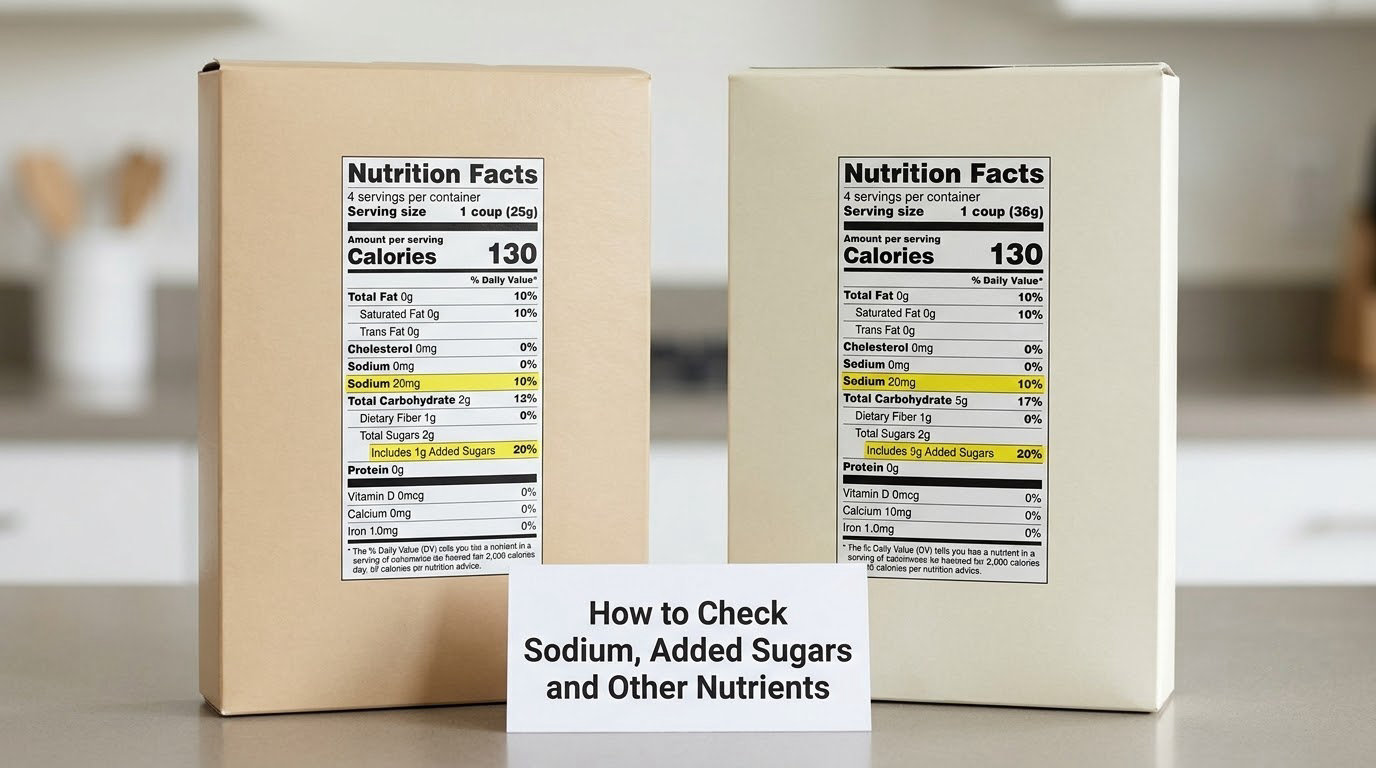
The table below is the reference I keep on the fridge. It uses the FDA’s Daily Values for a 2,000-calorie reference diet.
| Nutrient | 5% DV or less (low) | 20% DV or more (high) | Why a family cares |
|---|---|---|---|
| Sodium | Low | High | The nutrient most often restricted in a prescribed diet |
| Added sugars | Low | High | Added sugars are listed separately from sugar that comes with fruit or milk |
| Saturated fat | Low | High | The basis for the reduced and fat-free style claims |
| Dietary fiber | Low | High | The fiber figure to aim for, 3 g or more per serving |
| Protein | Low | High | Relevant for growing children and for satiety |
| Potassium | Low | High | Listed as a nutrient of concern to get more of |
| Vitamin D | Low | High | Frequently listed as low across packaged foods |
| Calcium | Low | High | Relevant to bone health, especially for growing children |
| Iron | Low | High | Listed as a nutrient of concern to get more of |
Added sugars have their own required line under total sugars, and the difference matters. Total sugars includes sugar naturally present in fruit, milk and vegetables. Added sugars are the ones an ingredient list added during processing, and they are the number most families are trying to keep low. A jar of applesauce with 0 g added sugars and a naturally occurring sugar total is a genuinely different product from one with 24 g added sugars, even if the front of the package says fruit on both.
Some packages carry a dual-column Nutrition Facts panel, with one column for one serving and a second for the entire package. The FDA requires dual columns when a package holds more than one serving and one serving provides 200% DV or more of a nutrient such as sodium, or when the package is large and looks like it holds several servings. When you see two columns, the right-hand column is the honest one for anyone planning to eat the whole thing.
How to Scan the Ingredient List for Allergens and Diet Needs
Ingredients are listed by weight, from heaviest to lightest, before any processing. The first three ingredients make up the bulk of the product, so if you only read three words, read those.
Below the ingredients list, the allergen statement names major food allergens as a separate line. As of 2026, the nine allergens that must be declared in the United States are milk, eggs, fish, crustacean shellfish, tree nuts, peanuts, wheat, soybeans and sesame. That last one was added later than the others, and it is worth re-reading if your household reacts to seeds or sesame.
A separate advisory line such as may contain or processed in a facility that also handles is a voluntary cross-contact statement. Its absence is not a guarantee, and its presence tells you shared equipment is possible. For a child with a documented allergy, that line is a conversation with an allergist, not a judgement call made in the aisle.
Families also track diet needs in the ingredient list, and a few patterns are easy to spot. Sugar appears under aliases such as cane sugar, syrup, dextrose, maltose, sucrose, high fructose corn syrup, fruit juice concentrate and molasses. If a product is sweet but the added sugars line reads 0 g, check whether sugar came from somewhere the manufacturer counts differently.
For sensory-driven and autistic eaters, this is also the predictability check. Texture words, seeds, chunks, coatings and multi-component builds all appear in the ingredient list, and a product that scores well on every number can still be a refusal at the table. Comparing the ingredient list for the same product across two consecutive purchases is a small habit that catches reformulations, which is the change most families notice too late.
How to Use Front-of-Pack Claims Carefully
Front-of-package claims are regulated, but they are not a complete nutritional picture. Low sodium means 5% DV or less per serving. Reduced means at least 25% less than the reference food, and for that comparison the reference must be named on the package. High fiber and good source of protein mean 20% DV or more per serving. Sugar free means less than 0.5 g of sugars per serving, which is not the same as zero sugar.
Terms like natural, multigrain, lite and made with real fruit have no single nutritional definition to check against. That is not proof they are dishonest, but it does mean the Nutrition Facts panel is the only place with numbers.
The quickest test takes one extra step: find the claim on the front, find the matching line on the panel, and see whether the number meets the legal definition. If the front says high fiber, check that the fiber row actually reads 20% DV or more. If it does not, the claim means something narrower than most shoppers assume.
How to Compare Two Products Before Buying
Comparing two similar products takes about a minute once you have the method down. First, make both serving sizes match by multiplying one product’s numbers up or the other’s down to your household portion.
Then rank the numbers by your own priority list, not by what the packaging shouts. One family is managing sodium and could not care less about fiber. Another is watching added sugars in a child who will not eat fruit. Sorting by your own list prevents the loudest number from deciding the purchase.
Finish with the ingredients list. Between two products that look identical on the panel, the shorter list with recognizable kitchen items is usually the one a sensory-sensitive eater will accept, and it is the one more people in nutrition and food-science forums report choosing for exactly that reason.
Last, check whether either product is on a rotation you already trust. Most households do better repeating a small set of acceptable products than re-deciding every single purchase from scratch.
Common Mistakes
Reading the whole package as one serving is the most common error, and the fix is to read servings per container before anything else.
Comparing unlike serving sizes is the second. If one label describes a cup and another describes a bar, the numbers cannot be compared until you convert both to the amount you actually eat.
Treating a front-of-package claim as a summary of the food is the third. Verify it against the panel or ignore it.
Overlooking ingredient changes between purchases is the fourth, and it is the one that catches families by surprise after a safe brand quietly changes texture or a shared-line warning appears.
Ignoring dual-column labels is the fifth. The per-container column is the honest comparison for anything you plan to finish.
Reading a nutrition label as personalized medical advice is the sixth, and it is the one with real consequences for a household managing a diagnosed condition. A label tells you what is in the food. What your child or your own body needs from it is a clinical question.
Frequently Asked Questions
How do I read a nutrition label when the serving size looks small?
A small serving size is a clue, not a problem. Multiply every number by the number of servings you plan to eat. If a label says 1 teaspoon and 45 servings per container, one teaspoon is an accounting unit rather than a portion. What matters is whether the printed serving resembles what your household eats; when it does not, do the math yourself before comparing two products.
Are allergens always listed in the ingredients?
Major allergens are not only in the ingredients list. The FDA requires a separate allergen statement naming them, and since 2026 that statement covers nine allergens including milk, eggs, fish, crustacean shellfish, tree nuts, peanuts, wheat, soybeans and sesame. A may contain line is voluntary and refers to possible cross-contact from shared equipment, so its absence is not a guarantee of safety.
Does gluten-free mean a food is safe for every person with a gluten-related condition?
No. Gluten-free means the food meets the FDA definition of less than 20 parts per million gluten. It does not guarantee a product is safe for someone with celiac disease, wheat allergy or dermatitis herpetiformis, and oats or cross-contact on shared equipment can still matter. Anyone with a diagnosed condition should confirm with their clinician before changing a diet they rely on.
What does 5% or 20% Daily Value mean on a nutrition label?
Percent Daily Value shows how much of a nutrient one serving provides against a daily reference. The FDA sets the thresholds: 5% DV or less is considered low, and 20% DV or more is considered high. They are guideposts rather than pass and fail marks. A high sodium number in a soup matters far more than the same number in a seasoning packet.
How can I compare two foods if their serving sizes are different?
Convert both products to the same amount before you look at any number. Multiply each label by the number of servings you would actually eat, or divide down to a common measure such as 100 grams or a single slice. Then compare like with like: grams of fiber, milligrams of sodium and percent Daily Value all become meaningful once the portions match.
When should I ask a doctor or registered dietitian for help reading food labels?
Any time a diet is restricted by a diagnosis rather than by preference. High blood pressure, diabetes, kidney disease, food allergies and prescribed elimination diets all have intake targets that a label alone cannot tell you. A registered dietitian nutritionist can translate the numbers on a panel into a plan for your household, and your clinician should confirm anything that affects a prescribed diet or a child’s growth.
Conclusion: Use a Simple Three-Part Check
Start with the serving size and servings per container, because every other number depends on them. Then read the nutrients that matter for your household using the 5% and 20% Daily Value guideposts, checking sodium and added sugars first when those are your priorities.
Finally, read the ingredients and allergen statements in order of weight, then compare similar products at matching serving sizes. That is the whole method for how to read a nutrition label quickly, and once it is a habit it takes less time than deciding between two nearly identical boxes on gut feeling alone.