

You request assistive technology at school in writing: you send a written request for an assistive technology evaluation to your district’s special education office, keep proof that it arrived, and ask for an assessment plan within a set number of days. The district pays for it, not you. Under IDEA, assistive technology is a service the school owes your child when it’s needed to access instruction, and you can ask at any time rather than waiting for the annual IEP review.
This guide is for parents and caregivers of school-aged children with disabilities, including autistic students and kids who have a 504 but no IEP. Processes, forms and deadlines change by state and district, so treat the steps here as the reliable spine and fill in the local rules. Every step is written so a tired parent can actually execute it on a Tuesday night.
Table of Contents
- What You Need
- Step-by-Step: How to Request Assistive Technology at School
- 1. Identify the Functional Problem
- 2. Gather Evidence About Your Child’s Needs
- 3. Contact the Right School Team Members
- 4. Send a Written Request
- 5. Ask for an Evaluation or Meeting
- 6. Review the School’s Response
- 7. Follow Up or Ask for Further Review
- A note on autism, AAC and “let’s wait and see”
- Common Mistakes
- Frequently Asked Questions
- Can a school deny a request for an assistive technology evaluation?
- Does my child need an IEP to get assistive technology at school?
- How do I get an AAC device through school?
- Are schools required to pay for assistive technology?
- What are the downsides of assistive technology?
- Can parents request a 504 evaluation, and is a 504 less severe than an IEP?
- Conclusion: Start With a Specific Written Request
What You Need
Assemble these before you write a single sentence. If you can answer “what does my child need to do that they currently can’t do?” with specifics and examples, the rest is paperwork.
- A written description of the problem. Not the diagnosis. Describe the task, the barrier and the educational impact.
- Examples. Photos or videos of the struggle, work samples, a screenshot of a message your child could not send, a recording of a meltdown that tracks to noise or crowding.
- Any existing evaluations. Speech-language pathology, occupational therapy, physical therapy, psychological, educational and medical reports all carry weight.
- Teacher notes and data. Ask for a short written statement about what happens during independent work time, group work, reading or writing tasks.
- Names and emails. The case manager, special education teacher or resource room teacher, school psychologist, related-services staff, building administrator, and the director of special education for the district.
- A device idea, loosely. “Text-to-speech for reading” is helpful. A brand and model number usually isn’t, and naming one too early is a common mistake.
Find out whether your state or district has its own AT request form. New York City routes families through a CPSE referral, Seattle uses a Request for AT Consult form, and California has its own assistive technology regulations. Two of the pages ranking for this question are district websites, which tells you local forms exist and differ.
Step-by-Step: How to Request Assistive Technology at School
1. Identify the Functional Problem
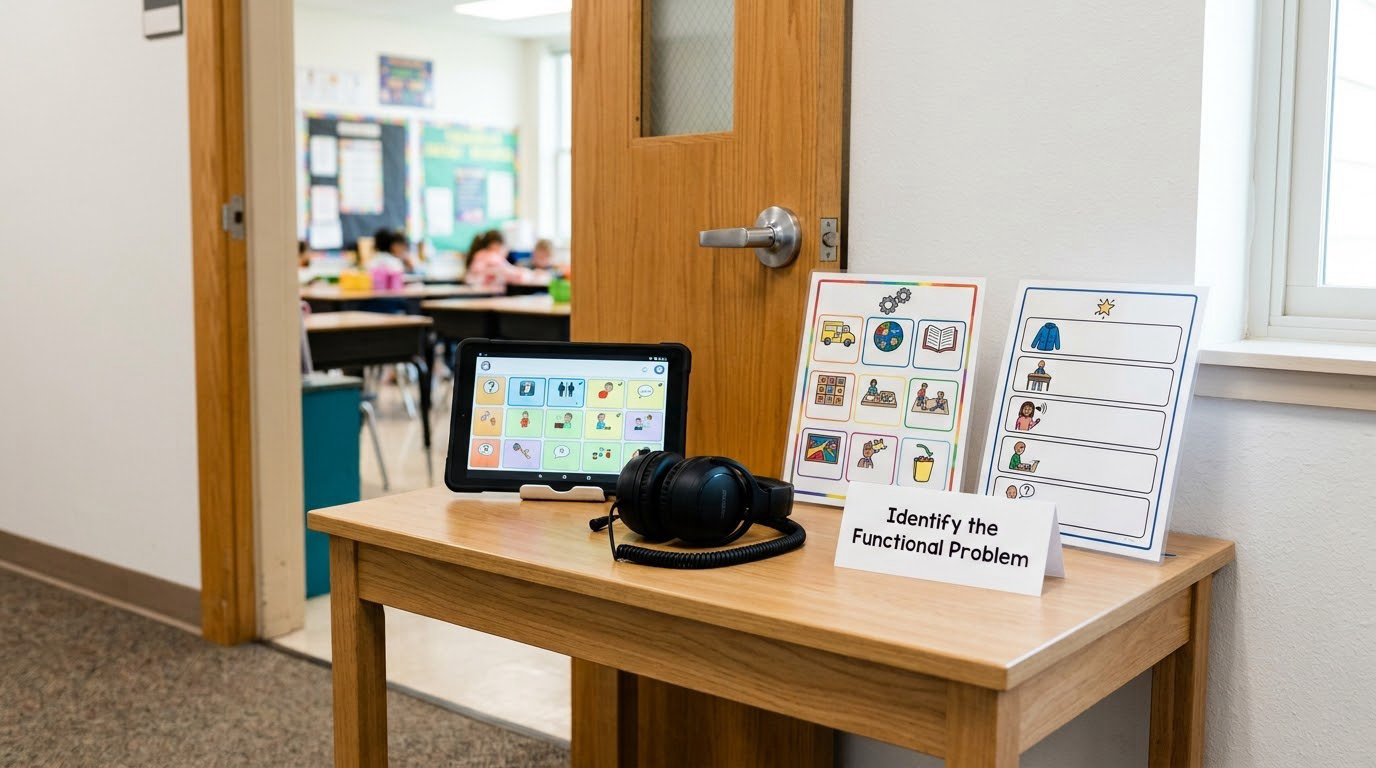
Start with the daily task, not the device. A request that names a tool without a context usually gets a polite non-answer, because the team has no way to tell whether the need is real.
Write down four things: the task, the barrier, the safety or access risk, and what your child loses educationally. Then repeat it for each area you care about.
- Communication: your child understands and wants to say something but has no reliable way to say it during group work, so they stop trying and peers talk over them.
- Reading: decoding is so slow that your child finishes four pages of assigned reading while peers finish forty, and stops volunteering to read aloud.
- Writing: handwriting takes so long that by the time a paragraph is finished the instructional part of the lesson is over.
- Mobility and classroom access: heavy books, a crowded doorway or a long carry between classes costs your child minutes of instruction and physical energy.
- Sensory regulation: hallway noise at a level your child cannot filter means the last two periods carry no learning at all.
- Organization: without a visual system for transitions, materials get lost and the end-of-day routine collapses.
You will know step one worked when the paragraph reads like an observation rather than an advertisement. “Miss Alvarez reported on October 3 that Jordan gave up after six minutes of writing and put his head down” is usable. “Jordan needs a laptop” is not.
2. Gather Evidence About Your Child’s Needs
Evidence turns an opinion into a request a team has to respond to. Three or four dated, specific items usually do more than a folder of thirty pages.
Start with dates. An observation from six weeks ago is worth less than one from last Tuesday, and dated material protects you at a due process hearing months later. Include work samples from different subjects, short teacher statements about specific tasks, and results of formal testing where you have them.
Organize everything chronologically in one folder, physical or digital, and give it a simple naming scheme. One document per child, one page listing contents, nothing that duplicates. Only include information the team genuinely needs. You are not required to hand over therapy records, medical history or anything unrelated to the request, and you can ask for reports rather than originals.
Success check: a reader who knows nothing about your child can tell what the problem is, how often it happens and what it costs educationally, without asking you a question.
3. Contact the Right School Team Members
Send to the right people and a request rarely stalls. Your case manager is the one who lives in the system, the building administrator holds the budget, and the director of special education at the district office is the person who can authorize an outside evaluation.
Copy the special education teacher or resource room teacher, the school psychologist, and any related-services staff already working with your child, such as the speech-language pathologist or occupational therapist. The team that knows your child is the team whose buy-in gets you a device instead of a trial that never happens.
Ask one of them, in a sentence, who decides on assistive technology in this building. That single question saves weeks. Then ask for the answer in writing.
4. Send a Written Request
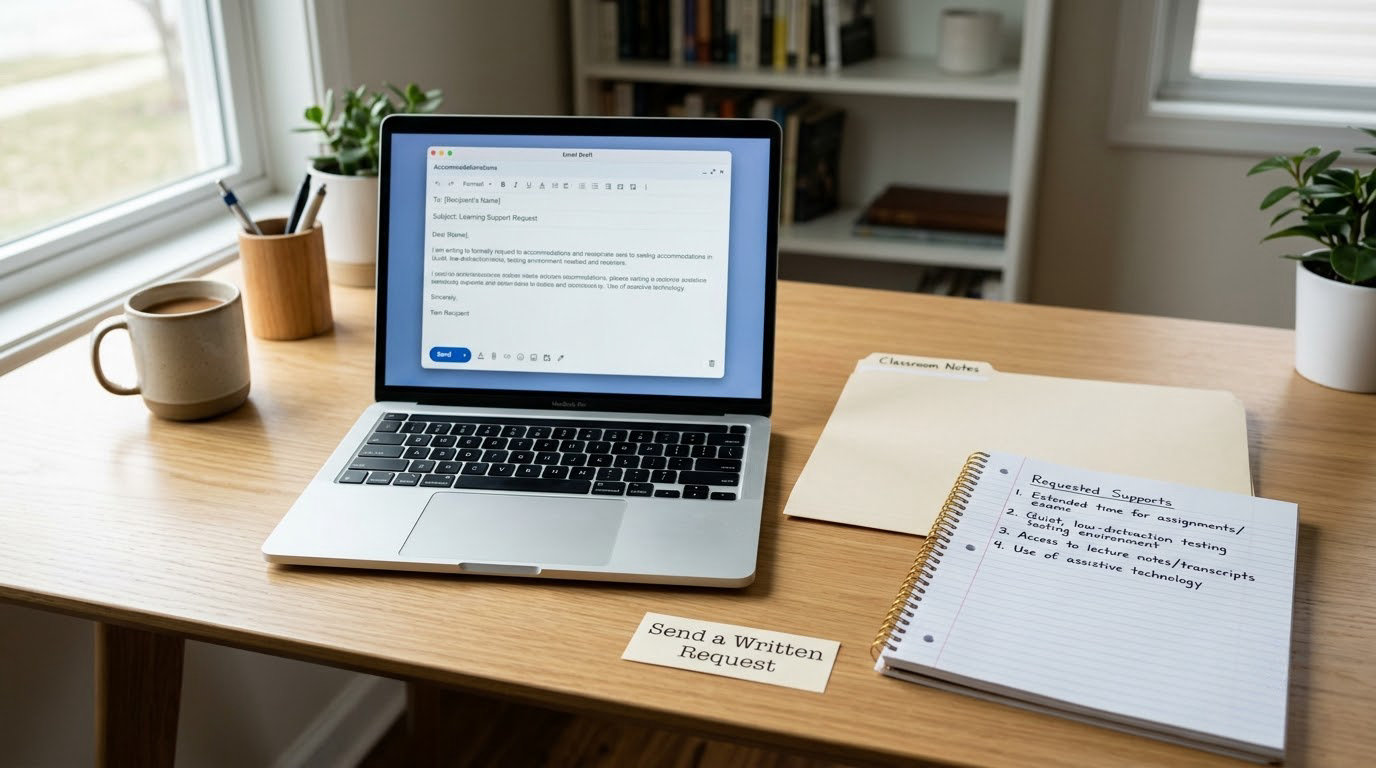
Put the ask in writing and keep proof it arrived. On r/specialed, parents describe the same pattern: written requests with specific citations get taken seriously, because a district has to respond to a document and cannot simply let a hallway conversation fade.
Your request needs five pieces: your child’s present level of academic achievement and functional performance in plain language, the specific barrier, the technology or service category you are asking the district to evaluate, the educational benefit you expect, and a request for a meeting with a written reply.
Use this outline:
- Header: date, your name, contact details, delivery method, the addressee (Director of Special Education or building administrator).
- Identify: your child’s name, grade, school and the date you are writing.
- The concern: two short paragraphs describing the functional problem with dated examples.
- The ask: a request for a written decision on an assistive technology evaluation, an assessment plan within a stated number of days (15 calendar days is the benchmark in California and a common reference point elsewhere), and an IEP team meeting to discuss it.
- Consent: state that you are signing consent for the evaluation, or ask for the assessment plan so you can review it.
- Close: ask for prior written notice if the district proposes to refuse, and list the people you copied.
Keep the tone neutral and solution-focused. “I am concerned that X is blocking Y, and I am asking the district to evaluate whether Z would help” travels much further than a complaint about a teacher.
For proof of delivery, pick at least two methods: email with a read receipt or a district portal upload that generates a timestamp, hand delivery to the front office with a signature, fax confirmation, or certified mail with return receipt. Keep all of it in the folder. When you send, ask the district to confirm receipt in writing within a few days.
5. Ask for an Evaluation or Meeting
Two different things can happen here, and you may want both. An assistive technology evaluation is a focused assessment, usually by an occupational therapist, speech-language pathologist or certified assistive technologist. An IEP team meeting is where the team decides what goes in the plan.
Before the evaluation, ask: who is evaluating, what data will they collect, will they observe the classroom, will your child trial devices, and when will the written report arrive. A solid assessment includes a background interview with you and the teachers, classroom observation, review of work samples, and hands-on sampling of options with data on accuracy and fatigue.
Ask for the report in writing and ask for the minutes of any meeting you attend. Request the assessment plan by a specific date rather than “as soon as possible.” Specific dates get answered.
Success check: after this step you have a date, a name and a document request in the email thread.
6. Review the School’s Response
Not all answers are equal. A teacher letting your child use a personal tablet for one lesson is an informal adjustment. It is not an assistive technology service, and it can vanish when the teacher changes.
Ask how the decision will be documented. If the answer is a paragraph in the IEP with measurable annual goals, who will provide training, who holds the device, how progress gets monitored and when the team will review it, that’s a service. If the answer is a shrug and a “we’ll try it this quarter,” ask for it in writing.
Also nail down the boring details that decide whether AT actually gets used: training for your child, for you, and for the classroom staff who will hand it over; a troubleshooting contact; a backup plan for repair or replacement; and access to the device outside the classroom, at home and over the summer when it’s needed for a free appropriate public education.
7. Follow Up or Ask for Further Review
If nothing arrived in the window you asked for, follow up once in writing, short and factual, then escalate in a defined order. You can ask the district’s special education office for a written status, request an independent assistive technology evaluation at district expense, use the dispute resolution process your state education agency offers (mediation first, then a due process hearing), or file a complaint with the U.S. Department of Education’s Office for Civil Rights for a Section 504 or ADA issue.
Use a simple template: “On [date] I sent a written request for an assistive technology evaluation and asked for a response by [date]. I have not received one. I am asking for the district’s response in writing within [date], and I am copying the family liaison and the special education director.”
Get an advocate involved early. Parent centers, state parent resource centers and non-profit special education law firms can review the letter before you send it, and many offer help at no cost. Keep documenting unmet needs and implementation problems with dates.
A note on autism, AAC and “let’s wait and see”
Autistic families get a specific version of “wait and see,” and it’s often the most expensive one. If your child is nonverbal or has unreliable speech, a request for AAC evaluation can go in at any time, and speech therapy alone doesn’t obligate the team to wait and see whether it improves. Bring in dated evidence and ask what measurable outcome the school expects by when.
On the other side, a device your child refuses to use is a failed recommendation, not a win. Ask for a trial period long enough to get a real signal, and match the tool to your child’s sensory profile rather than the loudest option in the catalog. Parents on r/slp describe the other half of this problem: private providers and school AT staff often disagree, and your child is the one living with the contradiction. Get the disagreement on the record in the report rather than resolving it hallway-style.
If you got the device and it sits in a backpack, the failure is usually implementation, not hardware. Ask for a written training plan naming the staff member who hands it over, a troubleshooting contact, and a check-in at 30 and 60 days.
Common Mistakes
Naming a specific brand too early. Fix: name the function (“a tool that lets my child read assigned text independently”) and let the evaluation determine the device. Teams resist requests that pre-decide the outcome, and pre-deciding it also wastes your trial period.
Leading with the diagnosis instead of the problem. Fix: lead with the task and the barrier. A diagnosis does not tell a team what to provide; a functional description does.
Sending a complaint with no measurements. Fix: add dates, durations, work samples and screenshots. “My child is exhausted by the end of the day” changes nothing; “homework takes 70 minutes instead of 20 across the last four weeks” starts a conversation.
Assuming a meeting request means an immediate decision. Fix: ask for a decision date and a written response, then send a follow-up the day after that date. Parents describe evaluations taking months, and planning around a single meeting date wastes a year.
Forgetting the classroom staff. Fix: include the general education teacher in the request. A device the teacher has not been trained on is a device in a drawer.
Skipping proof of delivery. Fix: keep the confirmation and ask the district to acknowledge receipt. This one habit is the difference between a documented request and a memory.
One last tip: keep the same file for every year and pull the dated observations forward at each annual review. Schools move slowly, and a folder that shows a pattern over three years moves faster than a fresh argument.
Frequently Asked Questions
Can a school deny a request for an assistive technology evaluation?
A district cannot simply ignore your written request. It must consider it and respond, and if it refuses to evaluate, you can ask for prior written notice explaining the reasons, request an independent assistive technology evaluation at district expense, use your state education agency’s mediation or due process process, or file a complaint with the U.S. Department of Education’s Office for Civil Rights. Keep every request and every reply in writing.
Does my child need an IEP to get assistive technology at school?
No. A child does not need an IEP to receive assistive technology, and a 504 plan can cover AT as a reasonable accommodation. What changes is who decides and what the district owes. Under IDEA the AT is a service documented in the IEP with goals, training and progress monitoring. Under Section 504 it is an accommodation the team documents in the plan file, which is usually faster to set up and lighter on paperwork.
How do I get an AAC device through school?
Write to the special education office requesting an assistive technology evaluation that specifically addresses augmentative and alternative communication, attach dated evidence of your child’s attempts to communicate, and ask for a device trial or sampling period. Request that AAC be written into the IEP with the device, a vocabulary system the team will fund, training for your child and staff, and access outside school when needed. You do not have to wait for speech therapy to show progress first.
Are schools required to pay for assistive technology?
When assistive technology is needed for a student with a disability to receive a free appropriate public education, IDEA puts the cost on the district, including evaluation, acquisition, fitting, maintenance and repair, and training for the child, family and providers. Districts generally may not shift that cost to you or condition the device on your filing an insurance claim. Confirm specifics for your state and district, because cost-sharing rules vary.
What are the downsides of assistive technology?
The real risks are practical rather than legal: extra steps, stigma, and a tool nobody trains. Photographing a paper worksheet to feed it into a device adds work rather than removing it, and a visible setup can make a child a target. Match the tool to the child’s sensory profile, choose something that looks ordinary where possible, and require a training and troubleshooting plan before the purchase order goes through.
Can parents request a 504 evaluation, and is a 504 less severe than an IEP?
Yes, parents can request a 504 evaluation in writing, and you do not need a diagnosis letter from a clinician to make the request. The two plans are not ranked by severity; they serve different purposes. An IEP is for students who meet IDEA’s disability criteria and guarantees a free appropriate public education, while a 504 covers students who need accommodations but do not meet those criteria. A student can move from one to the other.
Conclusion: Start With a Specific Written Request
Three actions move this forward, in order. Document the functional problem in your own words, with dates and examples of what your child cannot do at school. Collect a short folder of supporting evidence: work samples, teacher notes, evaluation reports, recordings. Then send a written request naming the technology or service category, asking for a written response by a specific date, and copying both the case manager and the director of special education, with proof of delivery kept in the same folder.
You can request an assistive technology evaluation at any point in the year, not just at the annual review. Start now, and adapt the details to your state’s rules and your district’s forms.