
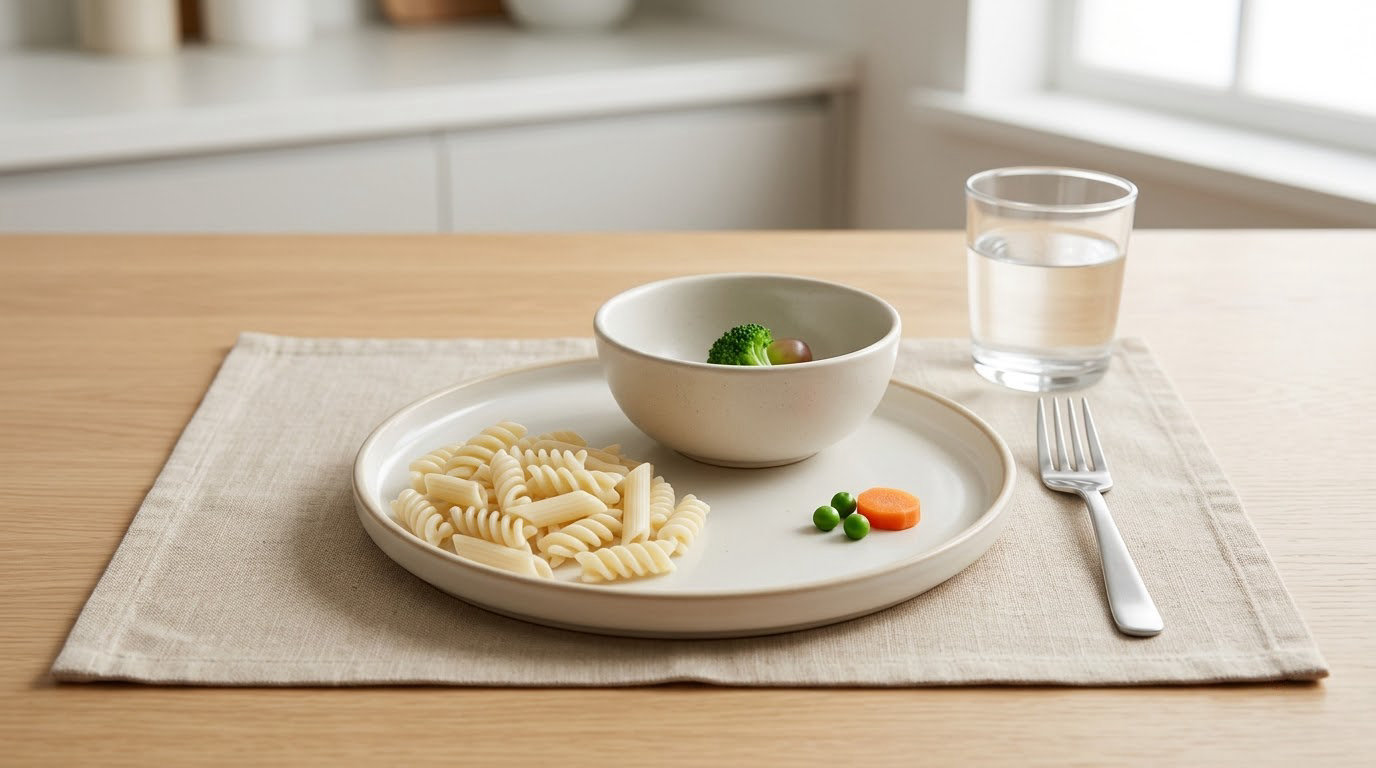
How to handle extreme picky eating in autism comes down to sensory processing, interoception and a real need for predictability working together. Lower the pressure first, then widen the accepted foods slowly. You are not trying to win a meal. You are building trust around food while protecting growth and nutrition.
Take the first step this week: write down everything your child reliably eats, then make one small change to how that food is served. Everything below builds on that.
A note before you start. This is general information, not medical advice about your child. If intake, growth or hydration concerns you, talk to your pediatrician or a registered dietitian, and follow their guidance rather than any general article.
Table of Contents
- What You Need
- Step-by-Step: Building a Safer, Broader Eating Routine
- Step 1: Identify What the Child Currently Eats
- Step 2: Look for Sensory and Routine Triggers
- Step 3: Check Growth and Nutrition Concerns
- Step 4: Make Mealtimes Predictable and Low-Pressure
- Step 5: Expand the Accepted Foods Gradually
- Step 6: Keep a Calm Record of Progress
- Step 7: Know When to Seek Professional Support
- Common Mistakes
- Frequently Asked Questions
- How should I introduce new foods to a child with autism?
- Is it normal for a child with autism to eat only a few foods?
- What if my child with autism is losing weight or constipated?
- Should I make my child eat a new food to prove they are trying?
- Can supplements help with extreme picky eating in autism?
- When does selective eating need a feeding specialist?
- Take One Small Step Today
What You Need
You need very little to start, and that is the good news. Most families begin with pen and paper, not equipment.
- A food-and-behavior log. A notebook or a simple spreadsheet where you note what was offered, what was eaten, the setting, and how distressed your child seemed.
- The current accepted food list. Write down every food that reliably goes in, including the specific brand, the exact cut, the cooking method and the container it comes in.
- Preferred routines and utensils. The same chair, the same plate, the same cup, the same order of events. Note the time of day your child eats best.
- A calm mealtime setting. Lower noise, predictable lighting, no television or arguments within earshot.
- Small portions of familiar foods. A tablespoon of something safe is a working portion. Overfilling the plate adds pressure without adding nutrition.
- Access to the pediatrician or a registered dietitian. You want that relationship ready before intake becomes a worry, not after.
If your child already has an occupational therapist, feeding therapist or board certified behavior analyst, tell them what you are changing before you change it.
Step-by-Step: Building a Safer, Broader Eating Routine
Step 1: Identify What the Child Currently Eats
Start by recording what your child eats without judgment. For each accepted food, log the texture, the temperature, the preparation method, the portion size, and the conditions under which eating is easiest.
Be specific, because the details carry the information. “Chicken” is not a data point. “Plain baked chicken breast, cut into cubes, served dry on a divided plate, eaten at 6pm at the table with the TV off” is.
Families often find the pattern is narrower than they assumed. One parent told me her daughter ate “bread and nuggets” until we listed it properly, and the list showed bread meant one brand of white sandwich bread with the crusts removed and the nuggets meant one shape, one coating and one box.
This baseline is a description, not a label. It tells you where your child is right now so you can build from a known-good spot. Framing it as a starting point rather than a failure is what makes the rest of the work possible.
Step 2: Look for Sensory and Routine Triggers
Most food refusal in autistic children tracks to something specific rather than to mood. Texture, smell, color, temperature, unpredictability, communication demands, anxiety, or a past experience with getting sick.
Watch for the child who eats smooth foods but pushes visible pieces around the plate. That is usually mixed texture rather than the food itself. The child who eats food only when it is a specific temperature is telling you about sensory tolerance, not appetite.
Interoception plays a role too. Interoception is the sense of what is happening inside your body, like hunger, fullness, pain, nausea and the feeling of food in your mouth. Many autistic people have a blurred or inaccurate internal signal there, so fullness registers early or hunger never registers clearly. A child who cannot reliably feel hungry will not eat because they are hungry, no matter how much you wish they would.
Note which trigger fits which food. That note becomes your map for the next step.
Step 3: Check Growth and Nutrition Concerns
Extreme picky eating in autism can come with low energy, constipation, and gaps in fiber, iron, calcium, vitamin D and protein. A very restricted diet is a medical situation, not just a behavioral one.
Check your child’s growth trend rather than a single measurement. Weight-for-height or BMI-for-age plotted over months tells you far more than today’s number. Ask your pediatrician about the curve, not just the current reading.
Bring specifics to the appointment: the food log, bowel pattern, energy levels, and the list of what your child will not eat. Ask about vitamin D, iron, calcium and fiber intake, whether a supplement is appropriate, and whether a stool test or other evaluation makes sense for ongoing constipation.
Do not start a supplement or restrict foods further on your own. A dietitian working from your log can tell you what the gaps actually are. If your child stops eating almost entirely, loses weight, vomits repeatedly, or seems dehydrated, seek medical care promptly rather than waiting for a scheduled visit.
Step 4: Make Mealtimes Predictable and Low-Pressure
A calm, repeatable setting does more for expansion than any trick you play at the plate. Keep the timing, seating, utensils and sequence the same, and let your child control the small non-food decisions.
What your child chooses can be which cup, which napkin, where to sit, or whether the meal comes on a blue plate or a white one. Those choices feel harmless and they return control to a person who has very little of it.
| What you notice | Likely trigger | Accommodation to try |
|---|---|---|
| Pushes food around the plate untouched | Mixed textures or foods touching | Serve items in separate sections of a divided plate, never combined |
| Refuses warm food, accepts cold | Temperature sensitivity | Serve that food at the temperature your child accepts, without asking why |
| Leaves the table when food arrives | Smell intensity | Move cooking and plating further away; let the child choose the distance |
| Covered plate, refused everything | Visual unpredictability | Use the same plate and layout every time; avoid patterned or sectioned plates if they dislike them |
| Covers ears, melts down at the table | Noise, lighting, crowding | Quieter room, dimmer lights, fewer people, noise-reducing headphones |
| Grabs the cup instead of the fork | Utensil sensitivity | Offer a plain fork, a spoon or a straw cup, whichever works |
| Will not sit for the meal | Seating discomfort or need for movement | Same seat every time; allow standing or rocking if that keeps them near the table |
Tell us what you need to eat, not what you must eat. If your child says no, thank them for telling you and move on. Do not add just one more bite, do not count bites out loud, and do not withhold a trusted food until something new is eaten. Withholding the reliable foods is the fastest route to losing the only nutrition you have.
You will know the routine is working when mealtimes get quieter and your child starts lingering at the table or helping with it. Not when they finish new foods. When the pressure at the table spills over into the rest of the day, that is usually a regulation problem rather than a food problem, and it is worth reading up on how to handle autism meltdowns at home before adding anything else to the plate.
Step 5: Expand the Accepted Foods Gradually
Expand one familiar food at a time. Change one variable only: texture, temperature, shape, location on the plate, or a pairing.
If you are working out how to handle extreme picky eating in autism without turning meals into a battle, this is where the patience pays off. A buttered noodle becomes a noodle with a small amount of sauce. A cube of bread becomes a thin slice, then a torn piece. A smooth yogurt becomes a thicker yogurt, then a yogurt with one small lump in it. This approach is often called food chaining, and it works because each step sits next to something already accepted.
Expect to offer a new food many times before anything changes. Fifteen to twenty neutral exposures is a common target in feeding therapy work, and each exposure can be tiny. Touching it, smelling it, licking it, putting it in the mouth and spitting it out, and adding it to a dish without eating it all count.
Repeat the same food across meals rather than introducing several new ones at once. Mixing targets makes it impossible to tell what your child is responding to, and it overwhelms the table.
Give your child two safe foods at every meal alongside anything new. If a meal goes badly, you still know they ate.
Step 6: Keep a Calm Record of Progress
Track exposure, distress, acceptance, bowel habits, energy and new foods. Look at the log every week or two, not after every meal.
| Food or change | Texture or temperature | First offered | Exposures so far | Response |
|---|---|---|---|---|
| Example: pasta with sauce | Smooth, warm | Date | 7 | Scooped onto side of plate, not eaten |
The response column is the useful one. Tactile exploration, smelling, licking, chewing with spitting, and eating whole are all progress, and they are ordered. Most parents stop too early because they only count eating.
Log bowel patterns and energy too, since constipation and fatigue often show up before weight does. Bring the log to appointments; it turns a vague conversation into a clinical one.
Step 7: Know When to Seek Professional Support
Contact your pediatrician or a registered dietitian when intake is worrying you, and ask about a feeding team when you see these signals:
- Weight loss, stalled growth, or a downward crossing on the growth curve
- Dehydration, dry mouth, dark urine, or reduced wet diapers or toilet trips
- Worsening constipation, abdominal pain, or vomiting
- Visible fatigue, dizziness, pale skin, or unusual bruising
- Gagging, coughing or choking with food, or pain when eating
- A safe food list that has shrunk or stayed under about a dozen foods for months
- Refusing food almost entirely, or eating for hours but not for days
Avoidant/restrictive food intake disorder, often called ARFID, can coexist with autism and deserves its own assessment by someone qualified. Urgent symptoms such as severe dehydration, inability to keep fluids down, or signs of choking need prompt medical care, not a home routine.
What the team looks like varies. An occupational therapist with feeding training works on oral sensory-motor skills and the gag reflex. A board certified behavior analyst works on the behavior around eating. A registered dietitian handles the nutritional gaps. A pediatrician or gastroenterologist looks for medical causes. Many families use more than one, and you can start with the pediatrician.
Common Mistakes
Most families who struggle with this have tried something counterproductive before they found what worked. Here are the ones worth stopping, with the replacement.
- Force-feeding or holding a child’s mouth open. This teaches that food and eating are dangerous and controlled by someone else. Replacement: offer the safe food, sit nearby, and end the meal calmly.
- Repeated demands. “Just one bite” repeated for twenty minutes raises pressure and lowers willingness. Replacement: ask once, accept the answer, and move on.
- Bargaining for a few bites of dessert or a toy. It works briefly and then trains your child to eat under pressure. Replacement: keep treat foods unconditional, outside the meal and outside any demand.
- Comparing your child to siblings or to other families. It communicates that their eating is the problem, not their sensory experience. Replacement: keep sibling meals predictable and separate, and stop narrating preferences at the table.
- Introducing five new foods at once. You learn nothing and the table gets louder. Replacement: one food, one variable change, repeated.
- Assuming exposure alone will fix a sensory reaction. Repeated exposure without addressing texture, temperature, smell or pain often increases avoidance. Replacement: change one sensory variable first, then re-offer.
Also worth saying plainly: an autistic person’s right to decline food deserves respect. A child who can say no, or who has a way to communicate no, is safer and more likely to keep eating at all than one who is pushed until the whole relationship breaks down.
Caregivers carry a lot here, and the stress is real. Many parents say the biggest shift came from lowering pressure rather than adding a new strategy. If the tension at your table is affecting the rest of your day, that is a reason to seek support for yourself too.
Frequently Asked Questions
How should I introduce new foods to a child with autism?
Introduce one new food at a time and change only one variable, such as texture, temperature or shape. Always include at least two foods your child already accepts at that same meal, so eating is never on the line. Offer it repeatedly without comments about trying or tasting, and treat touching, smelling and licking as real progress. Most feeding therapy programs work toward fifteen or more neutral exposures before expecting a change, and your child’s pace may be slower.
Is it normal for a child with autism to eat only a few foods?
Food selectivity is common in autistic children, and eating a narrow range of foods for a period of time often fits their sensory experience and need for predictability. What matters is whether the range is stable or shrinking, and whether growth and hydration are on track. A child eating a very limited diet without weight loss or distress may simply have strong sensory needs. Talk to your pediatrician or registered dietitian about your child’s own pattern and growth curve.
What if my child with autism is losing weight or constipated?
Contact your pediatrician promptly and bring your food log, bowel pattern and growth records. Restricted diets commonly run low in fiber, iron, calcium, vitamin D and protein, and constipation is frequent because low fiber and low fluid intake slow things down. Ask what testing and supplementation make sense for your child rather than adjusting their diet or adding supplements yourself. Rapid weight loss, dehydration, severe abdominal pain or vomiting need prompt medical attention.
Should I make my child eat a new food to prove they are trying?
No. Requiring your child to eat in order to earn a trusted food, a treat or an activity is a form of pressure, and it usually makes avoidance worse. The goal is a broader, safer eating routine over years, not compliance at one meal. Instead, offer the new food without comment, keep your child’s reliable foods unconditional, and record what happened. If your child can decline safely, protecting that right keeps mealtimes calm enough for progress to continue.
Can supplements help with extreme picky eating in autism?
Supplements can correct a specific gap, such as vitamin D or iron, but they do not expand the foods your child accepts. Anyone recommending supplements for your child should work from your actual food log and your child’s bloodwork or clinical picture. A registered dietitian is the right person to tell you whether a gap exists and what dose is appropriate. Never start a supplement or restrict foods further on your own, and never use one to replace mealtime work.
When does selective eating need a feeding specialist?
Ask for a feeding team evaluation when the safe food list keeps shrinking, stays very small for months, or comes with weight loss, stalled growth, dehydration, worsening constipation, pain, gagging, vomiting or choking. Severe selectivity can also coexist with avoidant/restrictive food intake disorder, which needs its own diagnosis. An occupational therapist with feeding training, a board certified behavior analyst and a registered dietitian each address different parts of the picture, and your pediatrician can help coordinate them.
Take One Small Step Today
Pick one food your child reliably eats. Note what makes it predictable, down to the brand, the cut and the plate. Then serve that same food one step outside its comfort zone, without asking your child to eat it.
Progress on extreme picky eating in autism runs in months and years, and it usually looks like a new texture tolerated or a new food moved around the plate. Most parents who get further are the ones who stopped negotiating and started being boringly predictable about meals. Keep your own calm steady, keep your reliable foods unconditional, and bring the log to your pediatrician or registered dietitian whenever you are not sure.
Last reviewed for 2026. This article is general information and does not replace advice from your child’s pediatrician, registered dietitian or feeding team.