

To report restraint or seclusion at school, start with a written, date-and-time-specific record of what you saw, request the school’s incident report and policies in writing, ask for an IEP or 504 team meeting within days, then escalate to your state education agency or the U.S. Department of Education’s Office for Civil Rights if the school does not act. Most parents can do the first three steps themselves without a lawyer.
Most parents never get a phone call saying the right thing happened. One parent in a teacher-focused online forum described a 7-year-old restrained for roughly 45 minutes by a certified administrator with no notification at all. Another parent, in an autism parent group, described being told her child was sent to the “calm-down room” for a while, which turned out to be a room that was not on any published list.
So before the process, some plain-language definitions. Restraint means physically holding a student still or restricting movement, either by hand or with a device, pads, belts, or a blanket. Seclusion means isolating a student alone in a room or area, away from other students, where the student is prevented from leaving or is not free to leave. A cool-down corner or time-out space is often one of these things, sometimes deliberately named something softer so it does not appear on an incident log. An FBA is a functional behavior assessment, a study of why a behavior happens. A BIP is a behavior intervention plan, the written strategy that follows it. FAPE is free appropriate public education, the IDEA guarantee of an appropriate public school education.
The federal bar is the same idea almost everywhere: restraint and seclusion may not be used unless there is a threat of imminent danger of serious physical harm to the student or others, and never as punishment, never for staff convenience or staffing shortages, and never after less restrictive methods were available and ignored. For 2026, before you start a process, take these seven actions.
- Photograph any injury the same evening and note the date and time.
- Write a factual record while the details are fresh: time, place, who was there, what you saw, what your child said.
- Send a written request for the incident report, your child’s records, and the school restraint and seclusion policy.
- Ask the teacher or case manager in writing for a meeting within the next few school days.
- Ask for a functional behavior assessment and a behavior intervention plan review if the restraint happened more than once.
- Note the date you sent each request, because the clock on the federal civil rights complaint runs from then.
- Decide your escalation route, and check whether your state education agency has a real complaint process at all.
Table of Contents
- What You Need Before You Contact the School
- Step-by-Step: How to Report Restraint or Seclusion at School
- Step 1: Check for Immediate Safety Needs First
- Step 2: Write Down What Happened Before You Report Restraint or Seclusion
- Step 3: Request the School’s Records and Policies
- Step 4: Contact the Teacher and IEP Team
- Step 5: Escalate Through the School or District
- Step 6: File a Formal Complaint With the Right Agency
- Step 7: Track the Response and Protect Follow-Up
- Common Mistakes Parents Make, and the Fix for Each
- Frequently Asked Questions
- What should I include when reporting restraint or seclusion at school?
- Who do I contact first if my child was restrained or secluded at school?
- Can I report restraint or seclusion if I was not there to witness it?
- What records can I request after a restraint or seclusion incident?
- What should I do if the school refuses to document the incident?
- When should I contact a state education agency or civil rights office?
- What to Do First, and What This Article Is Not
What You Need Before You Contact the School
Parents who get a real response usually brought something organized with them. The school is not required to treat an angry phone call the way it treats a dated written request, because the phone call leaves no record and cannot trigger a formal review.
Start with a factual incident record. One page is fine. Include the date, the start and end time if you know them, the exact location, the name of the staff involved, the names of any witnesses, what you personally observed versus what a staff member told you afterward, and what you still do not know. Keep unresolved questions marked as questions. That habit alone prevents the most common failure mode, which is a report that blends what you saw with what you assume happened.
Next, gather the documents that define your child’s rights. Pull the IEP or the 504 plan, the current behavior intervention plan if one exists, any safety plan, and the sections of the IEP about self-regulation, elopement, or sensory triggers. Students who are restrained repeatedly usually have a plan on file, and that plan is the baseline against which the incident gets measured.
Then get the school’s own rules. Every district has a restraint and seclusion policy, and schools are expected to distribute it. Ask for it directly if no copy was ever sent home. Read the version for your own state as well, because the state rules add detail the federal rules leave open, and requirements change. Check the current version for 2026 rather than relying on a parent’s post from three years ago.
Finally, write down the contact chain before you need it. The teacher, the case manager or special education coordinator, the building principal, the district special education administrator, the district superintendent’s office, and the state education agency special education complaint line. Add the name and number of your child’s doctor, and the phone number for the protection and advocacy agency that serves your state. Finding that number while you are upset at 7pm is a lot harder than finding it now.
Step-by-Step: How to Report Restraint or Seclusion at School
Step 1: Check for Immediate Safety Needs First
Safety comes before documentation, always. If your child has trouble breathing, a shoulder or neck injury from a hold, a seizure, a head injury, or marks that need checking, get medical care the same day and ask the clinician to document what they see. Photograph injuries yourself too, and keep any note the doctor writes, because injury documentation is one of the strongest pieces of evidence in a later complaint.
Call emergency services if the situation is ongoing or the danger is immediate. If the incident already ended and the child is physically safe, you can slow down and start the paperwork instead.
Watch for the effects that show up a day or two later rather than immediately. Autistic children in particular may not describe fear directly. A child who becomes clingy, refuses to enter a particular classroom, has new sleep problems, stops eating, shuts down, or becomes suddenly aggressive toward staff at home may be reacting to something that happened at school. Write the change down with dates, because it becomes evidence of impact that a records request alone will not surface.
Step 2: Write Down What Happened Before You Report Restraint or Seclusion
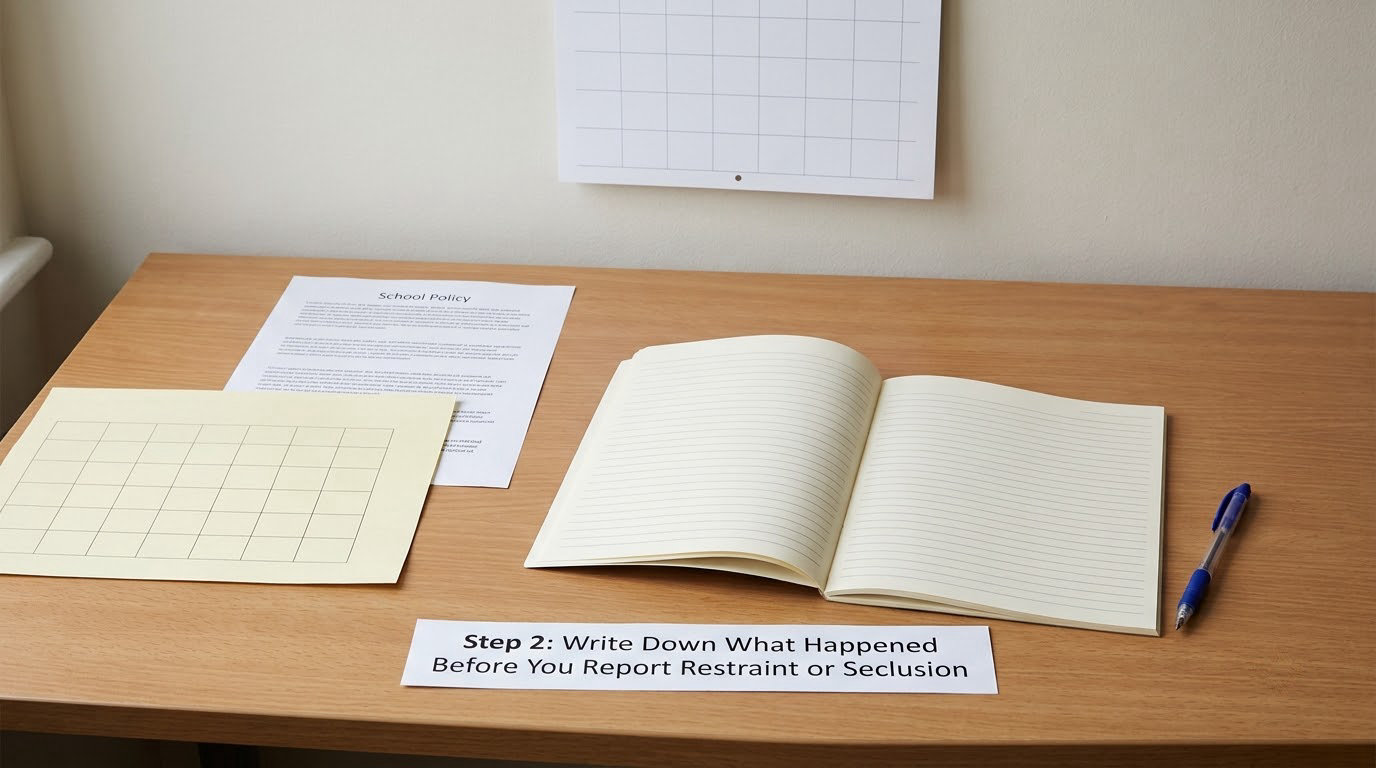
Write the record the same day, while you are still certain about the sequence. Four blocks work well: what you observed directly, what your child told you in their own words, what school staff said, and what remains unknown. Keeping those four blocks separate is what turns a complaint into something a school or agency can actually investigate.
Use the child’s words for their words. “She said she was in the small room and nobody was there” is useful. “They put her in isolation” is a conclusion, and conclusions are harder to act on.
Add a running incident log. Autistic children who are restrained are often restrained more than once, and a single incident reads as an emergency while a pattern reads as a plan that failed. Every parent in every forum thread on this topic eventually says the same thing: I wish I had started writing it down the first time. A spreadsheet with one row per incident, the date, the location, the duration, the staff member, and what happened before it, turns ten isolated events into a case.
Photograph bruising, marks on wrists, and torn clothing, and include something for scale and the date in the frame. If the school has cameras in that area, note the camera location and the approximate time, then request the footage in writing before it is overwritten.
Step 3: Request the School’s Records and Policies
Send one written request and send it in a way that creates a record: email the teacher, case manager, and principal together, and copy the special education administrator. Attach your incident record.
Ask for the incident or event report for that date, any staff statements, the restraint or seclusion data collection form the staff member completed, your child’s behavior log entries for the surrounding weeks, progress notes and daily reports, the school and district restraint and seclusion policies, the staff training records for anyone who was involved, any video you identified, and the plan review that followed.
The district generally has to respond to a records request on a fixed schedule, and a refusal or a partial response is itself something you can complain about. Under federal special education law, a parent is entitled to inspect and review records, and the school cannot charge a fee for the copies. Keep a copy of the request itself, because the deadline for responding runs from the date the school received it.
Sample language you can copy: “I am requesting, under my rights to inspect and review my child’s education records, a copy of the incident report dated [date], the event data collection form, staff statements, the current restraint and seclusion policy, and any video of the area between [time] and [time]. Please let me know by [date] how this request is being processed and when the records will be available.”
Step 4: Contact the Teacher and IEP Team
The fastest route to an actual change is usually internal, and parents report this repeatedly. A request for a functional behavior assessment and a behavior intervention plan review frequently produces a faster and more concrete result than an outside complaint, because it forces the school to explain the plan in a meeting with you in the room.
Send a short written notice that does four things. It identifies the incident by date, time, and location. It states that you are requesting an immediate safety plan for your child pending review. It asks for a meeting with the teacher, case manager, building administrator, and any related service staff who were present. And it names a deadline, because a request without a date tends to drift.
Ask for four things in that meeting. A functional behavior assessment that treats the restraint as data, not as a behavior to be eliminated. A behavior intervention plan review with a de-escalation and self-regulation section, not just consequence language. A statement of what will trigger an emergency response and what the staff will try first, in writing. And a plan for what happens if the staff member does not know what to do, which is the most common failure in practice.
If your child is under a 504 plan rather than an IEP, the same request works, and the Section 504 coordinator handles it. Some students are protected under Title II of the Americans with Disabilities Act without either plan, and those requests go to the district’s ADA coordinator instead.
Step 5: Escalate Through the School or District
If the teacher does not respond within a few school days, move up. The building principal is next, then the district special education administrator, then the superintendent’s office. Many districts also have an ombudsman who handles complaints informally and can often get a faster answer than a formal state filing.
Describe the response as inadequate when it is vague, delayed, or aimed at the child’s behavior instead of the adult’s decision to restrain. A plan that only says the child needs more self-regulation training is not a response. A response names the staff member, reviews the training they have had, describes the alternatives that were tried before the hold, and says what changes.
Two things worth knowing about this stage. First, if the school never notified you at all, that is an independent problem, not just bad luck, because the federal expectation is verbal notice as promptly as possible and no later than the end of the school day, a written report within five business days, and a copy to the parent within two additional business days after that. Second, the school is expected to hold a post-incident staff de-briefing, and for a student with an IEP or 504 plan, a review of the plan after the first incident and again at your request. Ask when that review happened and what it produced.
Step 6: File a Formal Complaint With the Right Agency
There are several formal routes and they do different things. The most important thing is picking the one that matches what you want to happen, because a complaint filed with an agency that cannot act on it wastes months.
| Where to file | What it can do | Deadline to verify |
|---|---|---|
| Your school or district | Can require a plan review, staff retraining, a change of placement, and a corrected incident report | Set locally; ask for the timeline in writing |
| State education agency | State complaint process for special education, including IDEA due process complaints; many states have no restraint-specific complaint route at all | Generally short, often 30 days; state-specific |
| U.S. Department of Education, Office for Civil Rights | Investigates discrimination claims under Section 504 and Title II, such as restraint based on disability or on a pattern that denies equal access | Generally 180 calendar days from the incident; verify current policy |
| Local law enforcement | A police report creates an independent record of injury or suspected assault; the district cannot always control what officers document | Promptly, ideally the same day as the injury |
| Child protective services or your state’s abuse hotline | Investigates suspected abuse or neglect in a setting, including a school, under state law | Promptly; many states require a report when there is reasonable cause |
| Your state’s protection and advocacy agency | Free advice, help filing, and sometimes direct representation for people with disabilities; the fastest way to get plain-language guidance | No deadline; call as early as you like |
| IDEA due process complaint or civil suit | A due process complaint can be filed quickly and cost nothing; a civil suit takes longer and needs an attorney | IDEA generally has a two-year limit from the date the dispute arose; civil claims against a public entity usually require a Notice of Claim with a shorter window |
Two routes deserve specific mention. The Office for Civil Rights complaint is free, does not require a lawyer, and can be filed online, but the 180-day window is the single most-missed deadline in this whole process. If the incident was in January, you do not have until next January. File early and refine the complaint later if you must.
The due process complaint is also free and also does not require an attorney, and it is much less commonly used than it should be. It goes to an independent hearing officer, not to the district, and the usual remedy is compensatory educational services. It cannot award damages, so it is not the route for a physical injury claim. For injury, the route is a civil suit, and public entities usually require a formal Notice of Claim with a short filing window that runs from the date of the injury. Talk to an attorney about that one quickly.
Whatever you file, keep the confirmation. Ask for a case number, a written acknowledgment, and the name of the investigator or intake person. An untracked complaint is indistinguishable from a call that went nowhere.
Step 7: Track the Response and Protect Follow-Up
Keep a simple tracking log: date sent, who you sent it to, date acknowledged, date of any meeting, what was promised, and the deadline for the promise. This is the least glamorous part of the process and the one that decides whether anything changes. A complaint that nobody follows up on is the reason parents describe the whole system as not working.
Be realistic about timing. An internal meeting can move in days. A state complaint can take months. A civil rights investigation can run a year or more, and its most common outcome is a resolution agreement that changes policy rather than a finding against an individual staff member. Set your expectation with that in mind, because a slow process that ends in a changed policy is still a real result.
Know that retaliation is prohibited and know that it happens. Federal law protects parents from retaliation for advocating for their child’s rights, and it also protects the child from being treated differently for having a parent who files. If your child’s schedule changes, staff stop sharing information, or your child suddenly has a new behavior plan, document the change and dates, and raise it in writing as a separate concern. Keeping your own tone factual is the cheapest protection you have, which is why the incident record matters.
Bring in help when the situation is one an advocate can change. If your child is restrained repeatedly, if the school denies a functional behavior assessment, if you cannot get the records, or if you are considering a civil suit, contact your state’s protection and advocacy agency first. It is free, it exists for exactly this, and it can tell you honestly whether your case is strong or thin before you spend money on it.
Common Mistakes Parents Make, and the Fix for Each
Arguing about intent instead of the facts. “The staff member clearly wanted to punish him” is an argument about motive, and motive is the hardest thing to prove. “She held him for 35 minutes and I was not called until 4pm the next day” is a fact, and it stands up. State what happened, not what you think it meant.
Waiting a few weeks to write it down. Details fade, staff recollections get aligned, and video gets overwritten. Write the same day, even a rough version, and add to it later.
Sending only emotional messages. A furious email gets answered with a polite phone call. A dated written request that lists specific records and a specific meeting date gets answered with records and a meeting.
Ignoring the pattern. One incident is treated as an emergency. Six incidents in a term is treated as a plan that failed, and that is the framing that produces a functional behavior assessment. Start the log at the first one, not at the tenth.
Assuming one complaint fixes it. The strongest cases usually combine a records request, an internal meeting, and one external filing. Decide at the start which two you are running and sequence them.
Filing with an agency that cannot help. Several state education agencies have no complaint process specific to restraint and seclusion violations and do not investigate individual complaints at all. Check whether your state has a route before you invest a month in it, and go to the civil rights office, the protection and advocacy agency, or law enforcement instead if it does not.
Losing the family-school relationship entirely. Most families need the school to keep functioning while the complaint moves. Stay factual, keep addressing the child directly, and keep attending what you can. Advocacy does not require a permanent war, and a tone that stays professional is what makes the rest of it survivable.
Frequently Asked Questions
What should I include when reporting restraint or seclusion at school?
Include the date, start and end time, exact location, names of staff and witnesses, what you personally observed, what your child said in their own words, what a staff member told you, and what remains unknown. Attach photos of any injury with dates attached, your child’s IEP or 504 plan, and your running incident log if you have one. Keep observation, reported fact, and open question in separate blocks so the record stays credible.
Who do I contact first if my child was restrained or secluded at school?
Start with the school, in writing. Email the teacher, case manager, and building principal together and copy the special education administrator, then request a meeting within the next few school days along with the incident report and any functional behavior assessment. Internal requests move faster than outside complaints. If the school does not respond, escalate to the district administrator and then to your state education agency, the Office for Civil Rights, or law enforcement if there was injury.
Can I report restraint or seclusion if I was not there to witness it?
Yes. Parents routinely report incidents they learned about from their child, a nurse, a bus driver, or a note home. What you lack in direct observation, you make up for with specifics: when the child told you, what they said, any injury you can see, and whether the school logged the event. Ask the school for the incident report, because their version and your child’s version often differ in duration, trigger, and number of adults present, and that gap is itself worth documenting.
What records can I request after a restraint or seclusion incident?
Ask for the incident or event report, the data collection form the staff member completed, staff statements, your child’s behavior log entries around that date, progress notes and daily reports, the school and district restraint and seclusion policies, training records for the staff involved, any video, and the post-incident plan review. Send the request in writing and keep the date it was sent. A refusal or a partial response is itself something you can complain about.
What should I do if the school refuses to document the incident?
Write to the principal and the district special education administrator stating that no incident report exists, that you are requesting one, and that you expect the written report within the usual five business days plus two more for your copy. Keep your own dated record. If the school still will not document it, note the refusal itself, because a missing report paired with a parent report is a pattern an agency can act on. Your state protection and advocacy agency can tell you how your state treats this.
When should I contact a state education agency or civil rights office?
Contact the state education agency when your school has not responded internally or you need an IDEA due process complaint, which is free and does not require a lawyer. Contact the Office for Civil Rights when you believe your child was restrained because of disability or because of a discriminatory pattern under Section 504 or Title II of the ADA, generally within 180 calendar days of the incident. Call your state’s protection and advocacy agency at any point for free advice, even while you are still deciding.
What to Do First, and What This Article Is Not
Do this today: write the record, send the written request for the incident report and policies, and photograph anything visible. Those three things take an evening and they are what every later step, from an IEP meeting to a civil rights complaint, is built on.
Restraining a child and then sending them back to class with no paperwork is not a rare accident, and it is not automatically illegal, but the rules around it are narrower than most parents expect and the reporting duties are specific. To know exactly where your state stands, check the current version of your state department of education’s restraint and seclusion rules and your district policy, and confirm every deadline for 2026 before you rely on it.
This article is general information for parents, not legal advice, and it cannot account for your state’s law or your child’s plan. If you are considering a civil suit, an IDEA due process complaint, or any injury claim, talk to a lawyer or to your state’s protection and advocacy agency. They are free or low cost, they are set up for exactly this, and they will tell you honestly how strong your facts are.