
How to help a child keep up with classroom pace usually comes down to one thing: finding out where the pace breaks down, then adding one small support at a time. Most children who finish last, lose their place during group work, or come home exhausted are not slow learners or lazy — they are carrying a learning gap, a slower processing speed, perfectionism, or plain old fatigue, and each one needs a different response.
I write from a parent’s side of the desk here, not a classroom, so treat this as practical organization rather than clinical advice. Nothing below replaces a conversation with your child’s teacher or an evaluation by a professional.
Table of Contents
- What You Need
- Step-by-Step: How to Help a Child Keep Up With Classroom Pace
- Start by Understanding What ‘Keeping Up’ Means
- Create a Visual Daily Routine
- Teach One Classroom Skill at a Time
- Build a Communication System With the Teacher
- Use Short Practice Sessions With Breaks
- Protect Sleep, Meals, and Recovery Time
- Review Progress Every Two Weeks
- Common Mistakes
- Frequently Asked Questions
- How can I tell whether my child is struggling with classroom pace or simply working more slowly?
- What should I do if my child can follow a lesson but needs extra time to finish the work?
- Can visual schedules and timers help a child keep up with classroom pace?
- How often should I communicate with my child’s teacher about classroom work?
- Should I help my child with homework if the assignments are not completed in class?
- When should I ask for an IEP review or additional learning support?
- Conclusion
What You Need
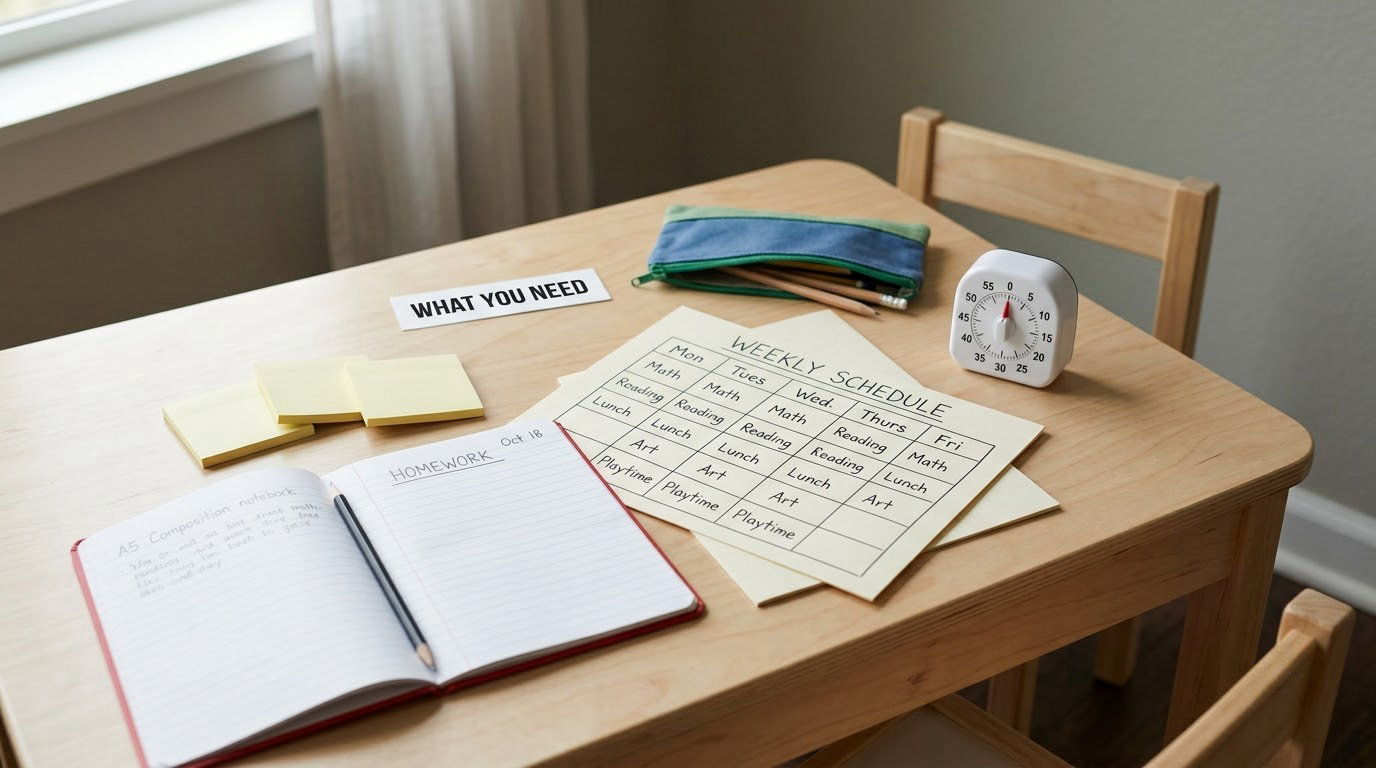
Gather what you have before you change anything. Trying new routines without knowing what the classroom day actually looks like is guesswork, and it wastes a hard week.
- The current classroom schedule. Period times, subject order, and how long independent work blocks run.
- Direct contact for the teacher plus, if your child has one, the specialist teacher or aide who works with them most often.
- A short list of the hard moments — not subjects, but moments. Starting a task. Finishing a worksheet. Transitions. Copying from the board.
- Any IEP, 504 plan, or learning support documents, including the current goals and any accommodations already in place.
- A homework organizer — a folder, a wall calendar, or a single notebook page that lives in one place.
- A way to track progress that does not add stress. A calendar with dates and two or three words per entry is enough.
That last item matters more than it sounds. A record lets you tell a real change apart from a bad Tuesday.
Step-by-Step: How to Help a Child Keep Up With Classroom Pace
Start by Understanding What ‘Keeping Up’ Means
Keeping up is not one skill. It is a chain: hearing the direction, holding it in working memory, deciding what to do first, writing or answering, and finishing before the group moves on. Break anywhere in that chain and everything after it gets harder.
So before adding supports, name the exact link that breaks. Some children follow the lesson comfortably and run out of time on the written part. Some understand everything and cannot start without the task chunked into steps. Some keep pace in short tasks and fall apart in long ones. Some are fine academically and exhausted by the third transition of the morning.
Watch for the difference between a rough week and a pattern. One bad week is noise. The same difficulty across three or four subjects, or across several weeks, is a pattern worth acting on.
Create a Visual Daily Routine
Turn the school day into short, predictable steps. A visual schedule, a written checklist, or a timer on the desk gives your child something to check against instead of remembering everything internally.
Keep it to what actually happens. Pack bag, shoes, coat, travel, snack, homework folder, fifteen minutes of reading, bed. Six to eight lines is plenty. Photographs of the actual items work better than drawings for many children, and for autistic children a written list may be clearer still.
Practice it at home before the school year starts, when expectations are low. Walk through the steps once a day for a week, then step back. If the routine only works when you stand over your child, it is not a routine yet.
Teach One Classroom Skill at a Time
Pick a single skill and break it into steps your child can finish. For packing materials, that might be: open the bag, put the folder in, put the water bottle in, zip it, put it by the door. Five concrete actions beat one instruction every time.
Model the first action out loud, then let your child do it while you talk through the rest. Practice the same sequence until it is automatic, then add the next skill. Clear success criteria help too: finish before the timer rings, hand it to me, three questions answered.
Once the skill holds at home, practice the classroom version of it — the desk setup, the way directions are given, the transition signal. That is scaffolding: supported steps your child can eventually do alone.
Build a Communication System With the Teacher
One short weekly check-in beats a panicked email after a bad report card. Share one specific observation, confirm what is already working, and agree one next step.
Try something like this: “This week at home, getting started on homework took about twenty minutes with the checklist. What does starting look like in your room? Could you try telling them the first step only, and see if that helps?”
Track patterns rather than impressions. Was work unfinished, or was work started and abandoned? Did the difficulty show up during transitions, group work, or timed tasks? Those answers point to different fixes, and your teacher sees the school day in a way you cannot.
Ask what is already in place too — a seating spot near the front, reduced copying, extra time — so you are not asking twice for the same thing.
Use Short Practice Sessions With Breaks
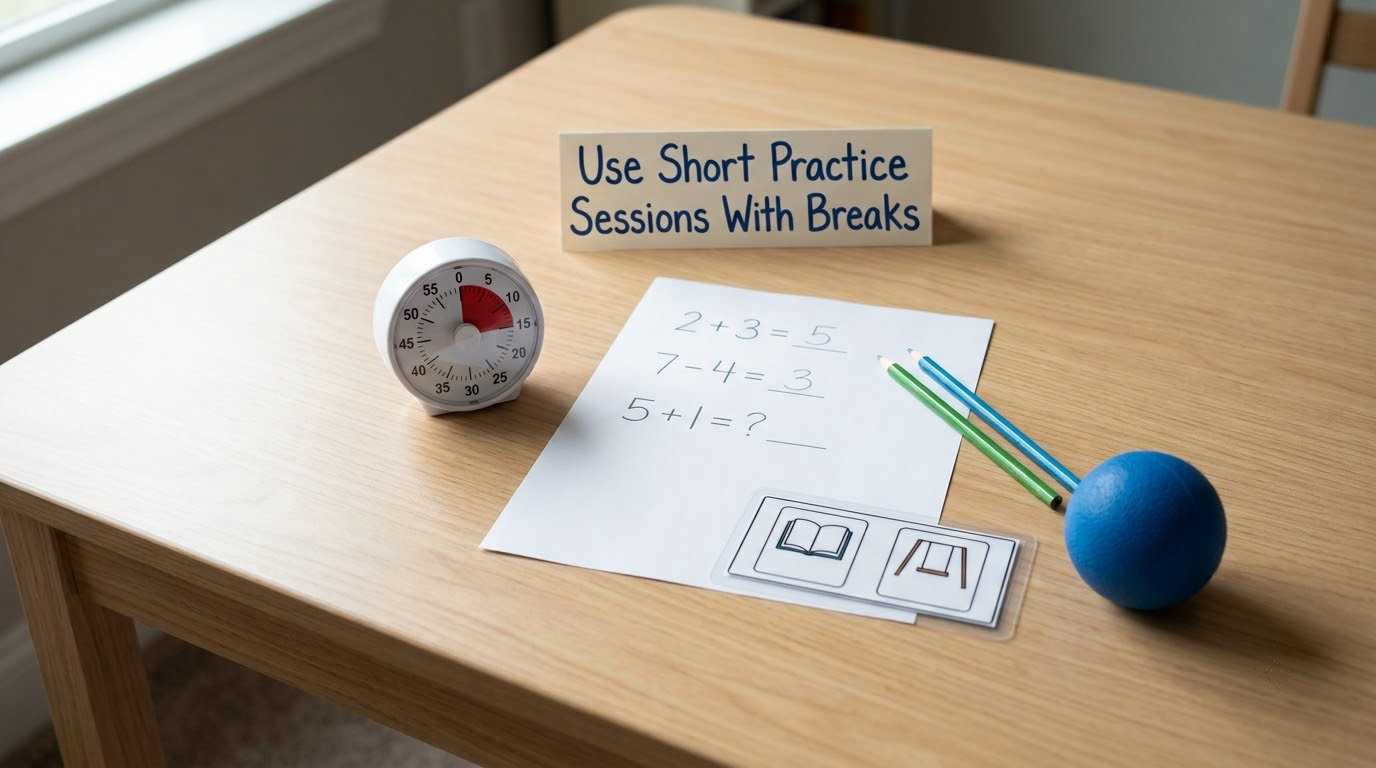
Short and low-pressure beats long and ambitious. Ten focused minutes with a real break is more useful than forty minutes of drift, and for many children it is the only format that produces finished work at all.
Start smaller than feels necessary — five minutes for a first-grade reader, two problems of math for a child who shuts down over a full page. End while your child is still succeeding, not after the frustration peaks.
Watch for the fatigue signs: more errors on the same type of question, drifting attention, repetition of the same instruction, a shift into escape behavior like doodling or refusal. Those mean the session is over. Movement breaks help too, especially for children who hold tension while they concentrate.
One caution worth repeating: timers work for some children and raise anxiety for others. If your child watches the clock instead of the work, drop the timer and use a checklist with a fixed number of steps instead.
Protect Sleep, Meals, and Recovery Time
Classroom readiness starts the night before. Regular sleep, a real breakfast, water through the day, and enough movement all affect how much of a lesson a child can actually take in.
Recovery time counts too. Many children who spend the school day working hard to keep up come home empty and cannot begin homework until they have decompressed. Fifteen quiet minutes before homework is often more productive than an immediate start.
If your child has allergies, sensory needs, or a medical condition affecting sleep or energy, talk to their pediatrician or your child’s care team. This article can only give general guidance on health matters.
Review Progress Every Two Weeks
Sit down twice a month with three things: what work came home finished, what the teacher wrote down, and how your child seemed about school. Then keep, change, or add exactly one support.
Adding five supports at once is the most common reason families give up. You cannot tell which one helped, and the child feels like everything about them is being corrected at once.
Judge progress on completion and calm, not on speed. A child who finishes most of the work and still enjoys school is doing better than one who finishes everything and no longer wants to go.
Common Mistakes
Comparing your child with classmates. The child who is a grade level ahead in reading may still be the last one to pack up, and that gap will not close by comparison. Compare your child with their own record from two weeks ago.
Adding every support at once. A visual schedule, a timer, a reward chart, and reduced homework all at the same time will feel like four new rules. One change, two weeks, then reassess.
Practicing when your child is already at their limit. Homework at the end of a hard school day is the worst possible moment to introduce a new skill. Practice earlier in the evening, or on a lighter day.
Focusing only on speed. Moving faster is not always the goal. A child who rushes through work and gets it wrong has not kept up, they have covered ground. Insist on finished, correct work instead.
Treating a support-plan concern as an effort problem. When a child has an IEP or a 504 plan, the plan exists because the difficulty was measured. Ask about the data before assuming motivation is the missing piece.
Two things worth remembering as you work through this: validating your child’s experience before offering a tactic usually gets more cooperation than the tactic itself, and honest timelines build more trust than quick fixes. Most children see progress over weeks and months, not days.
Frequently Asked Questions
How can I tell whether my child is struggling with classroom pace or simply working more slowly?
Look at the shape of the difficulty, not just its existence. A slow-but-fine child finishes tasks, asks for clarification, and needs more minutes. A child who is struggling often loses the first instruction, cannot start, abandons work partway, or shuts down when the pace picks up. Track which subjects and which moments are hard for two weeks. If the pattern spans several areas or weeks, bring that record to the teacher rather than guessing.
What should I do if my child can follow a lesson but needs extra time to finish the work?
Ask the teacher about reduced copying, a reduced number of items, or time during a later, quieter period for unfinished work. At home, set a realistic amount rather than the whole page, and let the rest stay unfinished on purpose. A written checklist of three to five steps often works better than an open-ended instruction to finish the worksheet.
Can visual schedules and timers help a child keep up with classroom pace?
Visual schedules often do, because they move the load of remembering out of the child’s head and onto a page. Timers are more mixed. Some children use them well; others watch the clock instead of the work and get more anxious as time runs out. Try a timer for one short task and compare. If your child stalls with one, switch to a fixed number of steps and no clock.
How often should I communicate with my child’s teacher about classroom work?
Weekly is the sweet spot for most families: short, specific, and not alarming. Share one observation, confirm something that is working, and agree one next step. After a bad report or a sudden change, increase contact for a couple of weeks. Consistency also means the teacher hears your child’s name in a positive context most weeks, not only when there is a problem.
Should I help my child with homework if the assignments are not completed in class?
Work on the unfinished portion together, but treat it as practice rather than a debt to repay. Sit nearby, break the task into steps, and stop when the work stops being productive. Long homework blocks after a hard day cut into sleep and rarely teach much. If the same work is coming home unfinished most nights, raise pace and workload with the teacher instead of adding hours at home.
When should I ask for an IEP review or additional learning support?
Ask when difficulty is consistent across weeks, appears in more than one setting, or is limiting what your child can access. Bring your notes and your teacher’s observations to the school. Evaluations are provided at no cost to families in US public schools. You can also ask for informal classroom adjustments at any time; a formal plan is not the only way to get extra time or a better seat.
Conclusion
Start small and specific. Pick the one moment where the pace visibly breaks, ask your child’s teacher what that moment looks like from her side of the room, and choose one support to test for two weeks.
How to help a child keep up with classroom pace is not a single fix. It is a short routine, an honest conversation with the teacher, and patience for progress that shows up over months rather than days.