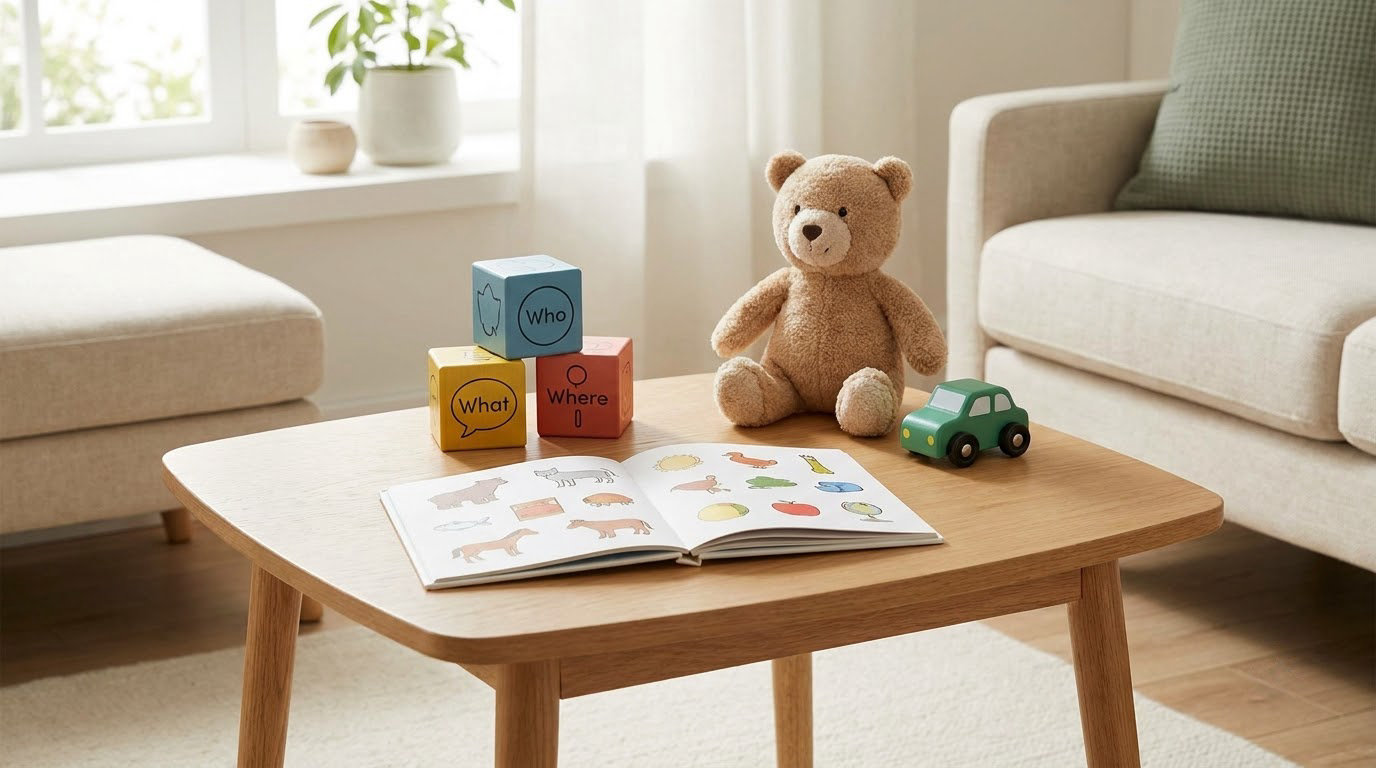
Wh questions are the questions built on who, what, where, when, why, and how, and each one asks for a different kind of answer. Most children learn to answer them by hearing the same handful of questions over and over in real moments, not by finishing worksheets. If you are wondering how to teach a child to answer wh questions, the whole method comes down to one move: match the question to the type of answer it needs, then slowly take your support away.
Most of this takes three to five minutes a day. You can start in the kitchen tonight.
Table of Contents
- What You Need
- Step-by-Step: How to Teach a Child to Answer Wh Questions
- Step 1: Choose One Wh Question to Teach First
- Step 2: Teach Each Wh Word With a Clear Example
- Step 3: Practice Matching the Question to the Answer
- Step 4: Ask the Child One Simple Question
- Step 5: Expand One-Word and Gesture Answers
- Step 6: Gradually Remove Prompts and Support
- Step 7: Practice Wh Questions Across Everyday Routines
- Common Mistakes
- When to ask a speech-language pathologist
- Frequently Asked Questions
- At what age should a child start answering wh questions?
- Can a child who is nonverbal learn to answer wh questions?
- How should I teach wh questions to a child with autism?
- Why can my child answer what questions but not where or why questions?
- How long does it take a child to learn to answer wh questions?
What You Need
Almost nothing. Sit down for a full set of flashcards and a printed game, and you will end up with a child who answers a question only when the exact materials are in front of them.
Gather four or five things your child already names without trouble — a ball, a cup, a shoe, a spoon, a family photo. Concrete objects beat drawings for this work, and photos of real people and real places beat clipart for the same reason.
Then set up one consistent response format so that answering is never limited to speech. Pointing to the object, handing you the card, or showing you with a sign all count as real answers. If your child is nonverbal or uses AAC, this format is not a bridge to talking. It is the answer.
- Objects: three to five familiar items, plus one interesting but familiar one.
- Cards: picture cards or photos of the people and places in your child’s life.
- A response format: point, hand over, or use the device or chart you already use.
- A fixed spot: the same five minutes in the same routine, so the child knows what is coming.
- A tiny record: a note on your phone of what you asked and what came back.
Step-by-Step: How to Teach a Child to Answer Wh Questions
Step 1: Choose One Wh Question to Teach First
Start with what. It is concrete, the answer is usually in front of you, and it establishes a question-and-answer pattern the child can hear as a pattern. Who is the good second move, because the answer is still visible and easy to point at.
Save why and when for last. Both are abstract, and pushing them early is the single most common thing that stalls a child who is otherwise making progress.
How to teach a child to answer wh questions is partly a question of matching the question to the age, so here is a rough guide. The CDC milestone checklists and the ASHA speech and language milestones are good places to check your own child against typical ranges rather than against a blog post.
| Age band | Question words to introduce | What a good answer sounds like |
|---|---|---|
| 12 to 18 months | What, who | A word, a point, or an object handed to you |
| 18 to 24 months | What, who, where | One word, sometimes two, occasionally a short phrase |
| 2 to 3 years | Where, when (with a routine attached), why with a concrete reason | A short answer, often still one word, sometimes “in the kitchen” |
| 3 years and up | All six, including how | Sentences of two to five words, and follow-up questions |
These are guideposts, not deadlines. A child with a diagnosed language delay will sit further left on this chart, and that is fine.
Step 2: Teach Each Wh Word With a Clear Example
Children do not learn the word “where” from a definition. They learn it from hearing where a thing is, every time, and pairing the question with the answer that fits it. Hold up the ball and say “Where is the ball? In the basket.” Hand over the cup and say “What is this? A cup.”
Say the question, then say the answer yourself, in the same breath. That models the pairing you want. If you only ask, you are testing your child instead of teaching them.
It also helps to color-code the question words on whatever cards you use. Speech-language pathologists describe the same idea: use real photos rather than clipart, and give the child a built-in visual answer choice so answering is never dependent on recall alone.
| Wh word | Answer type it needs | Common wrong answer | What to model instead |
|---|---|---|---|
| Who | A person or a group | “Aunt Jo” | “Who is that? That is Aunt Jo. The girl with the red hat.” |
| What | A thing or an action | “Red” or “Round” | “What is that? That is a ball. It is a big ball.” |
| Where | A place | “Cooking” | “Where is Mommy? Mommy is in the kitchen.” |
| When | A time or a routine step | “Soon” | “When do we eat? We eat after bath time. Dinner is next.” |
| Why | A reason | “No” | “Why are we going? We are going to the park. Because it is sunny.” |
| How | A method or a tool | “Fast” | “How did you open it? You used the lid. You turned it.” |
The third column is the one to read twice. A child who answers “where is Mommy?” with “cooking” has understood the whole question and still needs the pairing corrected, and that is a very different situation from a child who walks away.
Step 3: Practice Matching the Question to the Answer
Lay out three cards face up: a person, a place, a thing. Point to each one and name it, then ask one question and let your child match. Say “Who is this?” and wait. If they slide the picture of grandma across, that is a correct answer and you say so out loud: “Yes, that is who. That is grandma.”
Keep this part short and dull. Two minutes is plenty, and the point is to make the answer feel predictable rather than exciting.
Step 4: Ask the Child One Simple Question
One question at a time, in a real moment, with nothing else happening. Do not ask a wh question while you are also handing over a shirt and pointing at the door.
Then wait. Five seconds feels unbearably long the first few times. Five to ten seconds is what most therapists advise before you add anything, and rushing that gap is the reason so many bright children stop trying.
If nothing comes, answer it yourself and move on. “Where are your shoes? Here they are. Put them on.” No pressure, no second attempt, no raised eyebrows. You are teaching, not testing.
Step 5: Expand One-Word and Gesture Answers
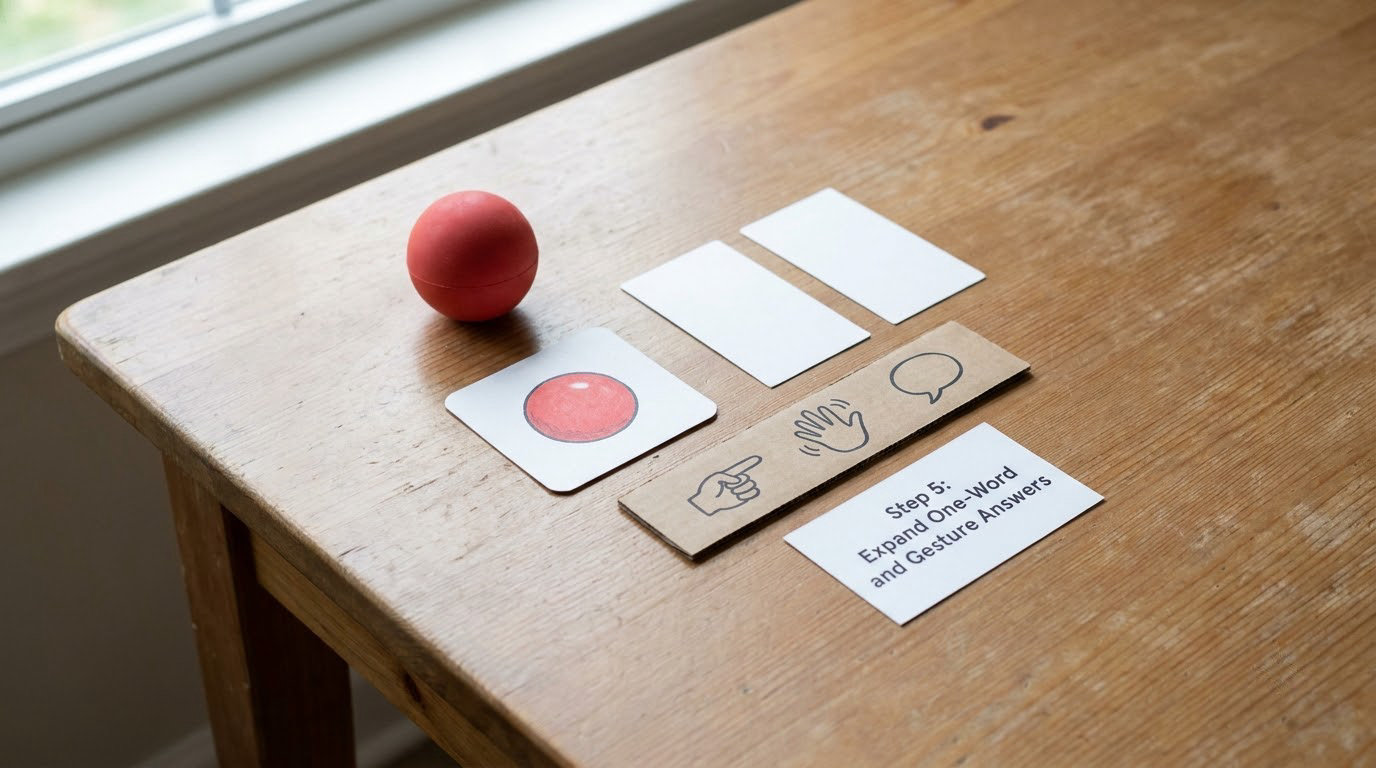
Accept the smallest correct answer first. A point at the ball, a handed-over card, or a single word “ball” is a real answer and you treat it like one. Expanding from there is easier than you think, because the concept is already there and only the packaging needs work.
Then add two words, then a frame. Take what they said and stretch it:
- Point at the ball and say “Ball. The ball is rolling.”
- Child says “ball” — you say “A ball. What color is the ball?”
- Use a sentence starter they can hear: “It is in the…”
Do not correct the expansion, only model it. If you stop to fix grammar, the answer you were after gets buried.
Step 6: Gradually Remove Prompts and Support
Support comes off in a fixed order, and rushing this is why progress stalls. Start by modeling question and answer together, then offer a choice of two, then a sentence starter, then point to the visual, then wait in silence. The child should be doing less work than you at every stage.
Move to the next rung only after the current one feels boring. If two choices still land most of the time, the choice is doing the answering, not the child — so keep it there a few more days rather than blaming them.
One caution: fading should never turn into disappearing. A child who has gone quiet for a week is not being independent, they have lost the thread. Put one rung back and stay there.
Step 7: Practice Wh Questions Across Everyday Routines
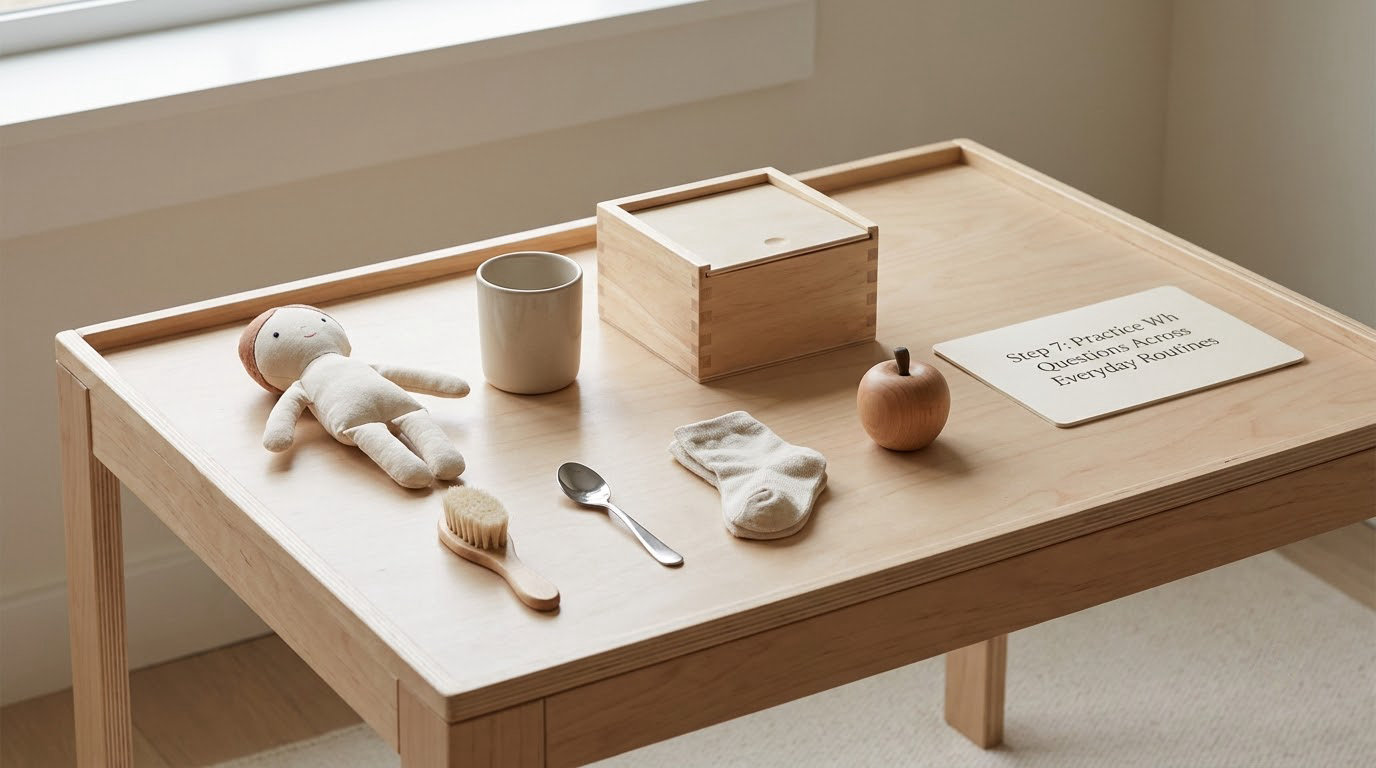
Progress that happens only at the table does not travel. The change parents describe comes from slipping questions into routines that were already happening.
- Mealtime: “What do you want on your toast? What is in your cup?”
- Getting dressed: “Where are your socks? Who put your coat on the hook?”
- Bath time: “What did we wash first? Where is the towel?”
- Play: “Where did the bear go? What is under the box?”
- Car rides: “What do you see? What color is that truck?”
Keep a note of one win a week. A single unprompted “where is my cup?” on a Tuesday is more informative than a whole bad session, and it is easy to forget a good moment by bedtime.
Once answering is steady in play and meals, turn it around and teach the child to ask. Give them a want, then withhold the object and wait. Most children catch on to this within a few weeks, and asking is what carries into a classroom.
Common Mistakes
Every one of these looks like diligence and stalls progress just the same.
| Mistake | Why it backfires | What to do instead |
|---|---|---|
| Teaching all six question words at once | The child hears one long undifferentiated stream of questions and no pairing | One question word for two weeks, then add the next |
| Starting with why and when | Both are abstract, and a wrong answer looks like disobedience when it is really a developmental stage | Anchor why and when to something happening right now: “Why are we putting on coats? Because it is cold” |
| Repeating or rewording the question too fast | It cuts off the processing time the child needed | Ask once, then stay quiet for five to ten seconds |
| Insisting on a spoken answer | It removes the only channel the child actually has | Count pointing, signing, and handing over as correct answers |
| Accepting a close enough answer | “Cooking” for a where question feels like progress and is not | Model the right category, then accept the same word back from them |
| Practicing until it feels like a test | Correct guesses stop and blanking out starts | Three questions a day, then a change of activity |
Two habits carry most of the work. Model the answer yourself, every time, without being asked. And treat a wrong-category answer as a mismatch to model rather than a mistake to correct — say “Where is Mommy? In the kitchen” and let them hand you the next one.
If your child repeats your question back instead of answering, that is a stage, not defiance. Answer your own question, keep the tone flat, and wait. Clinicians usually call this a question-answer form mismatch, and it moves on as the pairing gets more practice.
When to ask a speech-language pathologist
Home practice is worth a lot, but not on its own. Ask for an evaluation through your pediatrician if, by around 18 months, your child has no clear words at all, or by age two is not putting any two-word combinations together. The CDC milestone checklists are a reasonable starting point for your own read on where your child sits.
Also worth raising: any loss of skills your child had, no response to their name by around a year, or a child who understands far more than they can say. Getting an evaluation early is not a verdict. It is the fastest way to find out whether what you are seeing is a gap, a difference, or a wait-and-see situation — and a speech-language pathologist can tell you which.
Frequently Asked Questions
At what age should a child start answering wh questions?
Most children begin combining a wh question with an answer somewhere between 18 and 24 months, starting with what and who and a single word or gesture as the reply. By age three, short answers to where questions are typical. These are guideposts drawn from CDC and ASHA milestone ranges, not deadlines, and a child with a language delay will sit further back on the chart without anything being wrong.
Can a child who is nonverbal learn to answer wh questions?
Yes. The question-and-answer pairing is about comprehension, not speech output, so a nonverbal child can show you the right answer by pointing, handing over a card, using a sign, or selecting on an AAC device. Treat any of those as a correct answer and say it out loud. What you are building first is the association between the question word and the type of answer it wants.
How should I teach wh questions to a child with autism?
Reduce the language load. One question at a time, in a real scene, with a visual support the child can point to or hand back. Say the question, then model the answer, then wait five to ten seconds. Keep supports visible and fade them slowly. Consistency matters more here than anywhere: if grandparents and other caregivers ask differently, practice loses much of its effect.
Why can my child answer what questions but not where or why questions?
Because what asks for a thing you can hold up and where asks for a place, which is harder to represent with a single word, and why asks for a cause, which is abstract. A child who says milk for what is that is showing a question-answer pattern, and the harder question words build on that pattern once it is solid. Keep working on what and who while you introduce where slowly.
How long does it take a child to learn to answer wh questions?
Expect uneven progress over months rather than a clean finish line. A child may answer where is your cup with in the kitchen for several weeks before adding anything else, and that plateau is normal rather than stalled. Consistent five-minute practice in real routines tends to move faster than longer sessions, and the useful measure is whether an unprompted answer is starting to show up on its own.
Start tonight, with one real object and one question. Hold up the cup, ask “What is this?”, model “cup,” wait, and let the first answer be a point, a word, or nothing at all. Do the same thing tomorrow in a different room, and keep the pattern steady for a couple of weeks before adding a new question word. That is the whole method, and it works on a bad day as well as a good one.