
To support a child with Down syndrome in school, you build a daily routine around how your child actually learns, then put the supports in writing so every adult follows the same plan. Most children with Down syndrome learn well from visual schedules, concrete materials, short instructions with extra wait time, and sight words taught alongside phonics. The gap is rarely ability. It is usually an adult who has not been told what works.
Parents on r/downsyndrome and r/specialed describe the same frustration repeatedly: the IEP exists on paper, and the classroom does not match it. Teachers on r/Teachers and r/kindergarten say the thing that changes behavior fastest is not a behavior plan. It is pre-teaching a transition and waiting ten seconds before repeating an instruction.
This guide is for parents, caregivers, and guardians of a child with Down syndrome from preschool through high school. Teachers and paraprofessionals can read it too. If you are outside the US, the school-planning terms differ, but the classroom strategies do not.
Table of Contents
- What You Need
- Specific examples of what your child can and cannot do yet
- Your child’s current plan and its date
- Anything medical that shows up at school
- Home routines that already work
- A communication method you can actually keep up
- Step-by-Step: How to Support a Child With Down Syndrome in School
- 1. Learn your child’s strengths and support needs before school starts
- 2. Build a relationship with the teacher first
- 3. Use the IEP or educational plan
- How the IEP and the 504 plan differ
- Matching a learning challenge to the right accommodation
- 4. Support learning with clear routines
- 5. Encourage communication and self-advocacy
- 6. Help the child build friendships
- 7. Support independence without taking over
- 8. Track progress and ask for adjustments
- Common Mistakes
- Comparing your child to classmates
- Speaking for your child
- Accepting vague feedback
- Practicing only at home
- Assuming one strategy works every day
- Letting homework run the evening
- Frequently Asked Questions
- Does my child with Down syndrome need an IEP or a 504 plan?
- What are the most effective classroom accommodations for a child with Down syndrome?
- How do I talk to my child’s teacher about Down syndrome?
- How do I help my child with Down syndrome make friends at school?
- How much homework should a child with Down syndrome get?
- What should I do if my child seems overwhelmed at school?
- Start With One Thing This Week
What You Need
Gather these before you meet with the school. It takes an evening, and it turns a vague conversation into a specific one.
Specific examples of what your child can and cannot do yet
Write three to five concrete examples rather than a list of difficulties. “She can match her shoes and get dressed with a picture prompt, but she cannot choose clothes independently” gives a teacher something to work with in seconds. Vague notes make parents look like they are complaining.
Your child’s current plan and its date
Bring the IEP or 504 plan, plus the date of the most recent review. Know how many minutes of speech and occupational therapy are written in, because services are the first thing cut when a schedule gets tight.
Anything medical that shows up at school
Conductive hearing loss, sleep problems, hypotonia, and attention differences are common alongside Down syndrome and all of them affect school performance. A note saying “seated away from the radiator” or “needs a quiet space when overloaded” is a legitimate classroom accommodation, not an extra.
Home routines that already work
Your morning sequence probably works better than anything the school could design. Write it out in order and share it. Paraprofessionals report that a one-page routine card they can see at the desk is the single biggest win in a classroom.
A communication method you can actually keep up
A daily message app, a shared notebook, or a weekly email. Pick the one you will maintain, because a dead channel is worse than no channel. A parent-teacher meeting twice a year cannot catch what changed in March.
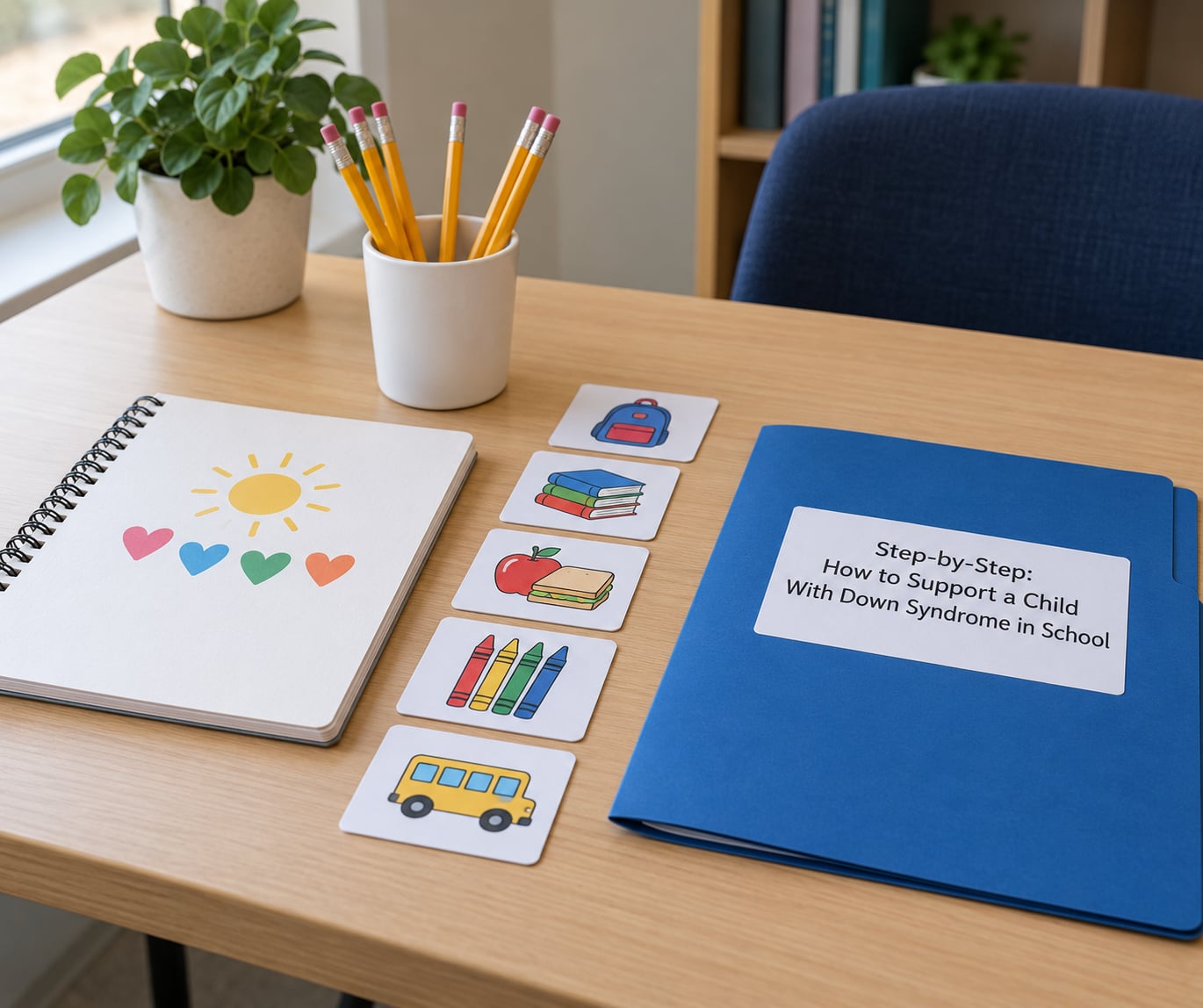
Step-by-Step: How to Support a Child With Down Syndrome in School
1. Learn your child’s strengths and support needs before school starts
Down syndrome is a learning profile, not a single level. Most children share a cluster: strong visual memory, social motivation, and imitation on one side, and slower auditory processing, shorter working memory, expressive language delays, and low muscle tone on the other. Individual variation inside that cluster is wide, so treat any description as a starting point rather than a verdict.
Sit down for a week and note what your child asks for, what they avoid, and what they can do with one prompt versus five. This is the raw material for everything that follows.
2. Build a relationship with the teacher first
Ask for a specific communication method on day one rather than hoping for the best. Teachers who get a short, useful update and who feel heard will do more for your child than a perfect plan handed over cold.
Send short notes. When something worked, say exactly what you did. When something did not, describe the moment rather than the child: “the transition to PE caused distress on Tuesday” lands better than “he was difficult about PE.” You are building a working relationship, not winning an argument.
3. Use the IEP or educational plan
Read your child’s plan looking for five things: present levels of performance, measurable annual goals, the accommodations listed in the daily schedule, the related services with minutes and frequency, and the review date. If a goal or a service is unclear, ask before the meeting ends rather than after.
Plans that live only in a binder are common. Parents on r/specialed often report that services get cancelled repeatedly during staff shortages, and that documenting each cancellation in writing is what eventually forces a conversation about makeup minutes.
How the IEP and the 504 plan differ
Both put accommodations in writing. Only one of them can promise services, and that difference decides which one most families need.
| Feature | IEP | 504 plan |
|---|---|---|
| Who needs one | Any child receiving special education services under IDEA | Any child needing accommodations but no special education services |
| Legal basis | IDEA, a federal law | Section 504, a federal civil rights law |
| Contains | Present levels, measurable annual goals, services, accommodations, progress reporting | Accommodations only |
| Related services | Yes, with minutes and frequency, such as speech and occupational therapy | No |
| Review cycle | At least once a year, and any time you request | Typically every one to three years |
| Progress measured against goals | Yes | No goals, so no written progress data |
If your child receives any pull-out service, or if you want measured progress data to hold the school to, you need an IEP. A 504 with no services is a floor, not a ceiling. Ask for an evaluation in writing, and ask which plan your child qualifies for in that same letter.
Matching a learning challenge to the right accommodation
Most supports fail because they are attached to a diagnosis rather than to a specific difficulty. Work down this list and request only the rows that match your child.
| Learning challenge | Accommodation that compensates |
|---|---|
| Shorter working memory, forgets instructions | One instruction at a time, visual timetable, now-and-next board, task checklist |
| Slower auditory processing | Extra wait time before repeating, written instructions alongside spoken ones, seat near the teacher |
| Difficulty with phonological processing | Sight word instruction taught alongside phonics, singing and music-based activities |
| Weak expressive language | Aided language or AAC available all day, one functional phrase taught at a time, real choices offered |
| Low muscle tone and difficult fine motor | Reduced copying and handwriting, alternatives such as typing, photos, or verbal answers |
| Cognitive fatigue by the end of the day | Shortened homework, tasks in shorter blocks, a lighter schedule on hard days |
| Sensory overload from noise and crowding | Seat away from the radiator and door, a quiet withdrawal space, advance warning of fire drills |
| Conductive hearing loss | Seat on the better-hearing side, reduced background noise, speaker at the front |
| Slow generalization to new settings | Same strategy used identically at home and school, re-taught each September |
Pick three rows, put them on one page, and hand it over. A one-page card at the desk beats a twelve-page plan in a binder whenever an adult has to remember it.
4. Support learning with clear routines
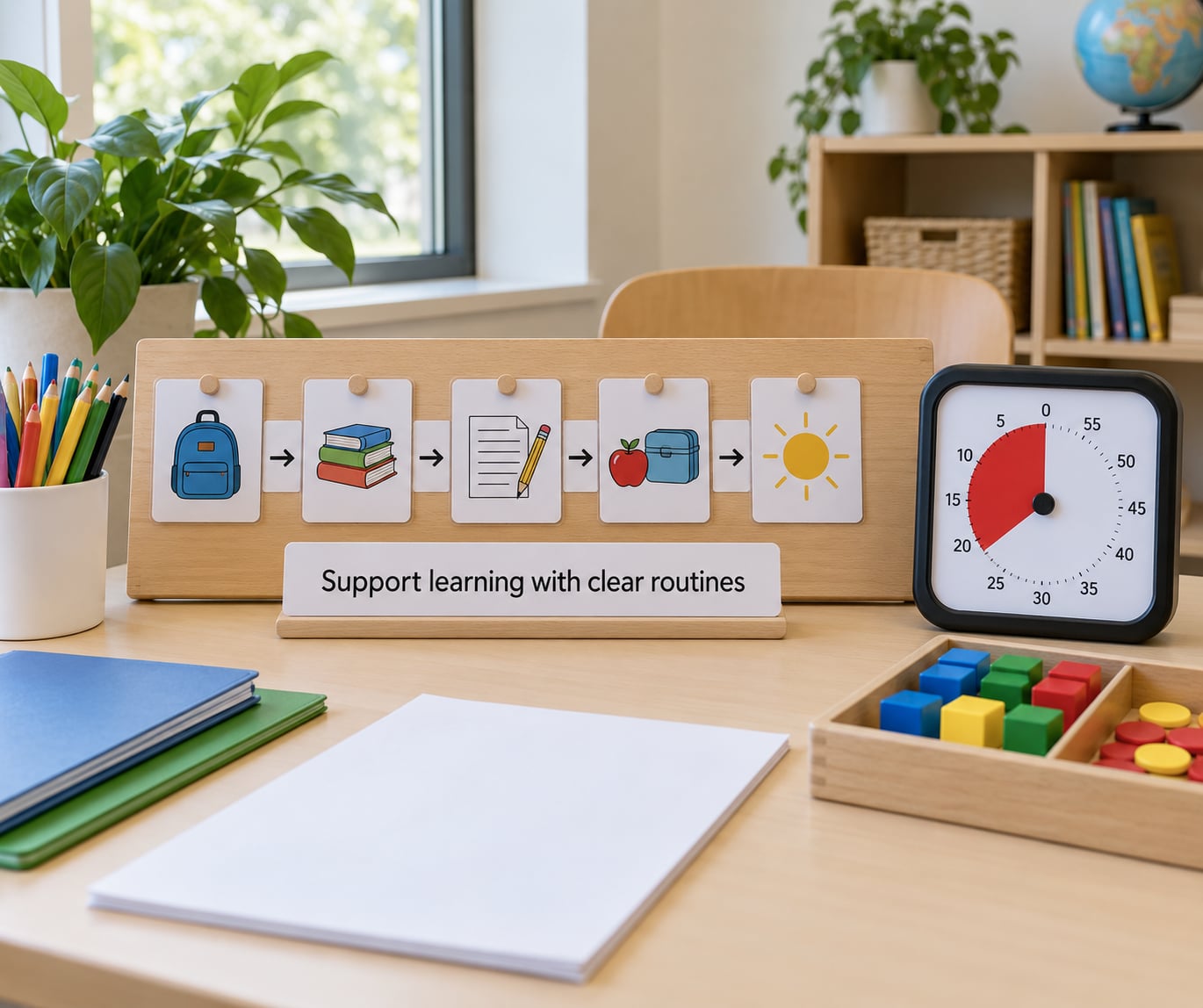
A visual timetable on the wall, a now-and-next board, a first-then board, and a task checklist with one line per step are the backbone of a predictable day. They work because they answer the question a child with reduced working memory cannot hold in their head: what happens after this?
Give one instruction at a time, then wait. Teachers on r/Teachers and r/kindergarten consistently point to processing delay as the most misread behavior in their classrooms. Ten honest seconds of silence is not a child refusing. It is a child searching for the answer.
Preview changes, keep practice periods short, and use concrete objects before pictures and pictures before words. For reading, pair a sight word program with phonics rather than choosing between them; parents report a visible jump in confidence once sight words are taught alongside. Our guide to teaching reading to a child with Down syndrome goes into the routine in more detail.
5. Encourage communication and self-advocacy
Respond to every attempt at communication, including gestures, sign, and sounds. A quiet child is often a child whose messages have been ignored, not a child with nothing to say. Classroom support staff note that children with Down syndrome are frequently sociable and eager to please, so a refusal usually means a demand went past their words.
Teach one functional phrase at a time and use it everywhere: “help me,” “I need a break,” “not yet.” Give real choices at snack time and in the line-up, because a child who is asked nothing learns that decisions are not theirs to make. Parents on r/specialed also flag that aides change weekly in many districts, so keep a written list of your child’s words and phrases in the classroom that anyone can use.
6. Help the child build friendships
Friendships in a mixed classroom usually grow around something repeated: the same reading group, the same recess game, the same job. Arrange structured peer activities and let the child copy the behavior of a classmate rather than scripting conversation for them. Parents emphasise how much more alike than different these friendships turn out to be.
On teasing, decide your school’s plan before it happens and write it down. What gets said, who handles it, and whether it is logged. Handle low expectations the same way: correct them in the moment, because a child absorbs a teacher’s ceiling faster than anyone.
7. Support independence without taking over
Break tasks into one visible step, wait for the response, and offer fewer prompts each time. Finishing something slowly beats finishing it correctly for you, every time, and the gap between those two things is the whole point.
Letting a struggle is uncomfortable. Give the child time, then offer one specific prompt rather than taking over: “the zipper” instead of doing it. Praise the effort and the retry, not only the finished work, because what you name is what your child will try again tomorrow.
8. Track progress and ask for adjustments
Keep a short monthly note: one example of progress, one barrier that keeps recurring, one strategy that worked, and one change you are asking for. Photos of work, a video of a successful transition, or a tally of independent steps give you something concrete in a meeting.
Reviewers of support plans frequently note the same gap: nobody checks whether the plan is actually being implemented. If something is written but not happening, that is an implementation conversation, and it is easier to have with evidence than with frustration. For day-to-day pace issues, see how to help a child keep up with classroom pace.
Common Mistakes
Comparing your child to classmates
Comparing by age is the fastest route to despair for both of you. Compare your child to your child from six weeks ago, and compare goals to your child’s own plan.
Speaking for your child
Answering for your child protects them from a struggle and teaches them that other people’s voices carry more weight. Wait through the pause. Let the imperfect attempt stand.
Accepting vague feedback
“He did fine” tells you nothing. Ask what he did, what he needed, and what would help next time. It takes one extra question and it changes the quality of every future conversation.
Practicing only at home
Skills taught only at home do not generalize. Children with Down syndrome retain what is well anchored, but they need re-teaching in each new setting, so the strategy has to be in the classroom, not just in your kitchen.
Assuming one strategy works every day
Auditory overload, poor sleep, and a hard morning all change what works. The same visual schedule that settles Tuesday can feel like clutter on a bad day. Check in and adjust rather than declaring a method a failure.
Letting homework run the evening
By the end of a school day, most of these children are cognitively fatigued, and writing tasks are the hardest kind. Agree at the meeting on what homework actually looks like, and keep it short. If evenings are collapsing, our piece on homework meltdowns covers what to change and what to ask the school for.
Frequently Asked Questions
Does my child with Down syndrome need an IEP or a 504 plan?
Most do, and the difference is what the plan can legally guarantee. A 504 plan lists accommodations only, such as extra time, a seat near the teacher, or reduced copying. An IEP is required for any child receiving special education services and includes measurable annual goals, related services such as speech and occupational therapy, progress reporting, and a meeting at least once a year. Ask for an evaluation if your child is struggling and no formal plan exists yet.
What are the most effective classroom accommodations for a child with Down syndrome?
The ones that match the learning profile. Give one instruction at a time and wait ten seconds before repeating it. Use a visual timetable, a now-and-next board, and a task checklist. Seat the child near the teacher and away from noise. Offer concrete objects before pictures and pictures before words. Teach sight words alongside phonics. Provide extra time to respond, reduce copying and handwriting load, and allow a quiet space when the child is overloaded.
How do I talk to my child’s teacher about Down syndrome?
Lead with what works, not what does not. Mention the picture schedule that made the morning smoother before you raise a problem. Bring two or three written observations, skip the diagnosis talk unless it is relevant, and ask what would help most in the classroom. If you have a plan, ask which parts of it the teacher can realistically use this term, and let the teacher explain their constraints before you solve them.
How do I help my child with Down syndrome make friends at school?
Friendships grow around repeated, structured contact rather than one-off playdates. Join the same reading group, art club, or recess activity every week, and let your child imitate a classmate instead of following a script you wrote. Teach two or three social phrases, such as asking to join in or offering a turn. Check in with the teacher about whether your child is being included or just seated nearby, because those look similar from the classroom doorway.
How much homework should a child with Down syndrome get?
Quality matters more than volume, because the school day already uses most of the child’s attention. Ask for the specific purpose of each assignment and request alternatives to writing-heavy tasks, such as typing, photos, or verbal answers. A tired child doing three pages poorly learns less than a rested child doing one task well. If homework is destroying the evening, raise it at a meeting with evidence rather than coping with it silently.
What should I do if my child seems overwhelmed at school?
Ask for data before assuming the cause. Noise, a bad night’s sleep, hearing difficulties, or an unclear instruction all look identical from the outside. A quiet withdrawal space, a lighter schedule on hard days, and a stated signal for needing a break are reasonable requests. Hearing loss is common alongside Down syndrome, so an audiology check is worth raising if the school has not already confirmed recent testing.
Start With One Thing This Week
Pick the single support your child needs most, write it down, and hand it to the teacher in writing. A visual schedule for the morning routine is a good place to start because it costs nothing and shows results within a week. The families who make progress are rarely the ones who do everything at once. They are the ones who get one thing genuinely working, then build from there.