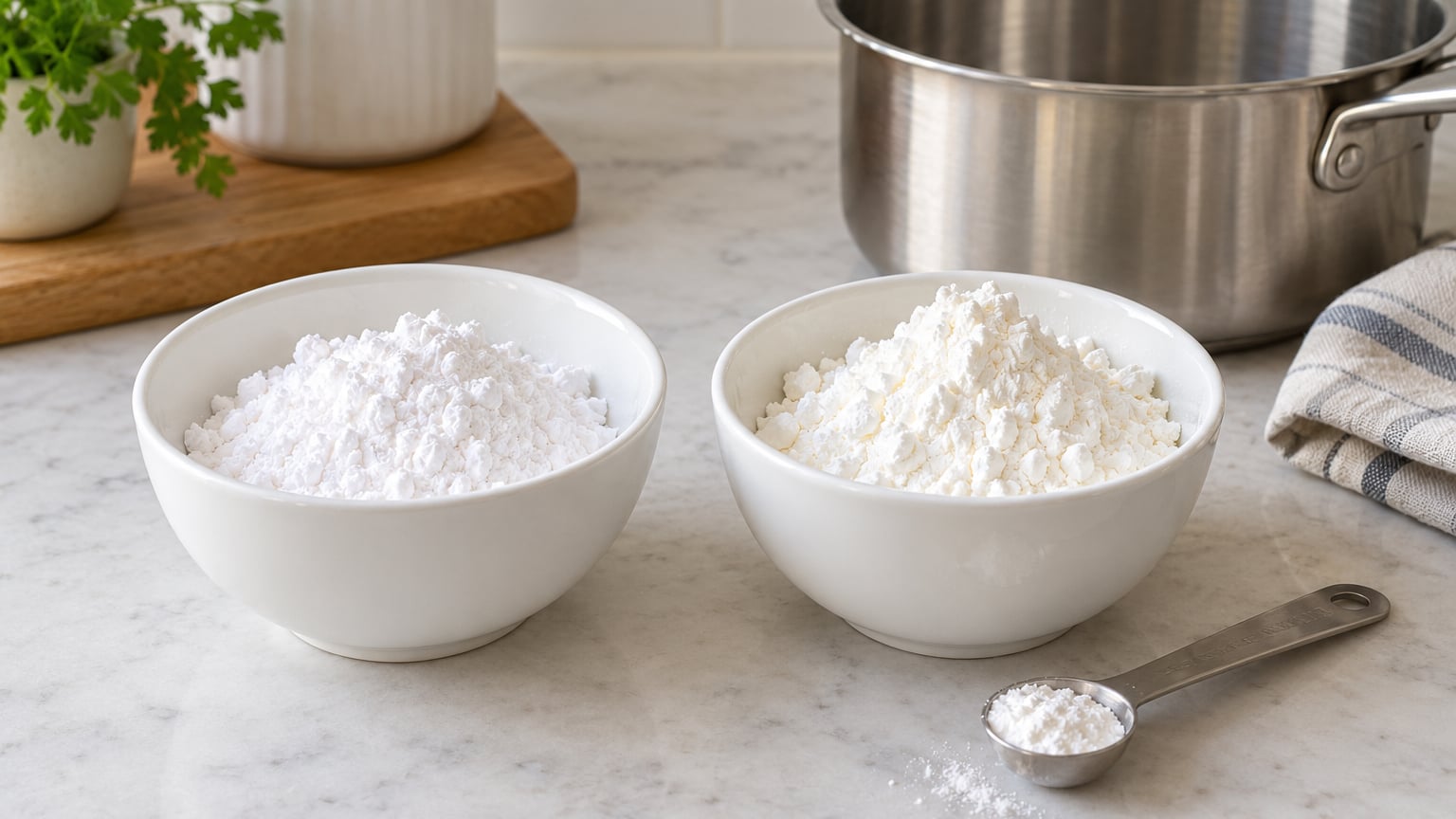
For arrowroot vs cornstarch for thickening, the short answer is that cornstarch wins for anything hot and long-cooked, while arrowroot wins for anything that needs to stay clear. Both are tasteless, gluten-free starches sold as white powder, but they behave very differently in a pan. Arrowroot gives a clear, glossy finish and thickens at lower heat, while cornstarch is stronger, slightly cloudy, and holds up to long cooking and boiling.
Pick the wrong one and you find out why people argue about this. Arrowroot turns slimy the moment it meets milk or cream. Cornstarch goes cloudy in a lemon curd and turns gluey after a week in the freezer. Knowing the difference before you start saves the dish.
This guide has been updated for 2026, and covers the exact swap ratios, the slurry method for each, and which one belongs in your gravy, pie filling, and pudding.
Table of Contents
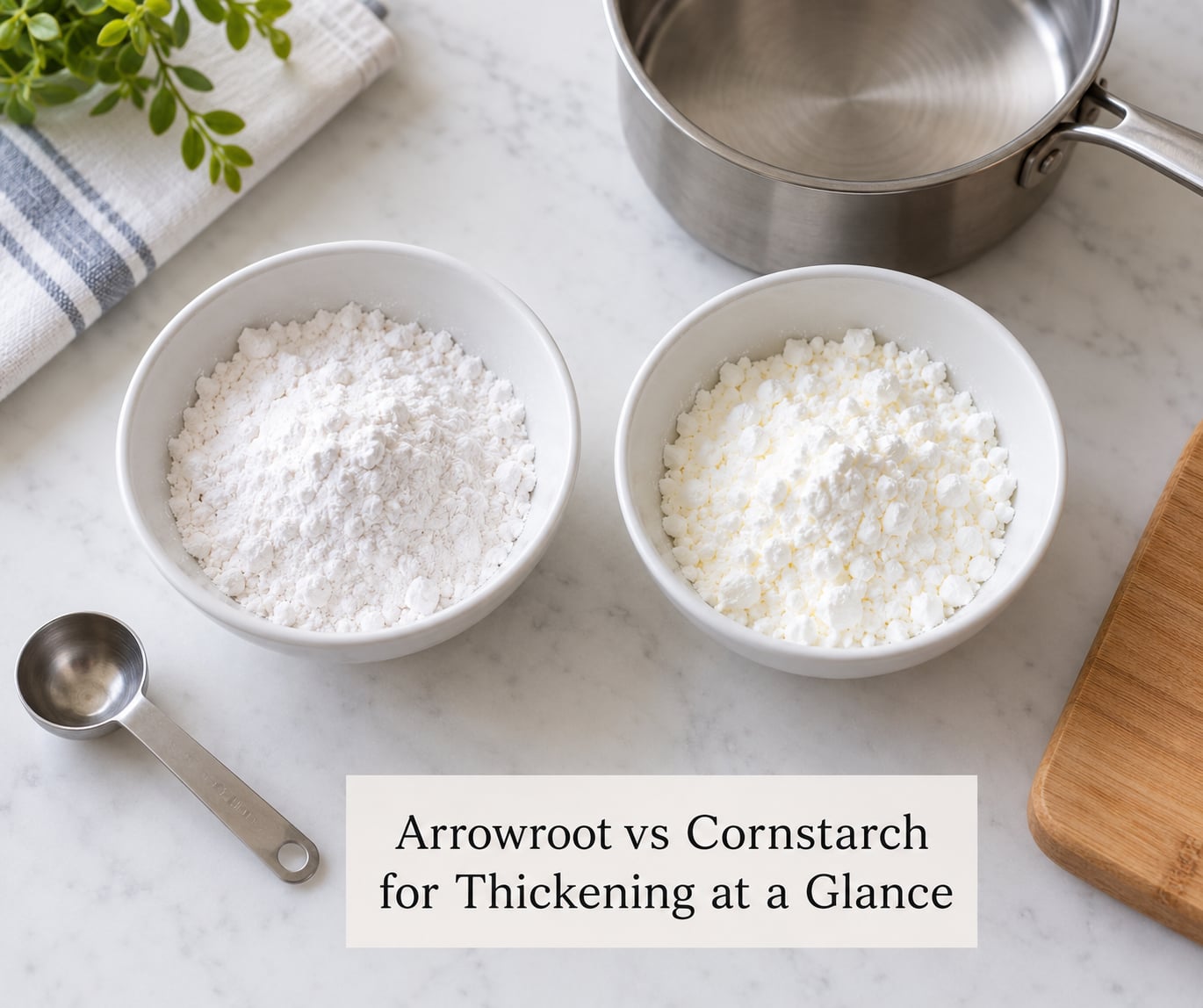
- Arrowroot vs Cornstarch for Thickening at a Glance
- How Do Arrowroot and Cornstarch Thick Differently?
- Why the finishes look different
- Arrowroot flour, starch, and powder are the same product
- Which Thickener Is Better for Sauces, Gravies, and Soups?
- The dairy failure case
- Arrowroot vs Cornstarch for Thickening: Which One Is Gluten-Free?
- Which Is Better for Pudding, Custard, and Cream Fillings?
- How Do the Two Starches Compare in Baked Goods?
- Arrowroot vs Cornstarch: Cooking Ratios and Practical Tips
- How much arrowroot for 1 tablespoon of cornstarch?
- How to make a slurry
- Troubleshooting
- Which Should You Choose?
- Frequently Asked Questions
- Does arrowroot thicken like cornstarch?
- Why do people use arrowroot instead of cornstarch?
- What are the potential downsides of using arrowroot?
- How much arrowroot should I use for 1 tablespoon of cornstarch?
- Can I substitute arrowroot for cornstarch in baking?
- Is arrowroot healthier than cornstarch?
- Does arrowroot or cornstarch freeze better?
- Final Take: Start with Cornstarch or Arrowroot
Arrowroot vs Cornstarch for Thickening at a Glance
| Factor | Arrowroot | Cornstarch |
|---|---|---|
| Appearance | Clear and glossy, translucent | Cloudy to opaque, satin sheen |
| Flavour | Neutral, no taste at normal amounts | Neutral, faintly corn-like when overused |
| Thickening power | Strong per teaspoon, needs roughly twice the amount by volume | Stronger overall, less powder per cup of liquid |
| Cooking temperature | Thickens quickly on gentle heat, weakens if boiled or simmered hard | Needs a full boil to reach full thickness, stable once thickened |
| Acidity | Relatively acid-stable, holds set in fruit and lemon | Breaks down in high-acid mixtures such as lemon curd |
| Dairy | Turns slimy and gluey with milk or cream | Works normally in milk and cream |
| Freezing | Freezes and reheats with less change in texture | Often turns watery or gluey after thawing |
| Mouthfeel | Silky, slightly gel-like, clears as it cools | Smoother, more satin, more stable body |
| Gluten-free | Yes, made from a plant root | Yes, made from corn endosperm |
| Starting amount per cup of liquid | 2 teaspoons | 1 to 2 tablespoons |
| Best for | Clear glazes, fruit pie filling, last-minute pan sauces, frozen meals | Gravy, soups, stews, puddings, cream and cheese sauces, stir-fry |
How Do Arrowroot and Cornstarch Thick Differently?
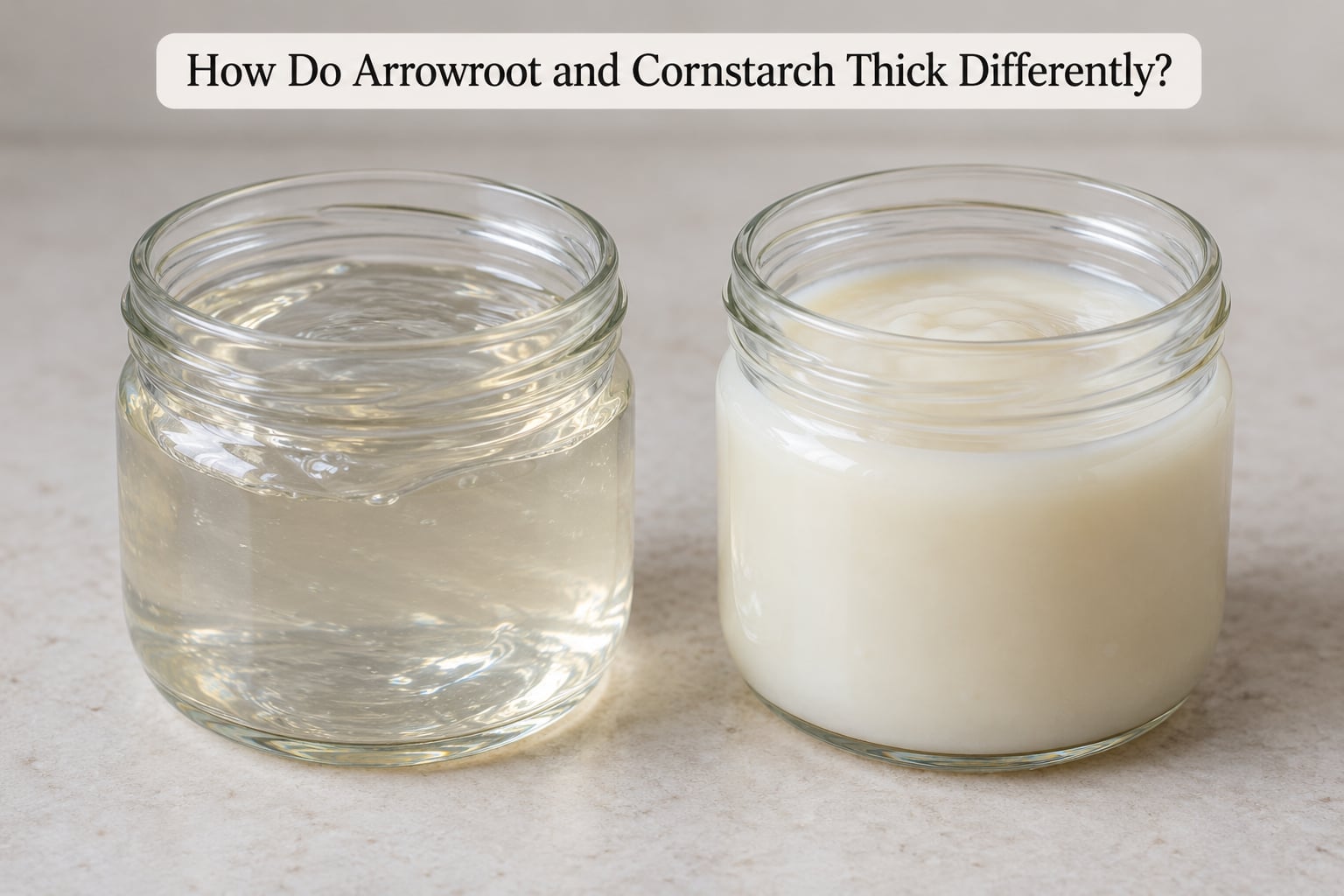
Both powders are made of the same thing, starch granules, which is why both swell in hot liquid and turn it viscous. Arrowroot comes from the rhizome of Maranta arundinacea, a tropical plant related to ginger, and is milled into a fine, soft powder. Cornstarch is ground from the endosperm, the starchy core, of a corn kernel.
The mechanical difference is in how the granules respond to heat. Arrowroot granules swell fast and at a lower temperature, so a sauce tightens in under a minute over medium heat. That same eagerness is why a hard boil or a long simmer tears the thickening apart again.
Cornstarch needs hotter, longer cooking to reach its full viscosity, which is a nuisance for a fast weeknight dinner and a blessing for a gravy that simmers for two hours. Once it thickens, it stays thick through boiling and through reheating.
Why the finishes look different
Arrowroot scatters light rather than blocking it, so a fruit glaze or a thickened apple juice stays see-through and glossy. Cornstarch reflects light back at you, which is why cream sauces and gravies look opaque and satin-finished. That difference is cosmetic, not a quality judgement.
Arrowroot flour, starch, and powder are the same product
Sellers use all three names interchangeably, and for thickening purposes they are identical. Arrowroot flour is not wheat flour and it is not a baking blend. If a container says flour, starch, or powder, you can measure it the same way.
Which Thickener Is Better for Sauces, Gravies, and Soups?
Cornstarch for anything that simmers. A beef gravy, chicken and rice soup, clam chowder, or a long-cooked stew all want a thickener that can hold its body through heat and stirring, and cornstarch is the more forgiving choice.
Arrowroot wins in the opposite situation: a pan sauce you make in the last three minutes, a glaze brushed onto pastry, or a fruit filling that should look transparent rather than milky. Because it thickens at low heat, you can add it at the end without boiling the sauce.
Arrowroot thickens much more effectively for less of it, as cooks on r/ketorecipes put it, so use half what you think you need on the first pass.
The dairy failure case
Do not put arrowroot in a cream soup, a béchamel, alfredo, or a milk-based gravy. Arrowroot and dairy proteins interact and the result is a slimy, gluey texture that cannot be stirred back out. This is the single most common ruined-arrowroot dish.
Use cornstarch in dairy. If the recipe must be gluten-free and dairy-free at the same time, a blended white bean purée is the usual workaround, and potato starch is the next best starch for a creamy result.
Arrowroot vs Cornstarch for Thickening: Which One Is Gluten-Free?
Both are. Neither contains gluten, and both are safe for celiac disease as long as you read the label for cross-contamination warnings, because most are milled in shared facilities that also process wheat.
Arrowroot has the advantage in a household avoiding corn entirely, whether that is a genuine corn allergy or a preference. Cornstarch has the advantage on price and shelf stability, and it is the thickener more gluten-free bakers already keep on hand.
Both are grain-free, which is why arrowroot shows up in paleo and grain-free recipes. Neither is low carb or keto-friendly in quantity, since a tablespoon of cornstarch carries roughly 7 g of carbohydrate, as parents on the WellTrainedMind forum noted years ago when debating carb load for gluten-free children. A spoonful of thickener is not the place to cut carbs.
One naming trap for allergy households: vanilla extract and almond extract are frequently suspended in alcohol that contains corn-derived ingredients, so a gluten-free thickener does not automatically make a dessert allergen-safe.
Which Is Better for Pudding, Custard, and Cream Fillings?
Cornstarch for chocolate pudding, crème pâtissière, and any custard that sets in the fridge. Its heat stability means the mixture can come to a proper boil without going gluey, which is exactly what you need to cook starch out of a raw egg base safely.
Arrowroot suits lemon curd and fruit curd. Cornstarch thins and breaks down in high-acid mixtures, which is a problem posters on r/Baking hit repeatedly with lemon curd. Arrowroot holds its set better in acid.
The trade-off is texture. Arrowroot puddings can set slightly gel-like in the fridge, and some people read that as slimy. That is a preference issue, not a fault, and it is the reason many cooks keep cornstarch as the default for creamy desserts.
Storage is where the two separate clearly. A cornstarch-thickened pudding goes watery or gluey in the fridge after a few days and again after freezing. An arrowroot-thickened filling reheats closer to its original texture.
How Do the Two Starches Compare in Baked Goods?
Neither is a straight swap for the other in baking, and that is where most of the bad advice online lives. They are not interchangeable cake thickeners the way they are sauce thickeners.
Cornstarch in baking is about tenderness. Added to cake batter or whisked into dry flour, it lowers the gluten network, so a sponge or layer cake crumb stays fine and light. Cooks on r/Cakes also use it as a one-for-one replacement for potato starch in lighter batters, which is why cornstarch is the general-purpose default in a gluten-free pantry.
Arrowroot in baking is about structure and crispness. It gives cookies and shortbread a snap that cornstarch does not, and it can carry part of the starch load in a gluten-free blend alongside tapioca starch, potato starch, or rice flour. Bakers also use it as a binder in no-bake bars.
One practical rule: in a baked recipe, arrowroot and cornstarch are not the same ingredient at the same weight. Follow the recipe you are in rather than converting, and expect a different crumb or spread if you swap.
Arrowroot vs Cornstarch: Cooking Ratios and Practical Tips
How much arrowroot for 1 tablespoon of cornstarch?
Use about 2 tablespoons of arrowroot for every 1 tablespoon of cornstarch. Arrowroot needs roughly twice the volume to reach the same thickness, but it thickens quickly, so the usual advice is to start at 1.5 tablespoons and add the rest if the sauce still looks loose.
| Cornstarch | Arrowroot equivalent | Liquid |
|---|---|---|
| 1 teaspoon | 2 teaspoons | About half a cup |
| 1 tablespoon | 2 tablespoons | About one cup |
| 2 tablespoons | 3 to 4 tablespoons | Two cups, or a medium gravy |
| 4 tablespoons | About 6 tablespoons | One quart of soup or stew |
Going the other way, 1 tablespoon of arrowroot replaces roughly half a tablespoon of cornstarch. Cooks on r/AskCulinary draw the same line between methods: slurry for these two starches, roux for anything flour-based.
How to make a slurry
A slurry is starch whisked into cold liquid before it ever touches heat. Whisking the powder into the hot sauce directly is what creates lumps, and cold water is what stops them.
- Measure the starch into a small bowl or cup.
- Add an equal volume of cold water, cold stock, or cold milk, depending on what you are thickening.
- Whisk or stir until every grain has disappeared and the mixture looks like thin milk.
- Pour the slurry in a thin stream while stirring the hot liquid, and keep stirring.
- Cook for the recommended time. Cornstarch needs a minute at a full boil to reach full thickness. Arrowroot needs 30 to 60 seconds at a gentle simmer and no hard boil.
Add half the amount you calculated first. Cornstarch thickens in stages, and you can always add more, but you cannot take it back out.
Troubleshooting
- Lumpy slurry: the powder hit hot liquid before it was dispersed. Whisk it out with cold water, or strain the sauce and whisk the strained liquid back in.
- Over-thickened sauce: loosen it with cold liquid, a tablespoon at a time, while stirring over low heat. Never add cold liquid to a boiling sauce, because that can break an egg-based or dairy emulsion.
- Slimy arrowroot: it was boiled hard or it sat after boiling. Whisk in cold water and bring it just back to a simmer. If dairy is the culprit, no amount of stirring fixes it, so start again with cornstarch.
- Thin sauce after a long simmer: cornstarch lost strength, or arrowroot did. Whisk a fresh slurry into the hot liquid and hold it at a simmer for a full minute this time.
- Watery after thawing: cornstarch-thickened dishes separate in the freezer. Whisk the thawed sauce over heat with a fresh teaspoon-level slurry until it re-thickens.
- Gummy texture: too much thickener, or too much heat after thickening. Loosen and dilute rather than adding more powder.
Which Should You Choose?
Choose cornstarch for gravies, soups, stews, puddings, custards, cream and cheese sauces, stir-fry sauce, and anything that simmers for a long time or goes in the oven. It is the default, and it is the more forgiving of the two.
Choose arrowroot for clear or glossy fruit glazes, pie fillings, lemon and fruit curds, last-minute pan sauces, sauces that will be frozen, and any household avoiding corn. Cook it gently, add it late, and keep it out of dairy.
If you only keep one powder in the pantry, keep cornstarch. Add a bag of arrowroot once you start cooking fruit fillings and freezing leftovers, because that is where it earns its shelf space.
Frequently Asked Questions
Does arrowroot thicken like cornstarch?
Yes, and it does it faster. Arrowroot thickens at a lower temperature and in less time than cornstarch, but it needs roughly twice the volume to reach the same consistency because cornstarch is the stronger thickener overall. Use about 2 tablespoons of arrowroot for every 1 tablespoon of cornstarch, and start with less than you think you need.
Why do people use arrowroot instead of cornstarch?
Arrowroot gives a clear, glossy, translucent finish where cornstarch looks cloudy, and it holds its texture better after freezing and reheating. That makes it the usual choice for fruit pie fillings, glazes, and frozen meals. It also suits households avoiding corn. The trade-off is that arrowroot goes slimy in dairy and loses its thickening if boiled hard or simmered for long.
What are the potential downsides of using arrowroot?
Arrowroot turns slimy and gluey when combined with milk, cream, or other dairy, and it is the wrong choice for any cream soup or béchamel. It also weakens considerably after boiling or a long hard simmer, so it must be added late and cooked gently. In large amounts it can set a pudding slightly gel-like.
How much arrowroot should I use for 1 tablespoon of cornstarch?
About 2 tablespoons of arrowroot. Because arrowroot thickens quickly and strongly per teaspoon, most cooks start at 1.5 tablespoons for 1 tablespoon of cornstarch and add the remainder only if the sauce still looks loose. For a full cup of liquid, the usual starting point is 2 teaspoons of arrowroot or 1 to 2 tablespoons of cornstarch.
Can I substitute arrowroot for cornstarch in baking?
Not as a straight one-for-one swap in cake or cookie recipes, because the two act differently in a dry mix. Cornstarch is used to tenderize batters and can replace potato starch at one for one. Arrowroot adds crispness and structure, and works as part of a gluten-free flour blend alongside tapioca starch, potato starch, or rice flour. Follow the recipe you are in rather than converting weights.
Is arrowroot healthier than cornstarch?
Neither is a health food in quantity, and both are pure starch. Arrowroot is grain-free, which matters for paleo and grain-free households, and it is the safer pick for someone with a corn allergy. Both are gluten-free. Neither is low carb or keto-friendly in any meaningful serving, since a tablespoon of cornstarch carries roughly 7 g of carbohydrate.
Does arrowroot or cornstarch freeze better?
Arrowroot freezes better. Sauces, fillings, and puddings thickened with arrowroot reheat much closer to their original texture, while cornstarch-thickened dishes often turn watery or gluey after thawing. If you freeze a cornstarch-thickened dish anyway, whisk a fresh small slurry into the thawed sauce over heat until it comes back to the right consistency.
Final Take: Start with Cornstarch or Arrowroot
Start with cornstarch for gravy, soup, stew, pudding, custard, and anything dairy or long-simmered. Start with arrowroot for a clear fruit glaze, a pie filling, a last-minute pan sauce, a lemon curd, or anything you plan to freeze.
Either way, whisk the powder into cold liquid first, add half the amount you calculated, and stir until the sauce looks right before you add more. That one habit solves most of the problems people run into when comparing arrowroot vs cornstarch for thickening.