
If your child melts down every year on December 25, the answer is preparation the night before and a morning built around one predictable sequence: quieter rooms, fewer surprises, familiar food, and a clear way out. Learning how to manage Christmas morning sensory overload takes about half an hour of planning, and nearly all of it happens before anyone wakes up.
Christmas morning stacks light, sound, scent, touch, faces and disrupted routine into about three hours. For an autistic or AuDHD child that is usually the highest-intensity stretch of the whole year. For an autistic parent it can be the hardest hour to get through, especially when the anticipation has been building since September. This plan is aimed at both.
Nothing here replaces advice from your child’s pediatrician or an occupational therapist. Treat it as a preparation framework to bring to appointments, not as a diagnosis or a treatment.
Table of Contents
- What You Need
- Step-by-Step: How to Manage Christmas Morning Sensory Overload
- 1. Build the sequence the night before, then leave it visible
- 2. Lower the demands before anyone wakes up
- 3. Offer two choices, never an instruction
- 4. Handle noise and touch as separate problems
- 5. Watch for the early cues of Christmas morning sensory overload
- 6. Adjust mid-morning instead of pushing through
- Common Mistakes and Helpful Adjustments
- Frequently Asked Questions
- How can I reduce sensory overload on Christmas morning?
- What should I do if my child becomes overwhelmed by Christmas activities?
- Can autistic children skip Christmas traditions?
- How do I handle a noisy or crowded breakfast?
- What if my child will not eat the usual Christmas foods?
- When should I talk with my child’s doctor about sensory sensitivities?
- Conclusion
What You Need
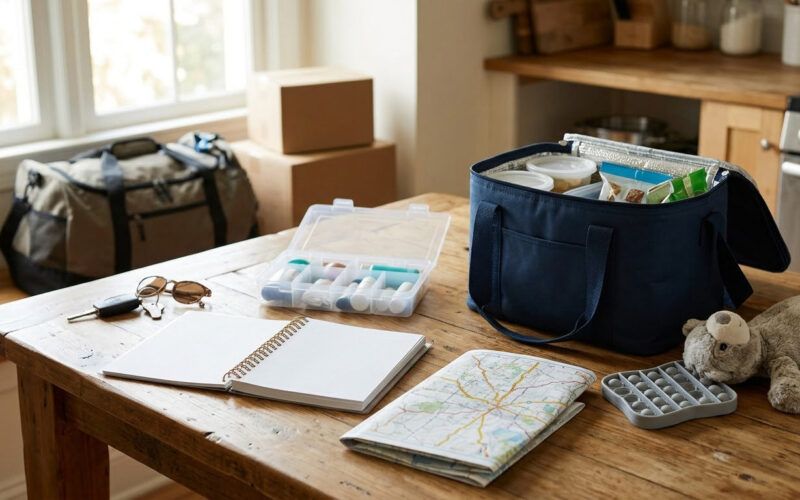
You need seven things, and six of them are already in your house. Gather them the evening before so the morning itself is just execution.
- A written morning schedule. Five or six lines on one card: wake up, open the big box, breakfast, quiet time, visit Gran. Not a detailed itinerary, just the shape of the day.
- A visual schedule or social story page. Photographs of the actual room, the actual breakfast table, the actual front door. Familiar pictures reduce the guessing more than any amount of verbal reassurance.
- Breakfast they already eat. Buy nothing new. The Christmas morning cereal that nobody has eaten before is a texture experiment nobody signed up for.
- Sound tools. Noise-reducing earmuffs or headphones that fit, plus a backup pair in the bag. Adults talking over each other indoors is the hardest sound to block, and volume control is not yours.
- Comfort items. A weighted blanket or a favourite heavy jumper, a fidget, a small blanket, one toy that is theirs and does not get shared.
- A known quiet spot. A bedroom, a car, a corner of a room with a door that closes. Somewhere in your home and somewhere within five minutes of wherever you are spending the day.
- One named adult on backup duty. A partner, a sibling, a friend whose only job on Christmas morning is to take over so you can breathe.
Step-by-Step: How to Manage Christmas Morning Sensory Overload
1. Build the sequence the night before, then leave it visible
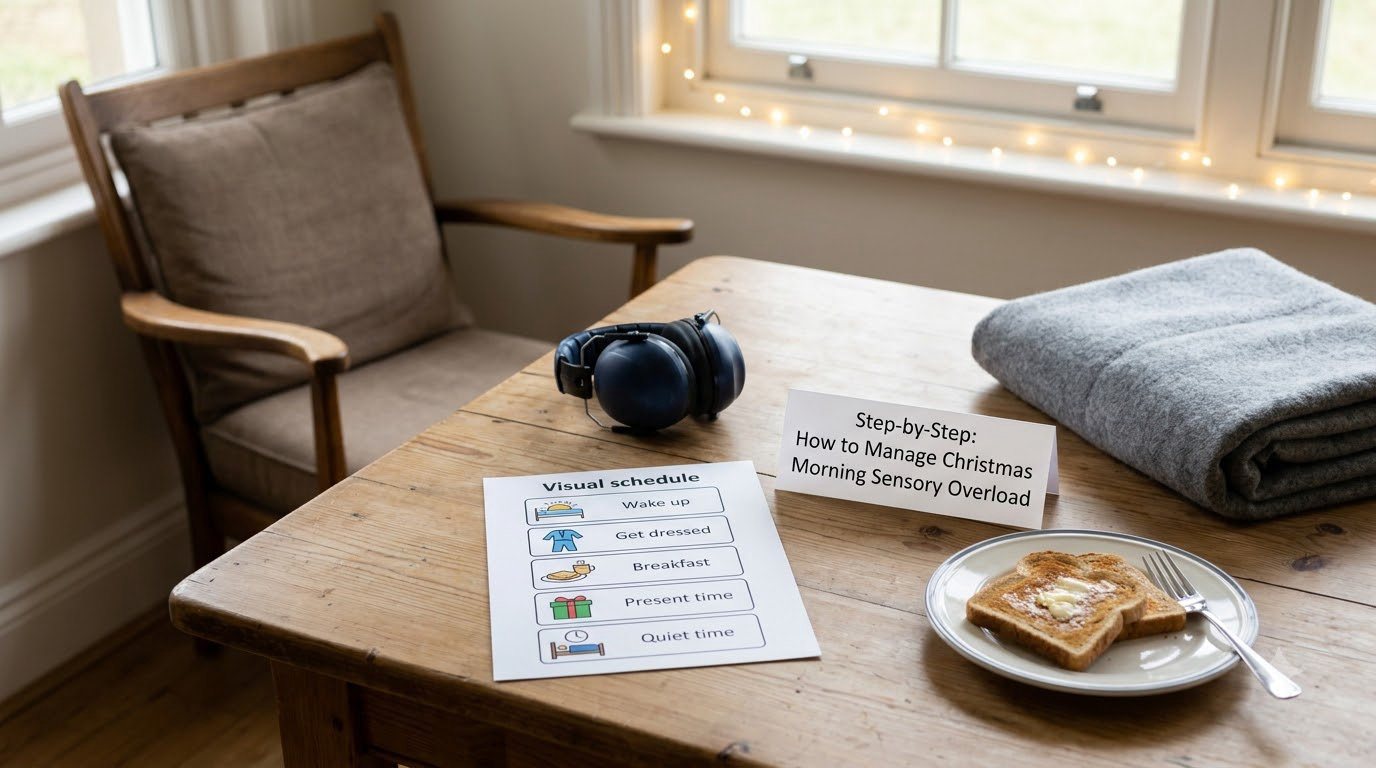
Write the morning out in order and tape it somewhere your child will see without being told to look at it: a strip of masking tape on a door, a card propped against the toaster, a photo on the fridge. The card should show the whole morning, including the boring parts, so there is no surprise about what comes after the presents.
You will know it worked when you can ask “what happens after breakfast?” and get a correct answer instead of a shrug. On r/autism, parents describe not knowing what comes next as the single biggest driver of the morning’s difficulty, ahead of any individual trigger.
2. Lower the demands before anyone wakes up
Swap any flashing or animated lights for static string lights. Put scented candles and potpourri away before December 24, and open a window after the Christmas dinner is cooked if cooking smells are an issue. Check the volume on the television before you turn it on, not after your child has already covered their ears.
Outfit choice happens the night before and it is not negotiable on the morning. Pajama-style or pyjama-bottom-and-favourite-top works far better than the stiff jumper, the tights or the itchy collar that only exists for the family photo.
3. Offer two choices, never an instruction
A command creates a demand, and a demand costs regulation. “Do you want to open the big box first or the small ones first?” gives the same outcome with none of the pushback. Keep the choice real, with both options actually available, or you will lose trust in the whole system.
One thing at a time is the rule for gifts. A pile of opened wrapping paper to stare at is harder than any single present. Adults on r/Autism_Parenting describe the audience effect as the real trigger: being watched opening gifts by seven delighted relatives registers as social demand, not as a party.
4. Handle noise and touch as separate problems
Sound and touch rarely arrive together, so stop treating them as one. Noise is managed by the earmuffs, a room with fewer people in it, and asking relatives to sit down for gift opening instead of standing and moving. Touch is managed by keeping hands out of it: a lap tray for the wrapping paper, a designated person to help open a difficult box, no forced hugs with goodbyes.
If relatives press for the traditional group photo, offer one short photo early rather than three long ones later.
5. Watch for the early cues of Christmas morning sensory overload
Overload has three stages, and you can only act on the first one. Early cues are a flinch at a sound, a hand clamped over the ears, rocking, going quiet, asking the same question four times, or a sudden interest in a corner object. Full overload is the meltdown: crying, screaming, dropping to the floor, bolting. Past it, you may get a shut down, where the child goes still, blank and silent.
Meltdown and shut down need opposite responses. With a meltdown, reduce input and wait it out without talking. With a shut down, do not pile on reassurance either, just keep the environment quiet and stay nearby. A parent on the Ontario Autism Coalition forum asked exactly this question about a family of eight opening gifts together, and the answer from most respondents was the same: fewer spectators, not more.
6. Adjust mid-morning instead of pushing through
Something will go wrong. The relative arrives early, the food is different at the other house, the child is tired, the plan falls apart at 8am. When that happens, cut rather than push: shorten the visit, move the noisy part to the afternoon, skip the ceremony and open gifts later in a quiet room.
Deciding in advance that leaving at 11am is allowed makes leaving at 11am easy. On r/AutismInWomen, adults describe the season starting earlier each year, sometimes in September, which is worth raising with your pediatrician rather than treating as a passing mood.
Common Mistakes and Helpful Adjustments
Most of what goes wrong on Christmas morning is a planning mistake rather than a child failing to cope. These are the six I see most often, with the adjustment that fixes each one.
Scheduling four activities before lunch. One anchor activity plus free time beats a packed morning. Predictability, not enrichment, is what most autistic children are actually after on December 25, so cut the schedule back to two events and let the rest be unstructured.
Treating participation as the goal. Sitting through a long present opening, hugging everyone, trying the pudding because it is Christmas. All of these cost more than the moment is worth. Decide in advance which traditions your child can join and which they will hear about afterwards, and hold that line kindly.
Introducing new Christmas foods on the day. Familiar food, familiar container, familiar seat. A parent on r/Autism_Parenting was blunt about it: if you want an easy Christmas, do not force a child to eat things that overload their senses. Bring a backup meal in a familiar form and eat it without comment.
Reading the meltdown as misbehaviour. It is not defiance and it is not a discipline problem. It is the nervous system saying it has hit its limit. Reward the early cues you can work with, and do not lecture during the event, because words are extra input at exactly the wrong moment.
Waiting for visible signs before intervening. By the time you see crying, the cup has already overflowed. Act on the flinch. A sensory break at the first flinch takes five minutes; recovery from full overload takes hours, and the rest of the day is often lost.
Forgetting your own load. If you are autistic, or you are simply exhausted in December, your stress arrives in the room before you say a word. Regulate yourself first: earmuffs on, a known quiet spot, and permission to hand over to the backup adult without explanation.
Two more adjustments that cost nothing: put the wrapping paper in a bin rather than across the floor so the visual clutter does not accumulate, and agree with your child before December 25 what the exit phrase will be. The phrase matters more than the rule behind it, because it gives them the decision.
Frequently Asked Questions
How can I reduce sensory overload on Christmas morning?
You reduce it by cutting predictable inputs before the day starts: static lights instead of flashing, no scented candles, familiar breakfast food, one gift open at a time, and a written schedule the child can read. Keep a quiet room available and decide the exit time in advance so leaving is normal rather than dramatic.
What should I do if my child becomes overwhelmed by Christmas activities?
Lower the input first: reduce noise and light, move to the quiet spot, and stop all talking and questions. Stay nearby but do not coach, negotiate or explain, because language adds load during overload. Wait for the hands, voice and breathing to come down before offering anything. Recovery usually takes far longer than the escalation did.
Can autistic children skip Christmas traditions?
Yes. Skipping is a reasonable accommodation, not a failure. Many families keep the parts their child enjoys, such as opening one present or a short visit, and drop the rest. Relatives often resist, so explain the plan before December 25 rather than on the morning, and keep the wording short and matter-of-fact.
How do I handle a noisy or crowded breakfast?
Move the meal to the smallest room that fits everyone and seat your child away from the door, the television and the kitchen. Ask relatives to eat after the children rather than talking across the table. Earmuffs work for many kids, and a familiar food in a familiar bowl does more than any decoration you can add.
What if my child will not eat the usual Christmas foods?
Serve the familiar version instead. A standard Christmas dinner can be rebuilt as plain potatoes, familiar meat, sauce on the side and the usual cereal on the table. Bringing your own safe food avoids a public refusal and keeps the meal short, which helps everyone. Never make eating a condition of receiving presents.
When should I talk with my child’s doctor about sensory sensitivities?
Talk to your pediatrician if the difficulties are getting worse each year, if they are appearing outside the holidays, if sleep, eating or school are affected, or if your child cannot recover from a busy day. An occupational therapist can also advise on desensitisation and rehearsal. Raise it early, ideally months before December, not in the week of the holiday.
Conclusion
Start with one action: pick your child’s biggest two triggers and write them down, then build a single sequence for the morning around them. Everything else in this plan hangs off that one card on the fridge.
Follow your child’s lead on the day. Cut early, cut often, and keep the exit phrase you agreed on. If the load is landing on you too, hand over and go somewhere quiet, because your regulation is part of the plan rather than separate from it.
If the pattern is worsening year on year or spilling into ordinary days, book an appointment with your pediatrician or an occupational therapist well before 2026 ends, so you have support in place before the next December.