
To make transitions between activities easier, give advance warning, make the next step visible, and repeat the same short routine every time you switch. Consistency matters more than any single tool: children who know what happens next, see it coming, and get the same sequence each time resist the switch far less.
The hardest part of a day is rarely the activity itself. It is the gap between blocks — stopping the tower build, ending screen time, leaving the park, closing the laptop. Every one of those asks a child to stop doing something they are enjoying and start something they are not, and that switch costs more executive function than almost anything else in the day.
What follows is a plan you can start tonight, built around eight steps. Nothing here requires buying anything or hiring anyone. You will need about a week of observing before you change much, and a lot of patience in the middle. This approach is drawn from pediatric and school psychology guidance on routines, visual supports, and sensory regulation, which is general information rather than individual medical advice.
Table of Contents
- What You Need
- Step-by-Step: How to Make Transitions Between Activities Easier
- Step 1: Observe When Transitions Become Difficult
- Step 2: Give a Clear Warning Before Switching
- Step 3: Use a Visual Schedule or Transition Card
- Step 4: Create a Consistent Transition Routine
- Step 5: Offer a Manageable Way to Finish
- Step 6: Help the Next Activity Start Clearly
- Step 7: Prepare for Sensory and Emotional Needs
- Step 8: Practice and Adjust the Routine
- Common Mistakes
- Transition Tips for Real Family Routines
- Frequently Asked Questions
- How much warning should I give before a transition?
- Are visual schedules useful for every child?
- Should I use a timer when changing activities?
- What helps when transitions lead to sensory overload?
- How do I handle transitions after an unexpected change?
- When should I ask for individualized support with transitions?
- Start With One Change
What You Need
You need almost nothing. Most families already have every support this plan calls for somewhere in a drawer.
- A simple daily schedule. A handwritten list, a printed chart, or a picture sequence on the fridge. The format matters far less than the fact that it stays in the same place and the same order.
- A visual timer or clock. A kitchen timer, a sand timer, or a cheap countdown app. For children who do not yet read numbers, a timer that fills up visually works better than a clock face.
- A transition card or stop signal. One card, one hand signal, or one word your family reserves for this and nothing else.
- A calming sensory item. A fidget, headphones, a weighted lap pad, a resistance band, or whatever your child already reaches for.
- A finished-activity organizer. A basket, box, or shelf corner where toys go when they are done. It gives closure a visible home.
- Notes on your child’s cues. Start a small list: what the transition looks like when it is going well, and what it looks like when it is going badly. This list is more useful than any advice you will read.
Also note the current skill level. A three-year-old and a nine-year-old need completely different amounts of warning and completely different amounts of help letting go.
Step-by-Step: How to Make Transitions Between Activities Easier
The plan has eight steps, and they build on each other. Consistency, advance notice, practice, and adjusting to your child’s actual response matter far more than forcing immediate compliance. Compliance on demand almost never survives contact with a real week.
Step 1: Observe When Transitions Become Difficult
Before you change anything, watch. Pick one transition — just one — and spend a week noticing what happens right before the difficulty starts.
Write down the specific behavior. Not “he melts down,” but “he pushes the truck away and says no when I say it’s time to clean up.” Specific descriptions tell you which strategy fits. A child who ignores words may need a visual. A child who understands the words but cannot let go needs a finish line. A child who cries at the sound of the vacuum needs sensory notice.
Also write down which transitions already work. Most families have at least one, and studying why it works tells you which support to copy. Usually the smooth ones share three things: a clear end, a visible next step, and the same person giving the same signal.
Step 2: Give a Clear Warning Before Switching
Warning before the switch is the single highest-value thing you can do, and it costs nothing.
Give a verbal cue, a visual stop signal, or a countdown such as five minutes, two minutes, one minute. Many families use all three at once and taper to one as the child learns. Adjust the interval to your child’s age and ability to understand time. A toddler may need two minutes turned into two visible events. An eight-year-old can handle a five-minute warning.
The point is not the exact number. The point is that the child registers the coming change while they are still calm enough to process it, rather than hearing it at the moment of maximum absorption.
Step 3: Use a Visual Schedule or Transition Card
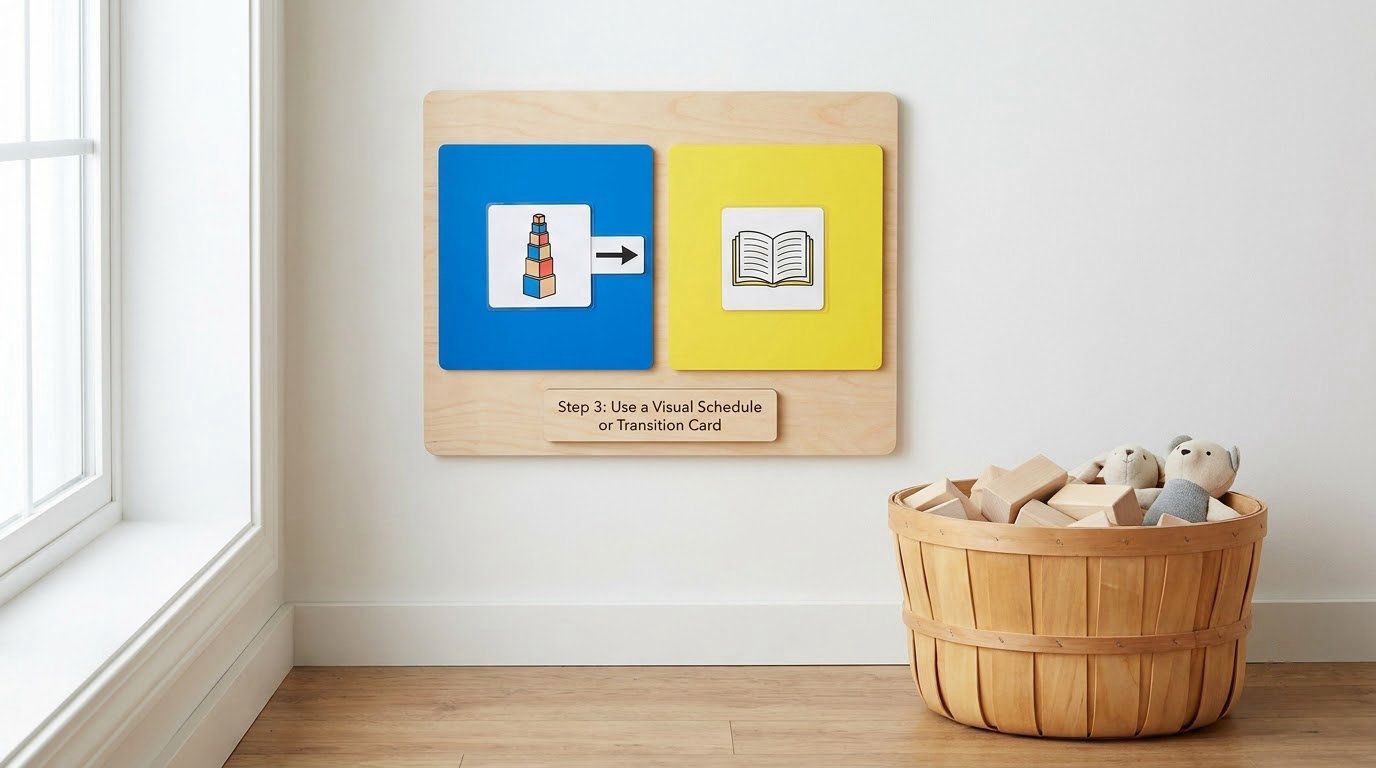
A visual schedule shows what happens first, what happens next, and when the next activity begins. Use photos, drawings, symbols, or written lines depending on your child’s reading level and communication style.
For a child who reads, a laminated list of the day’s activities in order works well. For a child who does not read yet, picture cards in a row or column, with a movable marker or a peel-away sticker for each finished item, makes progress visible without anyone having to explain it.
Keep the schedule in one fixed location. A schedule that moves around becomes decoration. If it is too long, show only the current activity and the next one, and hide the rest.
Step 4: Create a Consistent Transition Routine
Repeat the same short sequence every time. Finish, put away, wash hands, take a movement break, begin.
Children do not need you to explain the sequence. They need it to be identical every time, in the same order, with the same words. Five steps that never change beat a clever plan that changes weekly, every time.
Pick a sequence of four to six steps that takes under two minutes and write it on the wall next to the schedule. Then run it. Every single time. Boring and predictable beats flexible and clever.
Step 5: Offer a Manageable Way to Finish
Most transition conflict is really a disagreement about how much time is left. Give a short preview, define how much longer is allowed, provide a timer if useful, and offer choices such as one final turn or choosing where the finished materials go.
Defining done helps more than almost anything else. “Ten more minutes” is vague and negotiable. “Two more turns, then the timer rings” is a fact. Some children need an actual start-to-finish scope — the specific three things that count as complete on a five-step jigsaw puzzle — or they will never feel finished.
Let the child choose the order of the tidying steps, or choose which basket gets the blocks. Choice costs you nothing and returns a measure of control to a child who is about to give it up.
Step 6: Help the Next Activity Start Clearly
Starting is harder than continuing, which is why a child who finally stops playing may then stand motionless instead of starting the next thing.
Reduce competing demands. Present one clear first step, not the whole activity. Prepare materials in advance so nothing needs deciding. And model exactly what beginning looks like — start it yourself for a few seconds, narrate what you are doing, then hand it over.
If there are five things to do after dinner, name only the first one. When it is finished, name the next.
Step 7: Prepare for Sensory and Emotional Needs
Anticipate the triggers. Noise, movement, clothing changes, waiting in line, hunger, bright light, a crowded room — each one has a predictable effect, and most can be handled before the switch rather than after.
Options include a short movement break, a quieter space, a calming item, or a regulation support like slow breathing with the child. For movement, ten wall pushes or a lap around the room often does more than any verbal reassurance.
If a transition always happens in a loud or bright environment, change the environment. Move the switch to a calmer spot. Hand over headphones at the door. Sensory support that prevents the difficulty beats soothing after it starts.
Step 8: Practice and Adjust the Routine
Rehearse low-pressure transitions. Practising a hard switch while the child is calm turns it from an unpredictable event into a known one.
Track what is improving, even loosely. Note on a calendar which transitions went smoothly. Then gradually adjust warning length, language, visuals, or wait time based on what you observe rather than adding more prompts.
Watch for fading. A support that never fades becomes scaffolding the child depends on forever. When the routine holds for about two weeks, shorten one element — drop from three warnings to two, or let the child move their own card. Fade slowly, and step back up the moment it falls apart.
Common Mistakes
Most failed transition plans fail in the same five ways, and each has a straightforward fix.
Giving no warning. Announcing the change at the moment of the change guarantees resistance, because the child has no time to disengage. Fix: warn twice beforehand, then once at the switch.
Relying only on spoken instructions. “Put that away now” requires the child to process language, hold it, and translate it into action while excited. Fix: pair the words with a visual every time, even for verbal children, and especially for anyone who struggles with working memory.
Making every warning identical. If the five-minute warning means the same thing every time, it stops carrying meaning. Fix: vary the approach so the warning stays a real signal — sometimes a card, sometimes a song, sometimes a physical cue.
Starting the next activity before the child is ready. Dragging a resistant child into the next task teaches them the next task is something to escape. Fix: let the closing routine finish, even slowly. The walk to the bathroom is part of the transition, not a delay of it.
Practising only during difficult moments. If the routine appears exclusively when things are going badly, the child learns to dread it. Fix: run the sequence on easy days too, when it is calm, so it becomes ordinary rather than alarming.
Two more worth naming. Adding prompts faster than the child can respond is pressure, not support; slow down. And punishing the transition itself usually escalates rather than teaches, because the child rarely chose to be mid-activity in the first place.
Transition Tips for Real Family Routines
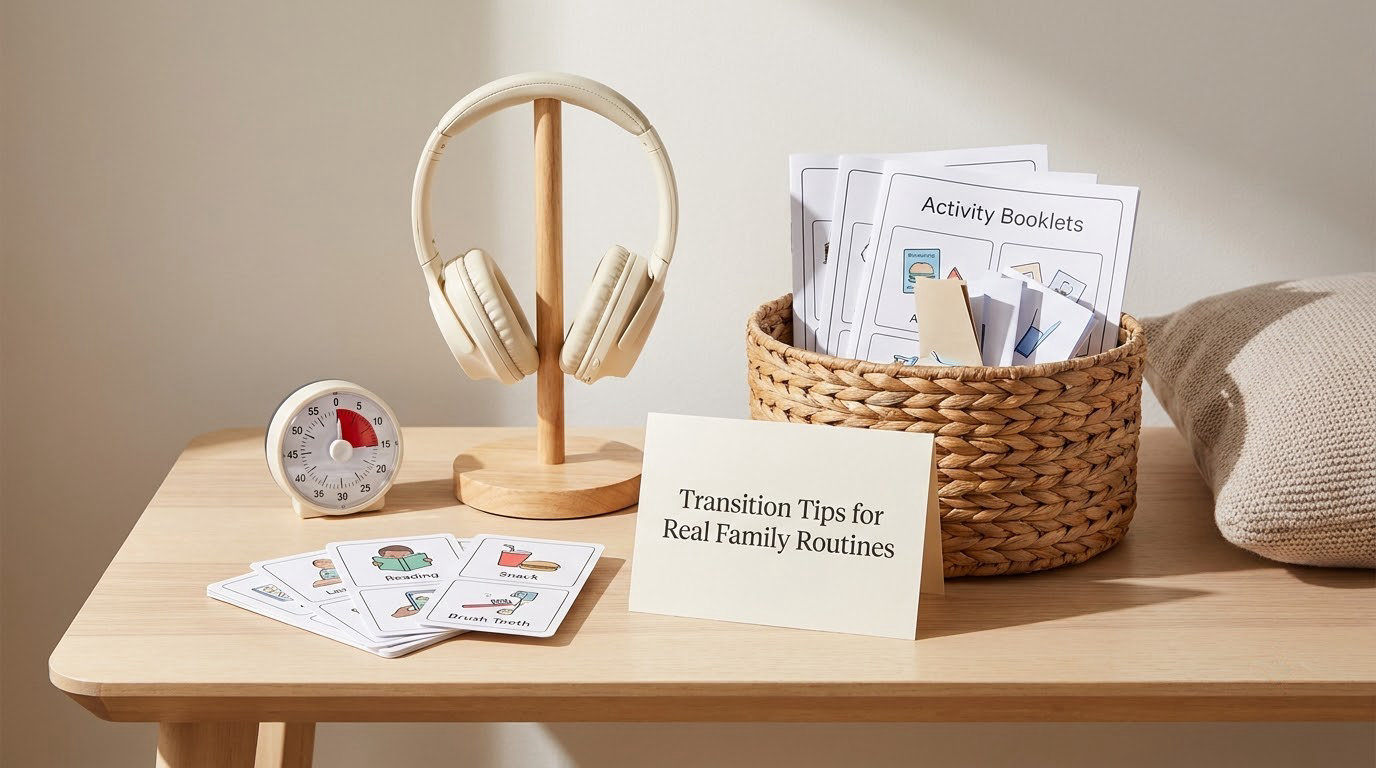
Once the basics are in place, adapt them to the specific transitions that fill your week.
Leaving play to do something else. Use a transition object — a small figure, a card, a toy that lives only in the basket. The child carries it to the next activity. It marks the switch as an event rather than a loss.
School pickup. Make waiting the hard part easier. Have the transition station ready before pickup, so the first ten minutes at home are predictable. A check-in routine of snack, then shoes off, then one specific thing keeps the arrival from becoming a free-for-all.
Appointments and errand waiting. Build the warning around the wait, not the arrival. Narrate the whole sequence, including the boring middle. When plans change unexpectedly, say so plainly and early, then keep the rest of the structure identical.
Meals. End meals with a defined finish rather than taking the plate away mid-bite. A clear end to the meal, followed by an immediate known next step, prevents the afternoon slump and the bargaining.
Screen time ending. Screen time is the hardest switch because the reward is strong and stopping costs something real. Warn early, use a visible timer, and agree in advance on the end signal so the ending never feels arbitrary. A quick physical transition afterwards helps — moving straight into a movement break.
Bath and bedtime. Run the sequence in the same order nightly and keep it short. Backward chaining works well here: teach the last step first and let the child complete it independently, then add the step before.
After a hard transition. Give recovery time. A child who just fought through a switch needs a quiet reset before the next demand, not another instruction on top. Ten minutes of low-demand time does more than any amount of pushing.
And for adults managing the same problem with their own day — closing the laptop, stopping the scroll, shifting off work mode — the same principles apply to you. A visible end marker, a defined finish line, and a deliberate bridge activity between the two things work about as well for adults as they do for children. Pad deliberately rather than letting one activity bleed into the next.
Frequently Asked Questions
How much warning should I give before a transition?
Give a first warning about five minutes before, a second about two minutes before, and a final one as the activity stops. For toddlers, replace minutes with visible events such as two more turns. Adjust the length to your child’s age and ability to understand time rather than to a fixed rule. Warning too late is the most common reason a transition goes badly.
Are visual schedules useful for every child?
They help most, but not all, children. Visual schedules work best for children who do not yet read fluently, who have limited working memory, or who find spoken instructions hard to act on. For strong readers a simple written list works just as well. The format matters less than keeping it in the same place, in the same order, every day.
Should I use a timer when changing activities?
A timer helps most when the activity has a clear start and a clear end, and it is less useful when there is no defined finish line to count toward. A visual timer that fills up works better than a numeric display for children who cannot yet read numbers. Keep the timer’s length fixed so it becomes predictable.
What helps when transitions lead to sensory overload?
Reduce the load before the switch rather than soothing after it starts. Lower noise and light, offer headphones or a quieter room, and provide heavy work or movement such as wall pushes beforehand. If overload happens at a specific point, change the environment or location of that transition. A child in overload cannot process language, so keep your words short.
How do I handle transitions after an unexpected change?
Tell the child immediately and in plain terms what changed and when the new plan starts. Keep the rest of the routine identical, because familiar structure is what carries a child through a disruption. If the change involves a wait or an unfamiliar place, preview it in advance or rehearse it when the child is calm.
When should I ask for individualized support with transitions?
Consider a pediatrician, occupational therapist, or educational psychologist if transition distress is severe, happens for several hours most days, interferes with sleep or eating, or is accompanied by regression, injury, or a marked change in mood. They can assess sensory processing, communication, and regulation skills and suggest supports matched to your child rather than a general plan.
Start With One Change
Pick the single transition that costs you the most conflict each week. Not the one you most want to fix — the one that actually goes wrong most often.
Choose one warning signal and one short closing routine for it. Run that on easy days when your child is calm, use the same words and the same order, and give it two weeks before you judge it.
Then adjust one thing at a time. A little more warning, a clearer finish line, ten wall pushes before you start. Change one variable, watch what happens, keep what worked.
Two weeks from now you will know more about your child’s transitions than any general guide can tell you, because you will have watched your own child. That observation is the whole method. Everything else is just how you act on it.