Learning how to help a child with dyslexia at home comes down to three things: short daily practice, explicit phonics instruction that engages sight, sound and touch, and steady protection of your child’s confidence. Fifteen focused minutes a day beats an hour once a week, and over a school year that adds up to roughly 60 to 75 hours of structured instruction on top of what the classroom already provides.
Dyslexia is not a lack of intelligence and it is not something a child outgrows by being read to enough. The International Dyslexia Association describes it as a specific learning disorder that interferes with accurate and fluent word recognition, spelling and decoding, and that typically does not affect overall intelligence. In plain terms, the brain struggles to connect the shape of a letter to the sound it makes, so reading stays effortful far longer than it should.
Nothing here is a diagnosis or a treatment plan. If your child has not been formally evaluated, a school psychologist or a qualified reading specialist is the right first call, and this guide is what you can do while you wait.
Table of Contents
- What You Need
- Step-by-Step
- 1. Learn What Your Child’s Reading Profile Needs
- 2. Build a Short, Predictable Reading Routine
- 3. Practice Decoding With Multisensory Tools
- 4. Read Texts at the Right Challenge Level
- 5. Strengthen Fluency Without Turning Practice Into a Test
- 6. Build Vocabulary and Comprehension Around Reading
- 7. Partner With the School and Monitor Small Wins
- Common Mistakes
- Forcing reading while a child is distressed
- Correcting every mistake
- Comparing your child with siblings or classmates
- Using text that is too hard
- Practising for too long
- Helping with everything at once
- Frequently Asked Questions
- How do I know if my child needs a formal dyslexia evaluation?
- Do children with dyslexia always need a private tutor?
- How many minutes a day should a child with dyslexia read at home?
- Can a child outgrow dyslexia?
- How can I help a child with dyslexia who refuses to read aloud?
- Start With One Successful Reading Step
What You Need
You do not need to buy a program before you begin. Every item below is either free, already in your house, or takes ten minutes to put together.
- A current sample of their reading. Ask the teacher for a short passage from last week’s book, plus one word your child found hard. Ten words tell you more than an afternoon of guessing.
- Easy-to-read decodable text. Short texts where nearly every word can be sounded out with the patterns your child already knows. Public libraries stock these, and the teacher can point you to the ones used in class.
- A visual schedule. Three or four cards on the wall, or a photo of the routine on your phone, showing the order of the session and the stopping point.
- Audio or recorded word support. Your own voice reading a passage aloud, an audiobook, or text-to-speech on a tablet.
- Writing tools. A pencil with a chunky grip, plain paper, and wide-ruled or lined paper if writing is also hard. That combination is often called dysgraphia, and it responds to different supports than reading does.
- One quiet spot. Not a bedroom with a television on. Somewhere you both can sit without being interrupted for fifteen minutes.
If you want a structured program later, look for one built on structured literacy, which is explicit, systematic phonics teaching rather than whole-word guessing. But start with the routine first. Waiting for the right materials is the most common reason this never begins.
Step-by-Step
1. Learn What Your Child’s Reading Profile Needs
Dyslexia affects four different skills, and the fix for one does not fix the others. Before you start practising, work out which one is actually breaking down.
- Decoding: working out that the letters in a word make the sounds that spell it.
- Fluency: reading words accurately and smoothly without effort.
- Vocabulary and comprehension: understanding and remembering what the text says.
- Encoding and spelling: the reverse trip, turning sounds into letters on paper.
Ask the teacher which of these is the sticking point right now. A child who reads accurately but slowly needs fluency and phrasing work. A child who guesses wildly needs decoding instruction. A child who reads well but will not talk about the book needs comprehension and vocabulary support.
Also rule out the neighbours. Dyslexia often travels alongside ADHD, dysgraphia and dyscalculia, and when attention is the bigger blocker, more reading practice at home goes nowhere until that is addressed. Reading profiles can look entirely different again in conditions such as Down syndrome, where teaching has to start from a different skill level entirely.
Whatever the profile is, assume your child is trying. Slow, effortful reading is the condition, not evidence of laziness.
2. Build a Short, Predictable Reading Routine
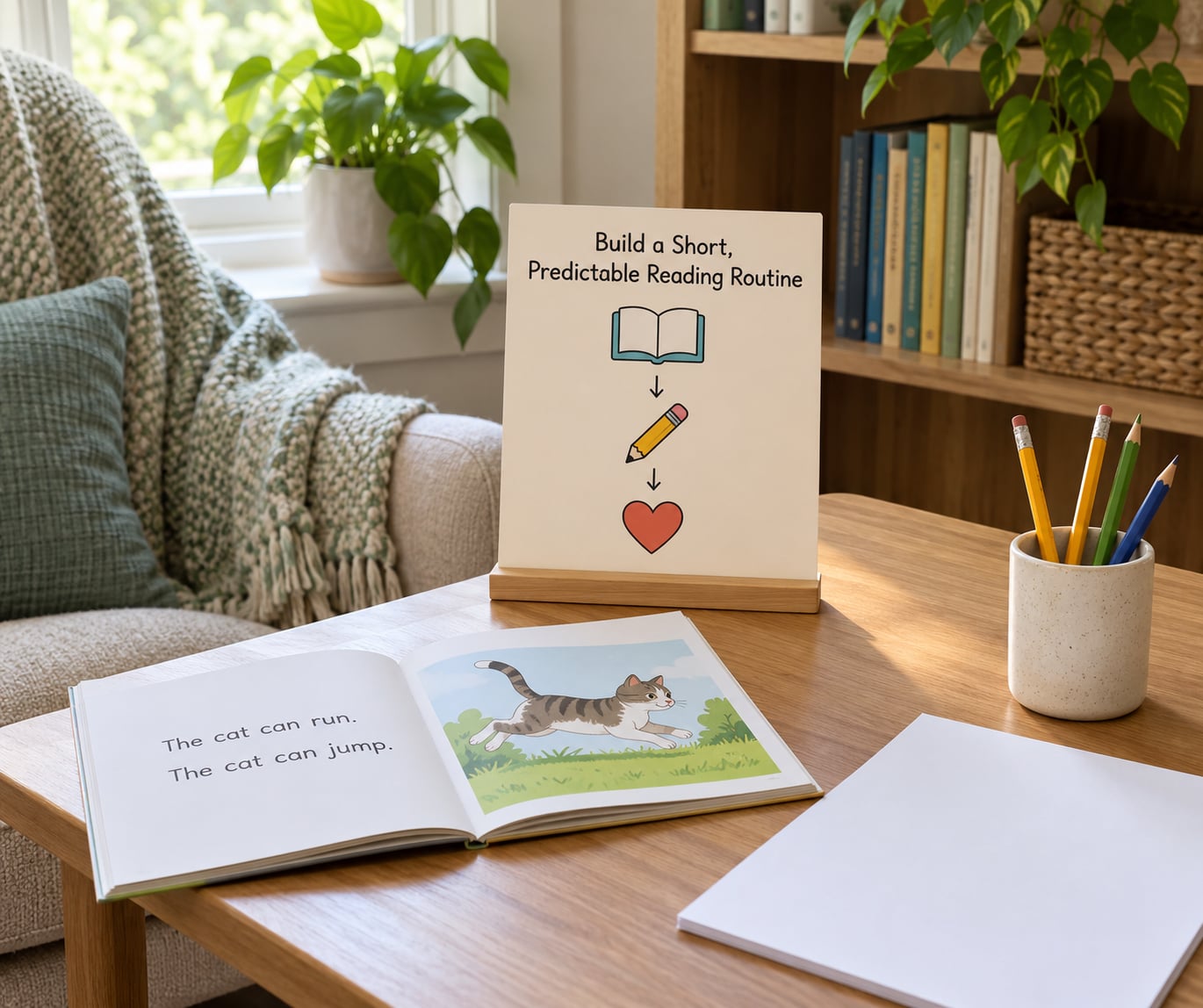
The routine matters more than the content. Fifteen minutes every day, in the same order, beats a long session on Saturday that both of you dread.
A workable session looks like this: two minutes of warm-up on the patterns your child already knows, eight minutes of decoding and reading practice, three minutes of comprehension talk, and two minutes of something they enjoy, which is usually where reading for pleasure belongs.
Put the routine where it happens. A row of cards on the wall beats a verbal reminder, because a dyslexic brain often struggles to hold a two-step instruction in working memory long enough to start.
You will know the routine is the right size if your child can finish it most days without a fight, and still wants to come back tomorrow. If sessions routinely end in tears, cut the minutes, not the effort. Ten good minutes a day is 3,000 minutes a year.
3. Practice Decoding With Multisensory Tools
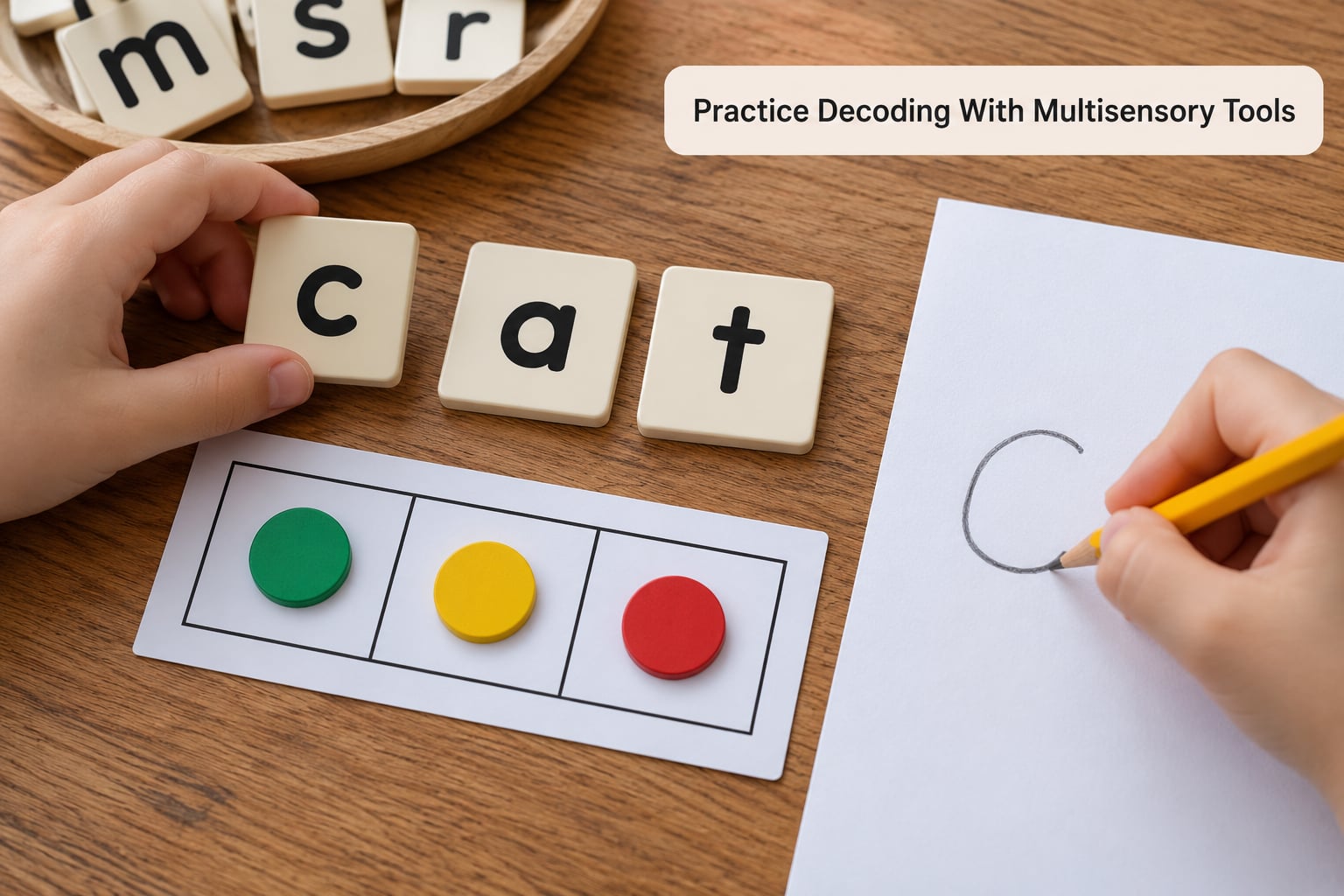
This is the heart of how to help a child with dyslexia at home: teach each letter-sound pattern by saying it, seeing it and touching it in the same moment. Say the sound, show the letter, trace the letter, then have your child do it. Repetition across senses is what makes the pattern stick.
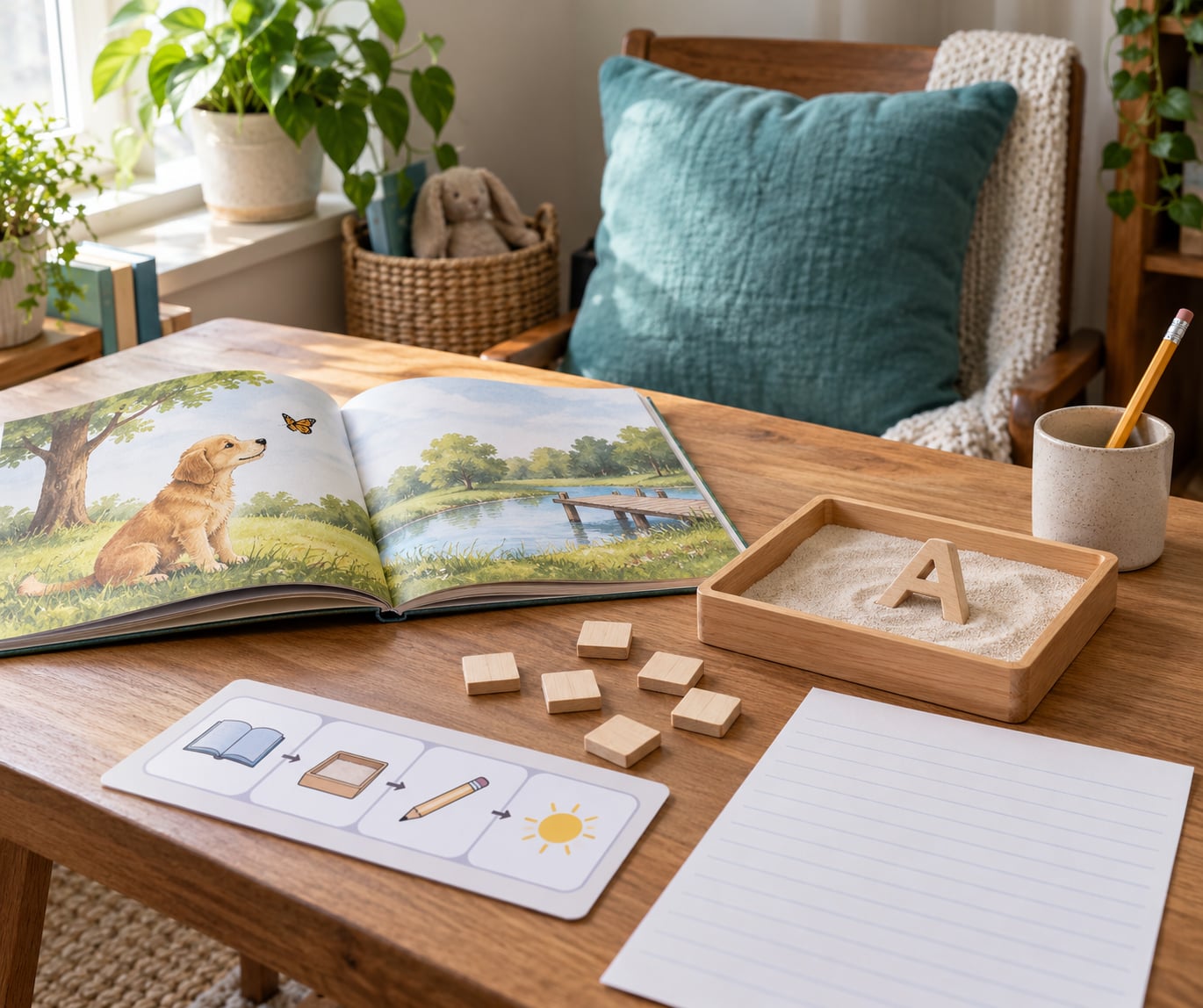
You need almost nothing to do it. Sand or salt on a tray for finger tracing. Magnetic letter tiles, or letters cut from cardboard. Modelling dough rolled into letter shapes. Your own forearm, tapped once per phoneme so a child can feel the separate sounds inside a word.
Keep the word examples short and patterned. Teach the short a sound, then use it in a small family: cat, mat, sat, hat. Let your child physically push the letters together while saying the sound. That blending step is where most decoding breaks down, and doing it with objects in the hands rather than on a worksheet tends to stick better.
You do not need to correct every mistake. Stop and model the word again, let your child echo it once, then move on. Correcting every single error turns a six-minute session into a forty-minute argument about the same three words.
Praise the process rather than the result. “You checked that word carefully all by yourself” lands very differently from “you’re so clever” after a lucky guess.
4. Read Texts at the Right Challenge Level
Two texts are worth using at once: one the child can read mostly independently, and one you read together. That split keeps practice from becoming a series of failures.
A rough calibration: if your child gets about 80 percent of the words right without help, the text is in the right zone. Below that, move down a level. If they are reading it perfectly, move up. Being bored for five minutes is far better than crying for twenty.
Use audiobooks and text-to-speech alongside printed books rather than instead of them. Play the audio while your child tracks the print with a finger, so the words arrive visually and auditorily at the same time. Experienced parents on dyslexia forums describe this as the change that reduced reading fatigue fastest, because the story keeps moving while decoding catches up.
If your child starts using audiobooks as an escape hatch, set the rule in advance and keep it: audio and print travel together, in the same session, on the same book.
5. Strengthen Fluency Without Turning Practice Into a Test
Decoding is only half the job. A child can sound out every word correctly and still read a page slowly enough to hate it, so fluency needs its own gentle attention.
- Repeated reading: read the same short passage three times across three days. The third read is noticeably smoother, and that experience is the point.
- Echo reading: you read a line, your child reads the same line back immediately, matching your pace.
- Paired reading: alternate one paragraph each, so no single reader carries the whole page.
- Expression practice: reread a funny line or a dramatic one and exaggerate it. Fluency is about phrasing, not just speed.
Measure progress by independence, not by words per minute. If a passage needed four prompts on Monday and needs one by Friday, that is real progress even though a stopwatch says otherwise.
Never time your child. Anything that turns fluency practice into a race teaches your child that reading is something to be graded in.
6. Build Vocabulary and Comprehension Around Reading
Decodable texts are short and narrow, which means vocabulary has to be taught deliberately alongside them. A few minutes of talk around the book does more than another worksheet.
Before reading, look at the pictures and ask what your child expects to happen. Then pre-teach two or three unfamiliar words using what the child already knows plus the picture. After reading, ask one before question and one after question, then invite a retell of the passage in their own words.
Push gently toward the main idea. Ask what the whole page was about, then why the author put that part in. These questions cost nothing and they are the ones that carry into every subject, including maths word problems.
Connect new words to real life the same day. If the word is “brisk”, walk outside and find something brisk together. Vocabulary learned in isolation is vocabulary that fades; vocabulary attached to an experience tends to stay.
7. Partner With the School and Monitor Small Wins
At some point, ask the teacher or literacy specialist which two skills matter most this term. Two, not twelve. Home practice and classroom instruction should reinforce each other rather than duplicate each other.
Share a short work sample every few weeks so you can both see the direction of travel. Ask whether the school has an IEP or a 504 plan, which are the two routes for documented academic accommodations such as extra time, text-to-speech access or a reduced copying load. Both require a formal evaluation, and you can request one.
If your child is falling behind on pace, background matters too, and our guide to helping a child keep up with classroom pace covers the school-side conversation.
Then watch for small wins rather than big leaps. A new pattern decoded without help, a word spelled correctly, less arguing at the start of a session. Expect months, not weeks. Many families see six to nine months before a clear click happens, and that is normal rather than a sign the plan is failing.
Common Mistakes
Forcing reading while a child is distressed
Pushing through tears teaches your child that reading is a punishment. Stop, change the activity, and come back tomorrow. If homework regularly ends in a meltdown, our piece on handling homework meltdowns has routines that lower the temperature first.
Correcting every mistake
Constant correction breaks the flow and trains your child to wait for you rather than try. Model the tricky word once, let them echo it, move on. Save full accuracy for writing, where it belongs.
Comparing your child with siblings or classmates
Comparison is the fastest route to shame. Notice your own child’s last month instead of their neighbour’s current level. If your child hears “why can’t you read like your brother”, the reading stops mattering and only the comparison remains.
Using text that is too hard
Text that is too difficult produces failure on every line, and repeated failure is what turns a child into an avoider. Step down until roughly 80 percent of words come easily, then climb back slowly.
Practising for too long
Twenty minutes is plenty for most children. Beyond that you are usually buying fatigue, not progress. Short and frequent has won every parent report we have read.
Helping with everything at once
Decoding, spelling, writing, handwriting, comprehension and reading for pleasure in a single session is a recipe for shutdown. Pick one decoding goal and one comprehension habit, and let the rest go for now.
Quick tips: end every session on something they enjoyed. Never use reading as leverage for good behavior. Keep decodable practice separate from pleasure reading, so neither one poisons the other. And tell your child directly that dyslexia is a difference in how the brain processes language, not a measure of intelligence, because parents who say that plainly report the biggest confidence gains.
Frequently Asked Questions
How do I know if my child needs a formal dyslexia evaluation?
Ask the school for a psychoeducational evaluation if reading accuracy has not improved despite consistent help, your child avoids reading in front of others, or spelling and writing lag far behind speaking. The evaluation measures decoding, fluency, comprehension and related skills, and it is what unlocks accommodations like extra time or text-to-speech access. Ask your child’s teacher or the school psychologist, and request it in writing so the process starts on a timeline.
Do children with dyslexia always need a private tutor?
No. A private tutor or structured program helps, but plenty of children make real progress with a short, consistent home routine plus solid school instruction. The thing to check is credentials and fit rather than price: a Certified Academic Language Therapist (CALT) or a trained reading specialist is a different category from a generic reading coach. If home practice has produced nothing after a few months, that is a reasonable moment to bring in a professional.
How many minutes a day should a child with dyslexia read at home?
Ten to twenty focused minutes a day is the range most families and reading specialists land on. Fifteen minutes every day works out to roughly 60 to 75 hours across a school year, which is where the change usually shows up. Longer sessions produce fatigue, not progress. The more important measure is whether your child can finish most days without distress and still wants to read tomorrow.
Can a child outgrow dyslexia?
Dyslexia is lifelong in the sense that the brain continues to process written language differently, so expecting it to disappear entirely is unrealistic. What does change is the impact. With structured instruction, support and time, most children become confident, functional readers, and many adults with dyslexia read well every day. The goal is access and independence rather than a cure.
How can I help a child with dyslexia who refuses to read aloud?
Stop asking. Reading aloud in front of an audience is close to the worst experience available to a dyslexic child, because every stumble is public and nobody else notices the effort behind it. Read together instead, take turns by paragraph, or let your child read to a puppet, a pet or a small sibling who is not judging. Confidence recovers in private long before it survives a classroom.
Start With One Successful Reading Step
Tonight, choose the easiest book in the house and read it with your child for fifteen minutes, with the routine on the wall and nothing else to fix. Ten minutes of decodable practice with a sand tray or a set of letter tiles, five minutes of talking about the story, then done.
That is the whole beginning. Keep it small enough that it survives a bad week, and long enough that it happens again tomorrow. When you are ready for the next step, book a conversation with your child’s teacher or a qualified reading specialist, and if the delays at school feel too long, ask about a formal evaluation. If you want to keep reading now, the next useful thing is understanding what the school-side support actually involves.
Everything in this guide is educational information for parents, not a diagnosis or a treatment plan. A school psychologist or a CALT can tell you what your child specifically needs, and no home routine replaces that.