Staying organized as a busy mom does not mean a spotless house or an elaborate planner system. It means a handful of simple, forgiving setups: one place where the family’s paperwork lives, one weekly reset that takes about ten minutes, a defined home for each daily clutter zone, and lists you write once instead of re-deciding everything each morning. Setting this up takes roughly half an hour. Maintaining it takes ten to fifteen minutes a week.
The reason most organization advice fails is that it assumes you start the week rested and with spare attention. Caring for a child with a disability, sensory needs, a restricted diet, or a therapy schedule already takes up the space where that attention would go. So the real problem is rarely discipline. It is the invisible work of remembering everything for everyone, all the time.
Below is the system I come back to. It works on a good day and, more importantly, on the day everything falls apart.
Table of Contents
- What You Need
- Step-by-Step
- How to Stay Organized as a Busy Mom: Build One Command Center (Step 1)
- 2. Set Up a Predictable Weekly Rhythm (Step 2)
- 3. Plan Meals and Special-Diet Supplies (Step 3)
- 4. Create Go-to Storage Zones (Step 4)
- 5. Build a Two-Minute Daily Reset (Step 5)
- 6. Manage Paperwork Without a Paper Pile (Step 6)
- 7. Protect Your Energy and Leave Room to Reset (Step 7)
- Common Mistakes
- Frequently Asked Questions
- What is the best planner for a busy mom with special needs?
- How can I stay organized when my child has sensory or behavioral changes?
- Should I use a shared family calendar or separate planners?
- How do I organize medical, school, and therapy paperwork?
- What if I cannot complete my organizing routine in one day?
- How do I keep meal planning manageable for allergies and sensory needs?
- A Small System You Can Keep
What You Need
You need five things, and none of them require a particular brand or a shopping trip. The whole setup costs one afternoon of unpacking time, not money.
- A weekly planner. Paper or an app, whichever you will actually open. If you write by hand, that tends to win. A big wall or fridge planner you can see from across the room beats a phone screen you have to unlock.
- One family command center. A single visible surface or basket holding the calendar, current schedules, appointment details, school notes, emergency contacts, and permission forms.
- Labeled storage. Clear or open bins with labels your child can read, plus a small number of trays so similar things stay grouped.
- A shared calendar or reminder system. One place where appointments, school events, and therapy sessions are recorded and shared with anyone who helps.
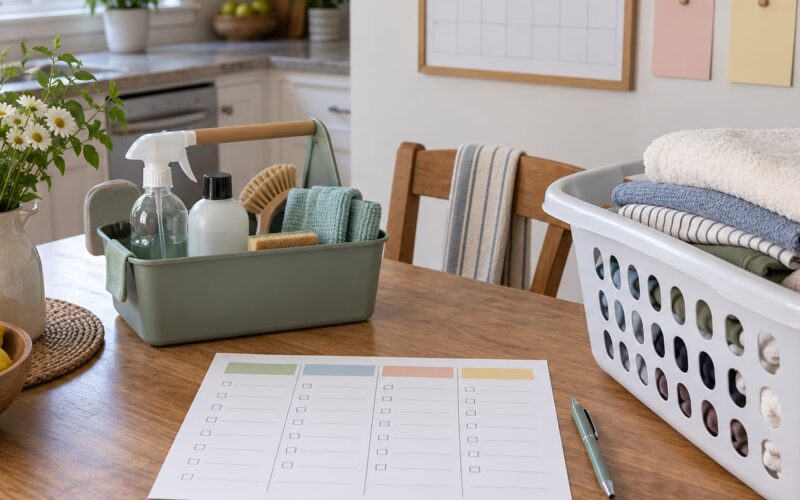
- Two reusable checklists. One for your weekly reset, one for your daily reset. Laminate them or keep them in a notes app. Reusable means you stop rebuilding the list from memory every time.
Keep the tool count low on purpose. People who juggle five apps, three planners, and a whiteboard end up maintaining the tracking system instead of their lives.
Step-by-Step
Introduce these one at a time rather than all at once. Most families can set up the first three in about thirty minutes and add the rest as they settle.
How to Stay Organized as a Busy Mom: Build One Command Center (Step 1)
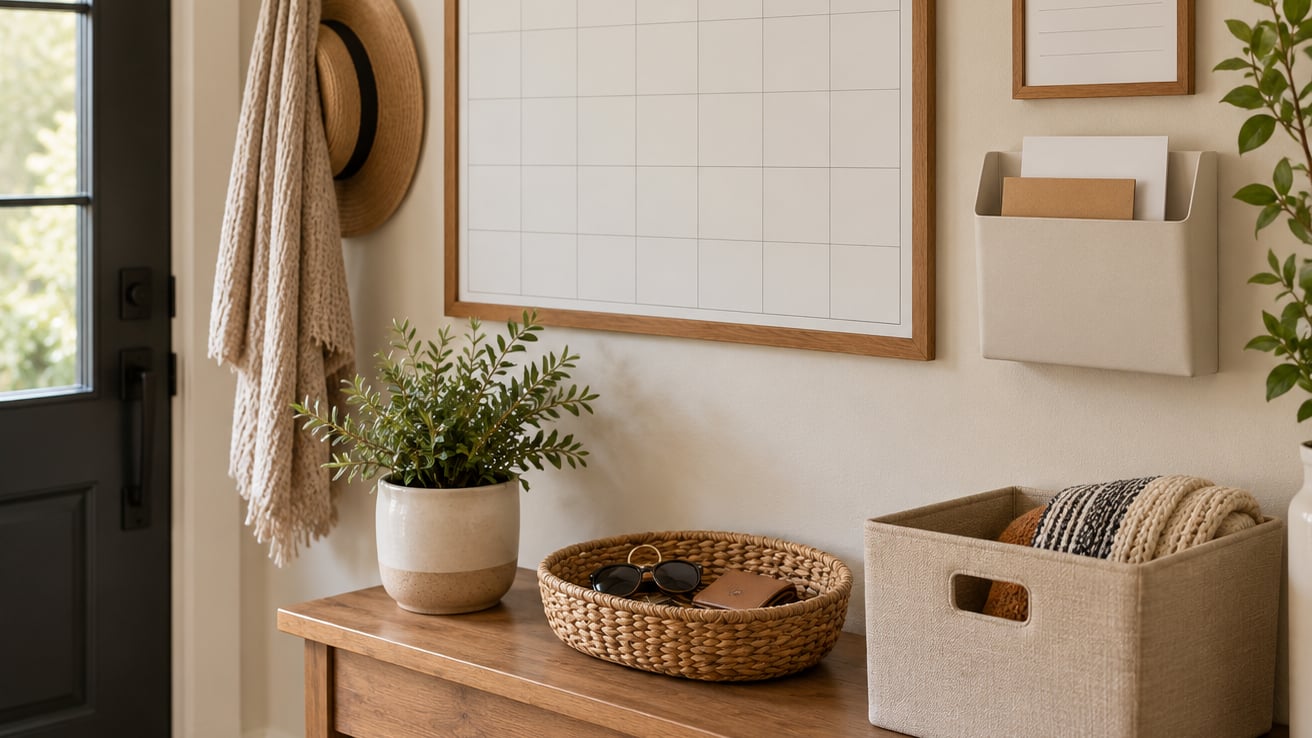
Pick one spot everyone passes through daily, usually the kitchen or the entryway, and let it hold everything on paper. A corkboard or a single sheet of paper with sections beats a pile of folders, because the point is that everything has an address you can point at.
On it, put the family calendar, current therapy and school schedules, appointment times with office phone numbers, your child’s emergency contacts and medical summary, and a small pocket for permission slips that still need signing. Put the actual permission slips in a wall-mounted envelope or a tray, not in your bag, so the school does not become the reminder system.
You will know this step works when you can answer “where is that form” without walking the house. That one question is worth more than any bin or label in the house.
2. Set Up a Predictable Weekly Rhythm (Step 2)
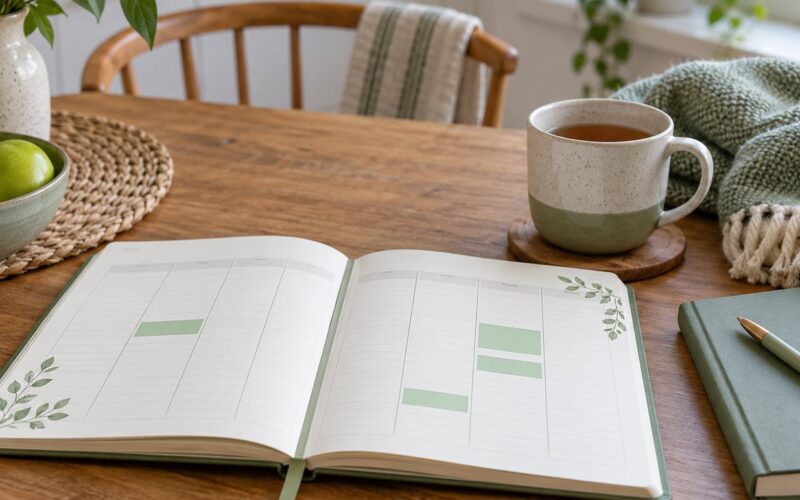
Choose one consistent planning window and protect it, even if it is only fifteen minutes on a Sunday evening. Put school routines, therapy appointments, work commitments, meals, sensory breaks, and recovery time onto the same weekly view so they stop competing with each other in your head.
Leave one or two blocks deliberately empty. Sensory overload, a cancelled appointment, or a rough night happens, and a plan with no gaps has nowhere to put the surprise. If you want a realistic week, build fewer things into it than you think you should.
Some families do this Friday night, some do it Sunday afternoon with coffee. The specific slot matters far less than the fact that it happens the same way most weeks.
3. Plan Meals and Special-Diet Supplies (Step 3)
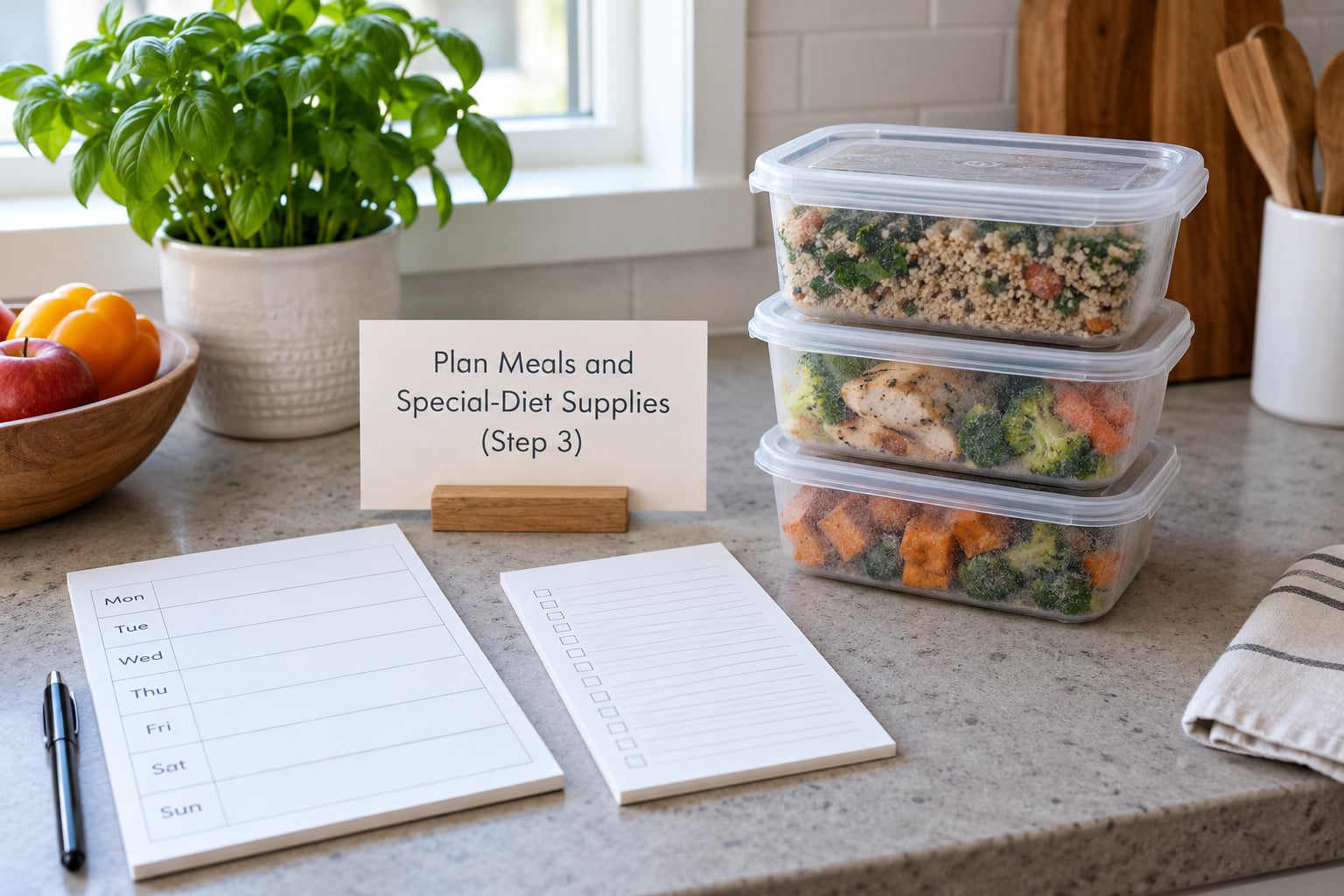
When meals are restricted by allergy, gluten-free or casein-free diets, medical needs, or sensory preferences, planning becomes a logistics problem rather than a cooking problem. Start by separating meals your child reliably eats from meals everyone else eats, so you are not cooking two entirely separate dinners most nights.
Build a simple grocery list from the repeating meals rather than planning every ingredient from scratch each week. Then keep a reserve: a small amount of safe food in the freezer for the evening when therapy runs late or the day goes sideways. For ideas on how to stock that reserve in advance, I wrote up how to stock a gluten-free freezer for busy weeks.
Ask your child’s pediatrician or a registered dietitian about any restriction you are considering. They can tell you whether a diet is safe for your child, and a plan built on their guidance will hold up when a growth spurt or a new diagnosis changes things.
4. Create Go-to Storage Zones (Step 4)
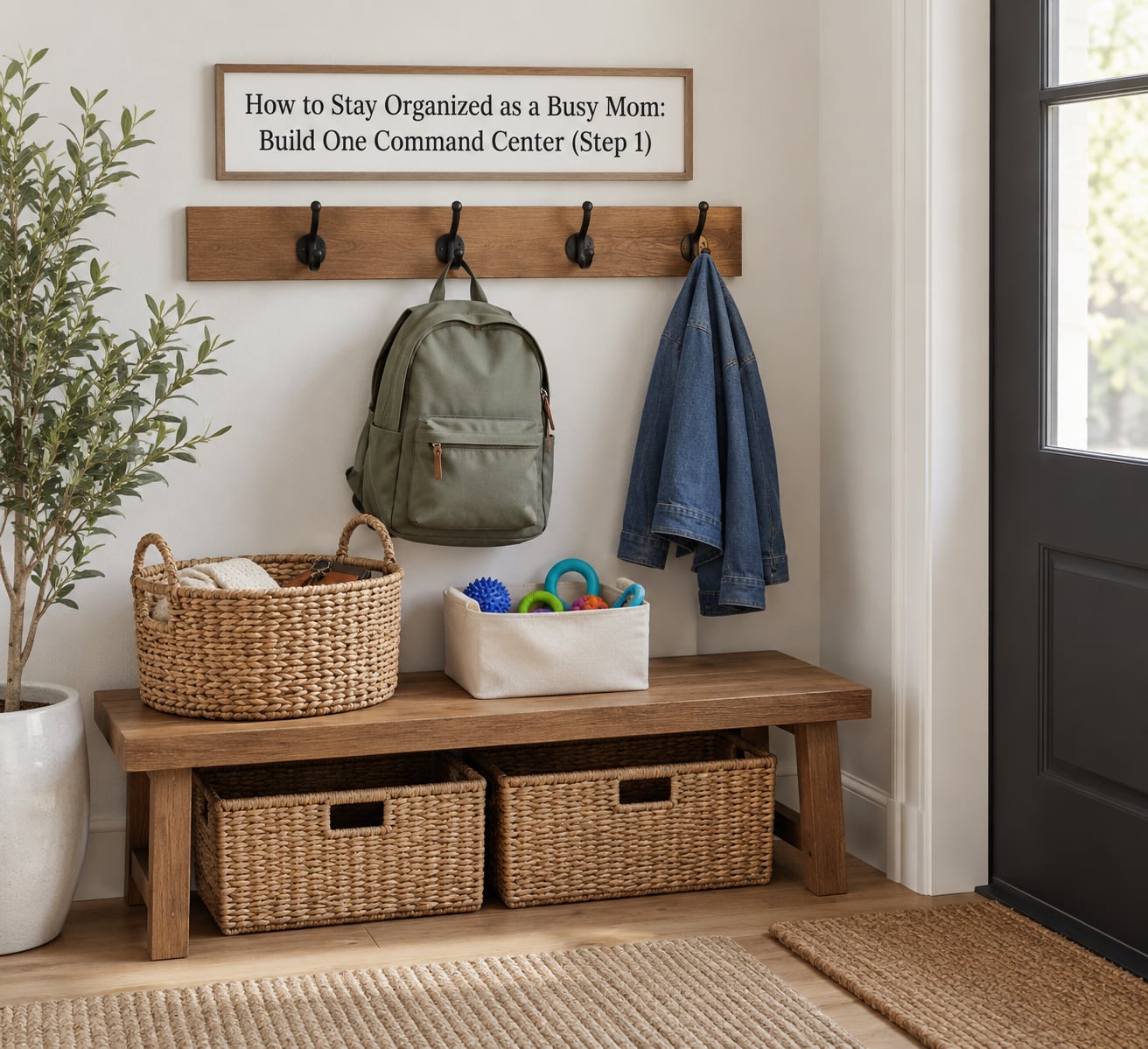
Give every category of daily clutter one assigned home, and put it where the thing actually happens rather than where it “should” go. A sensory toolkit lives in the room where your child uses it, therapy materials sit near the spot where you unpack them, and a grab-and-go activity bin lives by the door.
Use open bins and picture labels for anything your child handles independently. Closed containers look tidier but add a step that a tired child will skip. A labeled basket for shoes, jackets, and backpacks near the door removes the search that eats ten minutes every single morning.
Expect this to be the step that needs redoing. Kids change interests, sizes, and coping tools constantly, so a zone that worked last season may need a new label this one. Reshelve rather than abandon.
5. Build a Two-Minute Daily Reset (Step 5)
Every evening, run the same short sequence: look at tomorrow’s schedule, prepare what tomorrow needs, clear the two or three high-traffic surfaces, and decide what the first task of the morning is. Write that first task down so you are not reconstructing your day while making coffee.
Two minutes sounds too short to matter, which is exactly why it works. It is short enough to do on your worst evening, and done often it prevents the late-night pile-up that turns a Tuesday into a crisis. Five-minute evening tidies are the most consistently recommended habit in mom communities, and the reason is durability, not effort.
6. Manage Paperwork Without a Paper Pile (Step 6)
Sort incoming paper into four destinations as it arrives: action, file, calendar, archive. Anything with a date goes on the calendar first. Anything requiring a signature goes into the action tray, and that tray gets emptied weekly whether or not you have signed the forms yet.
Set a recurring weekly reminder, ten minutes, to process the action tray and check for expiries such as insurance forms, therapy authorizations, and IEP or school plan reviews. Record the important dates on the command center calendar so they stop living only in your memory.
Most lost paperwork is not lost at all. It is sitting in a bag waiting for a moment of attention that never arrives, and a scheduled ten minutes prevents that.
7. Protect Your Energy and Leave Room to Reset (Step 7)
Put your own meals, water, movement, and sensory support into the weekly plan as fixed entries, not leftovers around the edges. Eating whatever is left over at 8 p.m. after everyone’s day is over is how most caregiving years quietly wear a body down. My short list for that is how to stay hydrated during a busy day and quick workouts for busy moms at home that take minutes, not an hour.
Then build in buffer time. Disability-related needs change: a new sensory trigger, a growth spurt, a medication adjustment, a therapy cancellation. A plan that assumes nothing will ever change will collapse the first real week, and you may blame yourself for the collapse rather than the plan.
Decide in advance what your minimum viable day looks like, and write it down. For some families that is breakfast, one therapy session, and everyone fed. Naming that floor in advance is what keeps a hard week from turning into a crisis.
Common Mistakes
Buying too many planners. Every new tool promises to fix it and none of them get used past the first week. The fix is consolidation: one calendar, one list, one command center. Two tools you love beat six you abandon.
Trying to organize everything at once. A whole-house Saturday produces a photo-worthy kitchen and a tired parent who never touches it again. Pick the single friction zone that costs you the most time, finish it, then move on.
Treating “organized” as a standard to maintain. A home with kids is never finished, and aiming for that ends in guilt. Aim instead for a baseline you can restore in ten minutes. Function beats appearance every time.
Sharing one account or one password across the whole family. It sounds efficient, but it makes it impossible to see what a co-parent already handled and impossible to hand off a task cleanly. Use a shared calendar that anyone can view and edit, and keep personal logins personal.
Skipping the backup plan. A system that only works when nothing goes wrong is not a system, it is a good week. Write your crisis-mode version in advance, short as a paragraph, and put it where you will read it.
Cutting self-care first when the week gets crowded. The meal you skipped, the water you did not drink, and the ten minutes you gave away are what make the next day harder. Protect them as non-negotiables, not as rewards you earn later.
A few tips for choosing a system that will last: pick something you can maintain on your worst day, review it after two weeks rather than abandoning it after two days, expect to relabel as your child changes, and ask other adults in the house to use the same command center instead of keeping their own private system. Organization only holds when it works on a bad day, not on a good one.
Frequently Asked Questions
What is the best planner for a busy mom with special needs?
The best planner is the one you will look at without opening an app, so a wall or fridge planner with room for the whole family week usually wins over a phone app. Choose one that shows therapy, school, and meals on the same view. Skip anything with bells, reminders, and streaks. Fill it in once during your weekly reset and stop managing it daily.
How can I stay organized when my child has sensory or behavioral changes?
Expect the change and plan capacity for it. Keep open bins and picture labels so routines can be found and returned quickly, give transitions a five-minute warning, and leave one flexible block in your week for recovery. When a new need appears, change one zone at a time rather than rebuilding the whole system in a stressed week.
Should I use a shared family calendar or separate planners?
Use a shared calendar for anything another adult needs to act on, such as appointments, school events, and permission deadlines. Keep a separate planner only for your own tasks and appointments. Two systems work well; two calendars for the same event is how duplicated calls and missed pickups happen.
How do I organize medical, school, and therapy paperwork?
Sort into four groups: action, file, calendar, and archive. Anything dated goes on the calendar immediately, and anything needing a signature goes in one tray you empty weekly. Keep a current one-page medical summary in the command center for emergencies, and confirm retention rules with your school or clinic before discarding anything.
What if I cannot complete my organizing routine in one day?
That is the normal case, not the exception. Work in ten-minute increments and only touch one zone per session, such as the entryway, the paper tray, or one shelf. A partial job that gets finished beats a full plan abandoned on Saturday. Keep the weekly reset as your checkpoint even when the deeper work is still spread across weeks.
How do I keep meal planning manageable for allergies and sensory needs?
Plan from a short rotation of meals your child reliably eats, rather than inventing a new menu each week, and separate those from meals the rest of the family can share so you are not cooking two dinners. Keep a reserve of safe options in the freezer for late therapy nights, and ask your child’s pediatrician or a registered dietitian before removing or restricting any food.
A Small System You Can Keep
Start with two things this week: the command center and the weekly reset. Put every piece of family paperwork in one place, then spend ten minutes at the same time each week writing down next week’s schedule, the meals you need, and the first task of Monday morning. That is the foundation.
After a few weeks, add the storage zones one category at a time, beginning with whatever costs you the most time each day. Add your own meals and water to the plan at the same time, since the system only works if it protects you too. Expect to relabel and re-shelve along the way; that is maintenance, not failure.
If you want to know how to stay organized as a busy mom without it taking over your week, the answer is deliberately small: one place for the paper, one ten-minute reset, one home for each thing, and enough slack built in for the week to go sideways.