The calmest way to handle trick or treating with sensory issues is to lower the demands instead of raising the effort. Pick the option your child can actually tolerate, rehearse the exact sequence at home, carry a small sensory toolkit, and agree in advance that leaving after three houses still counts as Halloween.
Most parents I hear from on autism parenting forums have tried the version where you keep pushing, and it usually ends in a meltdown on a stranger’s front lawn at 7:40 pm. A calm plan is not the traditional one. It is the one your child survives with the routine still intact, which is a harder thing to plan and a better thing to protect.
This guide covers what to gather, how to choose an activity level before October 31 arrives, how to run each doorstep the same way every time, what to do about candy, and what to do at 8 pm when the adrenaline drops and the crash begins.
Table of Contents
- What You Need
- The essentials
- The supports that make it easier
- Step-by-Step Plan for Sensory-Friendly Halloween
- How to handle trick or treating with sensory issues: Choose the right activity level
- How to handle trick or treating with sensory issues: Prepare for predictable sensory demands
- How to handle trick or treating with sensory issues: Rehearse before Halloween night
- How to handle trick or treating with sensory issues: Make each stop predictable
- How to handle trick or treating with sensory issues: Create a candy plan
- Common Mistakes and Better Alternatives
- Pushing past the limit
- Spending the whole day preparing
- Going out at peak hours
- Changing plans mid-evening
- Focusing on manners
- Skipping the recovery plan
- Frequently Asked Questions
- What if my child refuses to trick-or-treat after we arrive?
- Can a child with sensory issues participate without wearing a costume?
- How can parents handle allergy-safe or special-diet Halloween candy?
- What sensory tools help with Halloween noise and crowds?
- Is it better to go trick-or-treating early or stay home?
- How do I keep trick-or-treating safe when my child may run into the street?
- Conclusion: Start With the Lowest-Stress Option
What You Need
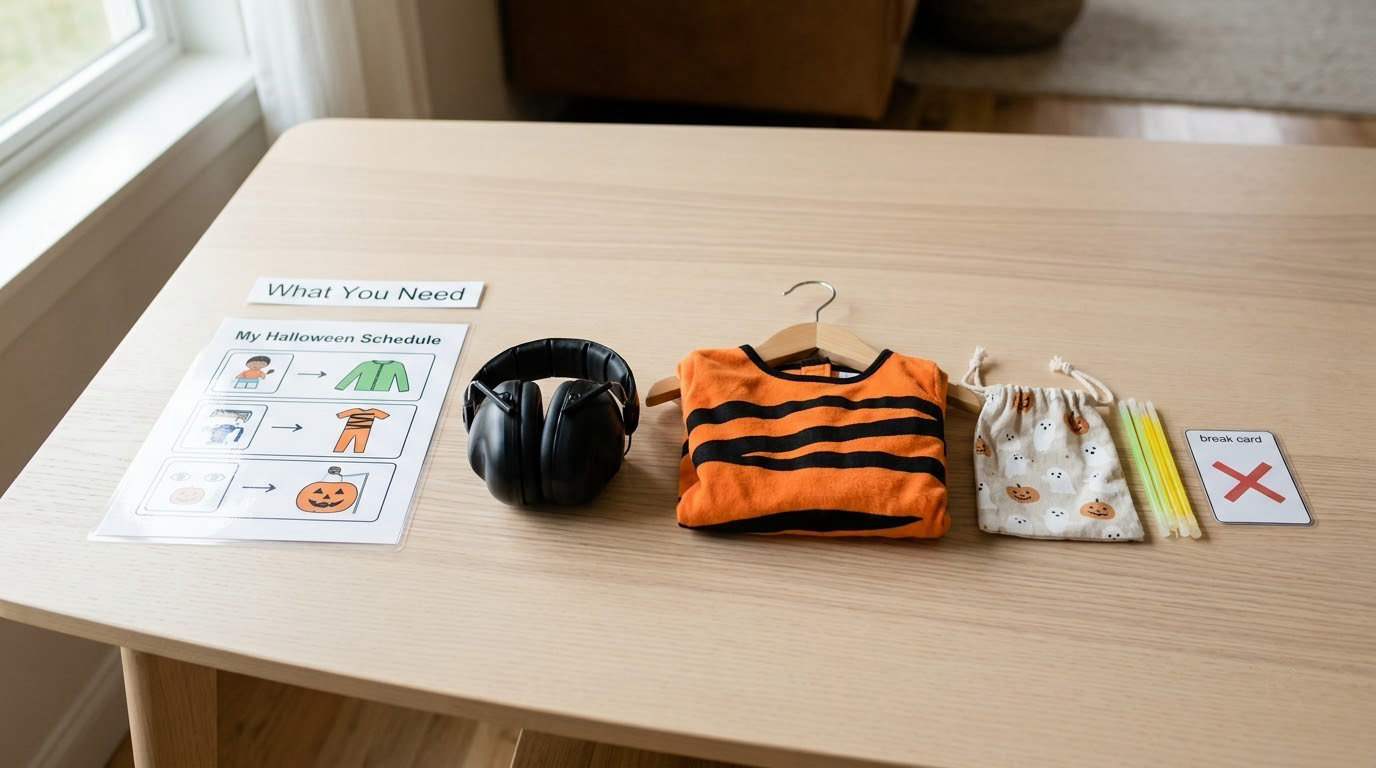
Gather these once, pack them in a bag that stays with you, and do not let the night depend on improvising at a dark doorway. The list is longer than it needs to be, so treat the first group as required and the second as optional.
The essentials
- A visual schedule with a photo or simple drawing for each step: costume, shoes, walk, first door, home, treat sorting. Keep it on one page and mark each step as it happens.
- A costume that has already been worn twice before Halloween, for twenty minutes each time, with no photos and no audience.
- Noise-reducing earmuffs rather than headphones. Over-ear cups that cover the whole ear cut more sound and do not add the pressure of a headband pressing on hair or skin.
- Tinted sunglasses for porch lights, strobe effects, and car headlights in the dark.
- Two fidgets and one chewy item that your child already uses at home. New sensory tools are not calming tools.
- Glow sticks or reflective tape on the costume, the treat bag, and the child. Darkness plus a road is the combination parents worry about most.
- A treat bag with a sorted section for anything your child can actually eat, plus a safe backup snack for the walk home.
- Identification with a caregiver phone number, in case the child is separated from you.
The supports that make it easier
- A code word or hand signal that means we are done. Something your child can signal without speaking, because a child who is shutting down often cannot say the word out loud.
- A second adult whose only job is the child. One adult handles doors, the other handles the child and the bag.
- A comfort layer of soft, tagless, familiar clothing worn under the costume. This is the single most-mentioned trick in parent forums for a reason: it removes the tag question entirely.
- Emergency exit language agreed in advance, like “we are going to the car for a snack” as a real statement rather than a threat.
What you do not need: a full trick-or-treat route mapped house by house, matching costumes for the family, or a plan that runs until 9 pm. Every extra element is another thing that can go wrong on the night.
Step-by-Step Plan for Sensory-Friendly Halloween
The plan runs in this order, and the order matters. Choosing the activity level first means every later step fits the version of Halloween you are actually doing, not the version you hoped for.
How to handle trick or treating with sensory issues: Choose the right activity level
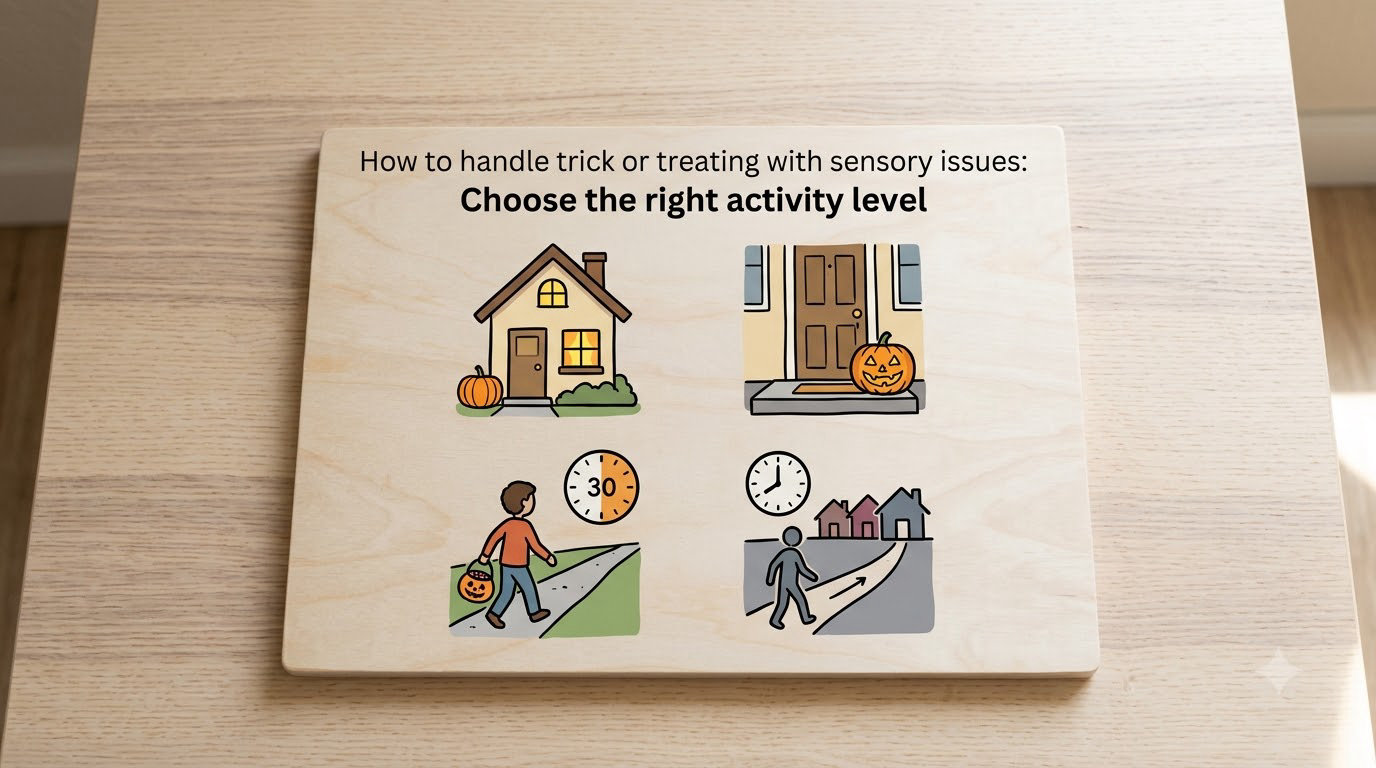
Before October 31, sit down and pick one of four levels. Present them to your child as choices rather than as a plan you are imposing, and let the answer be final.
| Option | Sensory load | Social demand | Best when |
|---|---|---|---|
| Stay home and hand out treats | Low, fully controlled | Neighbors come to you | Your child wants the treat but not the door |
| One or two familiar neighbors | Low, short | Two known adults | Your child is close with those families |
| Short timed outing | Medium, time-boxed | Several brief doors | Your child handled practice runs well |
| Skip trick-or-treating | None | None | Recovery, illness, or a hard month |
Parents in autism parenting groups say the same thing over and over: the answer for most children is one of the first two rows, not the third. A child who ends the night distressed has not had a good time, no matter how many doors you knocked on.
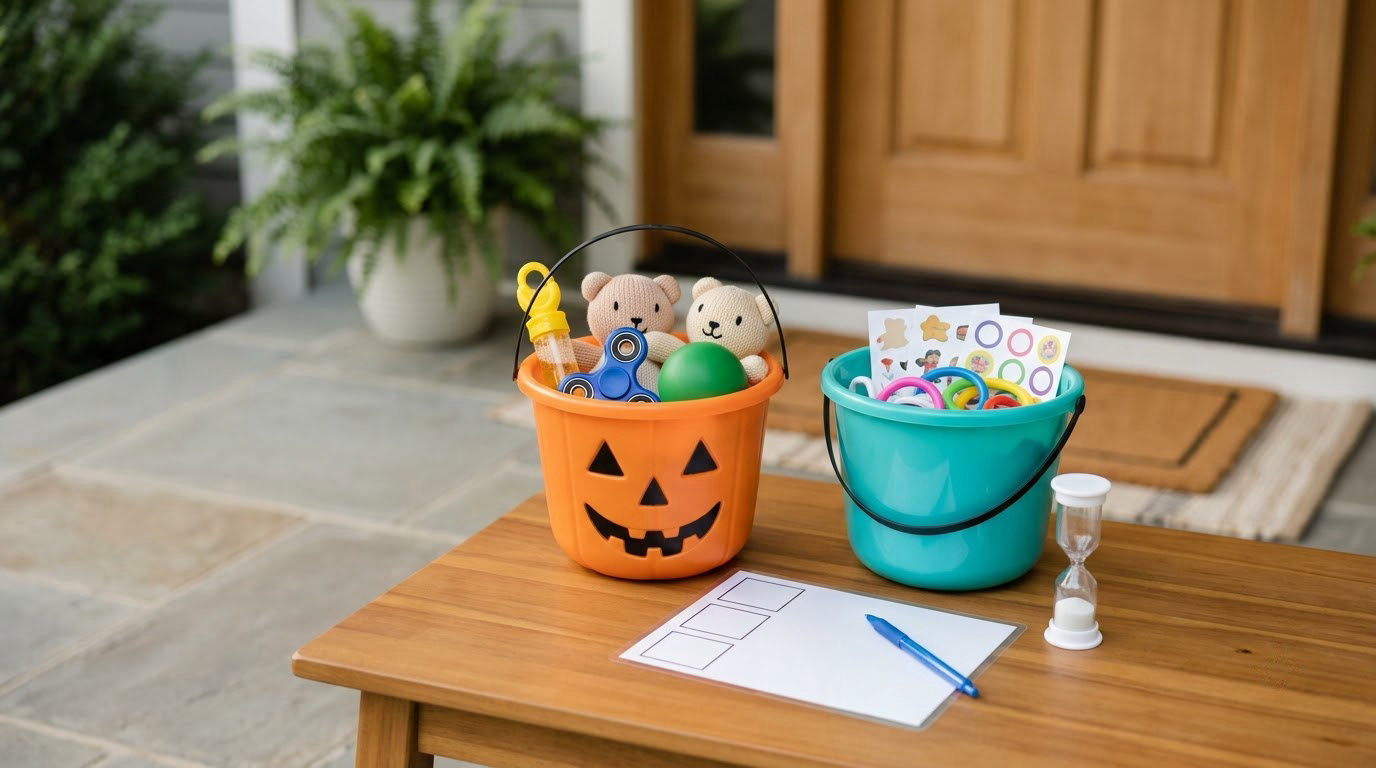
Two more options sit alongside these. A trunk-or-treat event at a school or community center gives your child a car trunk to approach rather than a front door, and a decorated home with treats set out on a table lets your child collect without performing the script at all.
How to handle trick or treating with sensory issues: Prepare for predictable sensory demands
Halloween stacks triggers instead of presenting them one at a time. Knowing which ones are likely lets you match each one with something specific, and a specific tool works better than general calm.
- Dark houses and porch lights. Carry the tinted sunglasses and let your child put them on before you knock, not after they flinch.
- Fog machines, strobes, and flashing decor. Walk the route in daylight first if you can, or pick streets you know are low on effects. Earmuffs come out when you see a light source you did not plan for.
- Barking dogs and outdoor speakers. Change sides of the street where possible. A two-minute detour is worth more than ten minutes of recovery later.
- Crowds. Go at dusk rather than at full dark, when most families with young children are out. Fewer people, more visible houses, more street lighting.
- Costumes on other children. Point this out in advance in the schedule, with a line like “some children wear big costumes, and that is okay.”
- Unfamiliar adults at the door. Practise the greeting so it is a known sequence rather than a small social test.
Keep a note of what actually overloaded your child last year. Sensory profiles shift with sleep, health, and school stress, so last year’s list is a starting point, not a fixed profile.
How to handle trick or treating with sensory issues: Rehearse before Halloween night
Rehearsal is the step parents most often skip and the one that changes the night most. The goal is familiarity, not performance, so keep every session low pressure and end while it is still going well.
Start two weeks out with the visual schedule. Read it through together, then again the next day, then let your child move the pictures around. A schedule your child built feels different from one you handed over.
Next, run pretend play at home. You play the neighbor: you answer the door, you hand over a piece of pretend candy, you say the thank-you, you close the door. Do it in daylight, in the same clothes your child will wear, five or six times over two weeks. Stop after two successful repetitions each session rather than pushing for a full run.
Then do one drive-by practice. Sit in the car on the actual street, look at the houses, do not get out. Some families do it a week before and again on the day, and the second pass is usually calmer than the first.
For a child who has never trick-or-treated, drop the social story for a photo story instead: a photo of your child in costume, a photo of a door, a photo of a treat in a bag, a photo of home. Photographs carry less language load and often land better with younger children.
Ages differ here. A toddler needs two-minute rehearsals and mostly needs to know nothing bad happens. A school-age child can work with a countdown and a clear house list. A teenager usually wants the whole thing dropped, and a costume that is optional gets a better response than a persuasive argument.
How to handle trick or treating with sensory issues: Make each stop predictable
The same six-step routine at every door does more for regulation than any single product. Run it identically at house one and house twenty, and your child learns that the sequence itself is safe.
- Pause before knocking. Two slow breaths, hand on the earmuffs. This is the step parents skip and the one that prevents most door escalations.
- Knock or ring, then wait. Let the door opening happen at their pace, not yours.
- Say the short greeting. “Trick or treat, please” works for verbal children. For a non-verbal child, hand them a card, hold up a phone with the words on it, or simply let your child wave. Nobody needs the script.
- Let your child choose their distance. Standing beside you, sitting in a wagon, or watching from the driveway are all legitimate positions.
- Take the treat and go. Do not linger, do not make small talk, do not accept a second offer. A short visit is easier to repeat than a long one.
- Check in between houses. One thumbs up or thumbs down, or point to a picture on the schedule to mark how many are done.
Two things to plan for. First, some neighbors will not hand anything over until your child says the phrase, and that moment can unravel a whole evening. Mentioning your child’s communication style in one sentence usually fixes it.
Second, treat the stranger-safety contradiction head on. You have spent years teaching your child not to approach strangers, and Halloween asks them to knock on doors. Say it out loud in the rehearsal: knocking is a rule for tonight only, we stay on the sidewalk, and you stay where I can see you. Giving it a defined boundary is more useful than skipping the tradition entirely.
Watch for the early signs, not the loud ones. Covering the ears, going quiet, hand flapping, or a sudden interest in the ground usually arrive well before crying. When you see them, use the code word and go. You can always come back to a different street tomorrow.
How to handle trick or treating with sensory issues: Create a candy plan
Candy is where the sensory profile and the diet restrictions collide, and parents on forums ask about this combination more than anything else. Settle it before you leave the house so nothing gets negotiated at a doorway.
Bring a small container and sort as you collect. Put the treats your child reliably eats in one pocket, and everything else in a bag for later sorting at a table, with the lights on and no clock pressure. Most sensory reactions to candy are about texture and temperature, not sugar, so the smarty candies and the gummy worms are often the ones that go straight in the bin.
For allergies and restricted diets, read labels at the door when you can and keep a backup snack in your own pocket. Many parents carry the same treat they know is safe and hand that out at every house, so the child gets the ritual without the risk.
The teal pumpkin project, run by FARE, uses a teal-painted pumpkin to signal that a household is offering non-food treats. A blue pumpkin bucket is used in some communities to signal autism. Both come up in parent conversations, and the honest split is that some families love the signal and others find the labeling harder to explain. If you use one, tell your child what it means beforehand so it is information rather than a mystery.
A small card that travels in the treat bag saves a lot of explaining. It can say that your child is non-verbal, that saying the phrase is not required, and that allergies mean no food, thank you. Neighbors generally respond well to a simple written explanation.
Decide the swap question early. A family that exchanges treats at the door adds a twenty-minute sorting task to a night you were already trying to keep short. Many parents now swap the next morning while everyone is rested, which works far better.
Common Mistakes and Better Alternatives
Almost every hard night traces back to one of six predictable mistakes, and none of them are about effort. They are about timing, load, and expectations.
Pushing past the limit
The mistake is treating the full route as the goal, with the child as the variable to manage. The better version is setting the number in advance and making the exit boring rather than dramatic. “We are doing four houses, then the car for a snack” is a plan the child can hold on to. If you need to leave after three, leave after three. Parents who build the exit into the plan report far fewer evening meltdowns than those who treat leaving as failure.
Spending the whole day preparing
Over-preparing without warning can be its own problem. A child who has rehearsed trick-or-treating in a costume and a schedule all day often arrives already tired, and the anticipation itself becomes the trigger. Do the practice in short blocks on separate days, and keep Halloween night itself low-key and boring until you actually go out.
Going out at peak hours
The busiest window, roughly 7 to 8:30 pm, is also the loudest and darkest. Start earlier, around dusk, when the sidewalk traffic is thin, the street is still visible, and adults out are less likely to be handing out anything alcohol-based. If your child tolerates the early evening well, the last ninety minutes of trick-or-treating is not worth the sensory cost.
Changing plans mid-evening
Announcing a new idea at a doorstep is the fastest way to end the night early. If you need to change something, say it in a neutral tone and give a reason: “we are going to the car now, then home, because it is getting loud.” When a breakdown is already happening, a full guide to calm steps for an autism meltdown (how to handle autism meltdowns at home) is worth reading ahead of time so you are not searching in the moment.
Focusing on manners
Expecting eye contact, a full greeting, and a polite thank-you at every door turns Halloween into a social test. Lower the standard to what your child can actually do and let the rest go. A nod, a wave, or nothing at all is a successful visit. Neighbors who matter will not keep score.
Skipping the recovery plan
The night is not over at the last door. Sensory crash is common hours later, once the adrenaline fades, and parents often describe an evening that went fine ending in a hard night around 9 pm. Plan the landing: a real dinner rather than a candy feast, dim lights, no new activity, screens only if they genuinely help, and an early bedtime than usual. Give the child heavy work afterward, like pushing furniture or carrying laundry, since that kind of input often settles a wired system.
Two more situations come up every year. When siblings have different tolerances, give each child their own level rather than splitting the family in two directions, and let the child who is staying home host something so the evening is not framed as a rejection. And if the costume gets refused on the day itself, drop it without a negotiation. Pajamas, a favorite t-shirt, or a costume worn as a cape all work, and the treat bag is what matters.
Frequently Asked Questions
What if my child refuses to trick-or-treat after we arrive?
Do not persuade at the doorway. Move to a neutral spot, offer water and a fidget, and ask for a thumbs up or thumbs down. If the answer is a down, go home. You can drive past the same street the next day without stopping, which keeps the route familiar without the demand. Most children do better with a short successful outing than a long one that ends in tears.
Can a child with sensory issues participate without wearing a costume?
Yes, and plenty of parents skip it entirely. A costume adds fabric on the skin, heat, tags, and a makeup or mask step, all of which can be a lot on top of everything else. Soft pajamas, a favorite costume worn as a cape, or a plain shirt all work. Many families hand out treats instead, where the treat is the point and the outfit is irrelevant.
How can parents handle allergy-safe or special-diet Halloween candy?
Carry your own safe treat and hand it out at every house, so your child still gets the door ritual without the risk. Read labels when the lighting allows and keep a phone flashlight in the treat bag. A teal pumpkin on the doorstep, as used by the FARE Teal Pumpkin Project, signals non-food treats to other households. Pack a backup snack for the walk home, because hunger adds a whole other layer to regulation.
What sensory tools help with Halloween noise and crowds?
Noise-reducing earmuffs are the first thing most parents reach for, and they matter more than anything else on the list. Tinted sunglasses help with porch lights, strobes, and headlights. Add two fidgets and a chewy item your child already uses at home, a water bottle, and a glow stick for visibility. None of it works if it is a new tool, so borrow and test everything in the weeks before.
Is it better to go trick-or-treating early or stay home?
If you go, go at dusk rather than at peak trick-or-treating hours. Fewer people are out, the street is still visible, and you have more adult supervision than at 8 pm. Staying home is a strong choice too, especially if your child had a hard week. Handing out treats, decorating a pumpkin, or watching a film together still counts as Halloween, and it costs your child nothing.
How do I keep trick-or-treating safe when my child may run into the street?
Add glow sticks or reflective tape to the costume and the treat bag, stay on the sidewalk, and keep a hand on your child or a hand on the wagon at every doorway. A wagon also gives a child a physical boundary to sit in when a door gets overwhelming, which reduces the urge to bolt. For a child who tends to run, practice the doorstep routine at home first and keep the outing short.
Conclusion: Start With the Lowest-Stress Option
Start where your child actually is. Identify the sensory limit, choose the lowest-stress option they can succeed at, and let the treats and the knocking be flexible parts of it. The night works when safety and connection come first and the tradition follows whatever they can handle. If things go sideways anyway, work through the calm steps in our autism meltdown guide and remember that next October is another chance to try a different version.