
Learning how to fit stretching into a caregiving day comes down to one idea: attach 30 to 60 second holds to the caregiving moments that already happen. You are not adding a workout to an already full schedule. You are borrowing two minutes from the kettle boiling, the bath running, or the commercial break while the care recipient watches television. Caregivers report that movement tied to an existing routine is the only kind that survives a real week.
This guide covers what you need, a six-step plan, and the stretches that work best in small spaces with no equipment and no change of clothes. It is general information, not medical advice. If movement causes pain, dizziness, numbness, or symptoms that keep returning, stop and talk to your doctor or a physical therapist.
Table of Contents
- What You Need Before You Start
- Step-by-Step: How to Fit Stretching Into a Caregiving Day
- Step 1: Choose One or Two Reliable Anchors
- Step 2: Start With a Calm Body Check
- Step 3: Use Three-Minute Movement Options
- Step 4: Pair Movement With Everyday Care Tasks
- Step 5: Keep the Routine Playful and Predictable
- Step 6: Track Comfort, Not Performance
- Common Mistakes
- Frequently Asked Questions
- How often should a caregiver get a break?
- What are some good 5-minute stretches for seniors?
- Is it safe to stretch every day?
- How long do you need to hold a stretch for it to work?
- What helps caregiver burnout fast?
- What is caretaker syndrome?
- Conclusion
What You Need Before You Start
You need about a square meter of floor or a chair, a wall, and roughly ten minutes a day that you do not have to defend to anyone. That is the whole list. No mat, no membership, no app, no special clothing.
A surface that is stable. A hallway floor, the end of a bed, or a clear patch of carpet works. If you use a mobility aid or a walker, do your stretches sitting down, where you are already stable. Keep one hand on the chair back or the counter if balance is a question.
Clothing you can move in. Ordinary daytime clothes are fine. This is not yoga, and nothing here needs bare skin or a change of clothes, which matters when the person you care for cannot be unattended for ten minutes.
A cue that does not depend on willpower. A visual schedule card, a note on the refrigerator, a recurring alarm, or a habit tied to something that already happens works better than motivation. Caregivers on Reddit’s r/CaregiverSupport describe the same thing: routines that hang off an existing cue survive, routines that hang off a decision do not.
Realistic timing. Hold each stretch 15 to 30 seconds. Most people need two rounds to feel real relief, and that is fine. Total time per break is 2 to 5 minutes, not 30. A short break that happens every day beats a long one that never happens.
Step-by-Step: How to Fit Stretching Into a Caregiving Day
Step 1: Choose One or Two Reliable Anchors
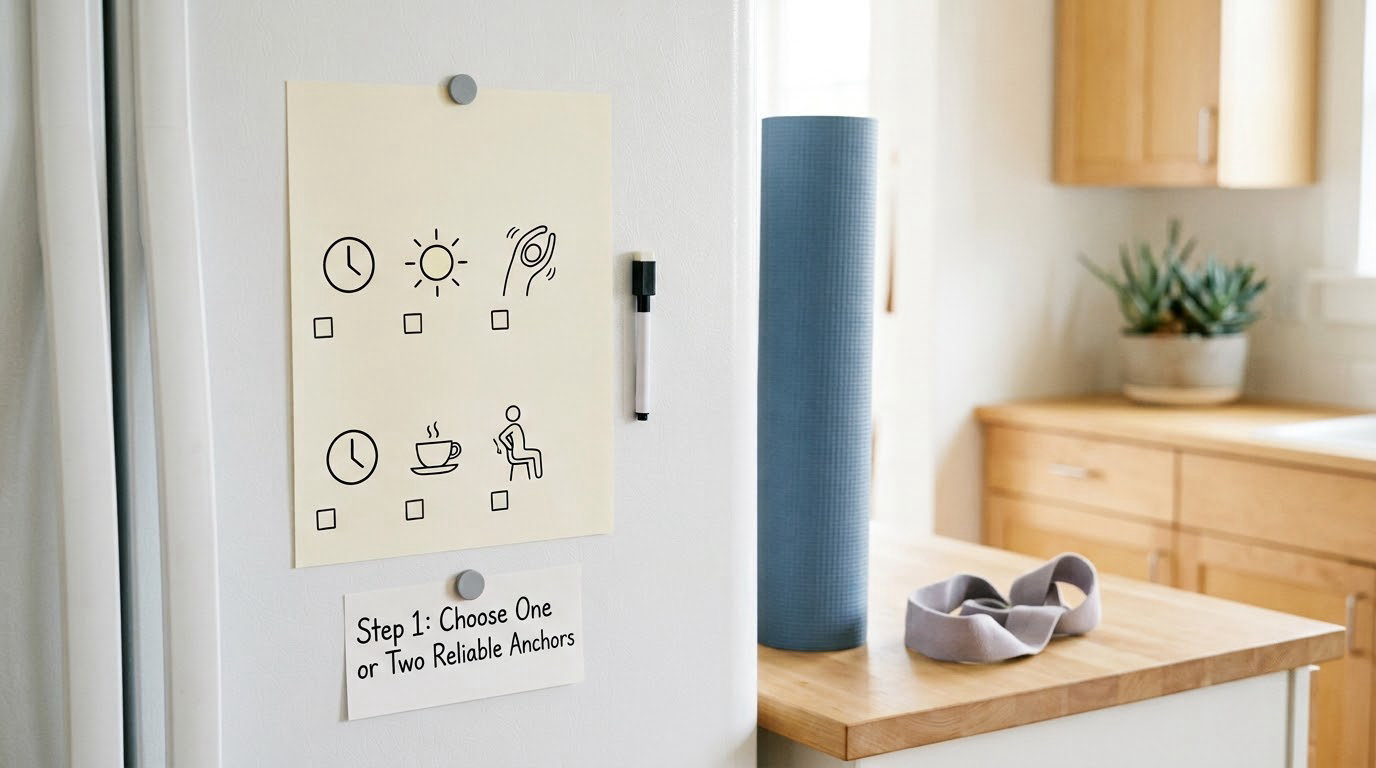
Pick the moments that happen every single day without anyone having to decide anything. Morning dressing. The wait for medication to be swallowed. After a transfer. The kettle. The last commercial before bed. Two anchors are enough, and two anchors you actually keep beat five you rotate through.
Here are anchors that work in real homes. Right after you finish helping with a transfer and before you let go of the person, you have roughly half a minute of natural pause. While a load of laundry runs, you are standing still anyway. During the television credits, both of you are sitting and nothing is required of you. When a load is in the machine rather than the dryer, you have a minute and a half of quiet.
Write the two anchors down and put them where you will see them. If the second one keeps sliding, that is information, not failure. Swap it for a different moment rather than adding a third.
Step 2: Start With a Calm Body Check
Before any movement, ask whether this stretch feels safe and comfortable right now. For an autistic or sensory-sensitive child, ask in whatever way works: a visual card, a picture sequence, a slow demonstration, a countdown, or a simple “stretch now?” and an honest answer.
Watch the signals. Turning away, going stiff, covering ears, crying, shutting down, or freezing in place all mean stop or change something. If movement triggers distress, the routine is doing harm even if the position itself is perfectly safe. Never hold a child in a stretch. Never make movement a reward withdrawn for bad behaviour, and never make it a consequence.
For your own body, the check is simpler. Skip anything that produces sharp pain, pinching, numbness, tingling, or a feeling of a joint slipping. Skip it when you are ill, fevered, or recovering from an injury. Gentle range of motion is the goal, not force and not bouncing into a stretch.
Step 3: Use Three-Minute Movement Options
Give yourself a menu rather than a set program, so you can match the day you are actually having. These need no equipment and work in a small room.
| Stretch | Target area | Hold time | Seated? |
|---|---|---|---|
| Shoulder rolls | Shoulders and upper back | 30 seconds each way | Yes |
| Neck side stretch | Neck and upper trapezius | 20 to 30 seconds each side | Yes |
| Seated knee to chest | Lower back and hips | 20 to 30 seconds | Yes |
| Heel dig or seated hamstring reach | Back of the thigh | 20 to 30 seconds each leg | Yes |
| Standing calf and soleus stretch | Calves and ankles | 30 seconds each side | No |
| Standing hip flexor lunge | Front of the hip | 20 to 30 seconds each side | No |
| Wall or doorway chest stretch | Chest and front of shoulders | 30 seconds | Standing |
| Cat and cow on hands and knees | Spine and lower back | 6 to 8 slow cycles | Floor only |
| Overhead tricep stretch | Back of the upper arm | 20 to 30 seconds each arm | Yes |
| Thoracic twist in a chair | Mid back and shoulders | 20 seconds each side | Yes |
On a low-energy day, do four seated stretches and call it done. On a good day, add the standing ones and work down the list. Animal walks, which means walking on all fours with the hips lifted, are often the most reliable way to get a reluctant child moving, and they double as a sensory-friendly proprioceptive input. Wall pushes and slow animal crawls work without any equipment at all.
Change the menu as needed. Nothing on this list is a commitment.
Step 4: Pair Movement With Everyday Care Tasks
Habit stacking is what makes this work long term. Attach each stretch to a caregiving task that already has a natural pause built into it.
- After bathing. Towel, pajamas, and then 60 seconds of calf and hip flexor work while the child is getting dressed. You are standing still in a small space anyway.
- While a meal cooks. The stove is off and nobody needs you for four minutes. That is one full routine.
- During television commercials. A two-minute commercial break is a natural timer. It even tells you when to stop.
- While waiting for medication. Two to three minutes of seated work fills the pause without asking for anything.
- After a transfer. The moment your hands come off, before you turn around. Shoulder rolls and a neck stretch take under a minute.
- Before you turn in for the night. Two minutes of slow stretching while the room settles helps you stop bracing.
None of these add a single minute of caregiving time. That is the whole point, and it is why this is the version of self care that actually fits.
Step 5: Keep the Routine Playful and Predictable
How to keep the routine workable with a sensory-sensitive child is mostly about predictability more than fun. Same order, same song, same time. A picture card with five icons showing the sequence reduces the anxiety of not knowing what comes next, and a countdown from three lets a child finish a movement rather than being stopped mid-way.
Add choice where you can: which stretch comes first, which song plays, whether you count to ten or to twenty. Choice costs you nothing and returns a surprising amount of cooperation.
Keep the language low pressure. “Stretch and then screen” lands better with most autistic children than any request framed as exercise or a lesson. If the care recipient joins in, you get bonding and role modelling at the same time, and caregiver support threads describe care recipients joining in as one of the few suggestions that made self care feel like shared time rather than time taken away.
If the music is too loud or the counting is stressful, drop both. Silent stretching with a visual timer works.
Step 6: Track Comfort, Not Performance
Judge success by how the routine feels, not by how far anyone bends. A good week looks like: the child participates without distress, you notice less neck and lower back tension at the end of the day, the routine still happens after a bad night, and taking the break stops feeling like a reward you have to earn.
Keep it simple. Once a week, note three things in a notebook or phone note: how many breaks you actually took, how your body felt during and after, and whether anything caused distress. Patterns show up within a month. Most families find one anchor works reliably and the other never takes hold, and they drop the loser.
Talk to your doctor or a physical therapist before starting if there is an injury, recent surgery, osteoporosis, balance problems, a history of fainting, or ongoing back and neck pain that is getting worse. A physical therapist can also hand you stretches matched to the specific transfers you do every day, which no general article can do.
Common Mistakes
Mistake 1: Building a 30 minute routine. It will not survive contact with a caregiving day. Fix: cap it at two anchors of 2 to 5 minutes each. The American Heart Association’s caregiver movement guidance works in the same direction, nudging small amounts of extra movement onto existing routines rather than onto a new schedule.
Mistake 2: Forcing participation. A break that ends in distress gets avoided for days. Fix: follow the communication, accept a smaller version, and try again later. A child who participates in one stretch out of five is doing better than a child hiding from the routine.
Mistake 3: Planning around an ideal day. If your plan assumes two free hours, it fails by Tuesday. Fix: write the plan for your worst realistic day first, then improve it.
Mistake 4: Treating stretch breaks as optional self care you have earned. Caregiver burnout builds when rest waits for a day that never comes. Fix: the 2 minute minimum counts. Do it imperfectly. Caregivers on support forums consistently point to short, regular breaks plus better sleep as what actually helped, not one heroic stretch session.
Mistake 5: Skipping movement entirely after a hard or sensory-heavy day. Those are the days your shoulders are most clenched. Fix: do the seated version only, 60 seconds, breathing slowly. Low is fine.
Mistake 6: Adding stretching without fixing lifting technique. Stretching cannot undo a bad lift, and it is not a treatment for an injury. Fix: keep loads close, lift with your legs, pivot with your feet rather than twisting your spine, and get hands-on instruction for any transfer that regularly hurts.
Mistake 7: Waiting for your own quiet time. If the person you care for cannot be left alone, you have designed for a day you will not get. Fix: do everything seated, in the room, in ordinary clothes. Nobody needs to know.
Frequently Asked Questions
How often should a caregiver get a break?
There is no single number that fits every caregiving situation, and anyone promising one is oversimplifying. In practice, most caregivers report that short and regular beats long and rare: a few minutes every few hours works better than one long break that never arrives. Movement every day also matters more than a large session once a week. If you are the only person available for supervision, break up your day instead of planning an escape.
What are some good 5-minute stretches for seniors?
Pick five that use no equipment and can be done seated: shoulder rolls, neck side stretch, seated knee to chest, a seated hamstring reach, and a thoracic twist in a chair. Hold each 20 to 30 seconds and repeat the shoulder and knee stretches a second time. That fills five minutes comfortably and covers the areas that get tight from repeated lifting and bending.
Is it safe to stretch every day?
Yes, for most people gentle stretching is considered safe to do daily, and regular movement is generally better than occasional long sessions. The key word is gentle. Move slowly, ease into each position, breathe out as you stretch, and never bounce. Stop if you feel sharp pain, pinching, numbness, or dizziness, and skip stretching entirely if you are ill or recovering from an injury. Ask your doctor or a physical therapist first if you have osteoporosis, balance problems, or recent surgery.
How long do you need to hold a stretch for it to work?
Most general guidance suggests holding a static stretch for 15 to 30 seconds and repeating it two or three times on each side. Longer holds are not automatically better, especially first thing in the morning when muscles are cold. In a caregiving day, two solid rounds of 30 seconds is realistic and counts. The second round is where most people notice the difference, so if you have time for only one, take the one that targets the area that aches most.
What helps caregiver burnout fast?
Burnout is not solved by one quick fix, but the fastest relief usually comes from reducing isolation and adding small, reliable breaks rather than one large change. Caregivers describe short regular breaks, better protected sleep, and movement that happens alongside the person they care for as the changes that helped most. Talking to other caregivers and arranging any form of respite matters too, because care that stays entirely in your head gets heavier. Persistent exhaustion, hopelessness, or trouble functioning deserve a conversation with your doctor.
What is caretaker syndrome?
Caretaker syndrome is the informal name for the exhaustion, sleep disruption, stress, and physical tension that build when someone provides sustained care to another person. It is widely discussed as a form of caregiver burnout and often shows up as irritability, trouble sleeping, and back or neck pain. It is not a diagnosis. If these symptoms persist, or if you feel hopeless, a doctor or therapist can help you work out whether depression or anxiety is also part of the picture.
Conclusion
Start with one three-minute movement break attached to a moment that already happens every day, such as just after a transfer or while the kettle boils. Do the seated version first, skip anything that hurts, and expect it to feel awkward for a week. Once it holds for a week, add a second anchor, then write down how your body felt. If pain shows up or symptoms keep returning, that is a conversation for your doctor or a physical therapist, not something to stretch through.