

The best way to talk to siblings about the future is to start before anyone is in crisis: pick a calm moment, share a short written agenda, describe what your child is good at before you describe what they need, and make clear that no sibling is legally required to become a caregiver. Then end the meeting with one written next step and a date to meet again.
I know how that sounds. Practising it in my head, the conversation still feels like opening a door I have been propping shut with my foot. The truth is most families are not avoiding this because they do not care. They are avoiding it because it is three conversations in a trench coat: one about a child’s future, one about a parent’s mortality, and one about who in the family will carry the load.
Silence does not fix any of that. It just decides for you. The default outcome of saying nothing is that the care lands on whoever lives closest, has the most flexible job, or feels least able to walk away, and nobody agreed to it.
Here is what a workable version of this conversation looks like, and how to run it without burning the sibling relationship you need more than ever.
Table of Contents
- What You Need Before the Conversation
- How to Talk to Siblings About the Future: A Step-by-Step Plan
- How to Prepare the Information You Want to Share
- How to Choose the Right Time and Setting
- How to Explain the Future Without Promises You Cannot Keep
- How to Help Siblings Ask Honest Questions About the Future
- How to Turn the Discussion Into a Shared Plan
- How to Revisit the Plan as the Child Grows
- Common Mistakes to Avoid in This Conversation
- Helpful Communication Tips
- Frequently Asked Questions
- When should I talk to my other children about their sibling’s future?
- What if my siblings disagree about what my disabled child will need?
- Does a sibling have to become a caregiver or legal guardian?
- What future-care documents should our family discuss with a professional?
- How do I bring up future needs without frightening my children?
- Conclusion
What You Need Before the Conversation
You do not need everything figured out. You need a small, honest pile of information, and permission to say out loud which parts are guesses.
The child’s current routines. What a good day looks like, what the hard parts of the day are, what helps when things go wrong. Concrete detail is far easier for a sibling to picture than a diagnosis, and it stops the meeting turning into a debate about labels.
How your child communicates. Spoken words, sign, a device, pictures, behaviour. Siblings who live far away often have no idea what this looks like now, and guessing badly is one reason conversations go sideways.
The support services already in place. Who comes to the house, which school or day programme, which therapies are booked, who holds the appointments. Write it on one page. This is often the piece siblings are most surprised by.
Dates you already know. School leaving age, the end of a service contract, a move, a parent starting a new treatment. Dates turn an abstract worry into a planning problem, and problems are easier to solve than dread.
Known future plans. Any support living option you have looked at, any benefit or waiver you have applied for, any advocate or case worker involved. Bring the options, not the decision.
Financial and benefits information. What benefits your child receives, what it covers, what it does not. Bring the question list, not the whole binder. A sibling who sees one page is far more likely to engage than one handed a folder.
The questions nobody can answer yet. Write these down separately and say out loud that they are open. Naming the gaps buys you enormous credibility, because you are no longer pretending to have a plan you do not have.
How to Talk to Siblings About the Future: A Step-by-Step Plan
How to Prepare the Information You Want to Share
Split what you have gathered into three piles and label them as such. Confirmed plans, possible options, and open questions. When those three are blurred together, a sibling hears a demand where you meant a discussion.
Write one paragraph about your child that starts with strengths. What they enjoy, what they have learned this year, what makes them laugh, the thing they do better than anyone else in the family. Siblings absorb that paragraph faster than any list of needs, and it changes the tone of everything after it.
Then write a second paragraph about support needs, and a third about what happens when those supports are missing. That third paragraph is the one that surprises people.
Keep the financial and legal material to whatever your siblings need in order to have an informed opinion. If a decision needs an attorney, a special needs planner or a care coordinator, mark it clearly as a question for a professional and move on. You do not need to become the expert in the room.
How you know it worked: your sibling can repeat back your child’s strengths before you get to the hard part.
How to Choose the Right Time and Setting
Choose a time when everyone has unhurried space. Not after a fight, not on the drive to a funeral, not during a holiday gathering, not the week a parent comes home from hospital. A conversation needs at least ninety minutes, and asking for a specific date is itself a good sign that you take it seriously.
Private beats public. A kitchen table with two chairs beats a group chat with eight people and no eye contact. If your sibling lives in another state or country, a video call works, but send the written agenda the day before so nobody is processing new information and new emotion at the same time.
Send the agenda early. Three bullet points and a time limit, plus the line that nobody is being asked to sign up for anything on the spot. That single sentence lowers the temperature more than almost anything else you can say.
How you know it worked: people arrive and you can tell they have thought about it, not just been summoned.
How to Explain the Future Without Promises You Cannot Keep
Use plain language, and keep hope in the same sentence as reality. Instead of saying everything will be fine, say which parts are still unknown and which parts are already handled. Parents have told me the honest version lands better than the reassuring version, because children can tell the difference.
Keep the child at the centre in how you speak about them. Talk about your child as a person with preferences, not as a case to be solved. If your child can express a view, even a narrow one, that view belongs in the plan and belongs near the top.
Be explicit that the future is a set of options with trade-offs, and that your family will keep choosing as your child changes. There is no single script that holds for a four-year-old and a nineteen-year-old, and pretending otherwise wastes everyone’s time.
And say the part most families skip out loud: no sibling has a legal obligation to take over day-to-day care. Brothers and sisters are not automatically next of kin in a way that creates a duty, and a sibling is fully allowed to say no, or not yet, or not that. Permission to say no is what makes an honest answer possible.
How you know it worked: your sibling is asking questions about your child rather than about themselves.

How to Help Siblings Ask Honest Questions About the Future
Give them permission to ask the hard ones, and ask some of them yourself first. A sibling who has never been invited to worry tends to worry alone, and worry alone turns into avoidance.
Ask what role, if any, they want to have. Ask what they can realistically offer: a phone call a week, a school holiday, a standing appointment, money, advocacy, a ride. Offer categories rather than one vague plea for help, because categories let people say yes to something small without agreeing to a lifetime.
Ask what they are worried about losing, because it is often not the caregiving itself. It is their own family, their freedom, their place in the family story, or the version of their sibling they grew up with.
Ask how they can take care of themselves in this, and say out loud that rest is a legitimate part of the plan. A sibling who is told to hold it all together will eventually break, usually badly, and usually silently.
Then ask the two questions that catch people most often. How will we share information as a family, so nobody is the sole relay between services and siblings? And what do you need from the rest of us to keep being in this?
How you know it worked: you leave with a list of wants and limits, not a vague feeling that something was discussed.
How to Turn the Discussion Into a Shared Plan
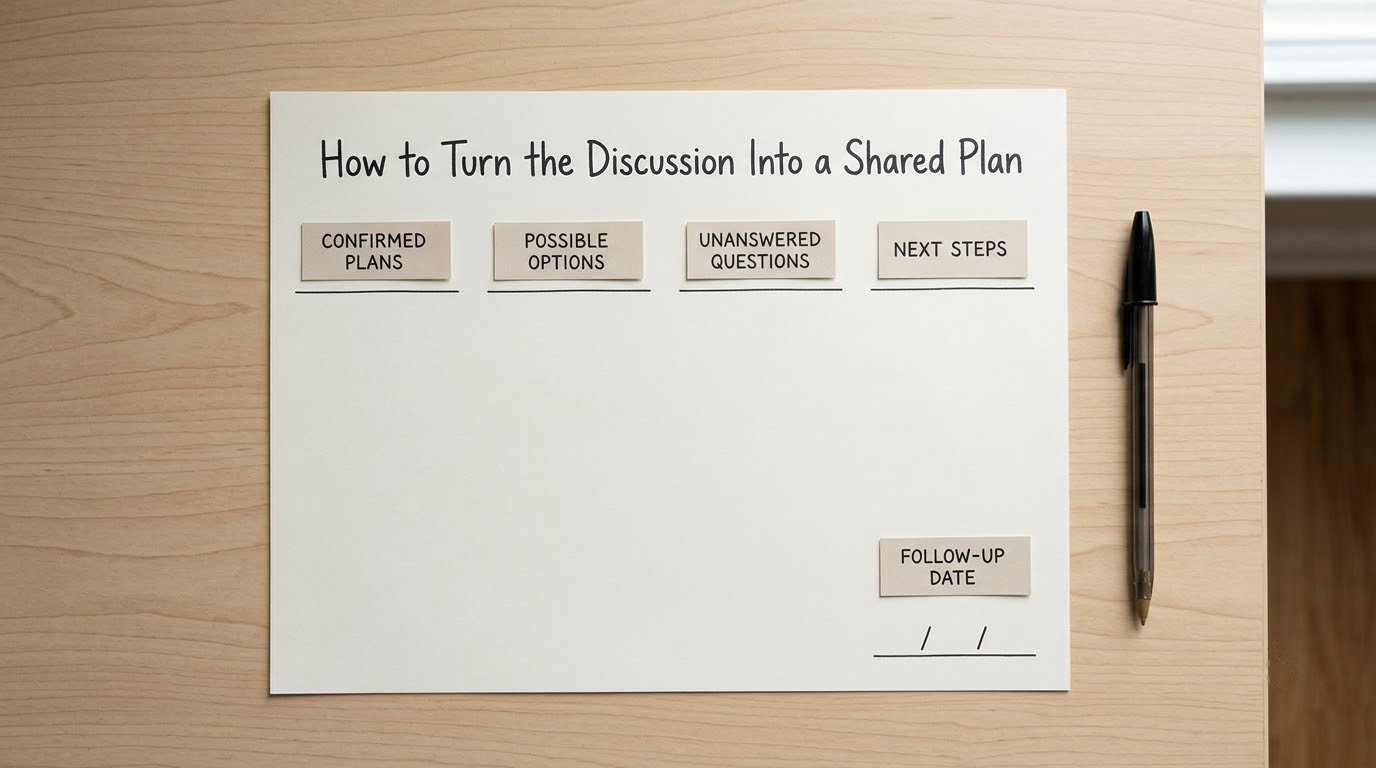
A conversation with no written outcome becomes a memory, and memories fade. Record five things at the end of every meeting.
Immediate actions. Who calls which service, what gets looked up, by when.
Responsibilities. Who holds the medical information, who manages the calendar, who is the named contact for the support team. These are small jobs, and small jobs are what actually distribute a burden.
Decisions that still need review. Financial and legal questions marked clearly as needing a professional, with a date to book that appointment.
Questions for professionals. Collected, not answered badly in the moment by a sibling with no training.
The follow-up date. Put it in a shared calendar before anyone leaves the table. A three-month rhythm keeps planning alive and stops the subject from being banished for another year.
How you know it worked: one person owns the document, everyone agrees where it lives, and the next meeting is on the calendar.
How to Revisit the Plan as the Child Grows
Treat future planning as a living document, because your child is a changing person. What worked at six will not work at sixteen, and a plan that never gets updated quietly stops matching the person’s life.
Revisit preferences first, since they shift fastest and matter most. Then look at transition services, living arrangements, communication methods, education or work, and the siblings’ own capacity to help. Capacity is not a fixed virtue, and a plan built on a sibling’s spare hours in one decade will not survive contact with a new job, a new baby or a new divorce.
Anniversaries and service transitions are natural review points, as are the ordinary moments when something stops working. If a placement falls through or a behaviour plan changes, the plan needs a rewrite, not a crisis meeting.
How you know it is working: the last review produced a change, even a small one. A plan nobody ever edits is not a plan, it is a keepsake.
Common Mistakes to Avoid in This Conversation
Forcing the conversation on a bad day. The fix: book it. A scheduled conversation nobody wants is still better than a confrontation nobody can process.
Assuming one sibling will step up. The fix: ask the whole group, never name a person first. The sibling you have already decided should do it is the one most likely to refuse and least likely to trust you afterwards.
Making legal or medical claims you cannot support. The fix: read those items out loud as questions, and commit to finding out. Guardianship rules, benefits and medical matters differ by state and country, and a confident guess is worse than an honest question.
Talking about your child as a burden. The fix: rewrite the sentence to start with what they can do and like. Language shapes what your siblings will say about your child when you are not in the room.
Delaying until there is no choice left. The fix: pick a date inside the next two months, however uncomfortable. Options shrink sharply once a parent is ill, once services have lapsed, or once a sibling has already moved on with their life.
Ending without agreed actions. The fix: never end a meeting with a hug and nothing else. Write the five items down before anyone gets up.
Leaving one sibling out of the loop and then resenting them. The fix: agree how updates are shared, and stick to it. Silence breeds the assumption that someone is shirking.
Helpful Communication Tips
Start every discussion with your child’s strengths. Use open questions rather than questions that defend a position. Repeat the family’s commitment out loud, so the sibling hears that nothing is being changed without them. Allow silence, because silence is often where someone is deciding how honest they dare to be.
Separate facts from fears explicitly. “The service ends in June” is a fact. “Nothing is going to work after that” is a fear, and the two deserve different responses.
When a sibling deflects with a joke or changes the subject, do not force it. Say something like: I can see this is a lot, and I would rather hear that you are not ready than leave with nothing. Then keep the date. That single move is often more productive than another hour of pushing.
Keep a shared written record, keep meetings short, and end early while everyone is still engaged. A forty-five minute conversation that ends with five written actions beats a three-hour marathon that ends with exhaustion and a vague agreement.
Frequently Asked Questions
When should I talk to my other children about their sibling’s future?
Start earlier than feels comfortable, and start small. A first conversation can be five minutes about one question, such as what happens to the family when school ends. Bigger topics come later, in a second or third meeting. Waiting until a parent becomes ill, a service ends or a placement fails takes the choice away from you, and options narrow fast at that point.
What if my siblings disagree about what my disabled child will need?
Disagreement is normal, and it is usually disagreement about fear rather than facts. Write both positions down without picking a winner, then find the one thing you can agree on this month. Use a care coordinator, social worker or family mediator for the parts you keep arguing about. If one sibling expects a level of care nobody has agreed to, name that out loud rather than leaving it implied.
Does a sibling have to become a caregiver or legal guardian?
No. Siblings are not automatically required to provide day-to-day care, and guardianship is a legal process with its own rules that differ by state and country. A sibling can say no, and can say not yet, and can offer support in a smaller category such as one phone call a week. Get any legal questions answered by an attorney who handles special needs planning rather than by a relative.
What future-care documents should our family discuss with a professional?
Bring a list of service plans, benefit award letters, school or transition plans, any existing will or power of attorney, and your written questions about housing, benefits and decision-making authority. Ask specifically about supported decision-making, which preserves your child’s autonomy, and about what happens to benefits if a parent dies. Write the answers down and keep them with the family plan.
How do I bring up future needs without frightening my children?
Describe what is real without narrating the worst case. Say what is already in place, what is being worked out, and what you want the family to do together. Avoid framing your child as a problem to be solved later, and do not bring up a sibling’s possible caregiving role in the first conversation. Calm, specific information steadies children far more than a vague warning about a difficult future.
Conclusion
You do not have to solve the whole future in one sitting. Pick a date in the next two months, send a three-line agenda, open by naming what your child is good at, say out loud that no sibling is obligated to become a caregiver, and leave with one written next step and a date to meet again.
Keep your child at the centre of every sentence. The point of this conversation is not to hand a duty to a sibling, it is to build a plan your child can live inside, whoever ends up carrying which part of it.