

To apply for SSI for a disabled child, you start by completing the Child Disability Report (form SSA-3820) online, or by calling the Social Security Administration at 1-800-772-1213 and scheduling an application. Everything after that is a disability determination, and it depends far more on how your child functions day to day than on the diagnosis alone.
I know how heavy that first phone call feels. Most parents who contact me have been chasing school paperwork and therapy notes for months before they ever hear the words Supplemental Security Income.
So this guide walks the whole thing in order: what to gather before you start, the seven steps of the application itself, the mistakes that sink otherwise strong cases, and what to do if the answer comes back no. Figures change every year, so payment rates and income limits get pointed back to ssa.gov rather than printed here where they would go stale.
Table of Contents
- What You Need
- How to Apply for SSI for a Disabled Child Step-by-Step
- Step 1: Confirm That Your Child May Qualify
- Step 2: Collect Medical and Functional Evidence
- Step 3: Gather Family Financial and Household Information
- Step 4: Apply for SSI for a Disabled Child Accurately
- Step 5: Submit the Application and Track the Case
- Step 6: Respond to Interviews and Requests for Evidence
- Step 7: Understand the Decision and Next Steps
- Common Mistakes
- Frequently Asked Questions
- How does a disabled child qualify for SSI?
- Does an autism diagnosis alone qualify a child for SSI?
- What documents are needed to apply for SSI for my child?
- How long does it take to get approved for SSI for a child?
- How do I appeal an SSI denial for my child?
- Do I need a lawyer to apply for SSI for my child?
What You Need

Most delays happen before the application is ever submitted, and almost always because of paperwork, not because of the child’s condition. Set aside an evening, gather what you can, and remember that you can start the application with incomplete records and add to it later.
Information about your child
- Date of birth, Social Security number, and where the card is
- Every diagnosis your child has, with the date each one was made
- Names, addresses, and phone numbers of doctors, therapists, and specialists
- A plain description of what your child cannot do easily, and what help is needed for it
Medical and functional evidence
- Medical records from the last several years, including visit notes, lab work, imaging reports, and medication lists
- Therapy evaluations and progress notes, including speech, occupational, physical, and behavioral therapy
- Any psychological or neuropsychological evaluation
- School records: the IEP, any 504 plan, report cards, attendance, and notes from teachers or a school psychologist
- An IFSP, if your child receives early intervention or developmental services
Family and household details
- Who lives in the home, their relationship to the child, and birth dates of any siblings
- Parents’ or guardians’ income sources, including pay stubs, benefit award letters, and any self-employment records
- Bank accounts, savings, vehicles, and any other assets, along with monthly rent or mortgage and utility costs
- Birth certificate and immigration or citizenship documentation for the child
One habit saves real trouble later: ask each provider for copies of records as you go, instead of waiting for the application. Clinics routinely destroy or archive old files after seven to ten years, and parents describe chasing missing records as its own project on top of everything else. If a record does not exist, a short note from the treating clinician explaining what they see in practice can fill the gap.
How to Apply for SSI for a Disabled Child Step-by-Step
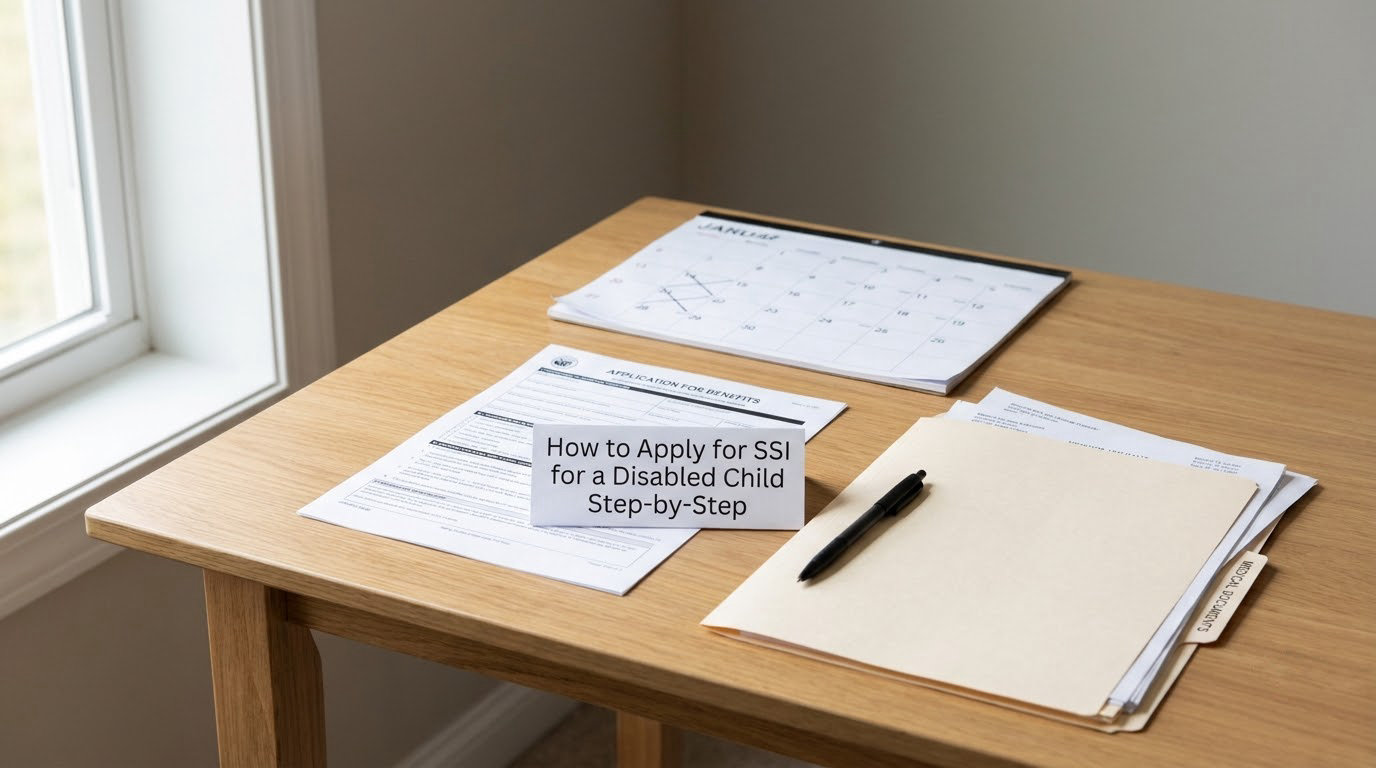
Step 1: Confirm That Your Child May Qualify
A child qualifies for SSI by having a physical or mental condition that causes marked and severe functional limitations, and those limitations have to be expected to last at least 12 months or result in death. There is no minimum age, and a child can qualify whether or not a doctor has used the word “severe.”
The other half of the test is financial. SSI is a needs-based program, so household income and countable resources are examined, and a portion of a parent’s income and resources is generally counted toward the child. That rule catches most families by surprise, which is why the eligibility guidance on ssa.gov is worth reading before you fill anything in.
Blind or disabled children under 18 are evaluated against the Childhood Listing of Impairments, the rulebook SSA uses for decisions. For a case-specific answer, check the official SSA guidance or talk to a benefits counselor rather than a general search result.
Step 2: Collect Medical and Functional Evidence
This is the step that decides cases. SSA looks for two things: what condition your child has, and what it actually does to daily life across more than one setting.
Build the record around concrete examples. If your child needs an adult to help with bathing, say who helps, how often, and what happens when that help is not there. If school notes describe a one-to-one aide, meltdowns in the hallway, or an inability to work independently for more than a few minutes, put that in writing from the teacher or the IEP team.
Cover three settings at minimum: home, school, and therapy. A limitation that appears in all three is far harder to dismiss than one that shows up in a single clinic visit.
Note the expected duration. Clinicians are asked directly whether a condition is expected to last at least 12 months, and a clear answer on that point saves a round of paperwork.
Step 3: Gather Family Financial and Household Information
Expect questions about household composition, living arrangements, parents’ earnings, benefits, and assets. Some resources are excluded from the calculation, including the first home and a limited amount of savings, so the full picture is more favorable than most families assume at first glance.
Keep figures consistent across forms and interviews. Mixed answers about income are one of the easier ways to slow a case down, because the agency simply has to reconcile them.
On payment: the federal SSI amount is a monthly benefit that SSA sets each year and adjusts for countable income, and many states add a supplement on top. Approval usually also opens Medicaid and sometimes SNAP, which is often worth more to a family than the cash itself. SSA publishes the current federal rate along with the income and resource limits on its official benefit parameters page, and those numbers are revised annually, so pull the current figures from there rather than trusting a number in an older article.
Step 4: Apply for SSI for a Disabled Child Accurately
There are two routes. The online Child Disability Report gets the application started and is usually faster, while calling 1-800-772-1213 sets up an application by phone or an appointment at a local office. If you are deaf or hard of hearing, the TTY line is 1-800-325-0778. Applications can also be completed in Spanish, and SSA will arrange an interpreter or accommodation on request.
Answer every question as it applies to your child, and describe limitations in plain language rather than diagnosis codes. Write out how long a task takes, how often help is needed, and what happens on a difficult day.
Do not assume a diagnosis is the whole case. Multiple specialists, multiple diagnoses, and a good therapist all help, but what decides the outcome is documented functional limitation in the two required domains.
Step 5: Submit the Application and Track the Case
After you submit the Child Disability Report, a representative normally calls within about three to five business days. Keep the confirmation number or a screenshot of the submission page; if a letter or call is lost, that record is your proof that you applied and when.
Watch your mail and your online SSA account between calls. Missing mail is common when families move or change phone numbers, and an unanswered notice can stall a case for weeks. Copy everything you send, and start a single folder for the case so that records for the next call take minutes instead of an afternoon.
Step 6: Respond to Interviews and Requests for Evidence
Expect a phone interview with a Disability Unit representative. Questions typically cover daily routine, eating, toileting, bathing and dressing, behavior, school, therapy, medications, and who helps with each task. Have a second adult on the call who sees your child daily, since a caregiver’s account carries weight, and have school reports and therapy goals in front of you.
SSA may also order a consultative examination, where the agency books and pays for its own evaluation. Attending it is not optional, and it is not a sign the case is going badly.
For records requests, sign and return release forms quickly. If a request arrives for a provider who does not have your child’s file, say so in writing and give an alternate source rather than letting the request sit.
Step 7: Understand the Decision and Next Steps
Three outcomes are possible: approval, denial, or a request for more information. Approval and the first payment are separate events, and parents frequently report weeks passing between the award letter and money arriving. Decisions often take a few months from application, and payment can lag behind approval.
If the answer is no, the appeal ladder runs from reconsideration to a hearing before an administrative law judge, then to the Appeals Council, and finally to federal court. File the appeal request within 60 days of the denial date, and free help exists in the form of benefits counselors, legal aid organizations, and state disability councils. SSA never charges a fee to help you apply, so an unsolicited call claiming you are “eligible for SSI” is a warning sign rather than an opportunity.
One more date to put on the calendar: the child’s 18th birthday. SSI continues for some young adults, but it is reviewed under adult rules, and families who prepare ahead have a much easier time at that redetermination.
Common Mistakes
Nearly every fixable problem in a child SSI application comes down to documentation, consistency, or timing. These are the ones that come up most, with the correction next to each.
- Stopping at the diagnosis. Multiple diagnoses are not the test. Fix: describe and document the daily limitation each one causes, in home, school, and therapy settings.
- Vague descriptions. “He has trouble in school” tells a decision-maker nothing. Fix: name the task, who helps, how long it takes, and what happens when help is missing.
- Waiting on old records. Clinics archive or destroy files. Fix: request records as you go and keep copies; if records are missing, ask the clinician for a written statement of current findings and history.
- Missing a deadline. The 60-day window to appeal a denial is the one that cannot be recovered. Fix: note every date the agency sends, and call the office when mail does not arrive.
- Inconsistent answers. Income, household size, or living arrangements described differently on two forms invites delays. Fix: check each form against your own file before sending it.
- Forgetting the school file. The IEP and teacher observations carry weight. Fix: request a copy of the IEP and a short written statement of daily support needs.
- Not keeping copies. Fix: one folder, physical and digital, with everything sent and received, dated.
A few habits help more than any single trick: apply earlier than feels urgent, answer in plain language, and treat every phone call as a chance to add specifics rather than repeat the diagnosis list.
Frequently Asked Questions
How does a disabled child qualify for SSI?
A child qualifies by having a physical or mental condition that causes marked and severe functional limitations expected to last at least 12 months or result in death, plus household income and resources below the limits SSA applies. Decisions for children under 18 are made using the Childhood Listing of Impairments, which weighs daily function more heavily than diagnosis alone.
Does an autism diagnosis alone qualify a child for SSI?
No. An autism diagnosis is necessary but not sufficient on its own. SSA looks for marked and severe functional limitations in areas such as the ability to learn, communicate, complete daily tasks, and regulate behavior and emotions, and it wants that limitation documented across home, school, and therapy settings.
What documents are needed to apply for SSI for my child?
Expect medical records and provider contacts, therapy and psychological evaluations, school records including any IEP or 504 plan, an IFSP if one exists, the child’s birth certificate and Social Security number, and household details covering who lives with the child, parents’ income, resources, and monthly expenses.
How long does it take to get approved for SSI for a child?
A decision commonly takes a few months from the application, and longer when records or a consultative examination are needed. Approval and payment are separate events, so money can arrive weeks after the award letter. Families describe the callback, the interview, and the decision as distinct milestones rather than one continuous wait.
How do I appeal an SSI denial for my child?
File a request for reconsideration within 60 days of the denial date, then request a hearing before an administrative law judge if the reconsideration does not go your way. Further steps include Appeals Council review and a federal court appeal. Benefits counselors, legal aid groups, and state disability councils can represent you at no charge.
Do I need a lawyer to apply for SSI for my child?
You do not need one to apply, and SSA never charges a fee to help you file. A qualified representative can be valuable when a case has been denied, records are missing, or a hearing is scheduled. Start with free help such as a benefits counselor or legal aid organization, and be cautious of anyone who calls unsolicited claiming your child is already eligible.
Start with the Child Disability Report today, and start pulling records this week rather than after you submit. If you hit a denial, the 60-day appeal window is the one deadline you cannot afford to let slide.