
How to handle gift giving with a child who hates surprises comes down to one move: take the surprise out and put the familiarity in. Tell them what is coming, when it will arrive and exactly what will happen, give them a job in the middle of it, and agree a way out. You are not training a child out of a hard moment. You are rebuilding the moment so it can actually be enjoyed.
For an autistic or sensory-sensitive child, gift giving is usually the highest-demand, lowest-payoff social event of the year. Paper crinkles, boxes tear, several adults talk at once, and nobody knows what comes next. On top of all that sits an expectation the child cannot yet predict, and a pile of social rules about smiling, thanking and being excited.
None of that makes your child ungrateful, and it is not a parenting failure. It is a predictable response to a confusing, noisy, uncontrollable moment. And because it recurs every year, the fix has to live in a plan rather than in a panic on the morning of the event.
One more thing worth saying up front: this is not only a Christmas problem. Birthdays, school gift exchanges, Secret Santa, sleepover bags and friends’ parties follow exactly the same rules.
Table of Contents
- What You Need
- How to Handle Gift Giving With a Child Who Hates Surprises Step by Step
- How to Handle Gift Giving With a Child Who Hates Surprises at Every Step
- Common Mistakes
- Use a Calm, Predictable Plan Instead of a Total Reveal
- Frequently Asked Questions
- Should I tell my child every gift before they open it?
- How can I keep birthday or holiday surprises meaningful for a sensory-sensitive child?
- What if my child becomes overwhelmed and leaves the room during gift opening?
- How do I handle gift giving when several children receive different presents?
- Start With One Low-Pressure Choice
What You Need
Before the event, gather five things. None of them cost much and all of them are reusable.
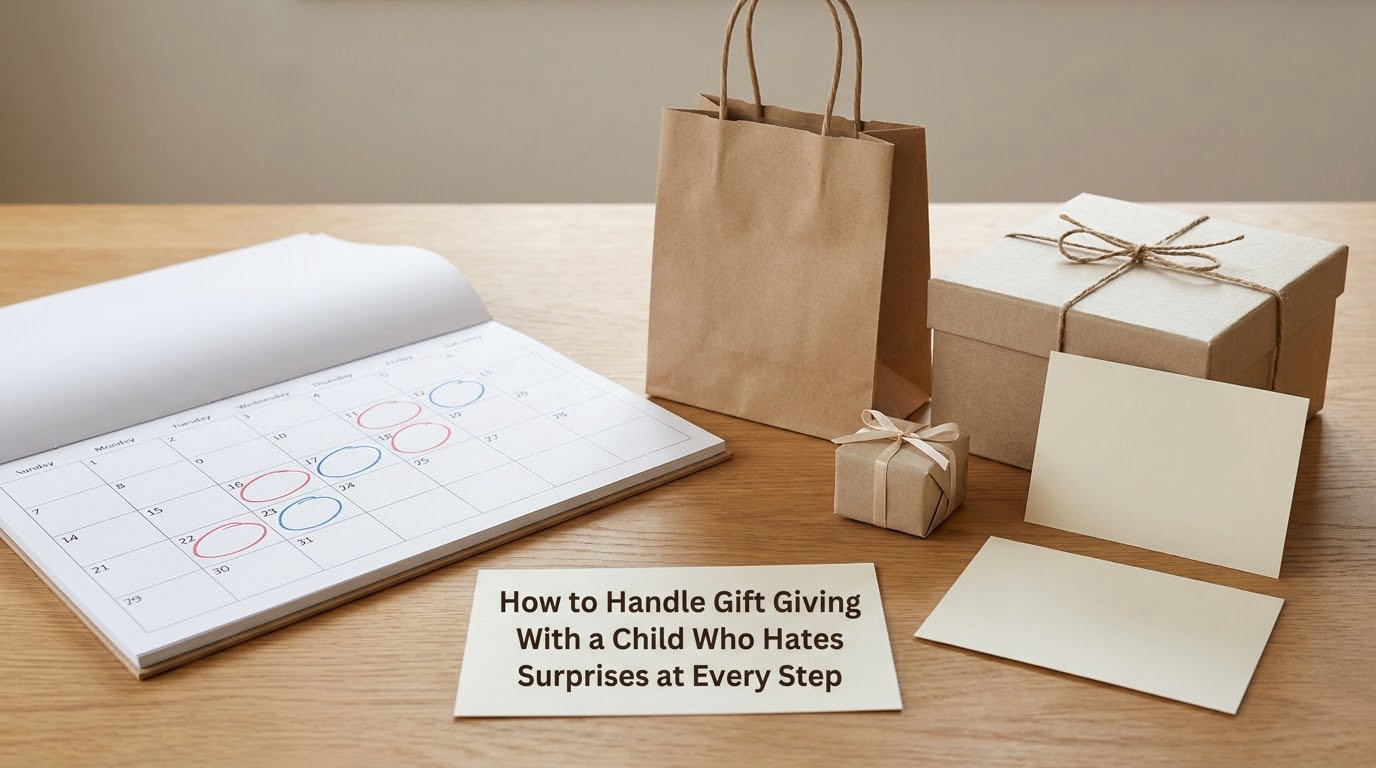
A visual calendar with the event marked. A paper calendar, a printed schedule or a simple wall chart works better than a verbal reminder, because it answers the question a child is already asking: how many days, and what happens on each of them.
A place to take notes. Somewhere you can jot down what worked, what broke and what your child said. Patterns only become visible once you write them down, and next year’s version of you will not remember this year.
A private conversation space. A car, a bedroom, a walk around the block. Explaining an event is much easier away from an audience, and so is repairing something after it goes sideways.
One small preview item. A single unwrapped gift of the same type the child will receive several times over, handed over days earlier with no ceremony. It turns a category into something familiar before the real event arrives.
A simple choice system. Two options, written or pictured, that the child can point at rather than talk through. Choices work when talking is already hard, which is often the exact moment you need them.
The point of all of this preparation is to remove uncertainty, not to remove the child from the family. A child who sits out a tradition entirely comes away with less belonging, not more calm.
How to Handle Gift Giving With a Child Who Hates Surprises Step by Step
How to Handle Gift Giving With a Child Who Hates Surprises at Every Step
Step 1: Find the edge before you plan around it. Sit down and work out what the last version of this event actually looked like. Did they cope with the gifts and fall apart at the singing? Did they cope until someone handed them something they did not choose?
Parents routinely treat all of it as one problem, and it is really three stacked on top of each other: unpredictability, sensory load and expectation mismatch. Predictability is the unknown sequence. Sensory load is the paper, the noise and the bodies in the room. Expectation mismatch is liking the object in the box once it is out.
You can tell which one is dominant by what actually happened. If the child froze before the wrapping started, it is unpredictability. If they managed fine and then bolted once six adults began opening things at once, it is sensory load. If they opened it calmly and said flatly that it was rubbish, it is expectation mismatch, and no amount of wrapping paper will fix that.
How you can tell it worked: you can name the trigger in one sentence rather than describing the whole event as a disaster.
Step 2: Explain the event in plain words, with the sequence written down. Most parents describe a birthday party. Try describing the order of it instead.
“Today is Grandma’s birthday. We are going to her house at two. There will be about six people. Auntie Jo will hand you a present. You can open it now or take it home and open it later. We are staying for one hour, then we are going home for tea.”
That is short, concrete and ends. It covers who, when, how many people, what will happen and what comes after. Avoid reassuring adjectives. “It will be lovely” is a promise you cannot keep, and a promise you cannot keep is worse than no information at all.
Non-verbal children need this too. A visual strip of five pictures, reviewed once a day for a week, communicates the same sequence without a single spoken word.
How you can tell it worked: the child starts repeating part of the plan back, or points to the picture of the part they are worried about.
Step 3: Offer real choices about how the moment happens, never about whether it happens. This is where most plans quietly go wrong. “Would you like to open it or not?” hands a child the whole event and asks them to sort it out. Two workable options are better than one open question.
Open now or open later. Unwrapped, or in a gift bag so nothing is torn. Sit on the sofa or take it to your room. One at a time, or all together. Real choices, each of which you can genuinely live with.
On a WellTrainedMind thread about children who hate surprises and waiting for gifts, the line that stuck with me came from a parent who put it more bluntly: the joy of gift giving sits with the person choosing and handing over, not with the person unwrapping. If a tradition only works for the giver, it is the giver’s tradition.
How you can tell it worked: the child picks one, or points at one, without a long negotiation.
Step 4: Rehearse it until it is boring. This is the single highest-leverage thing you can do, and almost nobody does it. Practise the whole sequence with objects you do not care about.
Use a rolled-up towel as a present. Walk through arriving, greeting people, being handed something, opening it, saying thank you, and going to a quiet room. Do it three or four times across a week so it becomes ordinary rather than familiar. By the time the real event arrives, your child has already done it four times and knows it goes fine.
Rehearsal also lets you see the wobble points. Watch which step makes them look away or step back, and shorten the route around it.
How you can tell it worked: on the day, they follow the sequence without needing a prompt.
Step 5: Make the moment itself predictable. Regulate the basics first. A hungry, tired or already overstimulated child has less capacity for the ceremony, so a snack and a quiet twenty minutes beforehand buys you a lot.
Then change the conditions. Gift bags instead of boxes, or nothing at all. One gift at a time rather than a pile. Small familiar items first and the big one last. Somewhere to sit that is not in the middle of the room. A job, if they want one: handing out the gifts, putting the wrapping in the bin, taking the photos. A job turns a spectator into a participant, and parents consistently report it slows the whole thing down.
Agree the signal before you need it. A card they can show you, a hand on your arm, a word, or a head shake. It has to be something that costs them nothing to use in front of other people. Then make leaving ordinary: “we are going to the car for a minute” said calmly, without drama, and without making it a reward or a punishment. If the signal comes early and often, it is worth working through our guide to how to handle autism meltdowns at home before the season gets busy, because a child with a reliable escape route rarely needs one.
How you can tell it worked: the opening takes less time, the noise drops, and the child chooses to stay rather than being talked into staying.
Step 6: Debrief while it is fresh, then adjust. Ten minutes the next day, when nothing is at stake. Ask what felt loud, what was unclear, what they liked. With a non-verbal child, watch what gets chosen, repeated or ignored rather than asking.
Change one thing at a time, or you will never know which change did it. After two or three events you usually find the pattern: not the surprise at all, but the crowd, or the order, or the singing. Now you know which lever to pull next time.
Common Mistakes
Mistake 1: Protecting the surprise as if it were the gift. Parents hold the surprise because the reaction is the payoff. That is the pressure that produces the scene everyone remembers badly. Parents on r/Autism_Parenting keep asking for a version of this without the reveal, and the replies that work all trade the reveal for predictability.
Fix: let the giver choose one small surprise moment for themselves, and make it separate from the child’s gift. Your child is not obliged to supply the reaction.
Mistake 2: Planning it the night before. You cannot build a sequence, rehearse a script or write a visual schedule in twelve hours, and asking for it at short notice removes every option but forcing.
Fix: two weeks is enough for a simple version. Write the date on the calendar today, even if you do nothing else until next week.
Mistake 3: Offering five options at once. Ten gifts to choose between is not a choice, it is a wall. Choices are hard to make under pressure, especially when everything looks loud.
Fix: two options maximum, written or pictured, and be ready to accept the one you did not offer.
Mistake 4: Reassuring with words you cannot promise. “You will love it” and “it will be fine” remove the child’s ability to prepare and set up a letdown. Plenty of autistic adults describe presents as difficult to receive, and the difficulty is the unknown, not the object.
Fix: describe what is true. “It is a book. You have not read this one yet.”
Mistake 5: Reading distress as refusal. A child who bolts from the room is overwhelmed, not rejecting you. Treating it as defiance produces the confrontation the child was trying to avoid.
Fix: drop the event for that day. You can always give the gift later, and later works better than public.
Use a Calm, Predictable Plan Instead of a Total Reveal
Script the exchange rather than improvising it, because improvised words in a noisy room tend to come out sharper than planned ones.
Before: “There are four presents. We will open them one at a time. You can stop any time and we will go to the car.”
During: “You can say thank you now or later.” And if the gift is not wanted, “that one is not for you today. That happens. You do not have to pretend.” Do not make the child perform enthusiasm; a flat “thank you” delivered straight to the gift giver is a complete response.
To a relative who comments: “he opens gifts when he is ready, so we are doing them one at a time. It works really well for him.” Short, factual, no apology in it. You will get pushback; in the Facebook autism parenting groups, the families who report the most relaxed holidays are the ones who said the same thing to every relative in advance and sent it in writing.
Send a short family gift policy before the season, not in the middle of it. Three lines is enough: what is happening and when, what the gifts will look like, and how the opening will run. Sharing it in writing takes the pressure off you having to repeat yourself to twelve people.
Follow the child’s lead on the day, including when the lead is backwards. Indifference is not rejection. Some children simply do not enjoy the unwrapping and have never enjoyed it, and for them the gift can be introduced days later, at home, in a quiet room, with no audience at all. Parents of non-verbal children describe exactly this, and the objects often get used happily once the ceremony is gone.
And if distress is severe or persistent rather than situational, it is worth raising with your child’s pediatrician or their occupational therapist, not as a behaviour problem but as a load that needs managing.
Frequently Asked Questions
Should I tell my child every gift before they open it?
Not every gift, but tell them enough that the moment stops being a surprise: how many there are, roughly what kind of things, who is coming and when you will leave. Autistic children generally cope much better with known quantities and categories than with named items. Some families give one real item a week ahead, unwrapped, so the category is familiar before the pile appears.
How can I keep birthday or holiday surprises meaningful for a sensory-sensitive child?
Keep the meaning and drop the reveal. The ritual can still include a card, choosing the wrapping paper, giving the gift to someone else and watching them open it. Many autistic children get more from the giving than the receiving, and letting them hand over a gift they picked is a low-sensory way to stay part of the event without facing a pile of unwrapping.
What if my child becomes overwhelmed and leaves the room during gift opening?
Let them go, calmly and without commentary, and follow at a distance rather than immediately. Skip the explanation you feel obliged to give the room. Once they are settled, offer water, a quiet spot and a simple choice about whether to return, opening later, or unwrapping at home. Recovery usually takes longer than the event itself, so build that time into the day.
How do I handle gift giving when several children receive different presents?
Say plainly in advance that everyone gets a different present, then sequence the opening so the first gift of the day is the smallest and least exciting. Give each child one at a time rather than opening them all together. If your child melts down when a sibling or cousin gets something first, move them to a separate room to open theirs, in the same week rather than the same minute.
Start With One Low-Pressure Choice
Do one thing before the next event on the calendar. Write down what your child was actually reacting to last time, and name it as one of three things: unpredictability, sensory load or a gift that did not fit.
Then prepare a single reassuring detail around it, and offer two acceptable choices about how the moment runs. Nothing else. Add more once that is holding.
And measure progress honestly. Success is not a delighted reaction in front of twelve relatives. It is tolerating one unfamiliar moment, or opening one gift, or saying thank you on their own terms. That is a real change, and it is the thing that makes next year easier than this one.