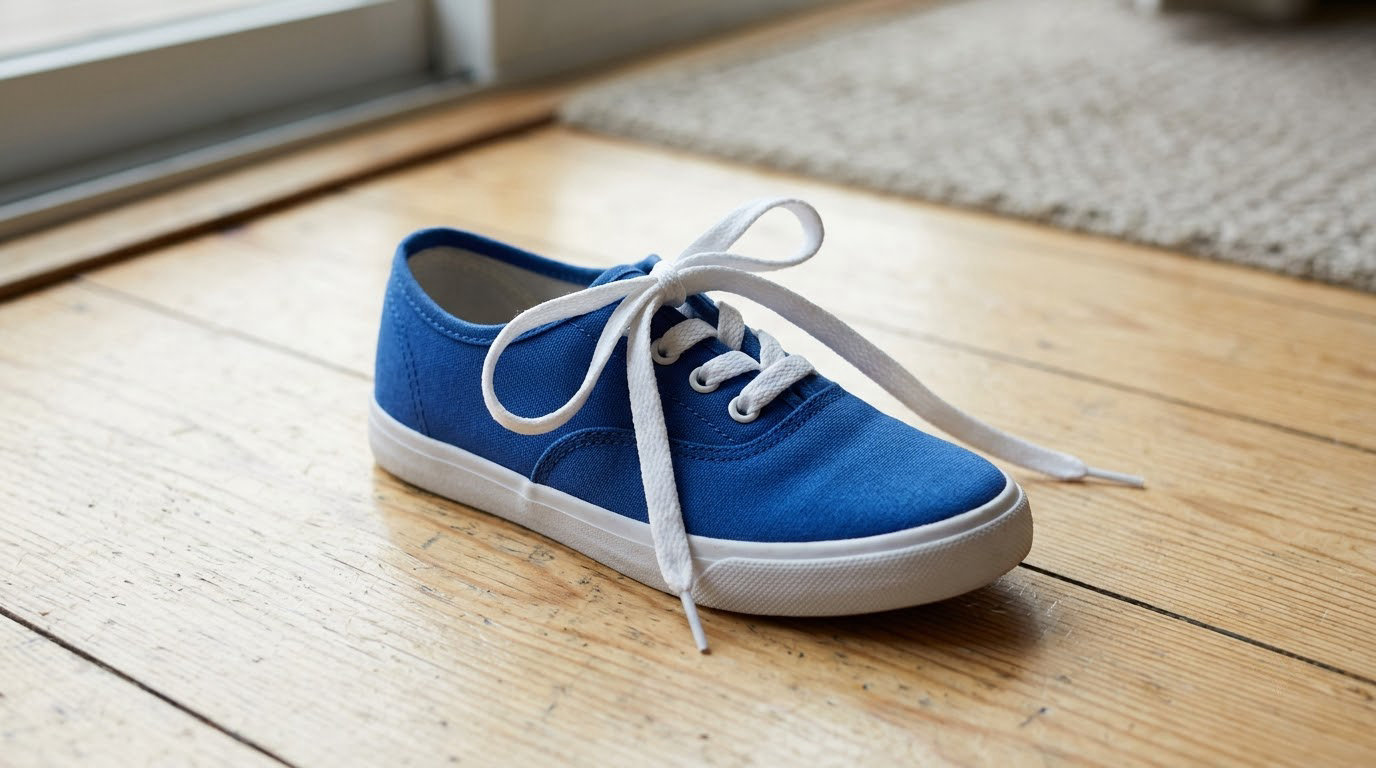
Most children learn to tie their own shoes somewhere between five and seven, and the method that gets them there fastest is the bunny ears knot taught one movement at a time. To learn how to teach a child to tie shoes well, sit behind them on a low chair or the floor so your hands travel in the same direction as theirs, and change one thing at a time. Most of the struggle you will hit is not a knot problem, it is a sequencing problem.
My youngest learned the whole thing in about three weeks of five-minute practices, once I stopped trying to teach the full bow in one go. The week before that, nothing worked. The difference was breaking the knot into pieces small enough for a five-year-old to hold in her head.
Below is the setup I use, the steps in the order that worked, and the specific mistakes that kept coming up before it clicked.
Table of Contents
- What You Need
- How to Teach a Child to Tie Shoes Step by Step
- Use the Bunny Ears Method to Teach the Crossing Motion
- Make the First Knot and Check the Readiness
- Create and Pull the Second Knot to Finish the Bow
- Practice Without Pressure on Either of You
- Use Adaptations for Autism, Motor Delays, or Sensory Needs
- Common Mistakes and How to Fix Them
- The Lace Ends Get Swapped Mid-Sequence
- A Loop Slips Out Before the Poke-Through
- They Pull the Wrong Part at the End
- The Whole Sequence Gets Lost After Step Two
- The Bow Comes Undone in Ten Minutes
- They Put the Shoes on the Wrong Feet
- Frequently Asked Questions
- At what age should a child learn to tie shoes?
- How can I tell whether my child is ready to learn?
- What is the easiest method for a child with fine-motor delays?
- Can an autistic child learn to tie shoes with visual supports?
- Are elastic laces or pre-tied shoes a useful alternative?
- Conclusion
What You Need
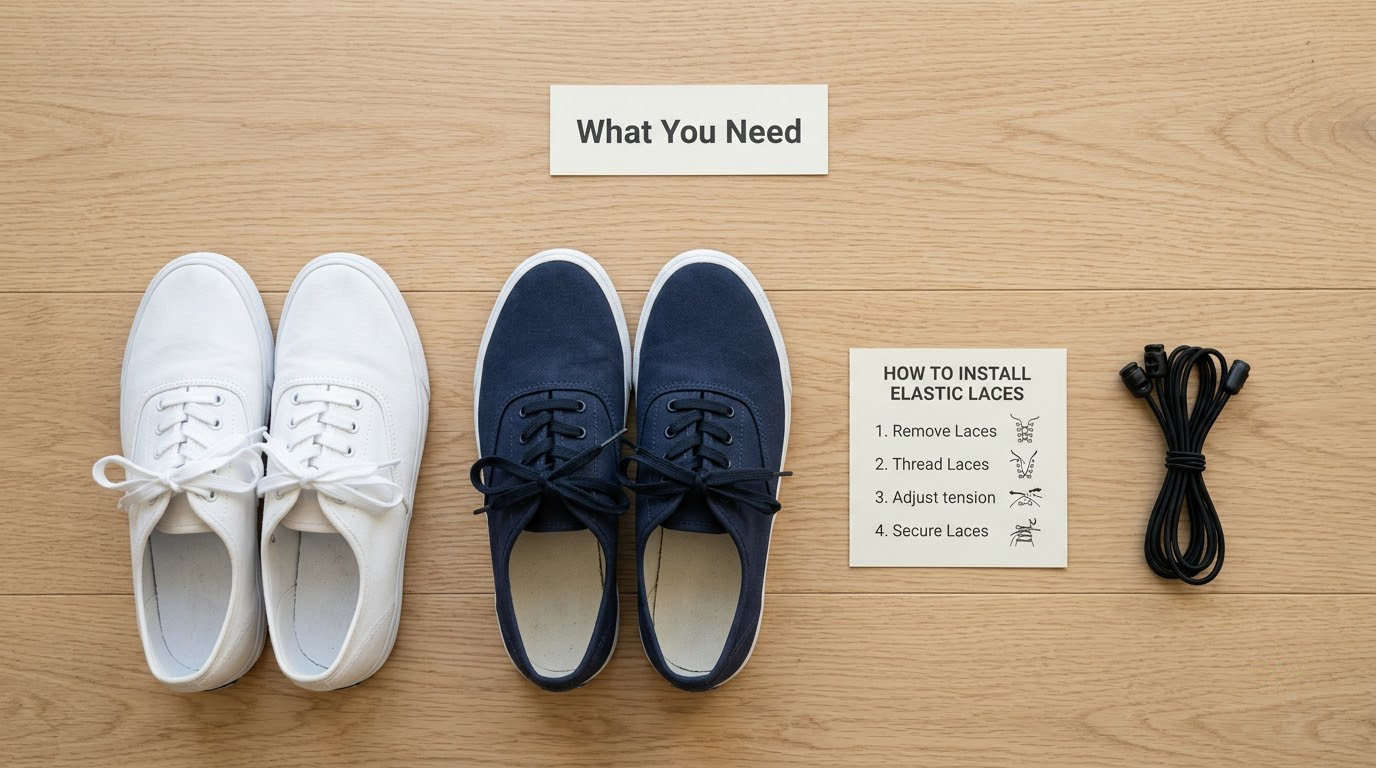
You need very little, and most of it is free. Gather the child, two pairs of lace-up shoes that fit well, a pair of elastic laces to keep in reserve, a printed step guide, and something to track progress on.
- Two pairs of practice shoes. One is a trainer the child wears without breaking a sweat. The other is a cheap older pair that does not matter if it gets sauce on it. Practising on a shoe the child cares about makes every wobble feel like a bigger deal.
- Elastic laces as a backup. Keep them in the drawer from day one. They are not giving up, they are freeing your child from a morning bottleneck while the skill catches up.
- A visual step guide. Four or five numbered steps, one photograph each, printed at roughly A5 size and kept in a plastic folder. Laminating tends to survive a parent who tries to laminate correctly only once.
- A progress tracker. A chart on the fridge with a sticker per successful attempt works better than praise in the moment, because a five-year-old can see the row of stickers filling up.
Put the shoe on a table or a lap rather than on the floor. Bending down and twisting to reach your own feet adds core strength and balance demands that have nothing to do with the knot, and it is where a lot of practice sessions quietly fail.
A pediatric occupational therapist is worth contacting if your child avoids lacing tasks entirely, has noticeably weak grip or hand control compared with the rest of their body, or has been working at this for a couple of months with no forward movement. A therapist can check the specific skill that is holding things up rather than just adding more repetitions of the same stuck step.
How to Teach a Child to Tie Shoes Step by Step
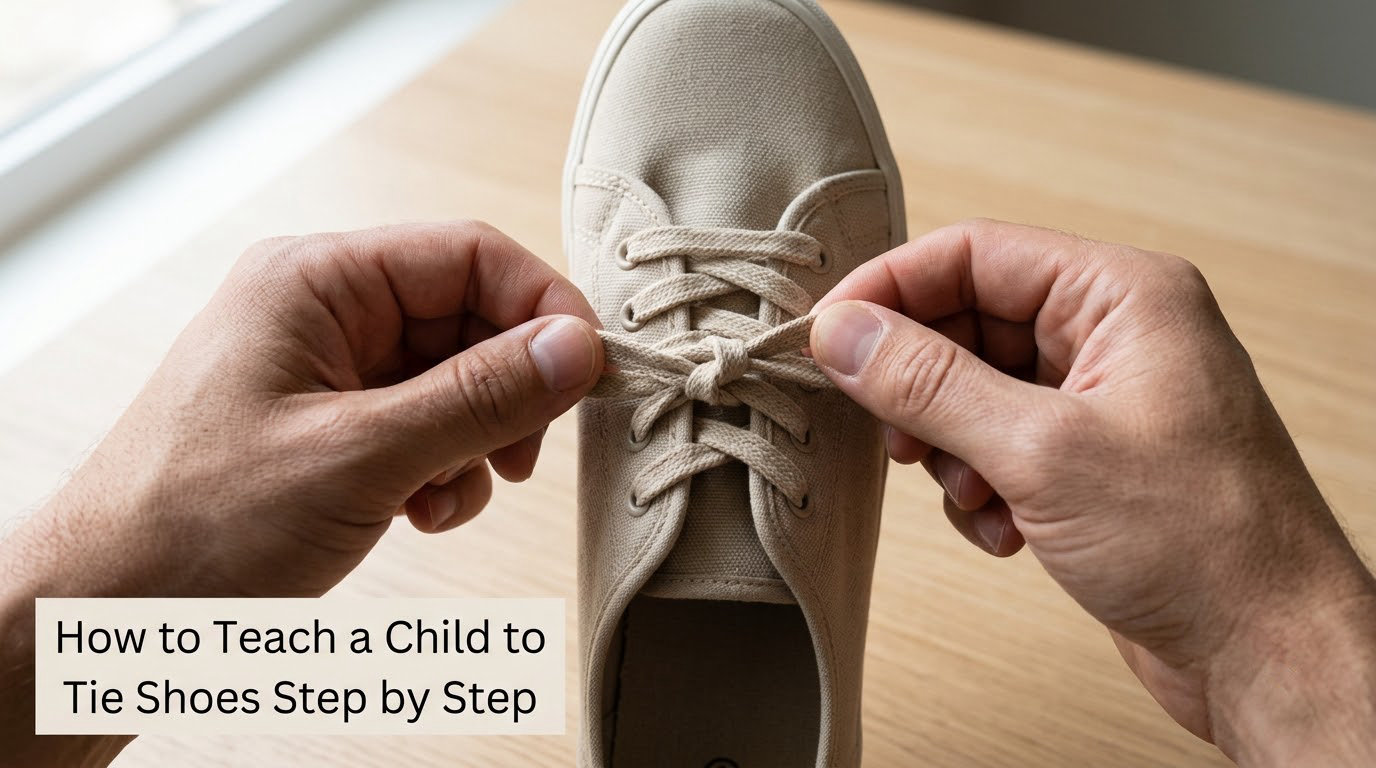
Treat the knot as three separate skills that happen to sit next to each other. Each one is only ready to move on when the child can do it without thinking, usually across three or four separate days.
Use the Bunny Ears Method to Teach the Crossing Motion
The bunny ears method is the easiest knot for most children, because both ends end up in the same place. Start by making the laces two different colours if you can, or mark one with a pen. Left and right stops being a question the child has to hold in their head.
Hold one lace in each hand. Cross the left lace over the right one halfway up, then put it into the loop. Pull both ends in opposite directions, not upward, to make the first knot sit tight and low against the shoe.
To know the step is ready to advance: your child can cross, thread, and pull without being told what comes next, and the knot lands in the same place every time rather than drifting up the laces.
Make the First Knot and Check the Readiness
The first knot is where most of the actual learning happens, so give it its own practice session. Slow your own hands way down. Narrate the movement in short phrases as you do it, and use the same words every single time rather than mixing synonyms.
Two tricks help here. Put a small mark on each lace with a permanent marker to show where the loops should be, which gives the hands a target instead of a vague size. And use backward chaining, where you do the crossing and they do only the final pull, so the last piece of the task is always the piece they own.
Ready to advance when they can do it three times in a row on a shoe that is not on their foot, distracted slightly by something else in the room.
Create and Pull the Second Knot to Finish the Bow
Each lace end now needs to become a loop. Make a loop by wrapping the lace around two fingers, and the opposite hand holds the other loop. Then the wrapping lace goes around the first loop and pokes down through the middle.
This final poke-through is where the internet tells you the trouble is, and it is genuinely the hardest part, because the hands have to move in opposite directions at once. A rhyme helps more than you would expect. One line per movement: cross and loop, make two ears, wrap and poke through, pull apart.
Ready to advance when the bow stays on the shoe through a tap on the laces and the child can tell you the bow is on the left or right side.
Practice Without Pressure on Either of You
Short and frequent beats long and rare. Five minutes, most days, for two to four weeks is a realistic expectation for a typically developing five-year-old. A ten-minute session on Saturday tends to produce nothing and a lot of complaining.
Practise in low-stakes moments. Waiting rooms, car rides before you leave the driveway, the ten minutes before dinner is on the table. Those pockets of dead time are where a habit actually forms, not a dedicated lesson at the end of a long evening when everyone is tired.
Fade your help deliberately. Hands on hands, then hands on their hands, then hands hovering, then hands in your lap. That ladder is the same idea as backward chaining, just applied to your support rather than the steps.
When a session goes badly, name what happened in plain words. That crossed the wrong way, we start again is less loaded than that was a disaster. Praise the specific motion rather than the outcome, since the outcome will not happen for weeks.
Use Adaptations for Autism, Motor Delays, or Sensory Needs
Autistic children and children with fine motor delays usually need smaller steps, more repetition and less unpredictability, rather than a different knot. What changes is the setup, not the goal.
- One step per visual card. A strip of cards on the table that advances as each step is mastered avoids verbal instructions and removes the guessing.
- Reduced visual clutter. Clear table, one shoe, no dinner happening in the same room if sound is a trigger.
- Extra processing time. Count to five silently after you finish a step instead of repeating the instruction. Repeated instructions often read as pressure.
- Seated practice, always. Shoe on the table, both feet on the floor. Fatigue and a wobbly posture both look like a knot problem.
- Finger isolation work first. Lacing cards, a peg board, or play-dough for five minutes before you start.
- No timed pressure. A child who associates the task with being rushed will get faster at escaping it, which looks identical to not learning.
Some families find elastic laces or slip-on shoes genuinely kinder. They remove a daily stress point for a child who is already carrying a lot, and they do not stop the skill developing if you keep practising on a practice shoe. Keeping both in rotation worked better for us than a hard switch to one or the other.
Common Mistakes and How to Fix Them
Each of these has a specific fix, and none of them mean you should start over with a new method.
The Lace Ends Get Swapped Mid-Sequence
Usually the child is not tracking which end is which, not that they have forgotten the step. Use two different coloured laces, or mark one lace with a permanent marker at the aglet. The colour becomes the label and the question stops existing.
A Loop Slips Out Before the Poke-Through
The loop was too small, or the wrist was bent in an awkward position. Mark the loop size on the lace with a pen so the child has a visible target, and have them rotate their wrist so the palm faces upward before they form the loop.
They Pull the Wrong Part at the End
They are pulling the loop rather than the lace ends, so the bow collapses. Narrate it explicitly once: pull the ears, not the middle. Then practise pulling on a bow you tied yourself so the sensation is familiar before they attempt it.
The Whole Sequence Gets Lost After Step Two
Too many steps at once. Go back to backward chaining and let the child own only the final movement until it is automatic, then add the previous step in front of it. Forward chaining works better for a child who gets anxious at the end and simply stops mid-task, since it lets them start with success.
The Bow Comes Undone in Ten Minutes
Common with children who tie the knot but never pull it tight. Add a firm double pull in opposite directions as its own named step. Practise pulling hard on purpose, and check the bow survives a firm tug at the end of every session.
They Put the Shoes on the Wrong Feet
This is a separate skill from knotting and worth naming rather than folding into the lesson. Marking the inside of each shoe with a sticker gives an obvious check without a comment that lands as criticism.
If a child is nine or ten and still cannot tie shoes, the technique still applies, but the framing matters. Practise privately, keep sessions very short, and treat the skill as something being learned late rather than something they are bad at. A parent on a parenting forum did not learn to tie until fifth grade, which is a reminder that the school timetable is not a deadline.
Frequently Asked Questions
At what age should a child learn to tie shoes?
Most children are ready between five and seven, and many are still learning at seven or eight. Readiness matters more than birthday. Look for a child who can follow a two-step direction, uses a pincer grasp reliably, and can hold attention on a hands-on task for a few minutes. If those are in place, start slowly. If they are not, work on lacing cards and simple crafts first and try again in a few months.
How can I tell whether my child is ready to learn?
Watch for five things: can they follow a two-step instruction, do they use a pincer grasp to pick up small objects, can their two hands work together while doing different jobs, can they hold a short hands-on task for a few minutes, and can they copy a movement you made first. Four out of five is a good sign. The slowest skill to arrive is usually sustained attention, and that one improves fastest once the task becomes familiar.
What is the easiest method for a child with fine-motor delays?
Start with the bunny ears method because both lace ends end up in the same place, which reduces the amount the child has to track. Use thick, stiff laces on a practice shoe with the tongue removed, and mark a loop size on each lace with a pen. Practise seated, on a table, for three minutes at a time. If there is still no progress after a couple of months, a pediatric occupational therapist can identify which specific hand skill is the bottleneck.
Can an autistic child learn to tie shoes with visual supports?
Yes. Many autistic children tie shoes well once the instruction stops being spoken and becomes visible. A strip of numbered step cards that advances as each step is mastered, one step per card, removes the need to interpret words in real time. Combine it with a clear table, seated practice, five seconds of processing time after each step, and no timers. Keep the sequence identical every session, because consistency is doing real work here.
Are elastic laces or pre-tied shoes a useful alternative?
They are a reasonable choice, not a compromise. Elastic laces remove a daily bottleneck during the weeks or months your child is still building the skill, and they stop a rushed morning turning into a fight. Most families do better using them for school shoes and lacing up normally at home for practice. A child still practises the full knot on a practice shoe and learns the skill on the same timeline, with far less resentment.
Conclusion
Start with one movement today. Pick the crossing step, sit behind your child, and put the shoe on a table so nobody is twisting to reach their own feet.
Practise that single movement for five minutes across a few days until it happens without a prompt. Only then add the next one, and keep the sequence the same every time you practise. The knot follows the habit, and the habit is what the five minutes a day is actually building.