
Choosing sunscreen for sensitive skin comes down to three things on the back of the bottle: broad-spectrum protection, SPF 30 or higher, and no added fragrance. Start with zinc oxide or titanium dioxide as the active filter, read the full ingredient list, then patch test before the formula touches your whole face. Five minutes on your inner arm saves you a week of redness.
That last step matters more than most people expect. Readers of reactive skin are rarely choosing badly in the aisle. They are choosing sensibly and then burning, because the formula is perfectly good for most faces and wrong for theirs, and nothing on the front of the tube tells you which one it will be.
The same method works if you are shopping for a baby or a child with eczema-prone skin, with one extra filter: skip anything with fragrance, essential oils, or a heavy tint. One more thing to clear up early, because it causes most of the frustration — the words hypoallergenic, natural, and chemical-free are marketing language. No regulatory body defines them, and none of them tells you how a formula will behave on your skin.
Table of Contents
- What You Need
- Step-by-Step: How to Choose Sunscreen for Sensitive Skin
- Step 1: Identify the Skin Type and Use
- Step 2: Check Broad-Spectrum Protection and SPF
- Step 3: Compare Mineral and Chemical Filters for Sensitive Skin
- Step 4: Look for Irritants and Sensitizing Fragrance
- Step 5: Patch Test Before Full Use
- Step 6: Apply the Right Amount and Reapply
- Common Mistakes
- Frequently Asked Questions
- Is mineral sunscreen better for sensitive skin?
- What should I look for in a sunscreen for a baby or child with sensitive skin?
- Does fragrance-free sunscreen mean hypoallergenic sunscreen?
- Can I use sunscreen if I have eczema or a skin allergy?
- How often should I reapply sunscreen for sensitive skin?
- Conclusion
What You Need
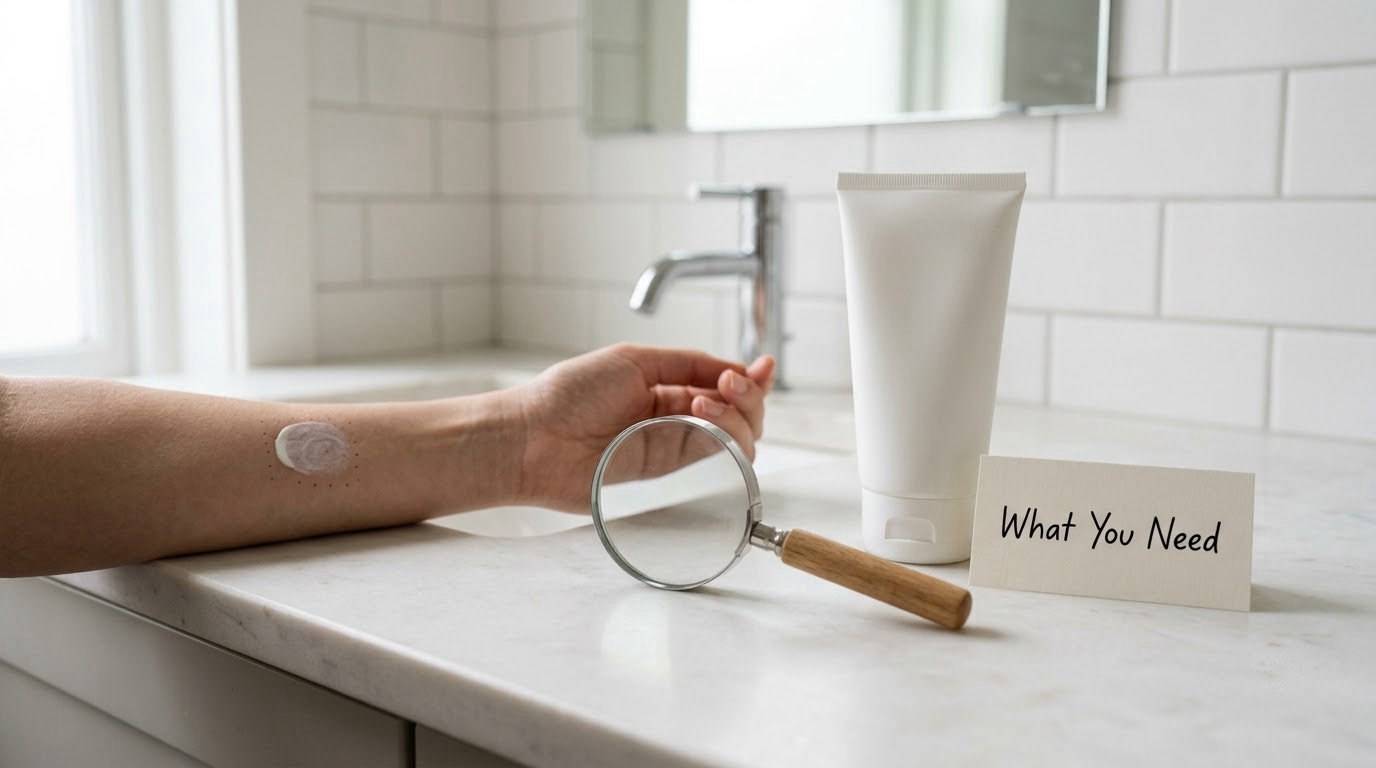
You need very little to do this well, and none of it is a special tool. What you need is a few facts about the person who will wear the sunscreen, the ingredient list in front of you, and a small patch of skin you can test on without consequences.
- The skin type and history. Reactive or flushing skin, eczema or atopic dermatitis, acne-prone skin, skin still healing after a peel or laser, or simply dry and dehydrated. Note any reaction to a previous sunscreen.
- The job the sunscreen has to do. A ten-minute commute, a full beach day, or a child’s outdoor sport each demand something different.
- The age of the wearer. Anything under six months is handled differently.
- The full ingredient list, not the front of the tube, and a magnifying glass if the print is small.
- A small amount of the product for a patch test, plus a quiet spot of skin that is not your face.
- The expiration date, especially if the bottle lives in a warm bathroom.
A magnifying glass is genuinely the only piece of equipment here. Sunscreen actives sit low on the ingredient list, and the difference between two formulas is usually something you cannot see at arm’s length.
Step-by-Step: How to Choose Sunscreen for Sensitive Skin
Six steps, in this order. Do them in a different sequence and you will end up comparing the wrong things.
Step 1: Identify the Skin Type and Use
Decide what the sunscreen is for before comparing anything. A formula you tolerate for a short commute is not doing the same job as one that has to survive a swim and eighty minutes of sweat, and the second one needs a more water-resistant base.
Then write down whether the wearer has diagnosed eczema or atopic dermatitis, rosacea, a previous contact dermatitis reaction to a sunscreen filter, active acne, or healing skin. That single fact changes your criteria more than the brand name does.
Age is the other half of this step. Under six months, the American Academy of Dermatology puts shade, a hat, and protective clothing first, with sunscreen used only on the small areas clothing cannot cover. From six months upward, the guidance becomes broad-spectrum, fragrance-free, and applied the same way as for an adult.
Step 2: Check Broad-Spectrum Protection and SPF
Look for the word broad-spectrum and an SPF number. Broad-spectrum means the formula protects against UVA as well as UVB. UVA is the longer-wavelength light responsible for most visible facial aging, and an SPF number by itself tells you nothing about it.
SPF measures UVB filtering only. SPF 30 filters about 97 percent of UVB rays, SPF 50 about 98 percent, SPF 100 about 99 percent. That is the whole math, and it explains why SPF 100 exists mostly as a marketing budget line.
- SPF 30 is the sensible daily baseline for most people, especially on reactive skin.
- SPF 50 is worth it for long outdoor days, high altitude, snow or water, fair skin that burns easily, and anyone managing hyperpigmentation or post-procedure skin.
- Water-resistant claims of 40 or 80 minutes only make sense if you swim or sweat.
None of that makes a high SPF gentler. Higher SPF usually means a higher concentration of filter, which means more of the base around it, and reactive skin is usually reacting to the base. Plenty of readers find a formula burns at SPF 50 and behaves at SPF 30.
Step 3: Compare Mineral and Chemical Filters for Sensitive Skin
Mineral filters, which are zinc oxide and titanium dioxide, sit on the surface of the skin and scatter or reflect UV radiation. Chemical filters, also called organic filters, absorb UV and convert it to heat inside the skin. Mineral is the usual starting point for reactive skin because nothing has to penetrate the barrier to work.
| What to compare | Mineral filters (zinc oxide, titanium dioxide) | Chemical filters (organic filters) |
|---|---|---|
| How it works | Scatters and reflects UV at the skin surface | Absorbs UV and converts it to heat |
| Sting risk | Lower on intact skin; can still burn over dry or flaky patches | Higher on a compromised skin barrier |
| Finish | Thicker, often chalky, can look ashy on deeper skin tones | Lightweight, often invisible |
| Time before sun exposure | Works immediately | Best applied 15 minutes ahead |
| Watch for | Titanium dioxide reactions, zinc-heavy bases, heaviness or breakouts | Alcohol-heavy bases, solvent sting, oxybenzone or octinoxate sensitivities |
Mineral is not automatically gentle. Posters on r/Rosacea and r/SkincareAddiction describe burning with mineral formulas too, often blaming titanium dioxide or the alcohol in the base. Acne-prone readers report the opposite problem, that mineral sunscreens sit heavy and clog pores, and describe being stuck between chemical formulas that flare them and mineral formulas that congest them.
That dilemma is real, and the honest answer is that no filter type wins for everyone. What settles it is the rest of the ingredient list and the fragrance status, not the mineral-versus-chemical label on the front.
Two label terms get misunderstood. Non-nano means the zinc or titanium particles are large enough not to be classified as nanoparticles, which is a reassurance some people want and a distinction dermatology guidance treats as a manufacturing preference rather than a safety switch. Hypoallergenic means nothing regulated at all. Outside the US, look for the UVA circle logo or a PA rating such as PA++++, since those are the local equivalent of broad-spectrum.
Step 4: Look for Irritants and Sensitizing Fragrance
Fragrance is the first thing to check, and it hides in more places than most people expect. On an ingredient list it can appear as parfum, fragrance, or aroma, and essential oils such as lavender, tea tree, and citrus are fragrance too. Fragrance-free is a stronger claim than unscented, which only means the product is masked or balanced.
- Parfum, fragrance, aroma, essential oils. The single most common trigger for contact dermatitis in sunscreens.
- Alcohol denat. A drying alcohol high in the list gives that tight, matte, slightly burning feeling.
- Heavy solvents and emollient overload. If your skin already feels too heavy or too occlusive, the texture will be the first thing you react to.
- Exfoliating acids such as glycolic, lactic, or salicylic acid layered into the same formula.
- Oxybenzone and octinoxate. Two organic filters with a long history of sensitivity reports, and easy to spot on the label.
- Parabens and sulfates. Low on most people’s list of triggers, but worth knowing about if your skin already reacts to a lot of things.
Going the other way, a short list of ingredients tends to sit well on reactive skin because they support the barrier rather than disturb it: ceramides, which refill the mortar between skin cells; niacinamide; hyaluronic acid; bisabolol, a chamomile-derived calming active; allantoin; and vitamin E. None of them make a sunscreen better at its job, but they make it easier to wear every day.
The fastest way I sort two similar bottles is to read the ingredient list twice, once for what is in it and once for how much of it there is. A long list of tiny amounts is fine. A short list with one item repeated at the top is a concentrated formula, and concentrated is where reactions live.
Step 5: Patch Test Before Full Use
A patch test takes 24 to 48 hours and eliminates most of the expensive mistakes. The version that gets recommended on skincare forums follows the same shape: test the inner forearm or behind the ear first, because skin there is thinner and a reaction is easy to isolate.
- Day one. A small amount on the inner forearm or behind the ear. Leave it on. Do not wash it off for 24 hours.
- Day two. Check for redness, itching, swelling, or a stinging that outlasts the application by more than a few minutes. A faint pinkness that settles within an hour is not the same as a spreading rash.
- Day three. If the arm is clear, dab it along the jawline, where facial skin meets the neck. Wear it through a full day and remove it with whatever you normally use.
- Day four. One quadrant of the face for a day, then stop if anything stings, flushes, or flakes.
- Day five onward. Full face, morning, with a real routine layered over it.
Two different things can happen here. An irritant reaction tends to show up within minutes as stinging, burning, or itching, and it fades when you stop. Contact dermatitis is a delayed allergy that can surface days or even weeks later as an itchy, spreading, sometimes blistered rash, which means you will not learn about it from a five-day test alone. Anyone who reacts that way should see a dermatologist, who can test which filter is the problem.
Seek medical advice straight away for swelling of the face or eyes, hives, difficulty breathing, or a rash that spreads past where you applied it.
Step 6: Apply the Right Amount and Reapply
Amount is where good intentions usually fail. For face and neck, use two finger lengths of product from the base of the little finger to the tip of the index finger. For the body, the familiar rule is roughly one ounce, about a shot glass, for a person in a swimsuit. Most people apply a quarter to half of what protects them.
Apply mineral sunscreen right before you go outside, since it works on the surface. Apply chemical filters about 15 minutes ahead so they have settled into the skin. Then reapply every two hours of exposure, and every 80 minutes if you are swimming, sweating hard, or wiping your face.
Reapplying over makeup is where reactive skin gives up. Look for a stick or a mineral powder you can press on with a sponge rather than rubbing, and skip anything that needs dragging across the face. Pair the sunscreen with shade, a wide-brimmed hat, clothing with a high UPF, and a check of the daily UV index before the sunscreen is your only defense.
Common Mistakes
Almost every stinging-sunscreen story I hear traces back to one of these.
- Choosing by SPF number alone. A higher number does not mean a gentler formula, and SPF 100 buys very little for most daily routines.
- Testing a new product straight on the face. The full face is the worst place to find out. Move up from arm to jawline to quadrant.
- Applying too little. Under-applying undoes the protection and the money at the same time. Use the two-finger length.
- Forgetting to reapply. Two hours is a ceiling, not a suggestion, and it is closer to 80 minutes once you are wet or sweating.
- Treating sensitivity as an allergy. Stinging within minutes is usually irritation from a solvent or alcohol. A delayed spreading rash is a different problem and needs a dermatologist.
- Trusting unregulated label words. Hypoallergenic, natural, chemical-free, and derm-tested are not safety claims. The ingredient list is the only real evidence.
- Relying on sunscreen alone. Shade, a hat, and clothing do more for a reactive face than any amount of reapplying.
One more worth naming: giving up on sunscreen entirely because six bottles burned. Unprotected reactive skin ages and pigment-changes faster, so the search is worth doing properly.
Frequently Asked Questions
Is mineral sunscreen better for sensitive skin?
Mineral sunscreen is usually the safer starting point, because zinc oxide and titanium dioxide sit on the surface of the skin instead of absorbing into it. That said, mineral formulas can still sting over dry or flaky skin and can feel heavy on acne-prone skin. Read the full ingredient list and patch test rather than trusting the filter name alone.
What should I look for in a sunscreen for a baby or child with sensitive skin?
Look for broad-spectrum SPF 30 or higher with zinc oxide or titanium dioxide, no fragrance or parfum, and no essential oils. Skip tinted versions, which add iron oxides that some children react to. Under six months, dermatology guidance puts shade, hats, and protective clothing first, with sunscreen used only on areas clothing cannot cover.
Does fragrance-free sunscreen mean hypoallergenic sunscreen?
No. Fragrance-free is a specific and useful claim about one ingredient category. Hypoallergenic has no regulatory definition anywhere, and a fragrance-free formula can still irritate you through alcohol, essential oils listed individually, or a concentrated filter. The ingredient list is the only thing that tells you what is actually in the bottle.
Can I use sunscreen if I have eczema or a skin allergy?
Yes, and sun protection matters for eczema-prone skin too, since certain medications and the condition itself can raise sun sensitivity. Choose a fragrance-free broad-spectrum formula, apply your usual emollient first so the sunscreen sits on a protected barrier, and patch test every time you switch products. If you have a known allergy to a specific filter, ask your dermatologist which to avoid.
How often should I reapply sunscreen for sensitive skin?
Every two hours of sun exposure, and every 80 minutes when you are swimming, sweating, or drying your face with a towel. If your skin is reactive, reapplication comfort matters as much as timing, which is why a stick or mineral powder works better than rubbing a fresh layer over the whole face.
Conclusion
If you do one thing, turn the bottle over. Broad-spectrum, SPF 30 or higher, zinc oxide or titanium dioxide, and no parfum anywhere in the ingredient list — that is the shortlist. Favor the simplest formula your skin has already shown it tolerates, patch test it over five days, and only then use it on your whole face.
Then remember that sunscreen is one layer, not the whole plan. Shade, a hat, and clothing carry more weight on reactive skin than a longer ingredient list does.
This article is general information for choosing a daily sunscreen, not medical advice. If you have diagnosed eczema, rosacea, a known sunscreen allergy, or an active skin condition, or if a reaction includes swelling, hives, or trouble breathing, contact your doctor or urgent care. Last reviewed October 2026.