
The fight about chores is rarely about the dishes. It is about who noticed the dishes needed doing, who planned the dinner, and who mentally tracked the appointment form that got signed three days late. Learning how to divide household chores with your partner well comes down to one thing: you cannot divide what you have never written down.
Here is the short version. Write down every recurring task, including the invisible planning ones. Weight each one by effort instead of counting them. Assign whole tasks to one person, based on preference first and available time second. Agree on what “done” means before anyone starts. Then review it for ten minutes a week. That system takes about two evenings to build and about ten minutes a week to maintain.
Below is the full version, with a word-for-word script for the conversation, since starting the conversation is the part most couples avoid.
Table of Contents
- What You Need
- Step-by-Step: How to Divide Household Chores With Your Partner
- 1. List every recurring household task, including the invisible ones
- 2. Talk about capacity, not blame, before you divide household chores with your partner
- 3. Match tasks to strengths and energy, including sensory differences
- 4. Assign ownership and backup coverage for every task
- 5. Put the plan where everyone can see it
- 6. Review and adjust the system every week
- Common Mistakes
- Assigning only the visible cleaning
- Using vague labels like “helping more”
- Counting tasks instead of weighting them
- Turning the record into a scoreboard
- Adding chores without renegotiating
- Assuming one partner is the household manager
- Frequently Asked Questions
- What is the 7 7 7 rule for marriage?
- What is the 2-2-2 rule for couples?
- Do couples actually break up over chores?
- Should household chores be split 50 50?
- What if my partner will not help with chores at all?
- How often should we review our chore split?
- A Fair Chore System Starts With One Conversation
What You Need
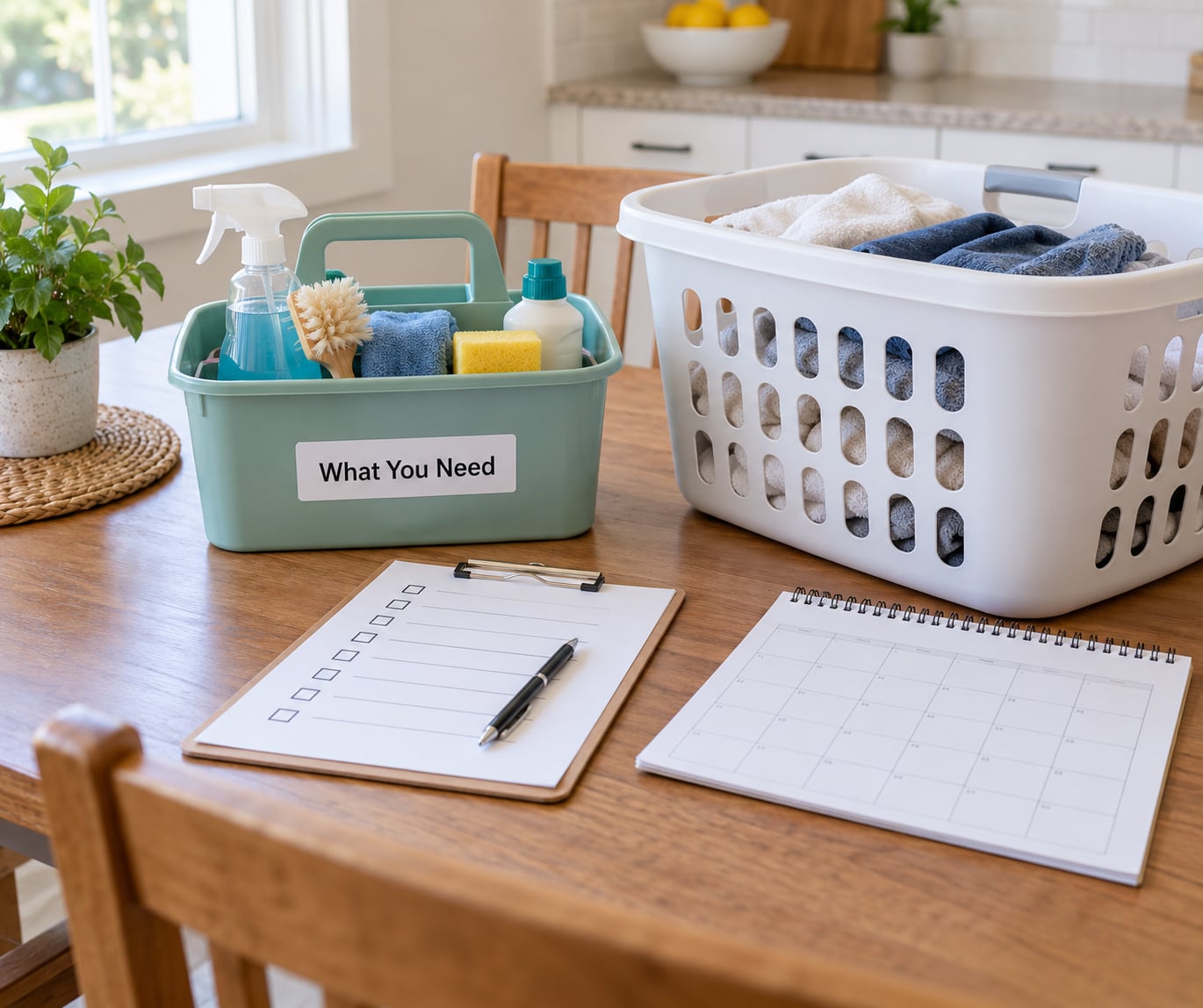
You need a calm twenty minutes, a shared list somewhere both of you can see, and honest information about how much capacity each of you actually has this month. That last one matters more than any app or template.
Gather the task list first, on your own, before either of you opens your mouth. Memory is the enemy here. People reliably remember the work they did last week and forget the work their partner did on Tuesday.
Then check three things:
- Realistic capacity. Commute, paid hours, caregiving, sleep, physical limits, and how much mental energy is left at 7pm. Capacity changes week to week, so write it down as a range, not a promise.
- Tasks with specific demands. Some jobs need a licence, a physical ability, a sensory tolerance, or a particular skill. Note those so you assign by fit rather than by default.
- A tracking method you both can tolerate. A paper chart on the fridge, a shared note on your phone, a whiteboard, a task app. Pick the one that will still feel normal in week six. A chore chart that feels like surveillance gets abandoned fast.
Step-by-Step: How to Divide Household Chores With Your Partner
Six steps, in order. Do not skip ahead to the assigning step, because most failed chore systems were built on a list that was missing half the work.
1. List every recurring household task, including the invisible ones
Write down everything that repeats, in four buckets: daily, weekly, monthly, and invisible.
Daily covers dishes, meals, trash, and one bathroom wipe-down. Weekly covers laundry, vacuuming, mopping, changing sheets, and taking out recycling. Monthly covers deep cleaning, filters, and restocking.
The invisible bucket is the one that changes everything. That is the planning, remembering, and coordinating: deciding what to cook, noticing the coffee is running low, booking the appointment, tracking the school permission slip, keeping track of whose turn it is for the pediatrician. A reader on a parenting forum described the real split this way: he makes breakfasts, she makes dinners, they both wash dishes, he vacuums, she does the bathrooms and kitchen. That level of detail is what makes a system usable.
How to tell it worked: when you read the list out loud, your partner adds at least three tasks you forgot. If nobody adds anything, your list is too short.
2. Talk about capacity, not blame, before you divide household chores with your partner
Have this conversation when you are both calm, which is the single most repeated piece of advice in the forums and the thing most guides leave out. Not during an argument about the messy kitchen. Not at the end of a long shift. Pick a quiet evening and start early.
Share your own constraints first, then ask about theirs. Some questions that work:
- What does a heavy week look like for you, and what does a light week look like?
- Which tasks drain you, and which ones do you actually not mind?
- What are you already carrying that nobody sees?
Say the quiet part out loud: equal effort does not mean identical tasks. One person cooking four meals a week and the other doing all laundry and bathroom cleaning may land closer to even than two people each doing a different half of every task.
How to tell it worked: you both said something out loud you had never said before, and nobody raised their voice.
3. Match tasks to strengths and energy, including sensory differences
Score each task by effort from one to three, where one is ten minutes and automatic, and three is a project. Weighting matters because a task count lies. Ten light chores can be less work than two heavy ones.
Assign by preference first, then balance the totals. Someone who finds cleaning genuinely restorative can take more of it without it becoming a burden, as long as you are assigning it on purpose rather than by default.
Now account for sensory and neurodivergent differences, which most chore advice ignores entirely. A person who is unbothered by clutter sees a different home than a person whose nervous system is overwhelmed by it. If one of you is autistic or sensory-sensitive, that is a difference in processing, not a difference in effort or character. Agree on the minimum standard of care for each space out loud, and write it down.
Then give the full loop. Conception, planning, and execution, the three stages Fair Play organises tasks around, means one person owns the whole thing rather than everyone touching it. Owning the laundry means noticing the pile, starting it, moving it, and putting it away, not just carrying one basket.
If your child has sensory needs, our guide on building a sensory diet covers how daily routines are built around regulation, which is the same thinking applied to household rhythms.
How to tell it worked: each person can name the tasks they own end to end, and nobody is left wondering whether a job is theirs.
4. Assign ownership and backup coverage for every task
Give each recurring task one primary owner and one named backup. Whole tasks, not shared ones, because shared tasks are the ones nobody finishes.
A workable split for a two-adult household might look like this: one person owns groceries and meal planning plus cooking on weeknights, the other owns laundry, bathroom cleaning, and taking the car for servicing. Backup coverage is different from shared ownership. The backup steps in when the owner is sick, working a double, or having a bad week, and then hands it back.
Say that out loud too, because “I covered it that week, so it is mine now” is how a temporary favour becomes permanent.
How to tell it worked: for any task, both of you could name who does it without checking the list.
5. Put the plan where everyone can see it
Visibility replaces nagging. A shared list on the fridge, a note in a group chat, a whiteboard in the hallway, or a task app all work. What matters is that it shows three things: who owns it, when it happens, and whether it is done.
A weekly calendar works better than a daily one for most homes, because it lets both of you see load before the week starts rather than after it has gone wrong. Keep a small weekly review built into that calendar so it does not depend on memory.
Children get their own age-appropriate column, never the adult workload. Our walkthrough on how to teach chores to an autistic child covers building a routine a child can predict, which matters more than speed. If school forms and therapy scheduling are part of your invisible load, the weekly rhythm in communicating with a teacher weekly keeps that part from quietly falling on one person.
How to tell it worked: the list gets updated without anyone asking. If you are still the only person editing it, the system is not working yet.
6. Review and adjust the system every week
Ten minutes, same time each week, both of you present. Three questions: what did not get done, what needs to move, and what needs to be renegotiated. Adjust assignments the moment a schedule changes, such as a new shift pattern, a new baby, an injury, or a school year starting.
Address missed chores calmly. Most misses are capacity, not attitude, and “what got in the way this week” gets a truthful answer far more often than “why didn’t you do it.”
Mark the calendar for the first week of 2026 to rebuild the list from scratch rather than patching last year’s version.
How to tell it worked: assignments change without anyone dreading the conversation. A system you revise weekly is not failing, it is doing its job.
Common Mistakes
Most households repeat one of these six mistakes. Each has a direct fix.
Assigning only the visible cleaning
Dishes and laundry get divided while planning, scheduling, and remembering stay invisible and therefore stay with one person. Fix: list the invisible tasks first, not last. If a task requires someone to notice and then act, it goes on the list.
Using vague labels like “helping more”
“You could help more around here” is not an assignment, because nobody can tell when it is finished. Fix: replace every vague label with a named task and an owner. This is the single highest-leverage edit in this whole process.
Counting tasks instead of weighting them
Splitting the list down the middle gives both people the same number of items and very different weeks. Fix: weight each task one to three by effort and balance the totals, then let the task counts fall where they fall.
Turning the record into a scoreboard
The moment the list becomes evidence for an argument, both of you start under-reporting or over-reporting. Fix: the list exists to plan the week, not to win a fight. Bring receipts only when the same task keeps slipping.
Adding chores without renegotiating
A new baby, a new job, or a new pet adds work, and the added work lands on whoever is already carrying the planning. Fix: when something new appears, add a task or name it as one person’s job at the next weekly review. Never let new work arrive unannounced.
Assuming one partner is the household manager
One person gets stuck as team captain by default, and the captain role is unpaid overtime nobody agreed to. Fix: management tasks like the schedule, the shopping list, and the calendar go on the list like everything else, and the captain role rotates.
Two more situations come up constantly. When work hours differ sharply, one partner coming home from a twelve-hour shift has no capacity left, so weight that partner’s tasks down and give the other person more of the load, permanently and without apology. And when one partner will not engage at all, name it directly, agree on a minimum set of tasks they will own, put a review date on the calendar, and if nothing has changed in a month, bring in a third party. A therapist or a structured conversation with a counselor is not an admission of failure; it is faster than months of the same argument.
Frequently Asked Questions
What is the 7 7 7 rule for marriage?
It is a relationship-maintenance ritual some couples use, not a chore-splitting method: every seven days, do something small together for the two of you; every seven months, plan something bigger; every seven years, mark the milestone properly. Couples who try it for chores tend to like the weekly part best, because it creates time that is not errands, screen time, or sleeping.
What is the 2-2-2 rule for couples?
A short framework floating around relationship forums: each month, aim for two nights out, two chores you each fully own end to end, and two evenings where nobody has to plan anything. It works as a starter rule for couples who have never split anything up. Most outgrow it after a month and move to a written list weighted by effort.
Do couples actually break up over chores?
Chores are rarely the sole reason, but they are a reliable source of the resentment that builds underneath a bigger decision. Time-use research, including the American Time Use Survey, consistently shows women doing more household management and care work than men, which is why an apparently equal-looking split still lands unevenly for many households. Fixing the imbalance early matters more than arguing about the dishes.
Should household chores be split 50 50?
No. Paid hours, commutes, caregiving, sleep, and physical energy all differ, so an identical task list can still produce a lopsided week. Most couples treat a split within roughly ten points of the middle as balanced and only address it when one side stays clearly ahead for weeks. Aim for fair, measured in total effort, not equal, measured by count.
What if my partner will not help with chores at all?
Say it plainly, without the full history attached: I am carrying all of it and I need you to own three specific tasks. Give examples, agree a minimum, and put a date on the calendar to check back. If a month passes with no change, this is usually a pattern worth taking to a counselor together rather than a negotiation you keep losing on your own.
How often should we review our chore split?
Ten minutes a week for small adjustments, and a fuller rebuild once or twice a year. Weekly reviews catch schedule changes before they turn into resentment. The bigger rebuild matters because needs shift: a new baby, a new job, an injury, or a school year can change the balance completely, and a split designed for last spring rarely survives one without a rewrite.
A Fair Chore System Starts With One Conversation
Start tonight with the list. Twenty minutes, both of you, no arguing about the messy kitchen, and every recurring task written down including the invisible ones. Then book a second twenty minutes to do the weighting and assignment together.
A system that works is not the perfect one. It is the one you can see, revise, and survive a bad week with. When you learn how to divide household chores with your partner using that standard, the arguing stops, because there is nothing left to guess about.