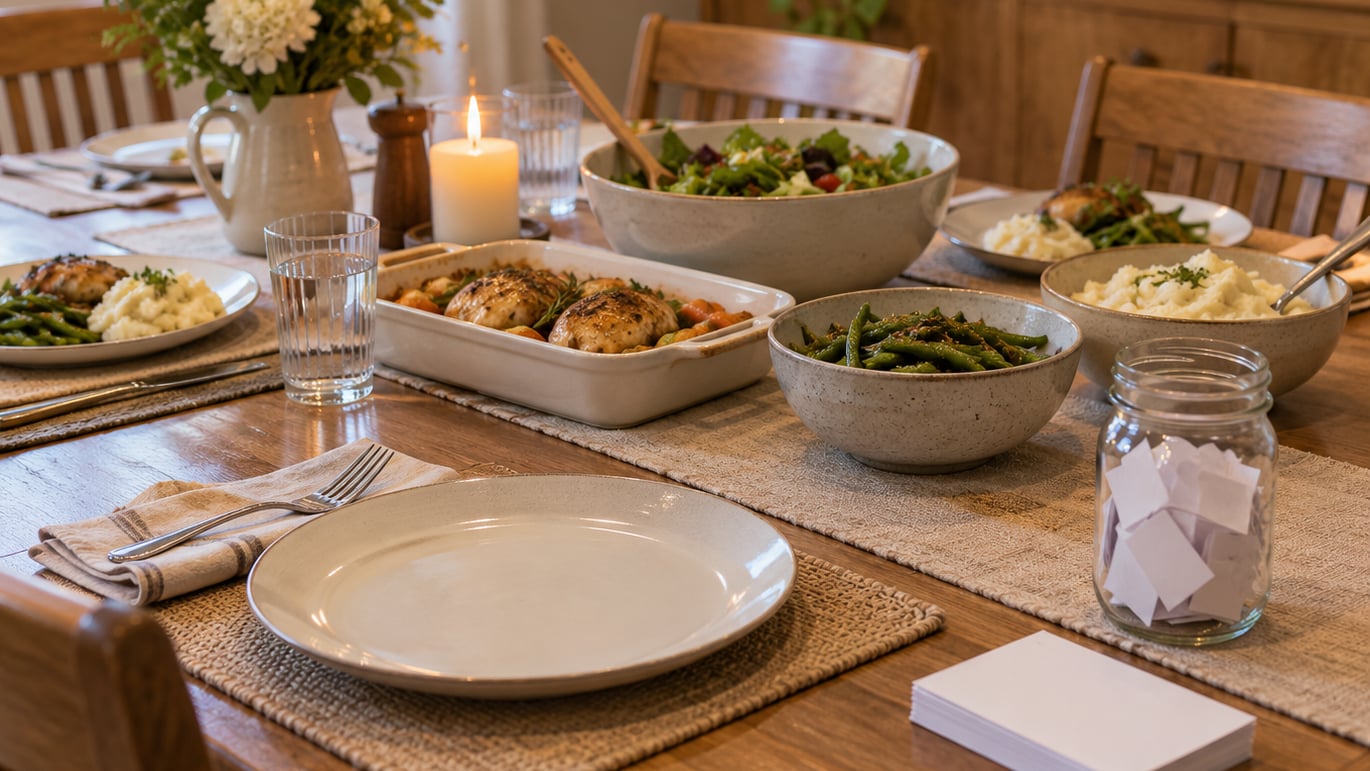
Family dinner conversation starters are open-ended prompts you ask at the table to move past the “How was your day?” routine and get every person actually talking. “Fine” is not a conversation, and for autistic children, kids with disabilities, or nonverbal children, familiar open questions usually get one word or no answer at all. The twenty prompts below are built to work with pointing, gestures, AAC devices, writing, or speech, and each one adapts to the communication style your child already uses. Last updated for 2026.
Table of Contents
- Family Dinner Conversation Starters at a Glance
- 1. Ask About the Best Part of the Day
- 2. Ask What Made Them Laugh
- 3. Talk About a Favorite Sensory Experience
- How to ask about sensory experience without making it overwhelming
- 4. Ask What Was Easy Today
- 5. Ask What Was Hard Today
- 6. Ask About a Color, Shape, or Pattern
- 7. Ask What They Want to Learn Next
- 8. Ask About a Favorite Song or Show
- 9. Ask What They Want More or Less Of
- 10. Ask About a Choice They Made
- 11. Ask What They Are Proud Of
- 12. Ask What Someone Else Did Kindly
- 13. Ask About a Place They Want to Visit
- 14. Ask What Makes a Good Helper
- 15. Ask About a Problem and Two Possible Solutions
- 16. Ask What the Child Wants to Be Thankful For
- 17. Ask About a Tradition or Family Memory
- 18. Ask What They Want to Try Next Week
- 19. Ask How the Family Can Help
- 20. Ask What the Child Wants the Family to Remember
- Frequently Asked Questions
- How do I get my autistic child to talk at family dinner?
- What if my child only gives one-word answers?
- Do these conversation starters work for nonverbal children and AAC users?
- How do I use conversation starters when my child has food sensitivities or is a picky eater?
- What are good family dinner conversation starters for shy or quiet children?
- What if my child does not want to talk at dinner at all?
- Conclusion
Family Dinner Conversation Starters at a Glance

Every prompt below is grouped by the job it does at the table, so you can pick the kind of conversation your family has the energy for that night.
| Number | Conversation starter | Conversation goal | Easiest response style |
|---|---|---|---|
| 1 | Best part of the day | Connection | Choice, gesture, AAC |
| 2 | What made them laugh | Lightness | Sound, face, video clip |
| 3 | Favorite sensory experience | Sensory awareness | Point, select, rank |
| 4 | What was easy today | Confidence | Model, imitate |
| 5 | What was hard today | Feelings, safety | Yes/no, scale |
| 6 | Color, shape, or pattern | Easy visual talk | Point, show |
| 7 | What they want to learn next | Curiosity | Two or three options |
| 8 | Favorite song or show | Interests | Title, hum, char |
| 9 | More or less of something | Self-advocacy | Card, scale, AAC |
| 10 | A choice they made | Decision-making | The choice alone |
| 11 | What they are proud of | Growth | Photo, symbol, point |
| 12 | Someone else did something kind | Kindness | Name, action, picture |
| 13 | A place they want to visit | Imagination, planning | Place, first thing to do |
| 14 | What makes a good helper | Values, roles | Task, object |
| 15 | A problem, two solutions | Flexible thinking | Choose, combine |
| 16 | What they are thankful for | Gratitude | Pick one thing |
| 17 | A tradition or family memory | Belonging | Photo, object |
| 18 | What they want to try next week | Ownership | Choose from two |
| 19 | How the family can help | Self-advocacy | One request |
| 20 | What to remember | Reflection | Message, color, object |
None of these require a full sentence answer. Caregivers can adapt any prompt for verbal, nonverbal, AAC, or written communication, and most families find one or two that work better than the rest and come back to those on rotation.
1. Ask About the Best Part of the Day
This is the gentlest way to open a dinner conversation because the answer is always something positive and small. Kids with limited vocabulary can answer with a single choice: music, movement, a person, a place, or a snack.
Offer the choices instead of asking for a story. “Best part of your day: music, movement, a person, or a place?” takes ten seconds and gives a nonverbal child four clear options to point at or select on a device.
2. Ask What Made Them Laugh
Humor lowers the stakes and gets a reaction before anyone has to explain anything. A laugh is a real answer, and it keeps the table from feeling like a homework check-in.
If verbal explanations are hard, ask for the sound effect, the face they made, or a ten-second clip on a tablet. “Show me the funny face” gets a full response without a single word required.
3. Talk About a Favorite Sensory Experience
Talking about sensory preferences gives your child permission to describe their own experience in a safe way, and it builds awareness that you notice what helps them.
How to ask about sensory experience without making it overwhelming
Keep it to one sense at a time. Sound, texture, temperature, smell, light, movement, clothing tags. Let them point to the thing on the table or select from a small set of symbols rather than describing it.
Never treat a “bad” sensory experience as something to fix in the moment. “That noise was too loud for you” is enough, and often more useful than a question about why.
4. Ask What Was Easy Today
Almost every parent leans toward hard problems at dinner, so this prompt deliberately flips the script. Naming a small win takes one word and gives your child practice at being seen for effort.
Examples: getting dressed, finishing school, sitting through a hard meeting, trying one new food, doing a chore without a reminder. For kids still learning to answer, model it first and let them copy the shape of the sentence.
5. Ask What Was Hard Today
This one works best when you are prepared for “no answer” and mean it. The goal is a safe place to name a difficult moment, not to extract details.
Validate first, then ask one follow-up. “That sounds hard. Do you want to talk about it, or leave it?” respects the choice, and waiting ten seconds of silence before you speak again does most of the work.
Whatever the answer, resist turning it into a lecture or a plan to fix things. A child who expected a consequence will stop telling you anything real next time.
6. Ask About a Color, Shape, or Pattern
Visual prompts need almost no language, which makes them ideal for nonverbal children, children with limited speech, and anyone tired after a long day.
Ask what color they saw, which object had an interesting shape, or which color they want on the table tonight. You can keep a small set of colored cards on the table and let them hand you the answer.
7. Ask What They Want to Learn Next
Curiosity gives your child a role at the table that is not about their behavior. It also turns a dinner conversation into something that continues for days afterward.
Offer two or three real options and then do the thing they pick. “Would you rather learn about bees or about trains? Fine, we’re watching a bee documentary after dinner.” The follow-through is what makes the next prompt easier to answer.
8. Ask About a Favorite Song or Show
Interests are reliable conversation fuel because your child already wants to talk about them. You do not need to ask why, only which.
Ask whether the song makes them happy, calm, energetic, or sad, and let them hum it, gesture the mood, or hand you the title. Predicting the next line together is a low-effort ritual that works even on bad days.
9. Ask What They Want More or Less Of
Asking about more and less gives a child a framework for making a request, which is one of the most useful skills a dinner table can teach.
Give real examples first: more quiet time, fewer questions at dinner, more movement before eating, less noise in the kitchen. Let them select a card, point on a one-to-five scale, or say it on their device.
10. Ask About a Choice They Made
Decisions are easy to talk about even when feelings are not. “What did you choose to wear today?” has a concrete answer your child can point to on their body.
You can ask why, but accept that the choice itself may be the whole answer. Many children explain their reasoning happily when you come back to it a few days later rather than mid-dinner.
11. Ask What They Are Proud Of
Noticing growth matters more than it sounds. A child who worked hard to regulate all day rarely sees that themselves, so an adult noticing out loud can land hard.
Pride can be shown rather than spoken. Point to a photo, choose a symbol, hold up the object that came home from school, or let your child pick the moment for you.
12. Ask What Someone Else Did Kindly
Shifting the lens to another person keeps kindness concrete. Ask about a sibling, friend, teacher, therapist, or family member who shared, waited, helped, or repaired a mistake.
Keep it to one action, not a character assessment. “What did your brother do that helped you?” works better than “why is your brother nice?” because the answer is a scene, not an opinion.
13. Ask About a Place They Want to Visit
Imagining a future trip is easier than remembering a past one, and planning gives your child something to look forward to between dinners.
Ask about access before the fun part: how noisy is it, how long is the drive, is there a quiet space, is there something to look at. Then ask what they would want to do first, which is usually a very short, very clear answer.
14. Ask What Makes a Good Helper
Family roles give children a sense of belonging and turn values into something they can practice rather than hear about. Ask what makes a good helper at home.
Real answers include setting the table, feeding the pet, sorting laundry, watering plants, sitting with a younger sibling. Children who learn by doing can answer by doing, so hand them the task while you ask.
15. Ask About a Problem and Two Possible Solutions
Offering exactly two solutions teaches flexible problem-solving without asking anyone to invent an answer from scratch.
Use an everyday problem: a missing shoe, a noisy room, a spilled drink, a schedule change. Name two manageable options and let your child choose, combine, or reject both. Rejecting an option is still an answer, and it shows you what is not working.
16. Ask What the Child Wants to Be Thankful For
Gratitude works better when it is specific and chosen than when it is assigned. Do not require thanks for everything, and do not ask a child to perform an emotion.
Let them name one thing: a safe place, a favorite activity, a helpful person, a pet, a song, a blanket. One item, said once, is plenty. Repeating it every night is how gratitude turns into homework.
17. Ask About a Tradition or Family Memory
Routines are the easiest thread to pull for connection, because the memory already exists and does not have to be reconstructed. Ask about a holiday, a game, a trip, a meal, a song, or a family activity.
Support recall with objects. Pull out a photo, a decoration, a recipe, or a leftover item from the shelf and let your child hold it while they answer.
18. Ask What They Want to Try Next Week
Giving your child ownership of one small upcoming experience is easy, and they usually take it seriously. Offer a new breakfast, a board game, a walk, an art project, or a dinner side dish.
Set the choices so they are realistic, then actually do the one they picked. A specific, chosen plan tends to change how the next dinner conversation goes, because the child knows their answer mattered.
19. Ask How the Family Can Help
This prompt gives your child a way to state one support that would make home, school, or community routines easier. Examples: more warning before changes, a quieter space, help with transitions, written instructions.
Be careful not to promise what you cannot control. Ask which one change would help most right now, and treat a clear, repeated request as important information rather than a complaint.
20. Ask What the Child Wants the Family to Remember
This closing prompt works through words, drawings, AAC, gestures, or choices. Ask what they want everyone at the table to remember about this week.
Let them pick a message, an object, a color, or an experience, then follow up respectfully. Write it down, repeat it back next week, and mention it before you start the next conversation. That small loop is what makes the whole habit stick.
Frequently Asked Questions
How do I get my autistic child to talk at family dinner?
Lower the pressure on talking. Offer the answer as a choice between two options, give ten seconds of silence, and accept pointing, gesture, sign, writing, or an AAC response as a full answer. Start with prompts about preferences and interests, which are easier than questions about events. Keep one prompt a night and let it go unanswered some nights.
What if my child only gives one-word answers?
One-word answers usually mean the question is too wide, not that your child has nothing to say. Narrow it instead of pushing. Ask where instead of what happened, or offer three answers to pick from. Say tell me more once, wait, and then stop talking. Short answers often grow into longer ones over a few weeks.
Do these conversation starters work for nonverbal children and AAC users?
Yes, as long as you adapt the prompt rather than the child. Every question on this list can become a two-choice selection, a pointed-at picture, a card to hand over, or a line on a communication device. Predictable phrasing helps, because many nonverbal children answer faster when the sentence structure stays the same each night.
How do I use conversation starters when my child has food sensitivities or is a picky eater?
Keep the conversation separate from the food fight. Let your child be responsible for one part of the meal they do enjoy, like pouring water or choosing the playlist, and talk about that instead of what they are not eating. If dinner is genuinely stressful, move the conversation to a snack or a walk after eating. Many families find that helps more than any specific prompt.
What are good family dinner conversation starters for shy or quiet children?
Pick prompts that do not require performance: what made you laugh, what color do you want, what do you want more of. Avoid anything that asks why, because why puts the conversation on the spot. Talk to the adults at the table too, out loud, so your child hears a question being answered normally before they try. Questions asked while everyone eats tend to land better than questions asked face to face.
What if my child does not want to talk at dinner at all?
Respect the no. Some evenings your child is done talking, and pushing turns dinner into a battle you both lose. Answer your own question out loud, share something about your own day, and let your child listen. Conversations at this table are a habit measured in months, not a performance measured in minutes, and a quiet night does not undo the good ones.
Conclusion
Start tonight with one familiar prompt, probably the best part of the day or what made them laugh, and pay attention to how your child answered rather than what they said. Then change the prompt, not the child, until you find the handful that keep working.
Families often have to solve the meal itself before the talking can begin. If dinnertime is still a negotiation, my guides to cooking one dinner for different dietary needs and stopping short-order cooking at dinner take pressure off the table so the conversation has room to happen.
Aim for one prompt a night, accept any communication style, and drop the question if it falls flat. Doing that for a few weeks is usually what turns these family dinner conversation starters into something the whole household looks forward to.