

Most morning routines fail because they were copied, not designed. If you want to know how to build a morning routine for yourself, the answer is shorter than most guides make it sound: pick a wake time you can actually keep, choose two or three anchor habits that take under five minutes each, move every decision you can into the night before, and test the whole thing for a week before changing anything. Then keep a one-step version ready for the mornings when that full routine is not happening.
That last part matters more than it sounds. A routine designed only for your best morning is a routine you abandon by Thursday. This guide is written for people whose mornings are complicated: autistic and neurodivergent adults dealing with executive function and sensory load, parents of children with autism or other disabilities, caregivers managing special diets and medication schedules, and anyone whose mornings depend on when other people in the house wake up.
If mornings have felt like a fight you keep losing, the problem is usually not discipline. It is that the routine asks for decisions at the exact moment you have the fewest left to give. On Embracing Imperfect we write about that gap a lot, because for a lot of families it starts before breakfast.
Table of Contents
- What You Need
- Step-by-Step: How to Build a Morning Routine for Yourself
- How to build a morning routine for yourself around your real schedule
- Choose two or three anchor habits
- Prepare the night before
- Add transition and sensory supports
- Start small and adjust for one week
- Common Mistakes
- Frequently Asked Questions
- Why are mornings so hard, even when I sleep well?
- How many habits should I put in a morning routine?
- Do I have to wake up at 5am to build a morning routine?
- What is the minimum viable morning routine?
- How do I stop hitting snooze in the morning?
- What does a good autism daily routine look like for a child?
- Conclusion
What You Need
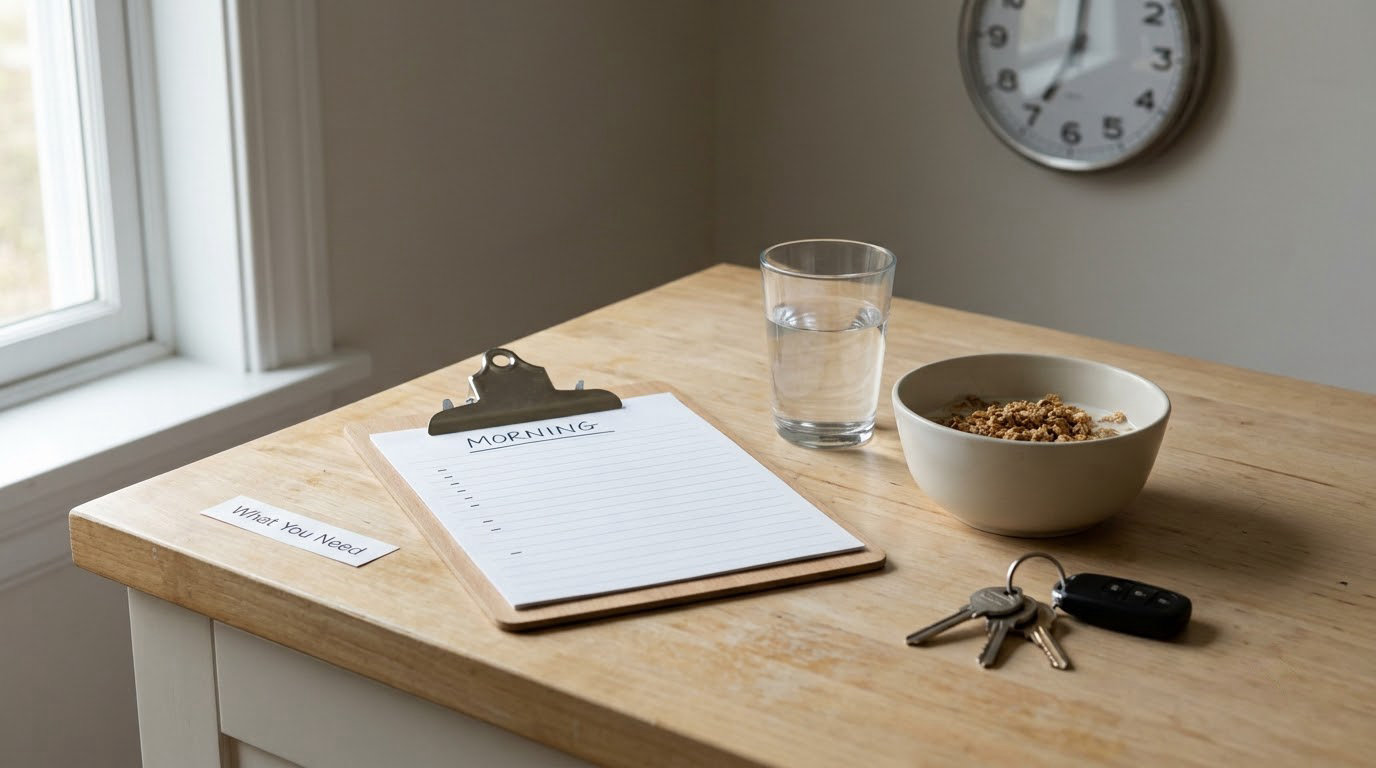
You need almost nothing to start. A note with your wake time, one or two things you already own, and ten minutes of honesty about what your mornings actually look like. You do not need a tidy house, a free hour before anyone else wakes, a specific alarm, or a body of knowledge about habit formation. If you have a real schedule with real constraints on it, you have enough to begin.
Before you write a single step, gather four things.
- Your real wake time. The time you actually surface on an ordinary day, not the time you wish you did. For a lot of caregivers that number is set by a small human, not by an alarm.
- The non-negotiables. Medication, feeding a child, getting to work or school, a scheduled appointment, a therapy session. Write these down first. Everything else has to fit around them.
- Your sensory triggers in the first hour. Light through curtains, the alarm sound, the feel of a shirt collar, the noise of a radio, tags against skin. Note the ones that reliably make the morning harder.
- One priority for you. Not the family’s priority. Yours. Water, medication, a shower, five minutes of quiet, walking the dog, sitting with a coffee before anyone speaks to you.
That last item is the one most morning routine advice leaves out, and it is the reason caregiver routines collapse. When the whole sequence is built around getting everyone else out the door, there is nothing in it for the person running it, so there is nothing holding it together on a hard day.
What you need is also what you are removing. Every item on the list above is a decision you would otherwise have to make at 6am while tired. The routine’s whole job is to have already made them.
Step-by-Step: How to Build a Morning Routine for Yourself
A morning routine is a short, repeatable set of actions you do in the same order after waking. It is not a timetable, and it is not a scoreboard. Its purpose is to remove decisions from the start of the day so you can begin without relying on motivation. Build one in five steps: map the real schedule, pick two or three anchors, prep the night before, add transition and sensory supports, then test it for a week and adjust.
How to build a morning routine for yourself around your real schedule
Write down your actual morning on paper, hour by hour, in the order things happen now. Do not tidy it. The goal is a map of constraints, not an improved version. Mark each item as fixed (it happens at a set time) or flexible (it can slide). Most people discover their fixed column is longer than they assumed and their flexible column is thinner.
Then pick your anchor points. An anchor is a cue that reliably signals the next action: a specific alarm, a bathroom door, a coffee machine finishing, a child sitting up in bed. Habits attached to anchors survive better than habits attached to a clock time, because the cue travels with the situation instead of failing the moment a child is up thirty minutes early.
Decide between a fixed time and a fixed sequence. If your mornings run on caregiving, appointments or shift changes, a fixed sequence beats a fixed time. The order stays the same, the clock is allowed to be strange.
You will know this step worked when you can say, out loud, what the next hour looks like without rehearsing it.
Choose two or three anchor habits
An anchor task is the smallest action that reliably moves you into the day. It should take under five minutes and require no decisions. A glass of water before coffee. Taking your own medication. Sitting up and taking three slow breaths before you get out of bed. Eating one thing you can eat without cooking.
Pick two or three, not seven. The reason most routines collapse is not willpower, it is that each added step is another place to stop. Adding a fourth habit to a shaky three usually produces a worse three, because the list gets longer at exactly the point where your capacity is dropping.
Stack each anchor onto something already happening. After you brush your teeth, drink the water. After the coffee finishes, take your medication. Pairing a new action with an existing one is the cheapest way to make it start.
You will know this step worked when you miss one and still finish the rest of the morning without treating it as a ruined day.
Prepare the night before
The evening routine is the real lever on the morning. Caregivers and autistic adults alike tend to describe calmer mornings almost entirely in terms of shifting prep to the night before: showering before bed, setting out grab-and-go food, laying out clothes the evening before. Whatever you can decide at 9pm is a decision you no longer have to make half-asleep.
A workable night-before list is short.
- Clothes laid out, including underwear and socks, in one place.
- Breakfast within reach and requiring zero choices. Note that not being hungry in the morning is common and valid; the plan needs an easy alternative for the days you eat nothing.
- Bag packed, shoes by the door, keys on a hook you never have to look for them.
- Medication sorted into tomorrow’s container, including anything refrigerated.
- Visual schedule or checklist ready for a child who uses one.
- Phone charging in another room, or at minimum out of arm’s reach.
- Sensory supports set out: compression shirt, noise-cancelling headphones, weighted blanket, whatever actually lands for your household.
You will know this step worked when a morning goes sideways and the morning still finishes, because the thing that went sideways was not the missing decision.
Add transition and sensory supports
A wake-up environment is a sensory environment. If mornings reliably feel like too much input before breakfast, the routine is not a discipline problem. It is a light, sound and texture problem, and it has substitutions.
- Light: a sudden bright room at 6am is a common trigger. A dimmer on the way up, or blackout curtains with the light turned on gently an hour later, works for a lot of people.
- Sound: change the alarm. A sharp digital beep and a slow rising tone are not equally bearable. Many autistic adults use vibration or a light-based alarm instead.
- Texture: keep the same comfortable clothing in rotation instead of deciding fresh each morning. If tags and seams are a problem, that is a laundry choice, not a character flaw.
- News and screens: two things come up again and again in autistic adults’ accounts of calmer mornings: limit screen time early, and do not eat when you are not hungry. Both are about protecting the nervous system before it has capacity to spare.
For a child, add predictable transitions. A warning before a change, the same order every time, and a visual schedule do more than reminders shouted across a kitchen. Do not interrupt an established sequence to add your own step. If the sequence works, it is doing exactly what a routine is supposed to do, even if it is not yours.
You will know this step worked when a morning begins without a flare, a shutdown, or a fight, and the person doing the routine is not bracing for it either.
Start small and adjust for one week
Run the routine for seven days before judging it. Most people quit on day three, which is usually the day the newness wears off. Keep a note on your phone: a mark for done, a dash for partial, nothing for missed. No streaks, no guilt. The point is data, not discipline.
At the end of the week, change one thing. If a step got skipped every single day, subtract it or shrink it. If a step happened easily every day you had the capacity for it, you can add the next one. One change at a time, because changing four things at once means you will never know which one worked.
Have a low-energy version ready before you need it. Write it out as a single step, not a shortened list. For some people that step is sitting up and drinking water. For others it is eating one piece of bread and taking medication. It counts as a successful morning, and treating it as a failure is the fastest way to make the full routine feel hopeless.
You will know this step worked when a bad day is a low-capacity day, not a character assessment.
Common Mistakes
Most failed routines are not discipline failures. They are design failures, and each one has a specific fix. Here are the six that come up most often, with what to do instead.
Copying someone else’s routine. A routine built for a person with no children, a nine-to-five and a body that wakes at 5am is a bad fit for a person with all three of those things different. Fix: rebuild from your own fixed column. Start with the non-negotiables and add upward.
Putting your own care last. The sequence works, everyone is fed and dressed, and then you have nothing left for the one thing you built it for. Fix: place your anchor habit before the caregiving tasks, not after. It survives better when it is not competing for scraps of time.
Demanding an identical morning every day. Not every day is a normal day. Appointments, illness, a bad night, a child’s meltdown. Fix: plan two versions in advance, a full one and a one-step one, and stop treating the second as a deficit.
Treating a disruption as a failure. Someone else’s wake time is not an adherence problem. Fix: separate the two categories. Breakage caused by other people gets a different response than breakage caused by you, and only one of them is yours to fix.
Adding steps when momentum drops. Adding a habit at the point where you are already struggling tends to produce a longer list and a shorter week. Fix: subtract. Cut a step in half, attach it to something existing, or drop it entirely for a fortnight.
Using shame as motivation. Autistic adults describe shame around broken routines as the most familiar and the least useful tool in the box, and it traces back to years of being told to simply try harder. Fix: if your routine is built on how you should feel about yourself, it will not survive a bad week. Rebuild it on logistics.
One more that gets missed: waking earlier to create time. If you are already sleep-deprived, an extra hour of wakefulness makes the morning harder, not easier. Ten minutes earlier is a different proposal from an hour, and only one of them usually works.
Frequently Asked Questions
Why are mornings so hard, even when I sleep well?
Mornings ask for the most executive function you have all day, at the point when you have the least left. Waking up means sequencing, task initiation, transitions and tolerating sensory input before you are regulated, all at once. That combination is why mornings feel disproportionately hard, and why so many adults describe mornings in terms of not being able to begin rather than not having enough time.
How many habits should I put in a morning routine?
Two or three, to begin with. Each habit is another point where the routine can stop, so a short list that survives a hard week beats a long list that does not. Stay at two or three until every one of them has held for around ten days, and only then add a fourth. Cutting a step in half also counts as keeping the list the same length.
Do I have to wake up at 5am to build a morning routine?
No. A routine is tied to your own wake time, whatever that is. Waking earlier is one possible input, not a requirement, and if you are already short on sleep it tends to make the morning harder rather than easier. Designing around a realistic wake time and taking ten minutes earlier, if you want it, produces a routine that lasts. Chronotype is real and your routine should respect it.
What is the minimum viable morning routine?
One step, chosen in advance, that you can complete on your worst day. For many people it is sitting up and drinking a glass of water. For others it is taking medication and eating one easy thing. Write it down before you need it and treat completing it as a full success, because a routine that only counts on good days is one you will abandon.
How do I stop hitting snooze in the morning?
Put the alarm where hitting snooze is a physical inconvenience, and give yourself one small reason to be up that is ready in advance, like your anchor task waiting on the bathroom counter. Snoozing usually means the first minutes feel purposeless, not that you love sleep. Waking somewhere else in the room and removing the next decision from the moment also helps more than willpower does.
What does a good autism daily routine look like for a child?
A good autism daily routine is short, visual, and predictable in order, with sensory supports and transition warnings built in. Keep the sequence identical across days and let your child know what changes before it changes. Do not add steps to a working sequence, and build in a quiet period where the routine ends and the day starts.
Conclusion
To build a morning routine for yourself, you do not need a better morning. You need a smaller one you can repeat. Map the real schedule, choose two or three anchor habits that take under five minutes each, move the decisions into the night before, add the sensory and transition supports your household actually needs, and test the whole thing for a week before changing anything.
Start tonight with one habit. Put it somewhere obvious, decide what the one-step version looks like on a bad morning, and write both down. That is the entire beginning, and it takes about ten minutes.