
Raising healthy eaters comes down to one idea: you decide what gets served, when it is served, and where the family sits, and your child decides whether and how much to eat from it. Add a predictable routine, small neutral portions of new foods repeated over many meals, and adults who actually eat the food, and most children widen their range without a single argument.
This matters for the long run. A child who learns to follow their own hunger and fullness is far less likely to land in the cycle of restriction, guilt, and pressure that adults bring to food. The approach below suits every child, and it is the one that works best for autistic, disabled, and sensory-sensitive kids whose eating difficulty is not fussiness but genuine distress.
Five principles carry most of the weight, and everything else in this guide is built on them:
- Parents handle what, when, and where. Children handle whether and how much.
- New foods are offered without pressure, praise, or bargaining, again and again, for 10 to 15 separate exposures before you judge the result.
- Nutrition is built from the foods the child already accepts, not from foods you hope they will try.
- The table stays calm, predictable, and boring enough that the child can focus on eating rather than on managing the room.
- Growth charts, medical causes, and skill gaps get checked by a professional rather than guessed at online.
If you only remember one thing: the goal is not a perfect plate tonight. It is a child who trusts their body, eats regularly, and keeps a relaxed relationship with food for life.
Table of Contents
- What You Need Before You Start
- A written list of the foods your child reliably eats
- A meal and snack schedule the child can predict
- A calm place to eat
- One reliable food that is always available outside meals
- A place to keep notes
- Access to a pediatrician or registered dietitian
- How to Raise Healthy Eaters Step by Step
- 1. Build a Reliable Mealtime Routine
- 2. Offer a Balanced Plate Without Demanding Variety
- 3. Keep Exposed Foods Accessible and Pressure-Free
- 4. Expand the Safe Foods Gradually
- 5. Make Mealtimes Predictable and Sensory-Friendly
- 6. Track Patterns, Not Perfect Plates
- Common Mistakes That Slow Everything Down
- Cooking a separate meal for your child
- Coaxing, bargaining, or offering rewards
- Treating the safe foods as failure
- Forcing, sneaking, or tricking
- Letting relatives undermine the plan
- Ignoring a medical or sensory cause
- Frequently Asked Questions
- How can I raise healthy eaters when my child eats only a few foods?
- What should I do if my child refuses every new food?
- How long does it take a picky eater to try new foods?
- How can food chaining help a child eat more foods?
- When should a parent seek help for a very restricted diet?
- How do I maintain nutrition while respecting my child’s sensory needs?
- Start With One Low-Pressure Next Step
What You Need Before You Start
Most families fail at this because they start with the food. Start with the setup instead. Here is what has to be in place before you change a single thing on the plate.
A written list of the foods your child reliably eats
Be generous, not selective. Include the plain pasta, the buttered toast, the cereal, the plain yoghurt, the apple slices cut a certain way. Food neophobia, the normal fear of new foods, peaks in the early years and eases with familiarity, so the safe list is not a failure list. It is the platform you build the rest of the menu on.
Write the list on one page and post it inside the fridge or on the pantry door. Caregivers, grandparents, and sitters all need the same version, because one adult making a separate meal on a Tuesday night undoes a week of patient work.
A meal and snack schedule the child can predict
Three meals and two snacks a day, spaced fairly evenly, does most of the work. Snacks are not appetizers, so avoid serving something small and appealing right before a meal when it is the only thing that will get eaten.
A calm place to eat
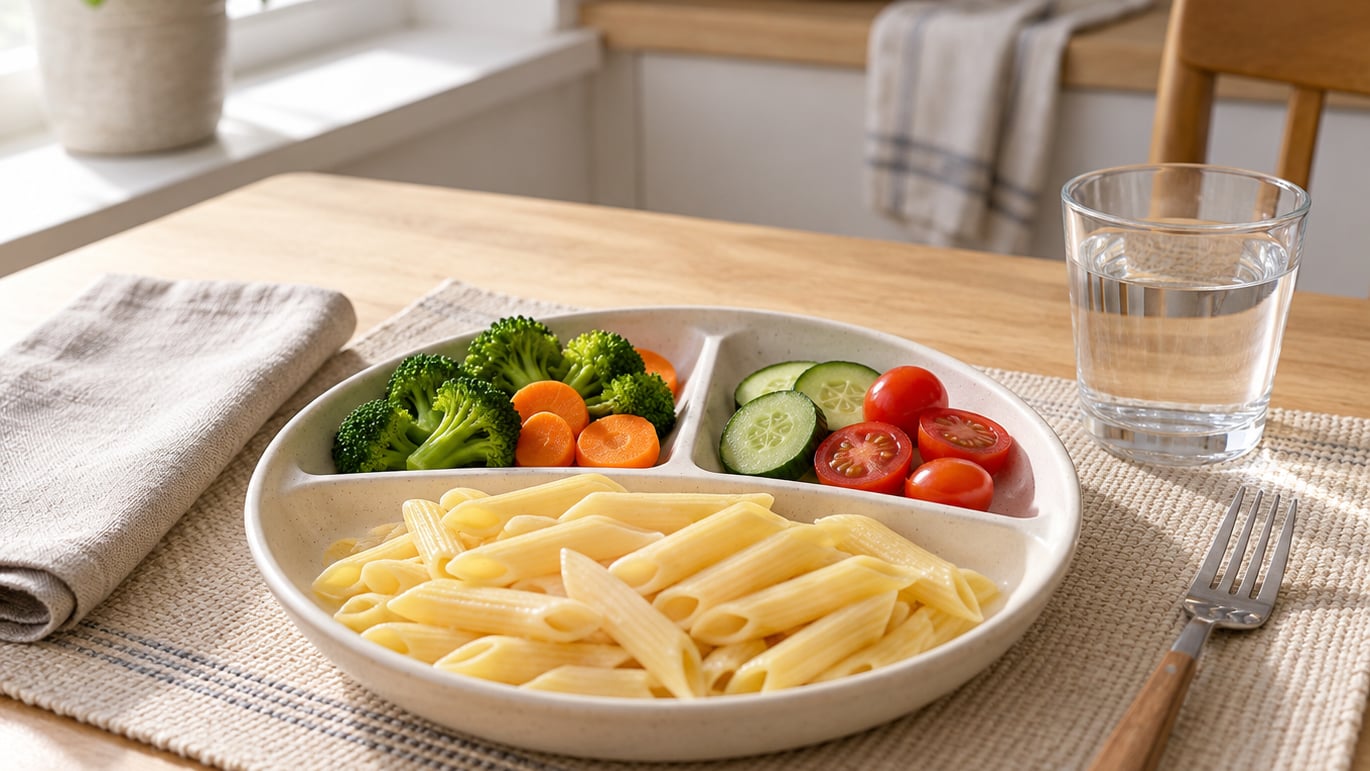
One chair, the same chair, a surface clear of clutter. A divided plate matters more than people expect, because mixed or touching food is a genuine sensory barrier for a lot of children, and a small portion of a new food sitting beside a familiar one feels far less threatening than a full heap of it.
One reliable food that is always available outside meals
Parents on parenting forums consistently name this as the thing that ends dinner battles: a shelf-stable backup everyone agrees on, such as crackers, cereal, or a specific bread. Having it available takes the panic out of a child who cannot face the meal.
A place to keep notes
A notebook, a notes app, a whiteboard on the fridge. The point is to see patterns across weeks rather than to judge individual meals. You are collecting information, not keeping score.
Access to a pediatrician or registered dietitian
Have the number saved. If intake worries you, growth is being tracked, or the child is losing skills, that is a conversation, not a search thread. Pediatric guidance on feeding and allergies varies by country, so your own clinician is the right source rather than a generic internet checklist.
That is the full toolkit. None of it costs money, and the hardest part, the routine, takes one evening to set up.
How to Raise Healthy Eaters Step by Step

Work through the six steps in order over about three months. Each one builds on the last, and skipping ahead is the most common reason a family sees no change and gives up.
1. Build a Reliable Mealtime Routine
Put meals at roughly the same times every day, including weekends, and keep them to about 20 to 30 minutes. Start a five-minute warning, use a timer the child can watch, and end the meal when it goes off whether or not anything was eaten.
Give one to three sentences of warning before food appears: dinner is in five minutes, then dinner is on the table. Predictability is doing the work for you, because a child who knows what happens next spends that energy on the sensory experience instead of on bracing for surprise.
Turn screens off at the table and ask everyone to stay seated, including adults. A child will not learn to read hunger and fullness signals from parents who are scrolling.
Signs it is working: the child comes to the table with less prompting, sits without a negotiation, and the meal ends at a predictable time. Meal length dropping from 45 minutes to 25 is progress even if the food barely changes.
2. Offer a Balanced Plate Without Demanding Variety
This is the division of responsibility in feeding, an approach developed by Ellyn Satter and used widely in pediatric feeding clinics. The split is simple, and once you hold it, mealtime arguments mostly disappear.
You decide what food is offered, when meals and snacks happen, where eating happens, and that everyone eats together. Your child decides whether to eat it, how much to eat, whether to sit or leave the table, and everything else. Hold both halves of that division without negotiating across them.
Then build the nutritional safety net from what already works. If the child reliably eats pasta, cereal, potatoes, and cheese, you can cover most nutrient needs by adjusting portions and fortified versions rather than by negotiating new vegetables. A divided plate with two thirds of the familiar foods and one small section of something exploratory is a well-balanced structure for most picky eaters.
Do not serve a plate that is entirely new food. If the entire meal is unfamiliar, refusing it is the rational choice, and you have learned nothing about the food.
Signs it is working: you stop cooking separate meals, the child starts asking when dinner is, and the safe food list grows by one item every few weeks.
3. Keep Exposed Foods Accessible and Pressure-Free
Put a tiny amount of the new food on the plate with no comment attached to it. A teaspoon of cooked carrot, two cooked peas, a small cube of a different cheese. Then eat your own food, talk about something else, and let the child do whatever they do with it, including moving it to the edge of the plate.
Expect 10 to 15 neutral exposures before the picture changes. Parents describe it as roughly six months from start to the first bite, and that is normal. Pressure shortens the process by teaching the child that the food is worth defending against.
No praise for touching, no praise for tasting, and no deals. Praise sounds supportive and lands as pressure because it makes the food a performance.
Some scripts that work better than arguing:
- Take the offer away after a minute: I see the carrot. I am not going to ask again tonight.
- Shorten the meal instead of fighting: you are done eating. You can sit with us, or you can go to the table.
- Handle throwing matter-of-factly: you threw the food. I will pick it up. More is not going to be served.
- Ignore the negotiation and keep eating your own dinner. Engagement is the thing you are avoiding.
Signs it is working: refusals become quieter, the child stops hiding food, and touching and smelling show up before licking and chewing. That sequence is the real early progress.
4. Expand the Safe Foods Gradually
Food chaining is the slowest and most reliable tool for a selective eater. The principle is that new foods are easier to accept when they differ from a safe food in only one property, such as colour, texture, temperature, flavour, or shape.
The steps are short. Pick one target food. List what makes it different from a food the child already eats. Change only that one property, for example go from steamed to roasted rather than from plain to a whole new dish. Serve the pair together, on the same plate, with the safe food still present. Stay at that step across several meals, or about 15 to 20 exposures, before changing anything else.
Then move one step along the chain, from raw carrot to roasted carrot to carrot sticks, or from butter to olive oil on the same pasta. Walking one property at a time is why it takes months rather than weekends.
Our full walkthrough, with chains for common starter foods, is in Food Chaining for Picky Eaters Explained.
Signs it is working: a food the child has refused for a year now gets eaten most weeks, and you can see a two-step or three-step chain, such as white rice to brown rice to mixed rice, taking shape on its own.
5. Make Mealtimes Predictable and Sensory-Friendly
For a sensory-sensitive child, the environment is not a nice-to-have. Lower the lighting, turn off a radio, and move the meal to a quieter room if the kitchen is loud. Serve foods separated rather than mixed or touching, and use a wide shallow bowl so the smell does not fill the room.
Let the child control the utensil, including a fork they have chosen themselves. A child who grips their own spoon usually eats more of it, and repeated success with the same tool builds self-trust.
Offer a small portion on a child plate you can fill again on request. Many children eat a small serving and then ask for more once the first one is gone, which the small serving itself caused.
Allow leaving the table with food in hand. A toddler who will not sit but will eat a banana while standing is getting calories, which beats a clean plate and an empty stomach.
Keep the safe backup available outside mealtime, and keep the schedule of three meals and two snacks even when a meal is refused. Skipping meals in response to refusal creates a pattern of low blood sugar and worse meals.
Signs it is working: the child stays at the table longer, arrives without a protest, and the number of sensory accommodations drops from three or four to one as confidence grows.
6. Track Patterns, Not Perfect Plates
Write down four things and nothing else: what was offered, what was eaten, what was refused, and any reaction such as gagging, distress, or a bowel or stomach symptom. One line per meal is plenty.
Then look at the page every week rather than every dinner. Patterns such as always refusing anything green, always refusing at school but eating the same food at home, or a week where intake drops alongside a flare of sensory behaviour are useful information you can hand to a clinician.
Where possible, ask the school what comes home untouched. A day of refusal at school with the same food eaten at home usually points at the environment rather than the child.
Notes are not a checklist and they are never a report card. The moment the notebook becomes a measure of your child, the child starts to feel watched, and the calm table is gone.
Signs it is working: you can name your child’s top ten safe foods without thinking, you can predict which new food will be refused, and you have a clear history to bring to an appointment.
Common Mistakes That Slow Everything Down
Almost every stuck family is making at least one of these. The fixes are not complicated, but they do need to be consistent across every adult in the house.
Cooking a separate meal for your child
The short-order cook approach feels kind in the moment and teaches your child that the family menu is negotiable, and that refusing pays. Offer one meal for everyone, place a familiar food on your child’s plate, and let them leave hungry sometimes. Hungry children eat at the next meal because there is nothing else.
Coaxing, bargaining, or offering rewards
Bribes work once and teach the wrong lesson. So do the reverse contracts, where dessert is withdrawn. Keep a dessert or treat that is offered on a schedule and never tied to finishing a plate, so dessert keeps its meaning.
Treating the safe foods as failure
Your child eating plain pasta every night for six months is a child eating the same nutrients every night for six months, which beats variety without intake. Improve the safe foods instead of dismissing them: fortified cereal, whole milk instead of skim, a pasta sauce made from an accepted vegetable, a different brand of the accepted bread.
Forcing, sneaking, or tricking
Force-feeding carries a real risk of choking and injury and can trigger fear around food that lasts years. Pureeing secretly into a meal breaks trust with the child who finds out, which is usually tonight. Neither is worth the trade.
Letting relatives undermine the plan
Grandparents handing out sweets, or a well-meaning adult insisting on the clean plate club, undoes weeks of work in one meal. Say it once and plainly before the visit: we do not do desserts after dinner, and I am not negotiating at the table. A partner disagreement behind closed doors also needs settling, because children read it instantly.
Ignoring a medical or sensory cause
Picky eating has physical explanations that no amount of patience will fix. Persistent gagging, coughing during meals, pain with chewing, a sudden change in food acceptance, or a child losing feeding skills needs a pediatric appointment, not more exposure. Reflux, constipation, dental pain, allergies, and sensory processing differences all present as refusal, and a registered dietitian can also check whether a very limited diet is short on iron, calcium, or other nutrients.
One more warning sign worth knowing: a child whose eating is so limited that they eat only a handful of foods, drops foods they once accepted, eats very little across all settings, or shows distress around food that interferes with school and daily life may have avoidant restrictive food intake disorder, ARFID. Ordinary picky eating narrows a little over time. ARFID does not, and it deserves an early professional assessment rather than a wait-and-see approach.
Frequently Asked Questions
How can I raise healthy eaters when my child eats only a few foods?
Start by treating the current foods as a solid base instead of a problem to fix. Three regular meals and two snacks a day, one predictable seat, and enough of the accepted food to cover most nutrient needs protect nutrition right now. Then add one new food at a time in a small portion, without pressure or praise, repeated across 10 to 15 separate meals. Build the variety from the bottom up rather than waiting for the child to become less selective on their own.
What should I do if my child refuses every new food?
Keep serving it anyway, because refusal at the table is rarely the whole story and a refusal is not a verdict. Reduce the portion, place it away from the safe food so smells do not mix, and stop talking about it entirely. Touching, smelling and moving food to the edge of the plate are early steps that count. If the child accepts the food in another setting, such as a picnic, keep that in mind. Never comment on a refusal, never bargain, and never withdraw something they already enjoy.
How long does it take a picky eater to try new foods?
Count in exposures, not weeks. Most children need 10 to 15 neutral opportunities before a new food is tasted, and it often takes months before it becomes routine. Parents report chains that took half a year, such as a child finally eating carrots after a long gradual process. Judge the pace by the child’s calmness, not the calendar. Moving too fast usually produces refusal; staying at one small step for a month is what moves things forward.
How can food chaining help a child eat more foods?
Food chaining connects a food the child already eats to a new food by changing only one property at a time, such as colour, texture, temperature, flavour or shape. Start with a food they reliably accept, then alter that single property to create a slightly new version, and serve both together. Stay at each step for roughly 15 to 20 exposures before advancing. Because the gap between the two foods is small, the new one rarely feels like a test the child has to pass or fail.
When should a parent seek help for a very restricted diet?
Book an appointment with a pediatrician or registered dietitian if intake worries you, growth is being tracked and looks off, or the child has lost foods they once accepted. Seek help sooner for persistent gagging, coughing, vomiting or pain with eating, and for any feeding skill that has gone backwards. Also ask when the range is so narrow that a handful of foods makes up nearly everything, when distress around food disrupts school or daily life, or when family meals have become unmanageable. Refusing to grow is not picky eating.
How do I maintain nutrition while respecting my child’s sensory needs?
Work from the accepted foods rather than waiting for new ones. Fortified cereals, whole milk, enriched pasta, and vegetables blended into a sauce the child already likes can close most gaps without adding a new sensory experience. Keep three meals and two snacks on schedule so a refused meal still leaves plenty of chances to eat. Ask a registered dietitian to review iron, calcium, vitamin D and protein intake for your child specifically, since needs differ by age, and follow guidance from your own clinician.
Start With One Low-Pressure Next Step
Pick one meal this week and make it the same time, the same place, the same length, with one familiar food and one small unfamiliar thing on the plate. Write down what happened in a single line.
From there, put the safe food list on the fridge so every adult works from the same page, and choose one bridge food for a food chain. Three months from now, the routine will be doing the work even on the nights when nothing goes right.
And if growth, intake or mealtime distress has you worried, book the appointment with a pediatrician or registered dietitian rather than another round of internet searching. Getting this right is a skill you build over months, and the goal is a child who eats regularly and trusts their own body.